
p>Develop skills in stakeholder communication, facilitation, and backlog management. You can strengthen your expertise by earning an Agile Business Analyst certification through a structured training programme.DSDM principles – the building blocks>"}},{"@type":"Question","name":"What does an Agile Business Analyst do?","acceptedAnswer":{"@type":"Answer","text":"DSDM based upon principles<
p>An Agile Business Analyst collaborates with Product Owners, stakeholders, and development teams to translate business requirements into user stories, manage backlogs, and facilitate prioritisation. They ensure each product increment delivers measurable business value while supporting continuous improvement and adaptive planning.Based upon 8 principles and an underlying agile philosophy, DSDM became a popular agile approach amongst software developers seeking an alternative to rapid application development (RAD) approaches in the years after 2000. RAD approaches did not scale well for people collaborating on a team however. DSDM thus became one of the first agile approaches to be used within the software development community.
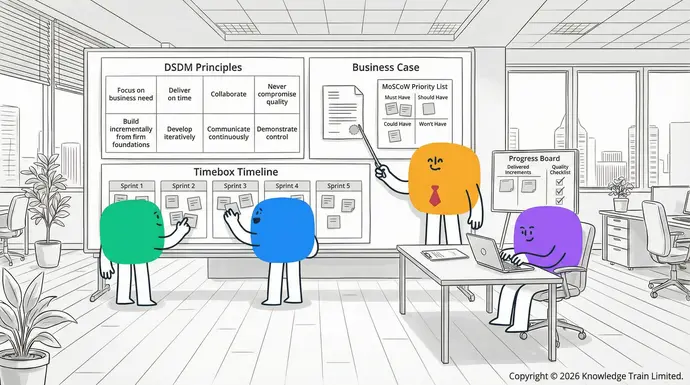
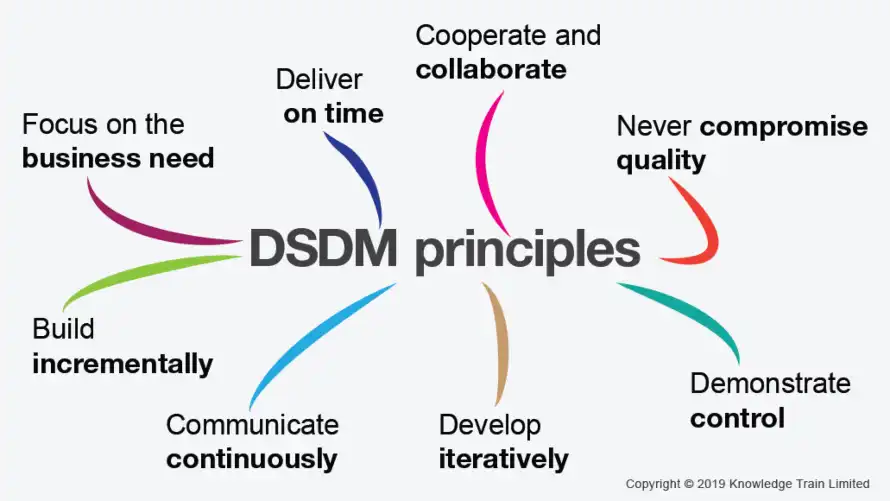
>The 8 DSDM principles underpin the whole framework. Each principle must be adhered to by the project team, as ignoring any of the principles can increase the chance of project failure.<
p>Typical responsibilities include:The graphic below was created to help you learn about DSDM. If you like it, please show your appreciation by linking back to this page.
>Now, let’s find out more about the <ul>DSDM principles<li>Eliciting and analysing requirements collaboratively and how teams can ensure they stick to them.
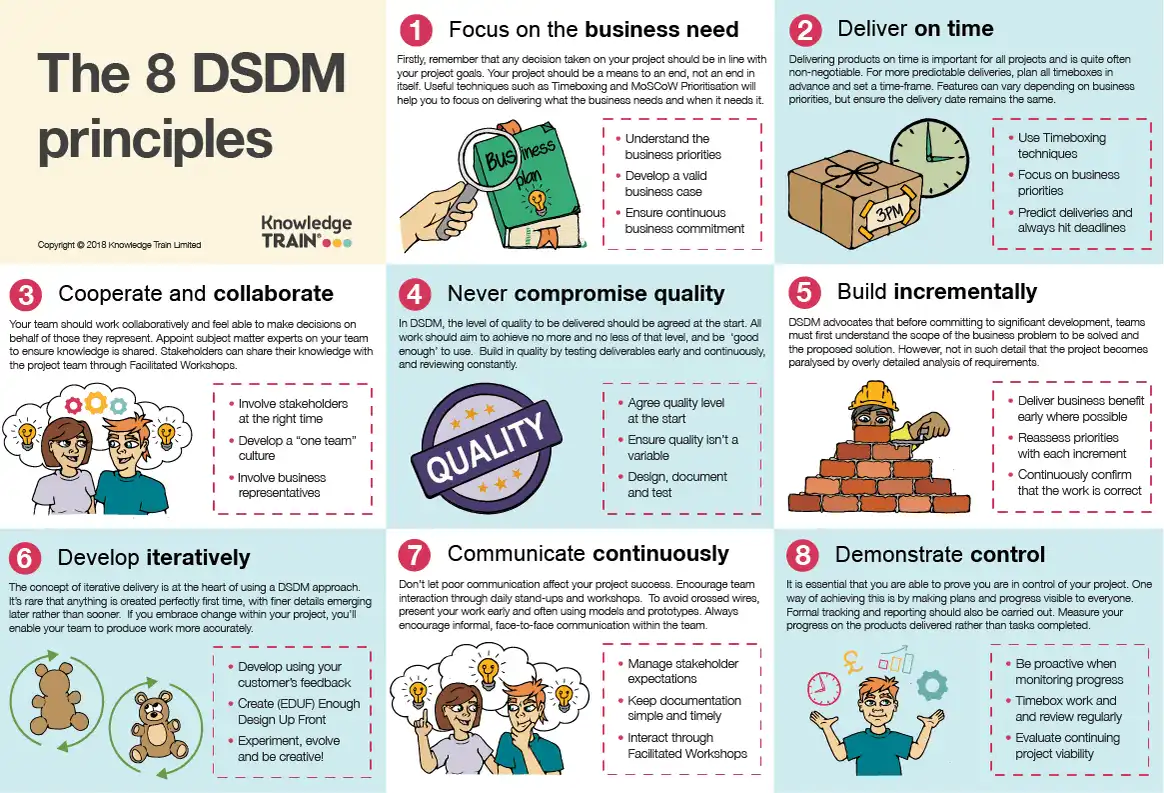
>The 8 DSDM principles<
li>Facilitating backlog refinement sessions1. Focus on the business need
>DSDM has a strong business-driven approach. A <li>Supporting sprint reviews and retrospectivesbusiness case> must be established for the project and the team must understand project priorities. Every decision the team make during the project should help achieve the project goal and the team must ensure the project is delivered on time.<
li>Ensuring alignment between business goals and technical deliveryMoSCoW prioritisation
>"}},{"@type":"Question","name":"What is an Agile business analyst?","acceptedAnswer":{"@type":"Answer","text":"
"}},{"@type":"Question","name":"What tools do Agile BAs use?","acceptedAnswer":{"@type":"Answer","text":"
Agile Business Analysts use various tools to collaborate, document, and manage work efficiently. Common tools include:
<3. Collaborateli>
– for documentation and collaboration
– for lightweight visual task management
– for virtual whiteboarding and workshop facilitation
< as it requires the foundations of the project to be agreed early. The foundations don’t need to be in too much detail – just agree on what the problem is and how to solve it. Once foundations are established, the solution must be delivered incrementally.p>These tools enable Agile BAs to maintain transparency, streamline communication, and support continuous feedback loops within teams.
"}},{"@type":"Question","name":"Which certifications are relevant for Agile BAs?","acceptedAnswer":{"@type":"Answer","text":"
<
ul>DSDM proposes that nothing is created perfectly first time and projects operate in a constantly changing world. Incremental delivery allows for such change to be embraced and leads to higher stakeholder satisfaction. Each iteration is combined with testing, demonstrations and feedback. This ensures that each iteration improves upon the last and leads to a decent final product.<
li>Feedback loop<
strong>IIBA Agile Analysis Certification (IIBA-AAC)DSDM teams can adhere to this principle by building feedback into each iteration. They must also be in the mindset that details should emerge later, not sooner, and they must embrace change. During each iteration, they should encourage creativity and experimentation, which will lead to learning and improvement. Constant review and feedback allow for change and progress to occur.
> – focuses on applying business analysis within Agile environments.To deliver an incremental working release of software at the end of each iteration DSDM recommends the >MoSCoW prioritisation<li> technique to prioritise requirements to be worked on by the team during a timebox. Requirements are typically capture in the form of <strong>Certified ScrumMaster (CSM)user stories> – ideal for those working closely with Scrum teams.. li>Bad communication often leads to project failure and traditional non-agile approaches fail to address this. DSDM aAgileBA Certification – specifically designed for Business Analysts working in Agile projects. "}}]}]} Modelling is a visual form of communication utilizing diagrams. This allows for complex systems, designs and products to be better understood.Related articles DSDM makes use of prototyping by creating prototypes of the product early in development, to allow stakeholders to ‘test-drive’ early versions of the solution. The idea is to build something fast, get feedback quickly, and to break it sooner, rather than later. The underlying DSDM philosophy is that if something isn’t going to work, it is better to find that out as soon as possible, and change course sooner, rather than later. Prototyping means creating prototypes of the product early in development, to allow stakeholders to ‘test-drive’ early versions of the solution. It is vital to keep control of the project. DSDM proposes that it is only possible to do this by using a plan aligned to the project aims, with both being accessible to the entire team. DSDM teams, especially the project manager and team leader, can fulfil this principle by ensuring plans and progress are visible to everyone. Managing must be proactive with an emphasis on reporting and tracking. Also, progress must be measured by looking at what has been delivered, rather than activities completed. Timeboxing helps to control who is doing what and when. DSDM can also be combined with methods such as Kanban, which help teams to visualize project progress and see who is doing what, when and how long it will take them. >7. Communicate continuously and clearly<
Modelling
Prototyping
8. Demonstrate control
Ensure progress is visible
Measure progress by delivery
Summary
As you might have noticed, the eight DSDM principlesHow do I become Agile certified? embody the principles of the agile manifesto. The focus on iterative delivery, effective communication, collaboration and continuous delivery all align with the agile philosophy. DSDM also has some of its own characteristics – it’s process model and specific team roles – for instance. Yet, many of the other tools and techniques recommended by DSDM – modelling, prototyping and workshops, timeboxing, MoSCoW – are used by other agile methods.
Because DSDM sticks to the original agile philosophy, this makes it an effective method to adopt in any workplace. If these principles strike a chord with you, why not take an Simon BuehringAgile PM course19 Feb 2026?
DSDMLearn what it takes to become Agile certified and the advantages it brings to your professional life. Read on for examination tips.® is a Registered Trade Mark of Agile Business Consortium Limited.
is an ‘umbrella’ term to represent a multitude of approaches, practices, and methods that are based upon the Agile principlesWhat is Lean Six Sigma? Definition, methodology, & benefits contained within the Agile ManifestoKnowledge Train. 22 Apr 2026DSDM is a specific Agile approach which was designed to manage Agile projects because until that point, all Agile methods were purely development methods and did not contain any broader project management focus. DSDM set out to incorporate a project management approach into Agile environments.Lean Six Sigma is a data-driven methodology for process improvement that reduces waste and variation. Combining Lean and Six Sigma, it helps organisations maximise efficiency, quality, and customer satisfaction.