
Portugal
Romania
SlovakiaSloveniaSpain
Sweden
Other countriesHome AgileAgile training {"@context":"http://schema.org","@type":"BreadcrumbList","itemListElement":[{"@type":"ListItem","position":1,"name":"Home","item":"https://www.knowledgetrain.co.uk/"},{"@type":"ListItem","position":2,"name":"Agile","item":"https://www.knowledgetrain.co.uk/agile"},{"@type":"ListItem","position":3,"name":"Agile courses and certifications","item":"https://www.knowledgetrain.co.uk/agile/agile-training"}]}
Instructor-led
Quality Innovation Social responsibility
Agile courses and certifications
Choose an agile route that fits your role – from managing agile projects to Scrum roles and improvement methods.SOCIAL RESPONSIBILITY
Some of the charities we have helped over the years:
Experienced trainers
Flexible study options
AWARDS
Trusted by professionals and organisationsWe don’t go seeking awards, but here are two of the awards we have received for our training.
Compare qualifications Request a quote
Speak to our team
+44 (0)207 148 5985
[email protected] Choose your route
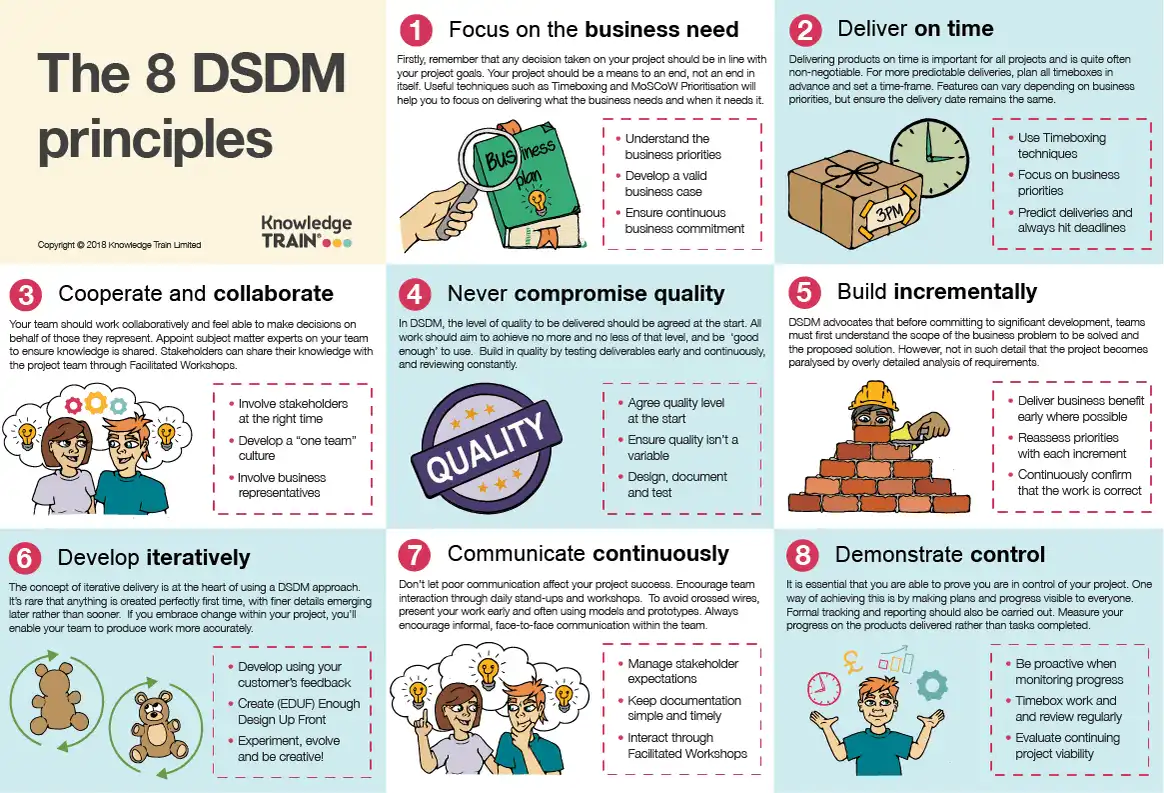
ims to improve communication by using frequent face-to-face meetings, visual communication (modelling), advance releases of prototypes and workshop sessions.
Daily stand-ups
DSDM teams can fulfil this principle with several methods. One way is to encourage team interaction through daily stand-up meetings. These informal meetings allow the team to meet and discuss issues or ideas together. Facilitated workshops are also an effective way for stakeholders to improve their understanding and discuss requirements.
DSDM teams commonly use modelling and prototyping to further improve communication. These practical methods help replace the need for heavy, useless documentation.
Modelling
Modelling is a visual form of communication utilizing diagrams. This allows for complex systems, designs and products to be better understood.
DSDM makes use of prototyping by creating prototypes of the product early in development, to allow stakeholders to ‘test-drive’ early versions of the solution. The idea is to build something fast, get feedback quickly, and to break it sooner, rather than later. The underlying DSDM philosophy is that if something isn’t going to work, it is better to find that out as soon as possible, and change course sooner, rather than later.
Prototyping
Prototyping means creating prototypes of the product early in development, to allow stakeholders to ‘test-drive’ early versions of the solution.
8. Demonstrate control
It is vital to keep control of the project. DSDM proposes that it is only possible to do this by using a plan aligned to the project aims, with both being accessible to the entire team.
Ensure progress is visible
DSDM teams, especially the project manager and team leader, can fulfil this principle by ensuring plans and progress are visible to everyone. Managing must be proactive with an emphasis on reporting and tracking.
Measure progress by delivery
Also, progress must be measured by looking at what has been delivered, rather than activities completed. Timeboxing helps to control who is doing what and when. DSDM can also be combined with methods such as Kanban, which help teams to visualize project progress and see who is doing what, when and how long it will take them.