
Key takeaways
Waterfall and agile suit different types of projects and risk profiles.Implementing the ADKAR model in your organisation
- Waterfall delivers work in fixed, sequential phases, so problems and missing requirements can surface late.Preparing for change
- Late changes in waterfall are costly, which can drive delays and budget overruns when user needs shift.Implementing the ADKAR model requires careful preparation to ensure a smooth transition. Start by assessing the current organisational landscape. Identify areas where change is necessary and align them with strategic goals. It is critical to secure
- Agile emerged to help teams deliver value sooner through short iterations and frequent feedback.leadership support
- Agile relies on clear roles, especially users, product owners, and cross-skilled developers. early on, as this endorsement sets the tone for the entire process.
- Iterative delivery supports continuous improvement and adaptation to changing business requirements.Next, communicate the impending change effectively. Use clear and consistent messaging to build awareness and desire among employees. Establish a timeline with specific milestones to track progress. This structured approach helps to minimise confusion and ensures that all critical elements of change management are addressed.
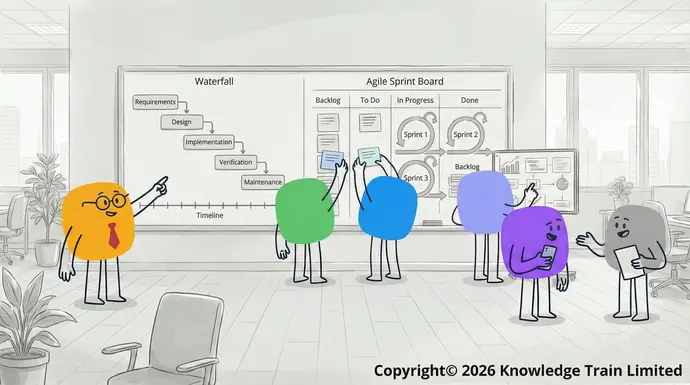
Before Agile: the ‘waterfall method’Resistance
Prior to the introduction of agile software development methods, traditional waterfall methods were the de-facto development process used across the software development industry. Waterfall project development is still used today in many modern industries (albeit with a few changes here and there).: Engage stakeholders early and involve them in decision-making processes. This involvement can reduce resistance and foster a sense of ownership.
Waterfall project management methods have undergone some revisions and improvement but are considered by many people to be somewhat dated when compared to the more modern agile methods.Engagement
Sequential phases: Maintain open lines of communication and provide regular updates. Transparency builds trust and keeps employees engaged.
Waterfall methodsResources take their name from the sequential nature of their development cycles. The first phase normally being requirements analysis, followed by design, followed by construction, followed by testing. The final phase marks the end of the project whereby the finished system is deployed and operated by users. When displayed on a chart, the development process very much resembles a waterfall, hence the name.: Ensure that adequate resources, such as time and funding, are allocated to support the change initiative.
Because waterfall development is linear, software development naturally followed a ‘layered’ development cycle. One team would do their job before passing the software on to the next team who would layer their respective components onto what had already been built. It often took months and years for the final product to be delivered to clients. Any missing or broken components were only discovered long after the product had been deployed and development closed.A key component of implementing ADKAR is using the ADKAR Assessment tool. This diagnostic instrument helps identify which elements are acting as barriers to change for individuals or groups. By rating each element on a scale of 1 to 5,
User uncertaintychange managers
In the early days of software development, waterfall-based projects were often plagued with delays and budget overruns. can pinpoint where additional focus is needed. For example, if Ability scores are low but Knowledge scores are high, this suggests the need for more practical application opportunities rather than additional training.
One major factor which contributed to such delays was the false assumption that users knew what they wanted from the system. Making changes to a system to accommodate users’ changing needs was more expensive and time-consuming the later in the project these were implemented, as such many projects were late and over-budget.Psychologically, the structured approach of the ADKAR model reduces stress and enhances confidence among employees. By focusing on individual change, it ensures that employees are well-equipped to adopt new behaviours. This focus leads to sustained improvements and long-term success.
That’s not to say though that waterfall methods aren’t still needed. They are used very successfully today on many projects – particularly those where users requirements can be clearly defined, or on projects (such as construction) whereby changes made late in the project are simply unfeasible.Best practices for each ADKAR element
The Agile ManifestoAligning goals with elements
In the early 90’s, small start-ups without limitless financial backing and time on their hands had to find a way to make software development more fluid and less costly. They slowly began to adopt agile policies into their development methods (although they had yet to be labeled as such).Aligning organisational goals with the elements of the
It was only in 2001 that a small group of luminaries gathered to discuss their knowledge of software development management and create what is called the ADKAR modelAgile Manifesto is essential for a cohesive change process. Begin by clearly defining your organisational objectives. Ensure that each of the ADKAR elements – Awareness, Desire, Knowledge, Ability, and Reinforcement – supports these objectives..Awareness
Why agile works
Agile works because it is flexible and can easily adapt to changing user demands and business requirements. You do not define a rigid development cycle and product specification up front as you do in waterfall projectsInstructor-led. If something doesn’t work as intended, or if research reveals a critical oversight, an agile team can quickly adapt the product in later iterations to ensure the final product meets the users’ needs.Change Management Practitioner (with Foundation) course
Agile works because its guiding principles and values closely mirror contemporary working conditions. Product owners may think£1,699 +vat they know what users want but can’t be sure until a working product has been delivered and feedback has been gathered. Likewise, development teams may thinkSee all dates they have made the perfect product but can’t be sure until they can demonstrate the product to its’ intended audience.
Agile highlights ongoing improvement and creates an environment of continuous learning and adaptation.
Today’s markets demand organizations hold a competitive edge in product development, and this is exactly what agile delivers. If you’d like to know more about what agile can offer you or your business, make sure to see our agile trainingSelf-paced courses.Change Management Practitioner (with Foundation) self-paced online