Waterfall method

Key takeaways
Waterfall is a linear delivery model that suits stable, well-specified work but struggles when change is frequent.
- Waterfall runs through fixed phases, and each phase is completed and documented before the next begins.
- It works best when requirements are clear, unlikely to change, and acceptance criteria can be agreed upfront.
- Strong documentation and upfront planning support predictable costs, resourcing, and stakeholder reporting.
- Late feedback can increase the risk of building the wrong thing and discovering issues near the end.
- Regulated and high-compliance environments often prefer waterfall for traceability and control of change.
- Success depends on rigorous requirements capture, formal change control, and thorough testing and QA.
Introduction to the waterfall method
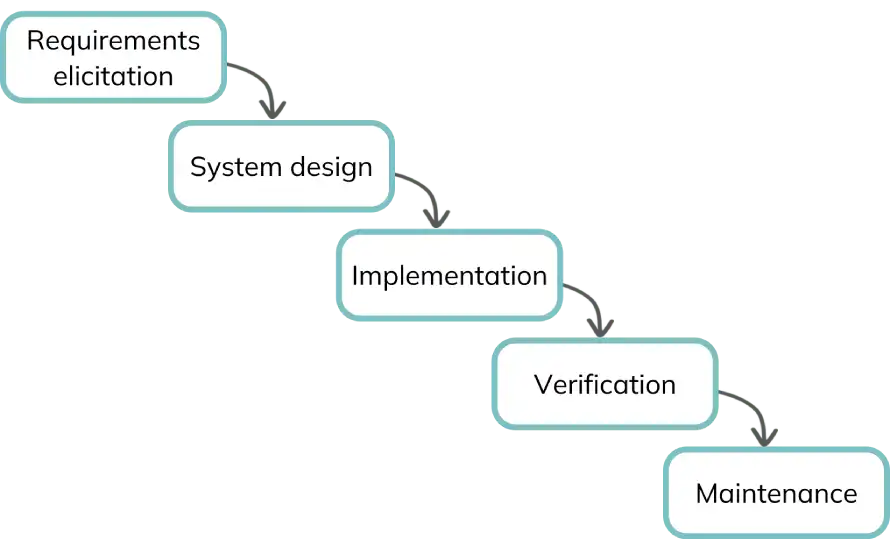
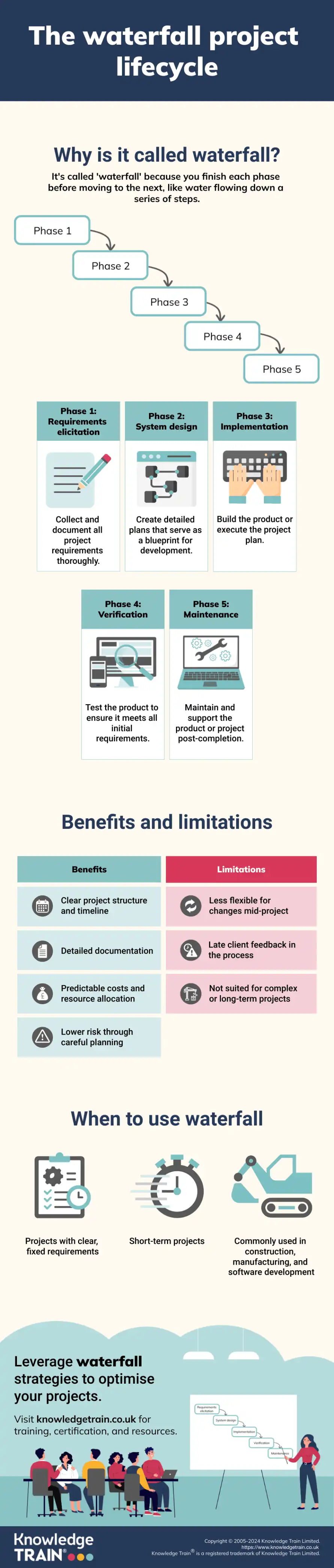
The waterfall method of project management is a sequential approach to a project . The phases of this methodology are completed one after another in the following order:
- Requirements elicitation
- Design
- Implementation
- Verification
- Maintenance.
Each of these steps should be completed and fully documented before the next step is taken. This linear approach is most known for the following characteristics:
- Rigid structure
- Comprehensive documentation
- Clear milestones
- Predictable timelines.
Waterfall method is the opposite of the Agile approach . It is less flexible and works on a fixed scope. Traditional waterfall method was not designed to be iterative like the Agile methodology. Waterfall project is best for software products and projects that have well-defined requirements that will not change much. It is good for software with certain endpoints and certain regulatory compliance checks needed for the software to function.
Waterfall phases
Waterfall is a structured , sequential approach that includes distinct phases with each phase building on the output of the previous phase. In this subsection, we will cover the phases in a waterfall lifecycle.
Requirements elicitation
In this phase, the team gathers and documents all project requirements. This includes defining the project scope and objectives, identifying stakeholders and their expectations, and creating a detailed specification document.
System design
Based on the requirements, the team designs the system architecture, user interface, database schemas, and detailed technical specifications.
Implementation
During this phase, developers write code according to the design specifications, adhere to coding standards and best practices, and create unit tests for individual components.
Verification
Testers rigorously evaluate the system by executing test cases based on requirements, performing integration and system testing, identifying and reporting bugs, and verifying bug fixes and retesting.
After testing is complete, the team:
- Prepares the production environment
- Migrates data if needed
- Deploys the system to users
- Provides user training and documentation.
Maintenance and support
After the system is deployed, ongoing activities include:
- Monitoring system performance
- Addressing user-reported issues
- Implementing minor enhancements
- Providing technical support to users.
Each phase in the waterfall process must be completed before the next phase can begin. This approach ensures that all necessary documentation is created and minimises the risk of overlooking important requirements. It can be inflexible if requirements change mid-project. The sequential nature of waterfall requires meticulous planning and clear communication throughout the development lifecycle.
Benefits of the waterfall method
Waterfall project management is a sequential and linear approach to executing tasks, and it has several advantages. Let’s discuss each one of them:
Clear project structure and timeline
The sequential nature of waterfall provides:
- Phases with clearly defined start and end points
- A planned structure with a timeline for when the work is to be completed
- Milestones that are easily communicated to stakeholders.
Comprehensive documentation
Waterfall methodology advocates comprehensive documentation, leading to well-defined project requirements and specifications, detailed design documents for future reference and valuable historical records for similar projects.
Predictable costs and resource allocation
The upfront planning involved in the waterfall model allows for accurate budget estimation, efficient resource allocation throughout the project lifecycle and minimised unexpected expenses.
Easier tracking and progress assessment
Waterfall’s structured approach facilitates easy tracking of progress with clear indicators at each phase, simplified reporting to stakeholders and easy identification of bottlenecks or delays.
Reduced risk through upfront planning
Upfront planning in waterfall can help:
- Identify potential risks early in the project
- Develop mitigation strategies before the work commences
- Minimise costly changes during the later stages of the project.
These strengths make waterfall ideal for projects with clearly defined requirements and relatively few changes expected. The methodology’s robustness is also very appropriate to the complexity of the work and the need for strict and complete control of change for medical device software development.
Limitations of the waterfall method
The waterfall method is a structured approach to project management that follows a linear sequence of phases. However, it has some limitations.
Limited flexibility for changes
The structured approach of waterfall can make changes challenging once a phase is completed. This rigidity can lead to difficulties in adapting to new requirements, costly revisions if requirements change mid-project and can inhibit creativity and innovation during the development process.
- Foundation Ongoing quality control through regular testing and reviews.
Each has its advantages and disadvantages. Waterfall provides structure and predictability, making it well-suited for projects with well-defined requirements and stable environments. Learn the fundamentals of the governance framework.AgilePractitioner offers flexibility and adaptability, making it ideal for projects with evolving requirements or uncertain outcomes. The decision to use Includes Foundation & Practitioner combined option.waterfall or AgileBetter Business Cases depends on several factors, such as project complexity, team dynamics, and organisational culture.™
When to use the waterfall methodFoundation
Agile methodologiesLearn the fundamentals of Better Business cases. have become popular in recent years, but the waterfall approach still has its place in certain situations. Let’s explore how and when waterfall can be successfully used.Practitioner
Projects with well-defined requirementsIncludes Foundation & Practitioner combined option.
This methodology works best when:P3O
- Requirements are known and unlikely to change®
- Stakeholders have a clear vision of the desired outcomeFoundation
- The scope of the project is well-defined from the beginning.Learn the fundamentals of the P3O project management office.
Industries with strict regulatory compliancePractitioner
Regulated industriesIncludes Foundation & Practitioner combined option. such as healthcare and medical device development, aerospace and defence and financial services with strict compliance requirements often adopt the waterfall methodology. These fields often require extensive documentation and adherence to specific protocols.Workshops
Large-scale, complex projects with fixed timelinesIntroduction to Project Management
Waterfall is often used for large projects that have many interconnected components, lengthy development cycles and strict deadlines and budget constraints. Infrastructure projects or large-scale enterprise-wide system implementations are examples of projects where waterfall is often used.1-day workshop to learn the basics of project management.
Projects with limited customer involvement during developmentProject Management Essentials
Projects that don’t need much customer involvement during the project2-day workshop to learn how to manage projects without getting certified.
Waterfall can be used when:Writing Business Cases
- The only customer interaction is at the start and finishHalf-day workshop to learn to write robust business cases.
- Little or no user involvement is required in the development cycleAI in Project Management
- The needs of the user are clear and stable.Learn how to use AI tools in everyday project work.
This method is effective when requirements are well understood upfront and do not change over time, as it follows a ARTIFICIAL INTELLIGENCE (AI)linear approachBCS AI.Foundation
Selecting waterfall for appropriate projects can lead to timely execution and successful project delivery. However, it’s important to carefully evaluate project characteristics and organisational requirements before adopting this methodology. When applied judiciously, waterfall offers a structured framework for managing complex projects with predictable outcomes.Learn the fundamentals of artificial intellegence.
Waterfall best practicesFoundation
To enhance the success rate of waterfall project management, consider the following best practices:Learn the fundamentals of the PRINCE2 Agile method.
Thorough requirements gathering and documentationPractitioner
To set a solid foundation for the project, gather and document all requirements comprehensively. This includes conducting detailed stakeholder interviews, creating a comprehensive functional specification, develop clear and measurable acceptance criteria and utilise formal sign-off processes for requirements documentation.Includes Foundation & Practitioner combined option.
Effective communication and stakeholder managementScrum
To ensure a project stays on track, ensure clear and regular communication with all stakeholders. This includes establishing regular status meetings and progress reports, clearly define roles and responsibilities for team members, maintain open channels for stakeholder feedback and utilise visual tools like Gantt charts to communicate project timelines and milestones.Scrum Essentials
Rigorous testing and quality assuranceSelf-paced training course to learn the essentials of Scrum.
To deliver a high-quality product, it is essential to implement a comprehensive testing strategy early in the project, conduct multiple levels of testing (unit, integration, system, user acceptance), allocate sufficient time and resources for thorough quality assurance activities and document and track all defects and their resolutions.Scrum Master
Change management and scope controlChoose Scrum Alliance or Scrum.org Scrum Master training courses.
To maintain project scope and control Scrum Product Owner changesChoose Scrum Alliance or Scrum.org Product Owner training courses., implement a formal change request process, assess the impact of proposed changes on the timeline, budget, and resources, maintain a change log to track all approved changes and communicate changes and their impacts to all stakeholders.AgileBA
Continuous monitoring and reporting®
- Regularly track progress against the – Agile Business Analysisproject planFoundation
- Use earned value management to assess project performanceLearn the fundamentals of Agile Business Analysis.
- Conduct periodic risk assessments and mitigation planningPractitioner
- Provide timely and accurate reports to stakeholders.4-day course including Foundation.
Following these best practices and tips will ensure greater chances of successful Lean Six Sigmaproject deliveryYellow Belt through the waterfall model. Adhering to these tips will assist you to keep your project organised and executed, excellent communication with stakeholders, as well as quality of deliverables.Self-paced training course to gain LSS Yellow Belt.
Waterfall tools and techniquesPMI
Waterfall projects benefit from a range of specific tools and techniques to support effective project management and execution:®
Gantt charts and project timelinesPMI-ACP
- Visual representation of project phases, dependencies, and timelinesSelf-paced course to prepare you for the exam (exam not included).
- Tracking of progress against planned schedules and milestonesKanban
- Identification of potential bottlenecks or resource conflicts.Estimating for Agile Foundation