Key takeawaysMake process policies explicit
Strong risk management improves delivery certainty by surfacing threats early and agreeing responses.Implement feedback loops.
- Define risks as uncertain events that can help or harm scope, schedule, cost, or quality.Industries benefiting from Kanban
- Classify risks (internal, external, technical, financial, operational, strategic) to avoid blind spots.Kanban is versatile and can be applied in various sectors, including software development, marketing and design, human resources, and manufacturing.
- Use a repeatable cycle: identify, assess likelihood and impact, plan responses, then monitor and adapt.Extreme Programming (XP)
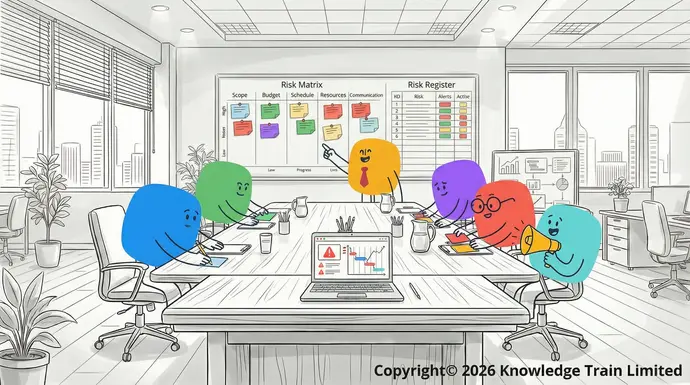
- Maintain a live risk register, supported by tools such as a risk matrix, SWOT, and project software alerts.Key practices and values
- Prevent common failures by controlling scope changes, monitoring budgets, managing dependencies, and planning resources.XP
- Keep stakeholders engaged with clear communication so risks are understood, owned, and acted on. emphasises technical excellence and customer satisfaction. Core practices include pair programming, test-driven development, continuous integration, and small, frequent releases.
IntroductionEarly detection of errors
Project managementAccurate status reporting is a challenging process that is prone to many possible failures. Scalability for larger projects.Risk managementAgile methodologies offer numerous advantages, including increased flexibility, faster delivery of value, and improved stakeholder satisfaction. However, they also present challenges, such as the need for cultural change and potential difficulties in long-term planning. is a key aspect of project management that can help increase the likelihood of project success. This involves the process of identifying, assessing, and mitigating risks that can threaten the project.When considering an Agile approach, evaluate your team’s skills, project requirements, and organisational culture. Some projects may benefit from combining elements of different Agile methodologies or even blending Agile with traditional approaches.
In this article, we will explore some of the risks that can arise on projects and how to deal with them effectively. We will discuss the following topics:Remember that successful implementation of any Agile methodology requires commitment from the entire team and support from management. Continuous learning and adaptation are key to maximising the benefits of
- The definition and importance of understanding project risksAgile project management
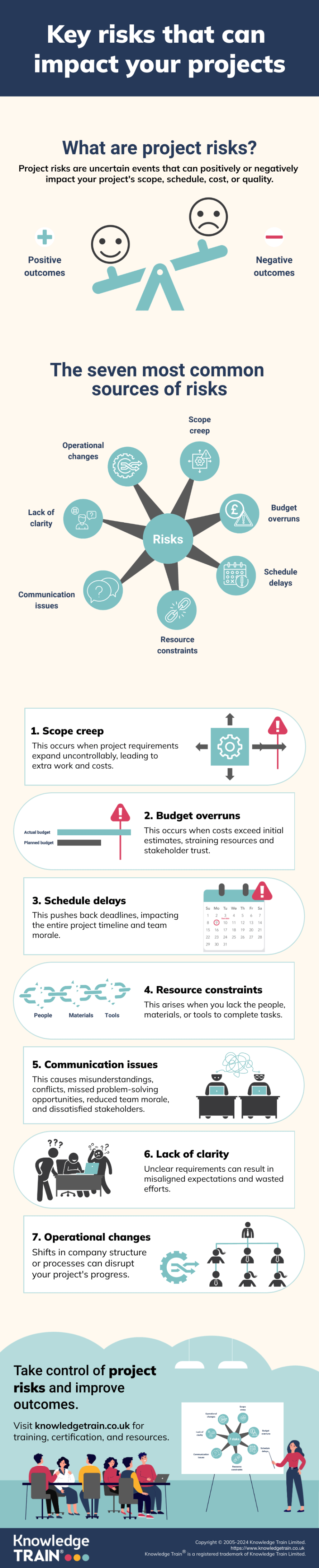
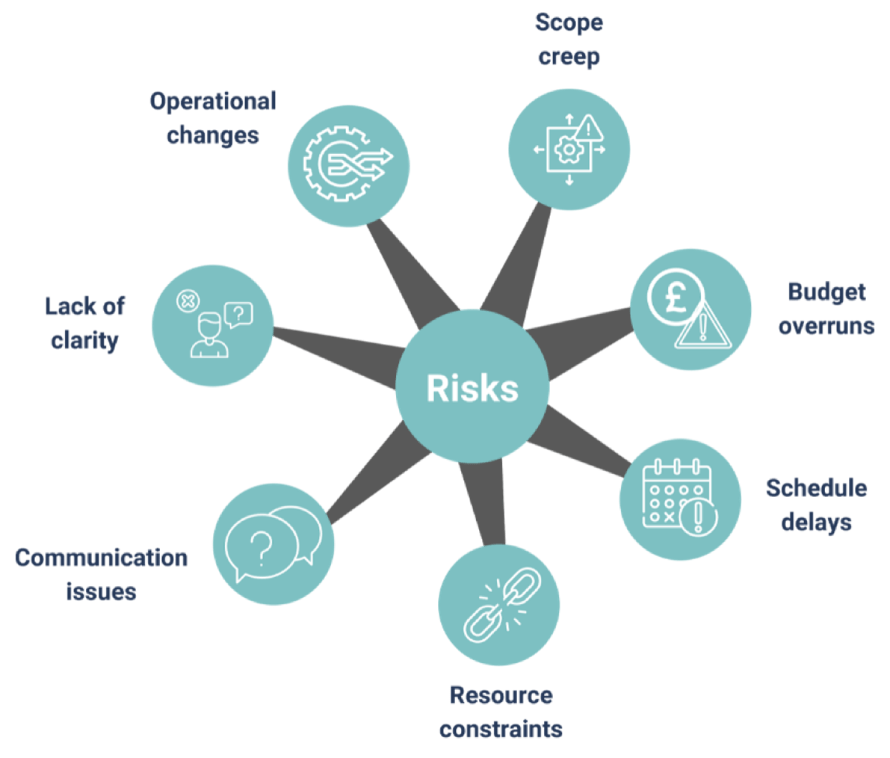
- The different types of common project risks.
- The process of risk management on projectsEnhance your skills with our expert-led courses
- The tools and techniques used in risk management
- The strategies for effective risk mitigation
- The best practices for successful risk management on projects.
By the end of this article, you will be able to:Instructor-led
- Identify potential risks on your projectsIntroduction to Project Management course
- Apply effective risk management strategies
- Improve the chances of your project’s success.£499 +vat
You can also learn about project risk management on a project management courseSee all dates such as PRINCE2 course or an APM courseInstructor-led.Project Management Essentials
Let’s begin and explore the world of project risk management£999 +vat and how to protect your projects from potential risks.
- ts for
- External factors (e.g. weather, supplier delays).prioritising requirements
Impact, which includes:
Schedule delays can lead to missed deadlines and milestones, increased costs due to prolonged project duration, reduced stakeholder satisfaction and potential loss of competitive advantage.Must have
To address time-related risks, implement effective project scheduling techniques and regularly monitor project progress.Should have
Resource constraintsCould have
Types of resource risksWon’t have this time.
Resource risksThis prioritisation technique ensures that the focus remains on essential deliverables within time and resource constraints. can take various forms, such as:Adaptive Project Framework (APF)
- Skill shortagesFlexibility in uncertain environments
- Equipment or material unavailabilityAPF
- Insufficient funding is designed to handle projects with high levels of uncertainty. It allows for continuous adaptation and adjustment as new information becomes available.
- Limited time availability.Key components of APF
Impact on project performanceAPF consists of five stages:
Resource constraints can result in reduced productivity, compromised quality of deliverables, increased stress on team members and potential project delays.Project scope
Conduct thorough resource planning and maintain open communication with stakeholders to proactively address resource-related issues.Cycle plan
Communication issuesCycle build
Importance of effective communicationClient checkpoint
Effective communicationPost-cycle review. is vital for project success. It facilitates alignment of project objectives, timely issue resolution, stakeholder engagement and buy-in and efficient team collaboration.These stages promote iterative development and frequent stakeholder involvement.
Consequences of poor communicationHybrid and adaptive methodologies provide tailored solutions for complex and dynamic projects. By combining elements from various approaches, teams can create flexible frameworks that address specific project needs and organisational cultures.
Poor communication can lead to misunderstandings and conflicts, missed opportunities for problem-solving, reduced team morale and productivity and stakeholder dissatisfaction.Choosing the right project management methodology
Establish clear communication channels and protocols to promote open and transparent dialogue throughout the project.Factors to consider
Lack of clarityProject complexity and size
Sources of unclear requirements: Larger, complex projects may benefit from a more structured approach like
Unclear requirementswaterfall
Brainstorming sessions can help identify risks that might be overlooked otherwise.
Project management software
Project management software is a valuable tool for helping to streamline your risk management processes. Features to consider include:
- Risk tracking and monitoring
- Automated alerts for risk triggers
- Collaboration tools for team communication
- Reporting capabilities for stakeholder updates.What soft skills do project managers need?
Project management software can greatly improve your ability to manage risks throughout your project.
Strategies for mitigating common project risksSimon Buehring
Preventing scope creep19 Feb 2026
- Clearly define project boundaries and scope during the planning stage
- Implement a change control process to evaluate and approve scope changesDiscover essential soft skills for project managers and why they are crucial for successful project delivery. Read on to enhance your skill set.
- Communicate the impact of scope changes to all stakeholders.
Managing budget risks
- Accurate cost estimation and inclusion of contingency reserves
- Regular budget monitoring and reporting
- Cost control measures and prioritisation of expenses.
Addressing schedule delays
- Utilise critical path analysisPRINCE2 study formats to identify key milestones and dependencies
- Build buffer time into Simon Buehringproject schedules19 Feb 2026
- Regularly review and adjust timelines based on progress updates.
Optimising resource allocationCompare the four study formats for PRINCE2 certification to find the best fit for your learning style and schedule. Read on for details.
- Conduct thorough resource planning at the outset of the project
- Utilise resource levelling techniques to balance workloads
- Maintain a skills inventory to quickly identify and address skill gaps.
Improving communication
- Establish clear communication channels and protocols
- Schedule regular team meetings and stakeholder updatesPRINCE2 roles and responsibilities
- Utilise collaboration tools to facilitate information sharing.
Ensuring clarity in project requirementsSimon Buehring
- Conduct thorough requirements gathering sessions with stakeholders19 Feb 2026
- Create detailed, unambiguous project specifications
- Implement formal requirements review and approval process.Discover the defined roles and responsibilities within the PRINCE2 framework and how to customize them for your project needs. Learn more by scrolling down.
Adapting to changes
- Stay informed of potential changes within the organisation
- Build flexibility into project plans to accommodate operational shifts
- Develop contingency plans for significant operational disruptions.
By following these tips, you can avoid most of the common pitfalls that can cause problems in your projects. Keep in mind that risk management is a continuous process. It is important to revisit the steps in this process as you continue with your project.
Best practices for effective risk managementHow APM qualifications can help your career
Proactive approach to risk identification
- Try to spot potential risks at the start of a Simon Buehringproject19 Feb 2026
- Ask team members to raise red flags as soon as possible
- Look at past data and apply any relevant lessons learnt.The Association for Project Management (APM), a leading UK educational charity, offers qualifications that boost your career at any stage. Read on to discover how these credentials can enhance your professional journey.
Regular risk assessment
- Hold regular check-ins to review identified risks and their status
- Re-evaluate risks as the project progresses and circumstances change
- Revise risk mitigation plans as necessary.
Stakeholder involvement in risk management
- Include stakeholders in identifying and assessing risksPMO consulting: Unlocking project success
- Keep stakeholders informed of risk management plans and progress
- Seek stakeholder input on risk mitigation strategies.Knowledge Train
Continuous learning and improvement23 Feb 2026
- Record lessons learnt from risk management successes and failures
- Share information with other project teams to improve organisational risk managementProject success depends significantly on PMO consulting expertise. This service provides expert advice which helps improve your project management office functionality to achieve enhanced results and productivity.
- Invest in ongoing training and development of risk management skills.
Follow these tips to help you establish a positive risk management culture and improve project success.
Conclusion®
Recap of key points Guide: A comparison
Effective project risk management is a multi-faceted approach that involves identifying and assessing potential risks, developing mitigation strategies, utilising appropriate tools and techniques, and implementing best practices for continuous improvement.
These elements form a comprehensive framework for managing uncertainties in project management.Simon Buehring
Importance of ongoing risk management19 Feb 2026
Risk management is an ongoing process that requires constant vigilance, regular reassessment and adaptation to changing project conditions.This article offers a detailed comparison between PRINCE2 and the PMBOK® Guide, helping you understand their unique methods and frameworks. Scroll down for insights.
By prioritising risk management throughout the project lifecycle, you increase the likelihood of project success. Remember, proactive risk management is an investment in your project’s future, safeguarding its objectives and deliverables.
FAQs
What is the difference between internal and external project risks?
Internal risks are those that originate within the project or organisation, while external risks stem from outside factors beyond the direct control of the project team.
How often should risk assessments be conducted during a project?
Risk assessments should be conducted regularly throughout a project, often at predetermined intervals or key project milestones. Monthly risk assessments are typical for most projects.
What role do stakeholders play in project risk management?
Stakeholders can provide valuable input in identifying risks, assessing their potential impact, and helping to develop risk mitigation strategies.PRINCE2 Agile glossary
Can all project risks be eliminated?
No, not all project risks can be eliminated. The focus should be on effectively managing and mitigating risks.Simon Buehring
How can small teams effectively manage project risks with limited resources?19 Feb 2026
Small teams can prioritise risks based on their potential impact, use simple risk assessment tools, and leverage the diverse expertise of team members to ensure comprehensive risk management.
InfographicAccess a comprehensive glossary of terms from PRINCE2 Agile to enhance your understanding of its unique vocabulary. Essential for practitioners.