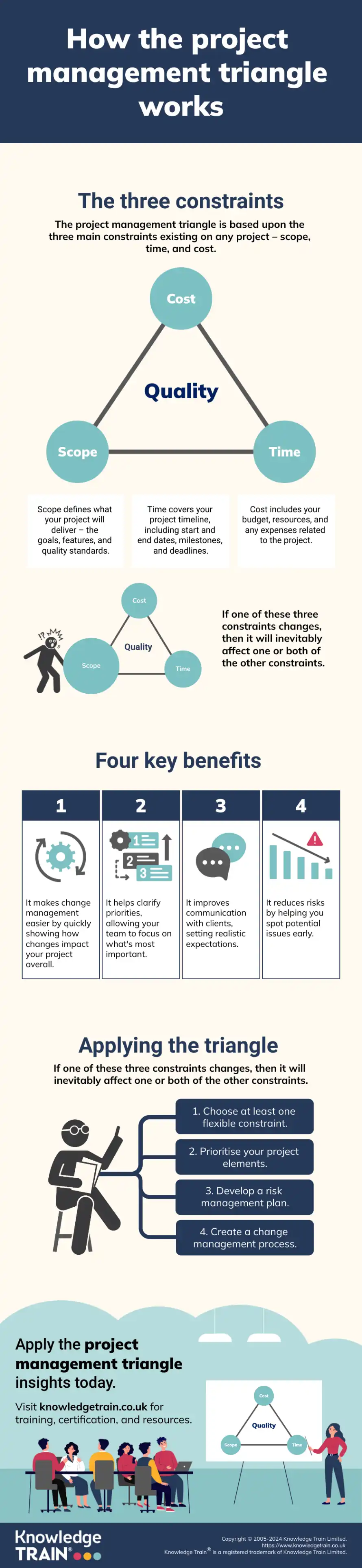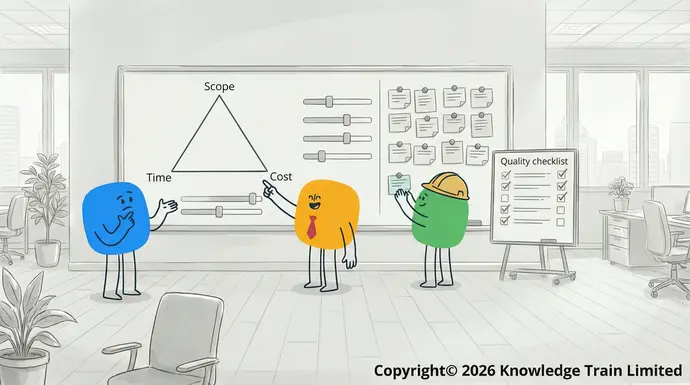
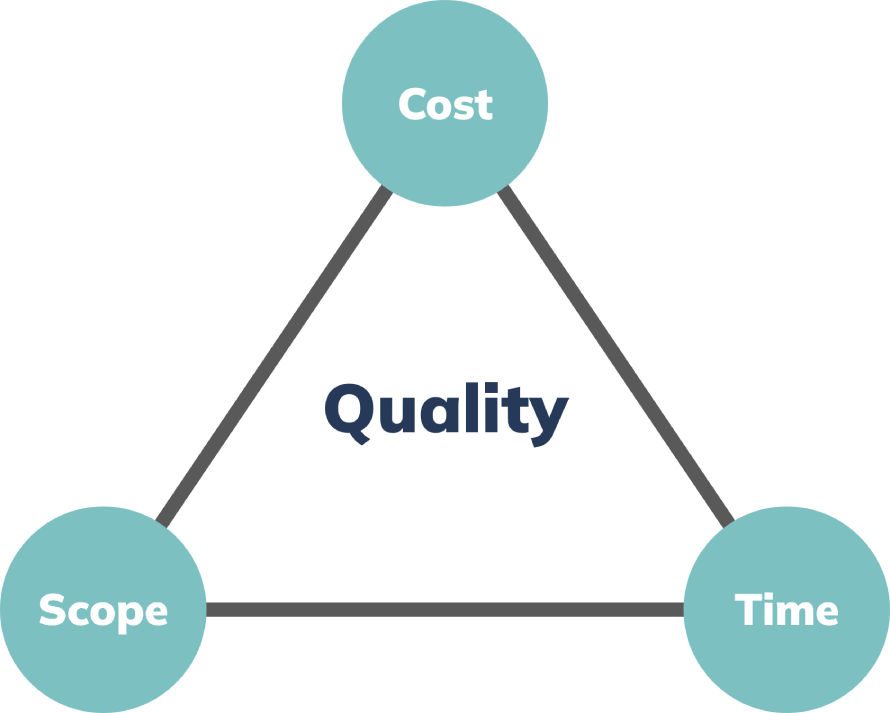
Managing the project management triangle
Maintaining the balance of the project management triangle requires strategic decisions and careful trade-offs between scope, time, and cost. Here are some tips to help:
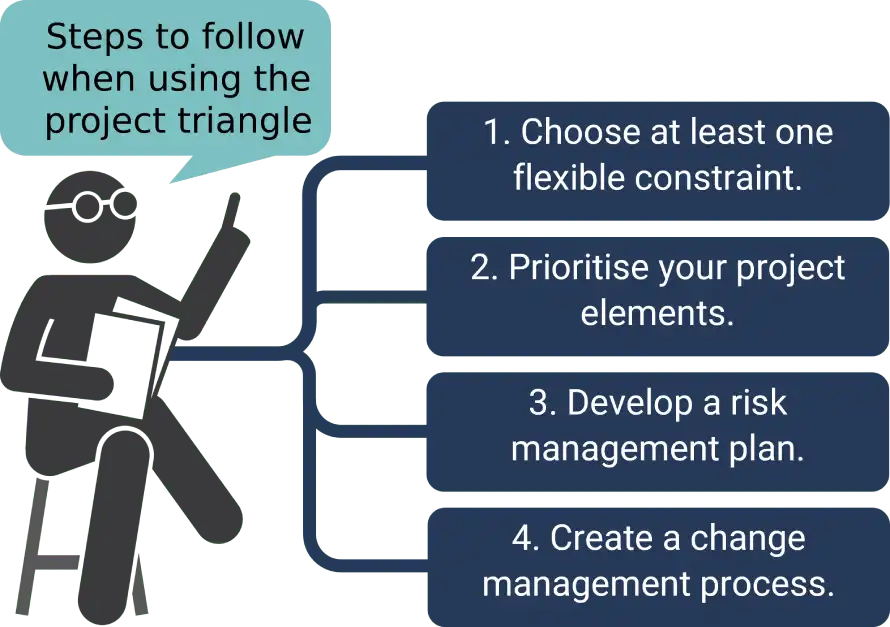
Choose at least one flexible constraint+44 (0)207 148 5985
One constraint should be identified as more flexible than the others. This allows some wiggle room when dealing with changes or issues. Ask yourself: Self-paced
- Which constraint is easiest or least impactful to change?Or chat with us using the link at the bottom of the screen.PMI Agile Certified Practitioner (PMI-ACP) self-paced online
- Are stakeholders willing to adjust scope, extend deadlines, or increase budget if necessary?Contact us with questions about the courses on this page, or about which project management certification or training is best for you.
- How will increased flexibility in one constraint impact the other two?Finance FAQs£449 +vat
Identifying a flexible constraint up-front allows for better risk management and issue resolution.ContactPMBOK
Prioritise features and requirementsCookies®
It is important to carefully evaluate the importance of each project deliverable. This will help you focus on what is essential to project success. Create a comprehensive list of features and requirements, then:Privacy Guide
- Rank or score each based on value and importanceTermsThe
- Clearly define “must-have” vs. “nice-to-have” featuresCustomer SupportPMBOK
- Leverage prioritisation to inform trade-off decisions. ®
This prioritisation process allows for objective trade-off discussions if needed.[email protected] Guide
Develop a risk management planJoin Our Team should not be read in isolation from
Proactively identifying and managing risks will help avoid imbalances in the triangle. A The Standard for Project Managementrisk management[email protected]. Both form one book, but each with its own distinct emphasis. plan Copyright © 2005-2026 Knowledge Train Limited. The should include: Registered in UK: 5566983. Standard for Project Management
- Identification of risks that could impact any of the constraints Registered VAT: GB872413526. describes some key terms and concepts. It also describes how projects form a way for organizations to create value and describes the project environment within which projects operate. The Standard for the first time introduces 12 core
- Risk scoring based on probability and impact Knowledge Trainproject management principles
- Detailed contingency plans for high-priority risks® which inform the project performance domains described in the
- A monitoring process to reassess risks throughout the project. is a registered trademark of Knowledge Train Limited. PMBOK
Risk management 20 Old Bailey, London, EC4M 7AN, England, United Kingdom.® ensures prevention of imbalances before they happen. Knowledge Train are experts in project management, PRINCE2, agile and change management training and certification. Choose from a full range of instructor-led and self-paced Guide
Create a change management planproject management courses.
Change is inevitable on projects. A , a The Standard for Project Management should be read in conjunction with the change management planPRINCE2 coursePMBOK provides a process for considering how changes impact the constraints. A plan should include:, or an ®
- A system for submitting, reviewing, and approving changesagile project management course Guide
- Procedures for assessing change impact on each constraint to boost your career. and sets the tone for everything described in the
- Approval thresholds based on change type and sizePRINCE2PMBOK
- Communication plans for approved changes®®
A structured change management process helps to prevent imbalances., MSP.
Match management methodology to priority constraints® It documents a set of standard terminology, knowledge, and guidelines for project management. It also describes itself as a standard for project management. This is because the PMI itself was approved by the American National Standards Institute (ANSI) to be a standards developer in 1998.
The project management methodology used should complement the project’s constraints. Consider:, ITILAlthough the PMI started in the USA, it is very much now a global organisation with chapters (groups of members) in many countries in the world.
- Waterfall methodologies® like traditional or predictive project management focus on upfront planning and are best suited for fixed-scope projects where time and cost can be more flexible., P3ODownload the PRINCE2 vs PMBOK
- Agile methodologies®® like Scrum or Kanban emphasise iterative development and are best for projects where scope may need to be flexible or change over time., PRINCE2 Guide ebook
- Lean approaches® prioritise efficiency and cost control and are useful when budget is the main constraint. Agile, RESILIADownload
Choosing the right approach from the beginning aligns with the key constraints.®
Follow the tips above to help manage the project management triangle and balance constraints throughout your project. The most important thing is to continuously monitor and maintain alignment of the three sides. Assess the status of scope, time, and cost regularly to identify imbalances. Be willing to make informed decisions and trade-offs as necessary. And communicate clearly with stakeholders about any changes to plans or constraints., and the Swirl logo are registered trademarks of the PeopleCert group. Used under licence from PeopleCert. All rights reserved. AgilePM
Strategies for balancing constraints®
Managing constraints effectively requires specific strategies for each side of the project management triangle. Here are some tips for balancing scope, time, cost and quality: and AgileBAPMBOK
Scope management techniques®®
When managing project scope, you can try these tips: are registered trademarks of Agile Business Consortium Limited. All rights reserved. The APMG International AgilePM and Swirl Device logo, APMG International AgileBA and Swirl Device Logo, APMG International Change Management and APMG International Better Business Cases and Swirl Device logo are trademarks of The APM Group Limited, used under permission of The APM Group Limited. All rights reserved. Better Business Cases™ is a trademark of Her Majesty’s Treasury. All rights reserved. DevOps Foundation Guide structure
- Define project boundaries®The : Clearly outline the scope of the project and its deliverables at the beginning. is a registered mark of the DevOps Institute. “PMI”, “PMBOKPMBOK
- Scope change control®®Knowledge Train Ltd is an Introducer Appointed Representative of NewDay Cards Ltd for the Newpay finance product provided by NewDay Ltd. NewDay Cards Ltd acts as a credit broker, not a lender. We will introduce you exclusively to Newpay finance products provided by NewDay Limited under this Introducer Appointed Representative arrangement. Finance available from other lenders is not covered by this arrangement. NewDay Ltd and Newday Cards Ltd are authorised and regulated by the Financial Conduct Authority (ref nos 690292 and 682417 respectively).
- Search
- Request a quote
Delivery
- Earned value management Measurement: Track the project’s progress in relation to its budget and schedule. Uncertainty.
- Vendor management Tailoring: Negotiate favourable terms and monitor supplier costs.To provide the best experiences, we use technologies like cookies to store and/or access device information. Consenting to these technologies will allow us to process data such as browsing behavior or unique IDs on this site. Not consenting or withdrawing consent, may adversely affect certain features and functions.The tailoring section is one which was introduced in the previous edition but gains more emphasis in the latest edition. Tailoring is the deliberate adaptation of the
Quality assurance practices project management approach
When managing project quality, you can try these tips: , governance, and processes so they better suit the specific context of a project. It considers the development approach, project life cycle, processes, choice of people with whom to engage with, and the methods and artifacts used.
- Quality standards This section describes the many factors that affect tailoring, including the project scale, duration, complexity, organizational culture, industry, and level of : Define specific, measurable quality criteria for the project deliverables. project management maturity
- Continuous testingFunctional.: Implement regular quality checks throughout the project lifecycle. Models, methods, and artifacts
- Peer review This section provides a high-level description of some of the most commonly used models, methods, and artifacts useful when managing projects. Some of these models (for example : Leverage the expertise of team members to identify and address quality issues. ADKAR
- Customer feedback , Virginia Satir) originated in the : Regularly collect and incorporate stakeholder feedback on project deliverables.Functionalchange management
Through the implementation of these methods, project managers can successfully navigate and mitigate trade-offs between the competing constraints of scope, time, cost, and quality. However, it is important to note that constraint management is an iterative process that necessitates continuous monitoring and adjustment in response to changing project dynamics. realm, but were introduced into the Guide because of the importance of change management to successful project outcomes.
Tools for managing the project management triangle Always active PMBOK
Software can help you keep track of the project management triangle and ensure your project management is top-notch. Here are some of the best project management software to consider: ®
Project management software options Guide strengths
- Monday.com When I reviewed the 6: A flexible platform suitable for multiple project types and management styles. With Visual boards for easy task tracking and prioritisation, it’s one of the best software for project management, and it also has customisable workflows for specific project requirements. th
- ClickUp edition of the : A feature-rich tool with robust Agile project support and time tracking and resource management features. ClickUp also provides multiple view options (list, board, Gantt, calendar) to cater to different preferences and project needs. PMBOK
- TeamworkThe technical storage or access is strictly necessary for the legitimate purpose of enabling the use of a specific service explicitly requested by the subscriber or user, or for the sole purpose of carrying out the transmission of a communication over an electronic communications network.®: A client-focused platform designed for team collaboration. It has a budget and expense tracking features, as well as Guiderisk management some years ago I wrote that key strength was its comprehensive treatment of the Knowledge Areas. However, in the 7 and issue tracking tools for comprehensive project management. th
Key features to look for in project management tools edition, the Knowledge Areas have been replaced by principles and the project performance domains.
When choosing a project management tool, consider these vital features and capabilities:PreferencesPrinciples
- Constraint tracking One of the best parts of the new : The ability to track and manage scope, time and cost constraints concurrently PMBOK
- Resource allocation ®: Features and tools to optimise team and resource utilisationPreferences
- Reporting and analytics Guide: Real-time project status and insights through intuitive dashboards and analytics is its introduction of 12 new principles. These are comprehensive and are designed to guide practitioners to tailor the guidance appropriately. The table below shows the most equivalent PRINCE2 principle.
- Collaboration features PMBOK: Shared workspaces, integrated communication tools and file-sharing capabilities for effective teamwork ®
- Integration capabilitie principless: Compatibility with other software and tools used within your organisation PRINCE2 principles
- Customisation options Be a diligent, respectful, and caring steward: Flexibility to adapt the software to your project management methodologies and processesThe technical storage or access is necessary for the legitimate purpose of storing preferences that are not requested by the subscriber or user.Create a collaborative project team environment
- Mobile accessibility Define roles, responsibilities, and relationships
Common challenges and solutionsA very welcome change to the latest
Scope creepPMBOK
Scope creep®Marketing involves changes or expansion in the project’s scope after it has already started. This can lead to an increase in resources, time, and effort needed to complete the project. is its focus on value. This formed a huge gap in earlier editions, and with its introduction it brings itself much more into line with PRINCE2. PRINCE2 for many years has focused on a business case driving the decision-making on
Solutionsprojects
- Establish a formal change control process to manage scope changes effectively., and whether the project will continue to realize the benefits that the project is designed to bring.
- Clearly define project scope and requirements during the planning phase.With the new emphasis on projects creating value, the Marketing
- Communicate regularly with stakeholders to manage expectations.PMBOK
- Implement a prioritisation system for new requests and changes.®
Time constraints can help to ensure that projects remain means to an end, rather than the end in itself.
Projects often face Project performance domains tight deadlinesSo, now, I would say that its key strength is its comprehensive treatment of these domains. As you can see from the comparison below, it covers many of the same topics as all the , which can put pressure on the team and the quality of work.PRINCE2 practices
Solutions.
- Use critical path analysis to identify and focus on essential tasks.The technical storage or access is required to create user profiles to send advertising, or to track the user on a website or across several websites for similar marketing purposes.
- Manage options
- Manage services
Manage {vendor_count} vendors
Read more about these purposes
Accept
- Deny
- View preferences
Save preferences
View preferences
- {title}
- {title}
- {title}
- Manage Consent
To provide the best experiences, we use technologies like cookies to store and/or access device information. Consenting to these technologies will allow us to process data such as browsing behavior or unique IDs on this site. Not consenting or withdrawing consent, may adversely affect certain features and functions.
Functional
Functional
Always active
The technical storage or access is strictly necessary for the legitimate purpose of enabling the use of a specific service explicitly requested by the subscriber or user, or for the sole purpose of carrying out the transmission of a communication over an electronic communications network.
Preferences
- Preferences
are aspects of project management which must be continuously addressed throughout the lifetime of the project. Themes are very much like the project performance domains in the
Result PMBOK: The project delivered under budget, with minimal impact on time, and fulfilled all essential business requirements.Statistics®
Construction project Guide
A commercial .skyscraper building construction Processes project faced unexpected geological conditions which created a major risk to the project triangle.StatisticsThe practices and principles are applied throughout the 7
Key measures include reallocated budget from non-essential features to resolve foundation issues, accelerated other construction phases to make up for initial delays, and negotiated with stakeholders to adjust project scope without compromising quality. PRINCE2 processes
Result . The processes describe who is responsible for taking decision, and when. Each PRINCE2 process is divided into a number of activities.: The building was completed safely, with a minor delay and a slight increase in the budget. Project context
Product development initiative Within each of the chapters about processes and principles the manual provides guidance on how to tailor the method to different projects, depending on their size, level of risk, complexity, and other factors. Tailoring guidelines are no dissimilar to those in the
A tech startup wanted to launch a PMBOKnew software product ® in a highly competitive market, but it struggled to strike the right balance between innovation and the pressure to get the product to market in time. Guide
Key measures include employed an The technical storage or access that is used exclusively for statistical purposes..Agile Roles & responsibilitiesmethodologyThe technical storage or access that is used exclusively for anonymous statistical purposes. Without a subpoena, voluntary compliance on the part of your Internet Service Provider, or additional records from a third party, information stored or retrieved for this purpose alone cannot usually be used to identify you.Appendix B of the to manage scope flexibly, focused on developing a Minimum Viable Product (MVP) for the initial release and utilised customer feedback to prioritise further feature development after launch. PRINCE2 manual
Result provides a very detailed set of responsibilities for the different project management team roles.: The product was able to be launched in time, within the budget, and has gained a high level of market share quickly due to its core functionality and the improvements that have been iteratively made since the launch. PRINCE2 strengths
These examples illustrate successful applications of the project triangle in diverse industries and projects. They show how effective management of scope, time, and cost can overcome challenges and deliver value. Business case
. This is very much in line with the concept of benefit realization in PRINCE2.
In its business case theme, PRINCE2 also describes the importance of measuring the performance of the project’s products in their operational life. This helps the organization understand whether the forecasted benefits are, in fact, being realized. To help the organization plan how to measure and who will measure the benefits after the project closes, a benefits management approach is recommended to be created whilst initiating the project.Project management team rolesA second major strength of PRINCE2 is its detailed and wide-ranging description of multiple project management team roles. Whereas in the PMBOK®
Guide
the emphasis is mainly on what the project manager does, in PRINCE2 there is a whole appendix providing detailed descriptions of the responsibilities for seven distinct project management team roles.
The different roles can be seen in the diagram below.
PRINCE2 project management team roles
PMBOK
®
Guide equivalent
Can the project management triangle be applied to all types of projects?executive
Yes, the project management triangle is a versatile concept that can be applied to various industries and projects.project sponsor
What are some signs that a project’s constraints are out of balance?senior user
Signs of imbalance may include frequent scope changes, missed deadlines, budget overruns or quality issues.no equivalent
How often should project managers review and adjust the project management triangle?senior supplier
Regular reviews are crucial, especially at significant milestones or when major changes occur.no equivalent
What role does innovation play in managing the project management triangle?project assurance
Innovation can help optimise processes, potentially improving all constraints simultaneously.no equivalent
Infographicproject manager