Project management triangle

Key takeaways
Scope, time and cost move together, so every change needs a conscious trade-off.
- Any shift in scope, schedule, or budget typically forces an adjustment in at least one other constraint.
- Imbalances often show up as rushed work, under-resourcing, or overambitious deliverables that reduce quality.
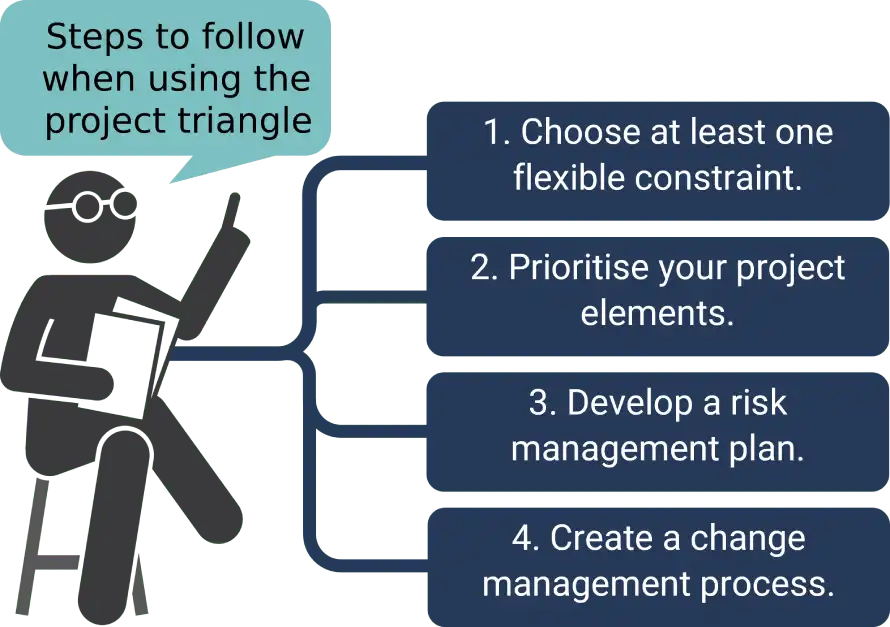
- Pick at least one flexible constraint early so you can respond to issues without losing control.
- Use prioritisation and formal change control to prevent scope creep and keep decisions objective.
- Monitor risks and progress continuously, and communicate trade-offs clearly to stakeholders.
Introduction
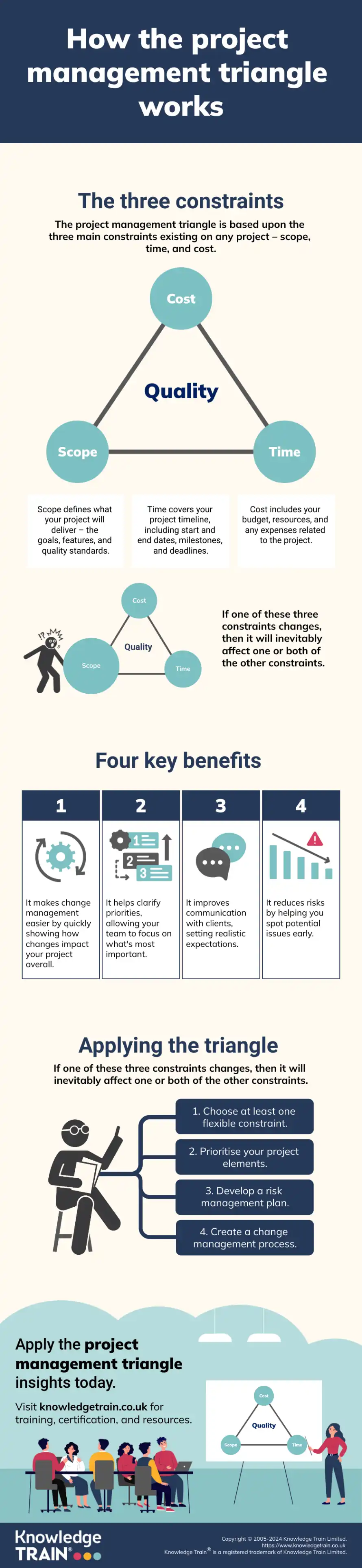
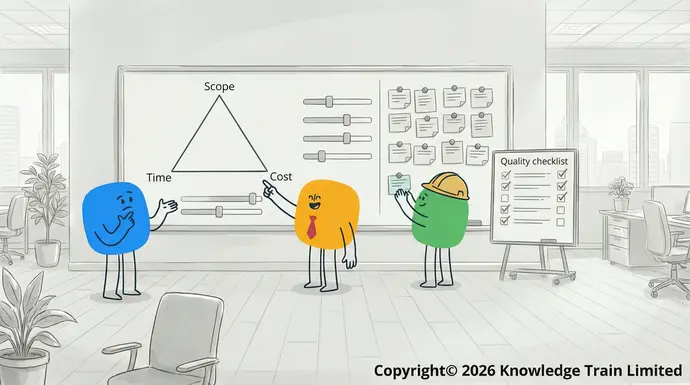
The project management triangle , also known as the triple constraint model, is a concept that visualises the constraints of scope , time , and cost in project management . It highlights the interconnected nature of these three aspects in delivering a successful project.
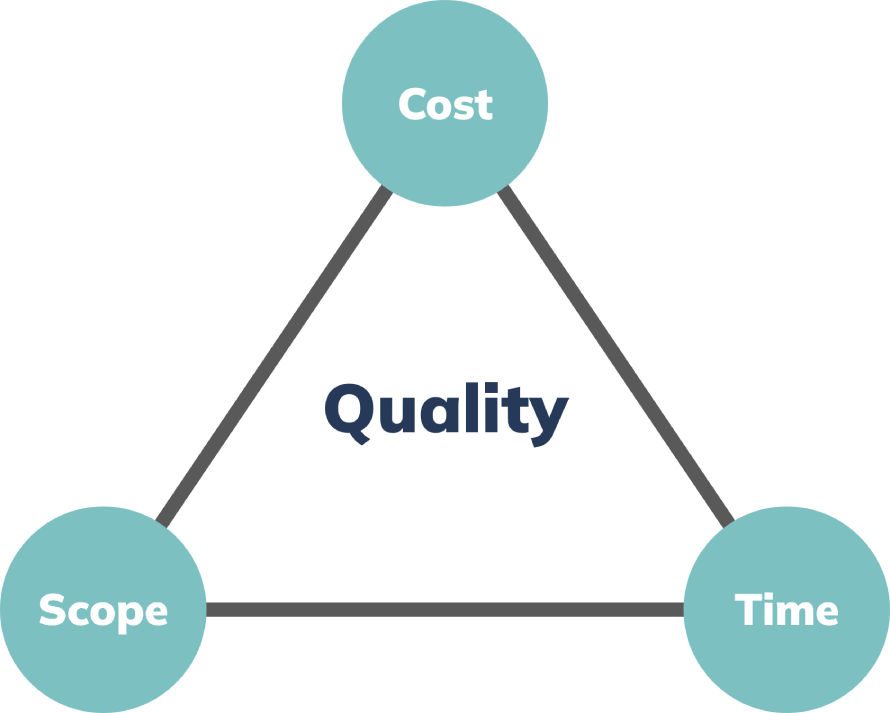
The triangle model is a crucial tool for project managers to understand and balance the competing demands of a project Request a quote. The scope refers to the project’s requirements, objectives, and deliverables. Time refers to the schedule and deadlines. Cost encompasses the budget and resources. The challenge is to optimise all three to meet project goals.
Each corner of the triangle is dependent on the other two. A change in one element typically results in a change in at least one other. By understanding and managing these constraints, project teams can make informed decisions and adjustments to ensure project success.
The project management triangle is a fundamental concept that helps [email protected]project managers visualise and optimise the key constraints of any project. By balancing scope, time, and cost, project teams can deliver successful outcomes that meet stakeholder expectations. +44 (0)207 148 5985
Understanding the project management triangleCourses
The three constraints explainedPROJECT MANAGEMENT
The project management triangle is made up of three main constraints: PRINCE2scope®, Foundation timeLearn the fundamentals of the PRINCE2 method. and Practitioner costIncludes Foundation & Practitioner combined option.. Let’s have a detailed look at each of these.Association for Project Management (APM)
- ScopeProject Fundamentals Qualification (PFQ) : Scope refers to the boundaries, objectives and deliverables of a project. It includes the goals and requirements of the project, as well as the specific features, functionalities and quality standards.Start your APM project management career.
- TimeProject Management Qualification (PMQ) : The time constraint of a project refers to its duration and schedule. It involves factors such as the project start and end dates, milestones and deadlines, as well as the sequencing and dependencies of tasks.Advance your APM project management expertise.
- CostProject Risk Single Certificate Level 1 : The cost constraint relates to the financial and resource aspects of a project. This includes the budget allocated to the project as well as the human resources and labour costs, and equipment and material expenses.Enhance your project risk management skills.
Relationship between constraintsAgilePM
The three constraints of scope, time and cost are interconnected and can impact each other. Changes to one constraint will likely influence the other constraints. For example, an increase in scope will often require additional time and resources, whereas a reduction in time may increase costs or decrease scope. Similarly, a reduction in budget may affect the project scope or timeline.®
Project managers – Agile Project Management must carefully balance these constraints throughout the project lifecycle.Foundation
Impact on project qualityLearn the key principles of Agile Project Management.
The balance of scope, time and cost also has an impact on the Practitioner qualityIncludes Foundation & Practitioner combined option. of the project outcomes. If the three constraints are well-balanced, the project is more likely to achieve high-quality results. On the other hand, if there is an imbalance in any of the constraints, the quality of the project may be compromised. For example:PRINCE2
- A tight deadline may lead to a rushed project, resulting in lower quality outputs.®
Common challenges and solutionsSelect your preferred training course below:
Scope creep
Scope creepCHANGE MANAGEMENT QUALIFICATIONS involves changes or expansion in the project’s scope after it has already started. This can lead to an increase in resources, time, and effort needed to complete the project.Select your preferred qualification.
Solutions
- Establish a formal change control process to manage scope changes effectively.APMG CHANGE MANAGEMENT COURSES
- Clearly define project scope and requirements during the planning phase.Select your preferred training course below:
- Communicate regularly with stakeholders to manage expectations.
- Implement a prioritisation system for new requests and changes.PROGRAMME MANAGEMENT QUALIFICATIONS
Time constraintsSelect your preferred qualification.
Projects often face tight deadlinesMSP COURSES, which can put pressure on the team and the quality of work.Select your preferred training course below:
Solutions
- Use critical path analysis to identify and focus on essential tasks.PMI COURSES
- Implement time-boxing techniques to improve focus and productivity.Select your preferred training course below:
- Consider parallel processing of tasks where possible.
- Negotiate for deadline extensions when necessary.PMI COURSES
Budget limitationsSelect your preferred training course below:
Limited budgets can restrict resources, impacting the project’s scope and quality.PRINCE2 COURSES
SolutionsSelect your preferred training course below:
- Conduct thorough cost estimation during the planning phase.
- Implement earned value management (EVM) to track project cost performance.APM COURSES
- Explore cost-effective alternatives for resources.Select your preferred training course below:
- Prioritise budget allocation for critical project components.
Balancing constraints may sometimes lead to AGILE PROJECT MANAGEMENT COURSESquality issuesSelect your preferred training course below: in deliverables.
SolutionsPRINCE2 AGILE COURSES
- Establish and communicate clear quality standards at the beginning of the project.Select your preferred training course below:
- Implement regular quality checks throughout the project lifecycle.
- Involve stakeholders in continuous feedback loops.BUSINESS CASE COURSES
- Allocate resources for testing and quality assurance processes.Select your preferred training course below:
With preparation of ways to address these hurdles, you will be one step closer to coping with the strain on the project management triangle. Keep in mind that this is where some creative strategising can help you maintain control of all these factors. It’s good to frequently ask “how are things going” and be willing to switch things around to keep them in balance.
Best practices for implementing the project management triangleAGILE COURSES
- MSP COURSESStay updated on emerging project management methodologies and tools.
Incorporating these best practices can help project managers to learn the project management triangle. However, success will depend on dedication, flexibility, and the ability to learn from both successes and failures.Select your preferred training course below:
Applying the project management triangle
To help us see how we can do this, it’s worth looking at some examples of best practice in real-world situations. We will take three case studies below and see how things were managed in each of them.IT QUALIFICATIONS
Large-scale IT projectSelect your preferred qualification.
A global corporation launched a worldwide ERP implementationITIL COURSES. The Project Manager in this case struggled to ensure the best balance between the different project triangle dimensions.Select your preferred training course below:
Key measures include prioritised the most important core functionalities to manage scope, implemented a phased rollout to manage time and cost constraints, and utilised change management processes to assess and evaluate new requirements.
ResultIT QUALIFICATIONS: The project delivered under budget, with minimal impact on time, and fulfilled all essential business requirements.Select your preferred qualification.
Construction project
A commercial ITIL COURSESskyscraper building constructionSelect your preferred training course below: project faced unexpected geological conditions which created a major risk to the project triangle.
ConclusionBCS accredited training partner for Business Analysis.
The project management triangle is a simple yet powerful tool for understanding and managing project constraints such as scopeKnowledge Train is an Agile BA Accredited Training Organization., timeKnowledge Train is a Change Management Accredited Training Organization., and costKnowledge Train is an MSP Accredited Training Organization.. By learning this concept, project managers can make informed decisions when trade-offs are required and ensure that they deliver high-quality results.
We hope that our blog post on the project management triangle has provided you with a clear and concise understanding of the concept. Remember, project management is not just about executing tasks but also involves communication with stakeholders, ongoing monitoring and adjustment of project parameters, team collaboration, and accountability, and continuous process improvement. Balancing these constraints is critical for project success, regardless of the industry or project type. As the case studies have shown, the effective application of the project management triangle can lead to exceptional outcomes.Knowledge Train is a PRINCE2 Accredited Training Organization.
We encourage you to apply these principles to your projects and experience the benefits of successful project management. With the right mindset, tools, and techniques, you will be able to navigate through challenges, meet stakeholder expectations, and consistently deliver successful outcomes. Embrace the project management triangle as an invaluable part of your project management toolkit.
FAQsKnowledge Train is an AgilePM Accredited Training Organization.
What is the iron triangle in project management?
The iron triangle is another name for the project management triangle, emphasising the importance of balancing scope, time, and cost.Knowledge Train is a PRINCE2 Agile Accredited Training Organization.
How does changing one constraint affect the others in the project management triangle?
Changing one constraint typically impacts the other two, requiring adjustments to maintain balance and quality.Knowledge Train is a Better Business Cases Accredited Training Organization.
Can the project management triangle be applied to all types of projects?
Yes, the project management triangle is a versatile concept that can be applied to various industries and projects.Knowledge Train is an AgilePM Accredited Training Organization.
What are some signs that a project’s constraints are out of balance?
Signs of imbalance may include frequent scope changes, missed deadlines, budget overruns or quality issues.Knowledge Train is a PRINCE2 Agile Accredited Training Organization.
How often should project managers review and adjust the project management triangle?
Regular reviews are crucial, especially at significant milestones or when major changes occur.Knowledge Train is a Lean Six Sigma Accredited Training Organization.
What role does innovation play in managing the project management triangle?
Innovation can help optimise processes, potentially improving all constraints simultaneously.BCS accredited training partner for Business Analysis.
Infographic