: The project delivered under budget, with minimal impact on time, and fulfilled all essential business requirements.
Construction project
- A commercial
- skyscraper building construction
- project faced unexpected geological conditions which created a major risk to the project triangle.
- Key measures include reallocated budget from non-essential features to resolve foundation issues, accelerated other construction phases to make up for initial delays, and negotiated with stakeholders to adjust project scope without compromising quality.
- Result
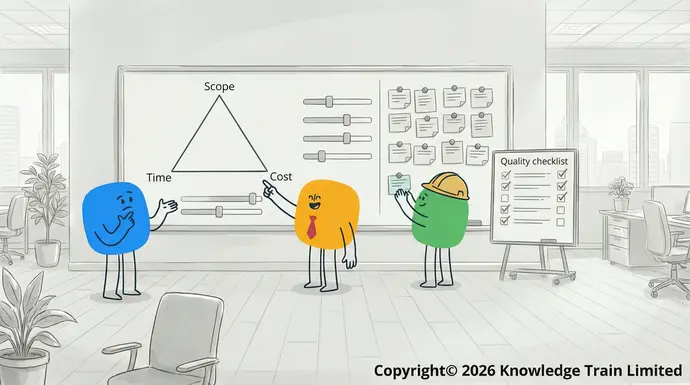
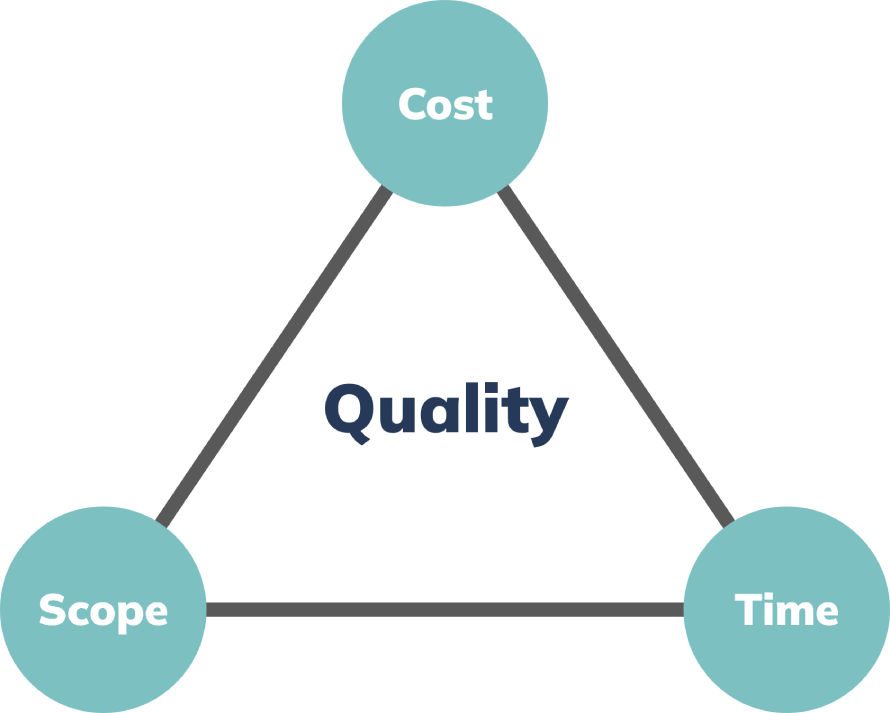
Maintaining the balance of the project management triangle requires strategic decisions and careful trade-offs between scope, time, and cost. Here are some tips to help: continuous improvement
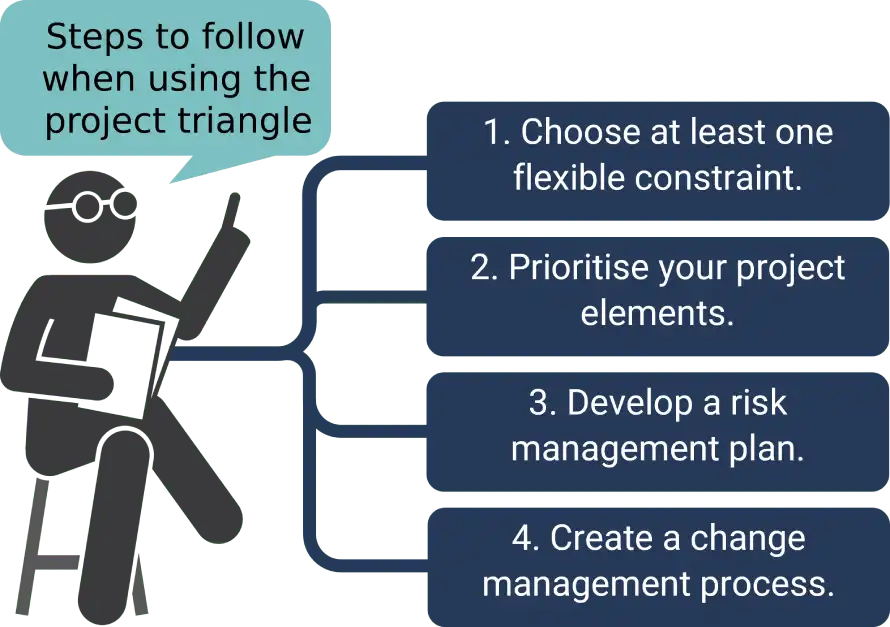
Choose at least one flexible constraint Sevcan Yasa{"@context":"https://schema.org","@graph":[{"@type":"WebPage","name":"What is a Project Management Office (PMO)? Roles, Types & Benefits","url":"https://www.knowledgetrain.co.uk/project-management/pmo","description":"Discover what a PMO is, its roles, types and benefits. Learn about PMO functions, standards and how PMOs support project success, with real-world examples.","significantLink":"https://en.wikipedia.org/wiki/Project_management_office","mainEntity":[{"@type":"Article","headline":"What is a Project Management Office (PMO)? Roles, Types & Benefits","about":[{"@type":"DefinedTerm","name":"Project Management Office (PMO)","sameAs":["https://en.wikipedia.org/wiki/Project_management_office","https://www.google.com/search?&kgmid=/m/01k6sk","https://www.wikidata.org/wiki/Q7302704"]},{"@type":"DefinedTerm","name":"Project Manager","sameAs":["https://en.wikipedia.org/wiki/Project_manager","https://www.google.com/search?&kgmid=/m/02y_w9","https://www.wikidata.org/wiki/Q7243378"]},{"@type":"DefinedTerm","name":"Project Portfolio","sameAs":["https://en.wikipedia.org/wiki/Project_portfolio_management","https://www.google.com/search?&kgmid=/m/0l1218y","https://www.wikidata.org/wiki/Q7226149"]},{"@type":"DefinedTerm","name":"Governance","sameAs":["https://en.wikipedia.org/wiki/Governance","https://www.google.com/search?&kgmid=/m/02vs1j","https://www.wikidata.org/wiki/Q1234823"]},{"@type":"DefinedTerm","name":"Supportive PMO","sameAs":["https://en.wikipedia.org/wiki/Project_management_office","https://www.google.com/search?&kgmid=/g/12hs3rl7x","https://www.wikidata.org/wiki/Q7302704"]},{"@type":"DefinedTerm","name":"Controlling PMO","sameAs":["https://en.wikipedia.org/wiki/Project_management_office","https://www.google.com/search?&kgmid=/g/1234testcontrol","https://www.wikidata.org/wiki/Q7302704"]},{"@type":"DefinedTerm","name":"Directive PMO","sameAs":["https://en.wikipedia.org/wiki/Project_management_office","https://www.google.com/search?&kgmid=/g/1234testdirect","https://www.wikidata.org/wiki/Q7302704"]},{"@type":"DefinedTerm","name":"Project Methodology","sameAs":["https://en.wikipedia.org/wiki/Project_management","https://www.google.com/search?&kgmid=/m/06c1s","https://www.wikidata.org/wiki/Q167067"]},{"@type":"DefinedTerm","name":"Stakeholders","sameAs":["https://en.wikipedia.org/wiki/Stakeholder_(corporate)","https://www.google.com/search?&kgmid=/m/025kcl","https://www.wikidata.org/wiki/Q745782"]},{"@type":"DefinedTerm","name":"PMI (Project Management Institute)","sameAs":["https://en.wikipedia.org/wiki/Project_Management_Institute","https://www.google.com/search?&kgmid=/m/04gjjn","https://www.wikidata.org/wiki/Q662929"]},{"@type":"DefinedTerm","name":"Portfolio Management","sameAs":["https://en.wikipedia.org/wiki/Project_portfolio_management","https://www.google.com/search?&kgmid=/m/0l1218y","https://www.wikidata.org/wiki/Q7226149"]},{"@type":"DefinedTerm","name":"Program Management","sameAs":["https://en.wikipedia.org/wiki/Program_management","https://www.google.com/search?&kgmid=/m/0405ykd","https://www.wikidata.org/wiki/Q7243378"]},{"@type":"DefinedTerm","name":"Best Practices","sameAs":["https://en.wikipedia.org/wiki/Best_practice","https://www.google.com/search?&kgmid=/m/01k6kd","https://www.wikidata.org/wiki/Q5369514"]},{"@type":"DefinedTerm","name":"PMO Tools","sameAs":["https://en.wikipedia.org/wiki/List_of_project_management_software","https://www.google.com/search?&kgmid=/g/11g_zdl9y8","https://www.wikidata.org/wiki/Q2142039"]},{"@type":"DefinedTerm","name":"Resource Management","sameAs":["https://en.wikipedia.org/wiki/Resource_management","https://www.google.com/search?&kgmid=/m/020lg1","https://www.wikidata.org/wiki/Q133134"]},{"@type":"DefinedTerm","name":"Standards","sameAs":["https://en.wikipedia.org/wiki/Standardization","https://www.google.com/search?&kgmid=/m/012n6","https://www.wikidata.org/wiki/Q229098"]},{"@type":"DefinedTerm","name":"Process Improvement","sameAs":["https://en.wikipedia.org/wiki/Process_improvement","https://www.google.com/search?&kgmid=/m/0c4fl6","https://www.wikidata.org/wiki/Q6193052"]},{"@type":"DefinedTerm","name":"Project Lifecycle","sameAs":["https://en.wikipedia.org/wiki/Project_life_cycle","https://www.google.com/search?&kgmid=/m/068n_j","https://www.wikidata.org/wiki/Q7243474"]},{"@type":"DefinedTerm","name":"PMO Certification","sameAs":["https://www.pmi.org/certifications","https://www.google.com/search?&kgmid=/g/11f63n5_7f","https://www.wikidata.org/wiki/Q662929"]},{"@type":"DefinedTerm","name":"Change Management","sameAs":["https://en.wikipedia.org/wiki/Change_management","https://www.google.com/search?&kgmid=/m/01jps2","https://www.wikidata.org/wiki/Q609056"]}],"mentions":[{"@type":"DefinedTerm","name":"Organizational Structure","sameAs":["https://en.wikipedia.org/wiki/Organizational_structure","https://www.google.com/search?&kgmid=/m/09gyp","https://www.wikidata.org/wiki/Q853035"]},{"@type":"DefinedTerm","name":"Project Management","sameAs":["https://en.wikipedia.org/wiki/Project_management","https://www.google.com/search?&kgmid=/m/06c1s","https://www.wikidata.org/wiki/Q167067"]}]},{"@type":"FAQPage","mainEntity":[{"@type":"Question","name":"Can a PMO be one person?","acceptedAnswer":{"@type":"Answer","text":" when working with the project triangle.
One constraint should be identified as more flexible than the others. This allows some wiggle room when dealing with changes or issues. Ask yourself: 19 Feb 2026p>Yes, a Project Management Office (PMO) can consist of just one person. In smaller organisations or teams, a single PMO professional may handle essential functions such as tracking project performance, standardising documentation, and supporting Project Managers.Review the project after completion to determine lessons learned
- Which constraint is easiest or least impactful to change?Manage Consent >Evaluate what worked and didn’t work for finding the balance between the constraints
- Are stakeholders willing to adjust scope, extend deadlines, or increase budget if necessary? In this video, Elizabeth Moon describes her experience of taking a PRINCE2 Foundation and Practitioner course with Knowledge Train.p>Although capacity is limited, even a one-person PMO can significantly improve project consistency and governance by establishing clear standards and frameworks.Promote team members to share ideas for process improvements
- How will increased flexibility in one constraint impact the other two?To provide the best experiences, we use technologies like cookies to store and/or access device information. Consenting to these technologies will allow us to process data such as browsing behavior or unique IDs on this site. Not consenting or withdrawing consent, may adversely affect certain features and functions. >"}},{"@type":"Question","name":"How does a PMO add value?","acceptedAnswer":{"@type":"Answer","text":"Stay updated on emerging project management methodologies and tools.
Identifying a flexible constraint up-front allows for better risk management and issue resolution. p>A PMO adds value by improving project success rates, optimising resource allocation, and ensuring projects align with organisational objectives. It also enhances communication across teams, enforces compliance with methodologies, and provides transparency on project performance through dashboards and reporting.Incorporating these best practices can help project managers to learn the project management triangle. However, success will depend on dedication, flexibility, and the ability to learn from both successes and failures.
Prioritise features and requirements >Applying the project management triangle
It is important to carefully evaluate the importance of each project deliverable. This will help you focus on what is essential to project success. Create a comprehensive list of features and requirements, then: p>Ultimately, a well-functioning PMO ensures that project investments deliver measurable business benefits.To help us see how we can do this, it’s worth looking at some examples of best practice in real-world situations. We will take three case studies below and see how things were managed in each of them.
- Rank or score each based on value and importance >"}},{"@type":"Question","name":"Is PMO a stressful job?","acceptedAnswer":{"@type":"Answer","text":"Large-scale IT project
- Clearly define “must-have” vs. “nice-to-have” featuresFunctional p>Whether a PMO role is stressful depends on the organisation’s structure and culture. When supported by leadership and empowered to influence project decisions, PMO professionals typically thrive. However, if the PMO is under-resourced or lacks authority, managing multiple priorities without visible impact can create pressure and stress.A global corporation launched a
- Leverage prioritisation to inform trade-off decisions. >worldwide ERP implementation
This prioritisation process allows for objective trade-off discussions if needed. PRINCE2 vs Agile or PRINCE2 Agile?p>Strong governance, clear goals, and management support help minimise stress and enable PMO teams to work effectively.. The Project Manager in this case struggled to ensure the best balance between the different project triangle dimensions.
Develop a risk management plan >"}},{"@type":"Question","name":"What are the 4 P’s of PMO?","acceptedAnswer":{"@type":"Answer","text":"Key measures include prioritised the most important core functionalities to manage scope, implemented a phased rollout to manage time and cost constraints, and utilised change management processes to assess and evaluate new requirements.
Proactively identifying and managing risks will help avoid imbalances in the triangle. A Simon Buehringp>The 4 P’s of a PMO are Resultrisk managementFunctional19 Feb 2026strong>People, Product, Process,: The project delivered under budget, with minimal impact on time, and fulfilled all essential business requirements. plan > and Construction project should include: Always active Confused between PRINCE2, Agile, or PRINCE2 Agile? Discover their distinctions and how they can be effectively combined in projects by reading on.strong>ProjectA commercial
- Identification of risks that could impact any of the constraints >:skyscraper building construction
- Risk scoring based on probability and impact > project faced unexpected geological conditions which created a major risk to the project triangle.
- Detailed contingency plans for high-priority risks ul>Key measures include reallocated budget from non-essential features to resolve foundation issues, accelerated other construction phases to make up for initial delays, and negotiated with stakeholders to adjust project scope without compromising quality.
- A monitoring process to reassess risks throughout the project. li>Result
Risk management strong>People:: The building was completed safely, with a minor delay and a slight increase in the budget. ensures prevention of imbalances before they happen. > Define clear roles and responsibilities for the project team.Product development initiative
Create a change management planThe technical storage or access is strictly necessary for the legitimate purpose of enabling the use of a specific service explicitly requested by the subscriber or user, or for the sole purpose of carrying out the transmission of a communication over an electronic communications network. >A tech startup wanted to launch a
Change is inevitable on projects. A Project management stepsli>new software productchange management plan strong>Product: in a highly competitive market, but it struggled to strike the right balance between innovation and the pressure to get the product to market in time. provides a process for considering how changes impact the constraints. A plan should include: Knowledge Train> Ensure the right deliverables reach the right stakeholders.Key measures include employed an
- A system for submitting, reviewing, and approving changes 19 Feb 2026>Agile
- Procedures for assessing change impact on each constraintPreferences li>methodology
- Approval thresholds based on change type and size Project management is crucial for success. Discover the essential phases and elevate your skills to ensure projects from start to finish deliver exceptional outcomes.strong>Process: to manage scope flexibly, focused on developing a Minimum Viable Product (MVP) for the initial release and utilised customer feedback to prioritise further feature development after launch.
- Communication plans for approved changes > Implement consistent procedures to manage and control delivery.Result
A structured change management process helps to prevent imbalances. >: The product was able to be launched in time, within the budget, and has gained a high level of market share quickly due to its core functionality and the improvements that have been iteratively made since the launch.
Match management methodology to priority constraintsPreferences li>These examples illustrate successful applications of the project triangle in diverse industries and projects. They show how effective management of scope, time, and cost can overcome challenges and deliver value.
The project management methodology used should complement the project’s constraints. Consider: strong>Project:Enhance your skills with our expert-led courses
- <
- < > Takes direct ownership of project delivery and management.PRINCE2 Foundation exam mock questions
- > >Simon Buehring
- p>Each type varies in authority and responsibility, depending on organisational needs and project complexity.19 Feb 2026 >"}},{"@type":"Question","name":"What does a PMO do?","acceptedAnswer":{"@type":"Answer","text":" p>A PMO establishes and maintains project management standards across the organisation. It supports Project Managers, ensures project governance, and aligns initiatives with business goals. The PMO often oversees project portfolios to prioritise strategic investments and optimise resource use.Access a full PRINCE2 Foundation exam sample for free. Perfect for assessing your readiness for the actual exam. >"}},{"@type":"Question","name":"What does PMO stand for?","acceptedAnswer":{"@type":"Answer","text":"
The technical storage or access that is used exclusively for statistical purposes.p>
strong>PMO
- The technical storage or access that is used exclusively for anonymous statistical purposes. Without a subpoena, voluntary compliance on the part of your Internet Service Provider, or additional records from a third party, information stored or retrieved for this purpose alone cannot usually be used to identify you.> stands for Project Management Office. It is an organisational function responsible for standardising governance processes, sharing methodologies, tools, and techniques, and improving overall project success. >
- p>A PMO may vary in size—from a single individual to an enterprise-wide team—but its purpose remains the same: to improve project performance and ensure alignment with business strategy. >"}},{"@type":"Question","name":"What is the difference between a PMO and a Project Manager?","acceptedAnswer":{"@type":"Answer","text":"
- p>The difference between a PMO and a Project Manager lies in scope and responsibility. A Project Manager delivers specific projects, managing budgets, timelines, and teams. The PMO, however, provides governance, guidance, and support to multiple projects, ensuring consistency and strategic alignment across the organisation. >"}},{"@type":"Question","name":"What is the purpose of a PMO?","acceptedAnswer":{"@type":"Answer","text":"
- Marketingp>The primary purpose of a PMO is to introduce structure, consistency, and strategic alignment to project management practices. By standardising processes and methodologies, a PMO helps organisations improve project success rates and realise greater value from project investments. >"}}]}]}]}
Related articles
- Marketing
The technical storage or access is required to create user profiles to send advertising, or to track the user on a website or across several websites for similar marketing purposes.
- Manage options Manage services
- Manage {vendor_count} vendors Read more about these purposesDeveloping your project management career
- AcceptSimon Buehring
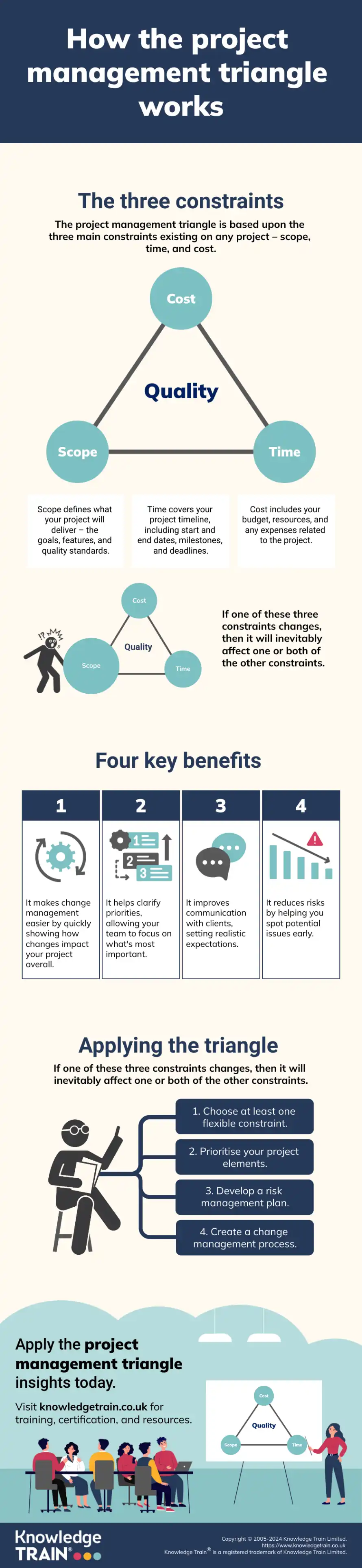
- 19 Feb 2026{"@context":"https://schema.org","@type":"ImageObject","contentUrl":"https://www.knowledgetrain.co.uk/training-courses/project-management-triangle-infographic-v1.0.webp ","description":"Project management triangle infographic","license":"https://www.knowledgetrain.co.uk/license","acquireLicensePage":"https://www.knowledgetrain.co.uk/license","creditText":"Knowledge Train","uploadDate":"2024-10-14T09:00:28.000Z","copyrightNotice":"© 2024 Knowledge Train Limited. All rights reserved.","creator":{"@type":"Organization","name":"Knowledge Train","url":"https://www.knowledgetrain.co.uk"}}
Give us a call +44 (0)207 148 5985
What is the iron triangle in project management?PRINCE2 courseFinance FAQs
The iron triangle is another name for the project management triangle, emphasising the importance of balancing scope, time, and cost. , or an Contact
How does changing one constraint affect the others in the project management triangle? agile project management courseCookies
Changing one constraint typically impacts the other two, requiring adjustments to maintain balance and quality. to boost your career. Privacy
Can the project management triangle be applied to all types of projects?The technical storage or access is required to create user profiles to send advertising, or to track the user on a website or across several websites for similar marketing purposes.PRINCE2Terms
Yes, the project management triangle is a versatile concept that can be applied to various industries and projects. ®Customer Support
What are some signs that a project’s constraints are out of balance?Manage options, MSP
Signs of imbalance may include frequent scope changes, missed deadlines, budget overruns or quality issues.Manage services®[email protected]
How often should project managers review and adjust the project management triangle?Manage {vendor_count} vendorsJoin Our Team, ITIL
Regular reviews are crucial, especially at significant milestones or when major changes occur.Read more about these purposes ®