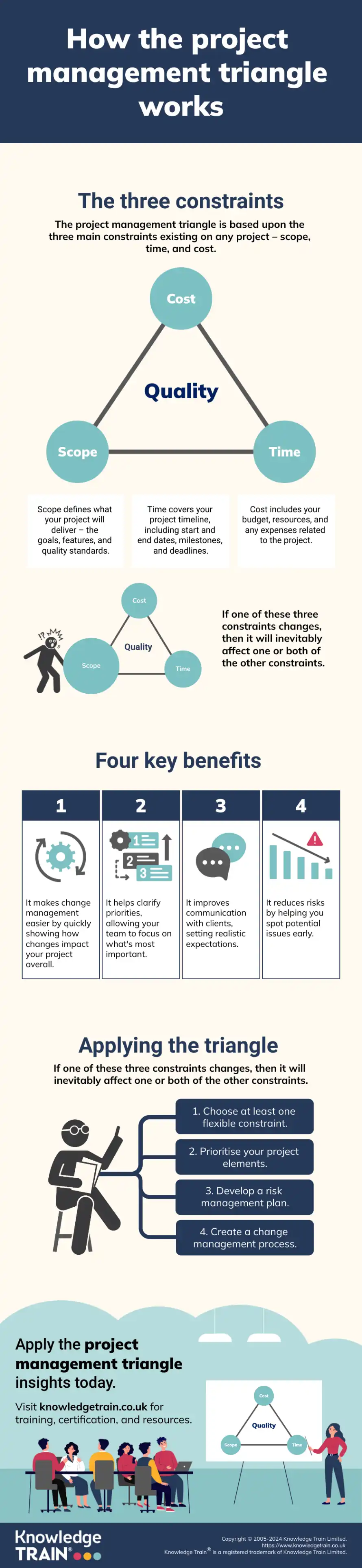
Scope, time and cost move together, so every change needs a conscious trade-off. Apply CPM and PERT to identify critical work, quantify schedule risk, and test scenarios.
- Any shift in scope, schedule, or budget typically forces an adjustment in at least one other constraint. Use Kanban to manage flow, limit work in progress, and surface blockers early.
- Imbalances often show up as rushed work, under-resourcing, or overambitious deliverables that reduce quality. Prioritise uncertainty with a risk matrix and stakeholder mapping to guide action and communication.
- Pick at least one flexible constraint early so you can respond to issues without losing control. Track delivery health with EVM and cost-benefit analysis to support timely, evidence-based decisions.
- Use prioritisation and formal change control to prevent scope creep and keep decisions objective.Search
- Monitor risks and progress continuously, and communicate trade-offs clearly to stakeholders.
Introduction Other countriesProject planning and visualisation
The Common challenges and solutionsHomeWork Breakdown Structure (WBS)project management triangle Project ManagementThe , also known as the triple constraint model, is a concept that visualises the constraints of Project management techniquesProject management triangle best practicesWork Breakdown Structurescope (WBS) is a project management technique that involves breaking down a project into smaller, more manageable components. It is a hierarchical decomposition of the total scope of work and provides a visual representation of all the tasks required to complete a project., {"@context":"http://schema.org","@type":"BreadcrumbList","itemListElement":[{"@type":"ListItem","position":1,"name":"Home","item":"https://www.knowledgetrain.co.uk/"},{"@type":"ListItem","position":2,"name":"Project Management","item":"https://www.knowledgetrain.co.uk/project-management"},{"@type":"ListItem","position":3,"name":"Project management techniques","item":"https://www.knowledgetrain.co.uk/project-management/project-management-techniques"}]}Applying the project management triangleThe essence of a WBS is to break down the final deliverable into smaller, more manageable components called work packages. It starts with the final deliverable at the top and is subdivided in a tree structure, where each level of detail represents an increasingly granular level of the project components. These components are typically organised into phases, deliverables, and work packages. By definition, WBS becomes more detailed as you go deeper into the tree. In time project management, and Conclusion , WBS is used to:cost Define and organise the total scope of a project in 11 essential project management techniquesFAQsEnsure all the work required is included, and nothing outside the scope is addedproject management Create a foundation for estimating costs, duration, and resources. It highlights the interconnected nature of these three aspects in delivering a successful project.InfographicKnowledge TrainAssign responsibilities to team members
Introduction19 Feb 2026The project management triangle
, also known as the triple constraint model, is a concept that visualises the constraints of
scope , time
, and
cost
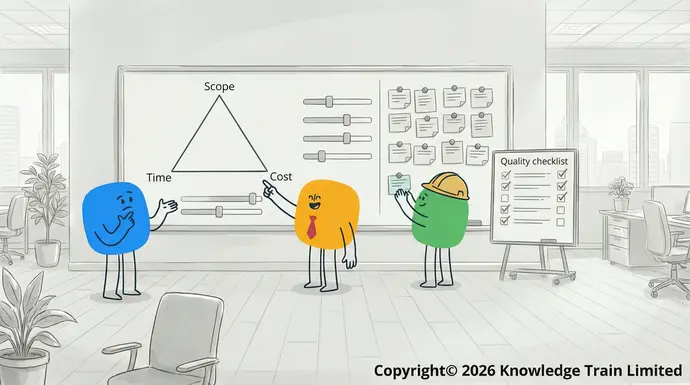
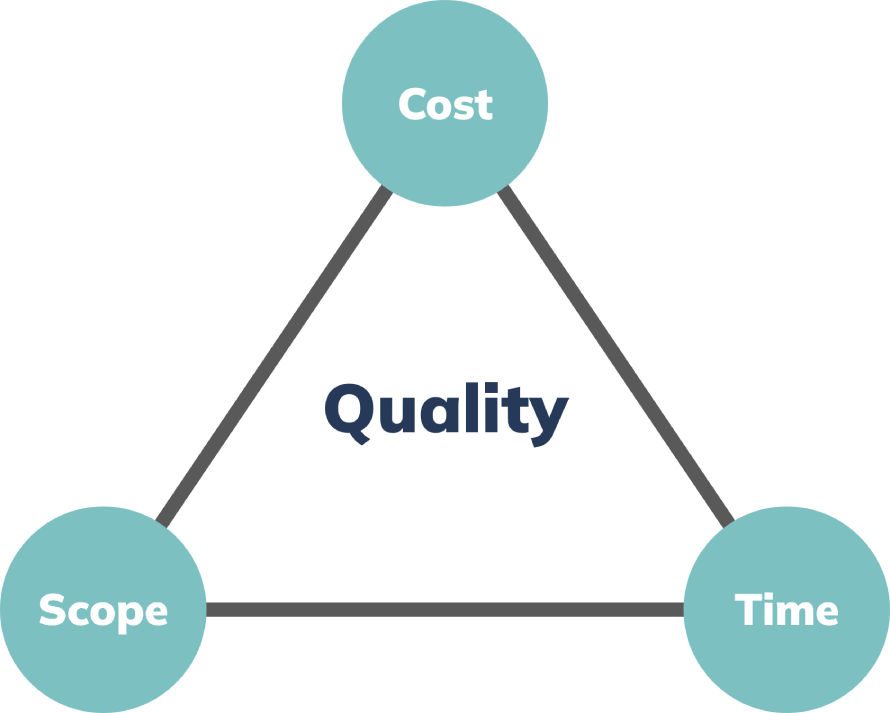
in project management . It highlights the interconnected nature of these three aspects in delivering a successful project. The triangle model is a crucial tool for project managers to understand and balance the competing demands of a project . The scope refers to the project’s requirements, objectives, and deliverables. Time refers to the schedule and deadlines. Cost encompasses the budget and resources. The challenge is to optimise all three to meet project goals. Each corner of the triangle is dependent on the other two. A change in one element typically results in a change in at least one other. By understanding and managing these constraints, project teams can make informed decisions and adjustments to ensure project success.
- The project management triangle is a fundamental concept that helps project managers
- visualise and optimise the key constraints of any project. By balancing scope, time, and cost, project teams can deliver successful outcomes that meet stakeholder expectations. Understanding the project management triangle
- The three constraints explained The project management triangle is made up of three main constraints:
scopeCopied!
, Key takeaways
timeStrong delivery comes from choosing and combining techniques that fit your project’s uncertainty, scale, and stakeholders. and Use a Work Breakdown Structure to define scope clearly and create reliable estimates and ownership.
costUse Gantt charts and network diagrams to visualise sequencing, dependencies, and progress.
. Let’s have a detailed look at each of these.Apply CPM and PERT to identify critical work, quantify schedule risk, and test scenarios.ScopeUse Kanban to manage flow, limit work in progress, and surface blockers early.: Scope refers to the boundaries, objectives and deliverables of a project. It includes the goals and requirements of the project, as well as the specific features, functionalities and quality standards.Prioritise uncertainty with a risk matrix and stakeholder mapping to guide action and communication.
- TimeTrack delivery health with EVM and cost-benefit analysis to support timely, evidence-based decisions.
- : The time constraint of a project refers to its duration and schedule. It involves factors such as the project start and end dates, milestones and deadlines, as well as the sequencing and dependencies of tasks.
- Cost
: The cost constraint relates to the financial and resource aspects of a project. This includes the budget allocated to the project as well as the human resources and labour costs, and equipment and material expenses. Relationship between constraintsContentsThe three constraints of scope, time and cost are interconnected and can impact each other. Changes to one constraint will likely influence the other constraints. For example, an increase in scope will often require additional time and resources, whereas a reduction in time may increase costs or decrease scope. Similarly, a reduction in budget may affect the project scope or timeline.
Project managers
must carefully balance these constraints throughout the project lifecycle.Contents
Impact on project quality
The balance of scope, time and cost also has an impact on the Introduction to project management techniquesquality of the project outcomes. If the three constraints are well-balanced, the project is more likely to achieve high-quality results. On the other hand, if there is an imbalance in any of the constraints, the quality of the project may be compromised. For example:Project planning and visualisation
A tight deadline may lead to a rushed project, resulting in lower quality outputs.
A limited budget may result in a project being understaffed or under-resourced, which may also affect quality.Scheduling and time managementA project with an overambitious scope can strain resources and time, leading to poor results. Successful project management involves finding the right balance and making trade-offs between the three constraints while maintaining the desired level of quality. By understanding the impact of these constraints on each other, project managers can make informed decisions to lead the Risk and stakeholder management
project
to a successful outcome.Financial and resource managementBenefits of using the project management triangle Utilising the project management triangle provides some distinct benefits to the project team and stakeholders. These are as follows.Conclusion
Easier change management
The triangle model helps to FAQsmake changes easier . This is because if a change arises, the project managers can easily evaluate how this change will affect the scope, time and cost, decide, as such it helps to quickly evaluate a change request, understand the ripple effects, and make an informed decision on change.Infographic
Priority clarificationIntroduction to project management techniquesVisualising the three constraints helps to Project management techniques have become an essential aspect of modern businesses, allowing organisations to achieve their objectives, meet deadlines, and deliver value to their stakeholders. These techniques refer to the tools and methodologies that project managers and teams use to plan, execute, and control projects efficiently. clarify prioritiesProject management techniques
£499 +vatDevelop a
project schedule
See all dates and budget.
Developing a
- WBS
- typically requires input from the project team and stakeholders to ensure it is comprehensive and accurate. A WBS is usually presented as a tree diagram or outline, with each level representing an increased level of detail and each item on the same level representing a similar type of work. Note that the term ‘tree’ is used by many software systems and it is not necessarily drawn as a tree.
- Instructor-ledA WBS becomes the foundation for other
Project Management Essentialsproject management processes
, including risk assessment, task assignments, and progress tracking. It helps the project team to provide a common structure for the whole project, and other details and activities are based on the work breakdown structure.
It is important to carefully evaluate the importance of each project deliverable. This will help you focus on what is essential to project success. Create a comprehensive list of features and requirements, then:£999 +vatGantt charts
- Gantt charts
- See all dates are one of the most widely used and recognised project management techniques. They provide a visual timeline for the project and can display the relationships and dependencies between different tasks or activities. Gantt charts have a long history, with their use dating back to the early 1900s when they were popularised by Henry Gantt, a mechanical engineer and management consultant. In recent years, Gantt charts have transitioned from physical, hand-drawn charts to digital project management tools.
- Managing the project management triangleA Gantt chart typically consists of a horizontal bar chart with the project tasks listed on the vertical axis on the left side and the time periods spread across the top. The project tasks are then represented by horizontal bars spanning the time periods in which they are scheduled to be performed. The length of the bar indicates the duration of each task. This format allows
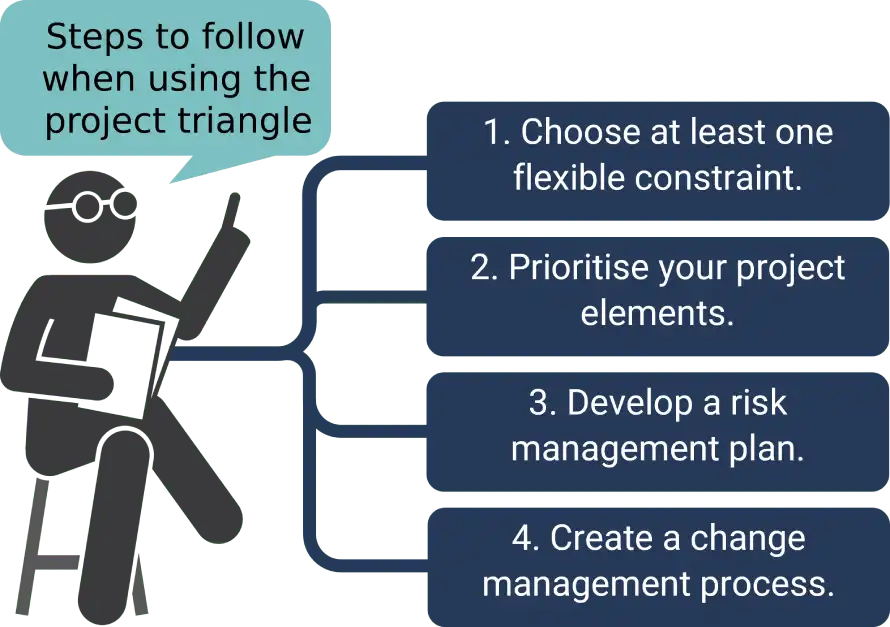
Maintaining the balance of the project management triangle requires strategic decisions and careful trade-offs between scope, time, and cost. Here are some tips to help:project managers
Choose at least one flexible constraint and team members to:
One constraint should be identified as more flexible than the others. This allows some wiggle room when dealing with changes or issues. Ask yourself:Clearly visualise the project timeline and the duration of each taskWhich constraint is easiest or least impactful to change?Identify dependencies and relationships between tasksAre stakeholders willing to adjust scope, extend deadlines, or increase budget if necessary?Track progress against the planned scheduleHow will increased flexibility in one constraint impact the other two?Allocate resources to tasks
- Identifying a flexible constraint up-front allows for better risk management and issue resolution.Communicate the project timelines to stakeholders.
- Prioritise features and requirementsSome modern Gantt chart software provides additional features such as colour-coding of tasks, milestone markers, and linking of dependent tasks. Some tools also allow for resource allocation and workload management directly from the Gantt view.
- It is important to carefully evaluate the importance of each project deliverable. This will help you focus on what is essential to project success. Create a comprehensive list of features and requirements, then:Gantt charts are most useful when you want to provide an overview of the entire project. However, for large and complex projects, they may become cluttered and difficult to read. Despite this, Gantt charts remain a popular tool for project managers because of their intuitive design and ability to communicate complex scheduling information quickly and clearly.
- Rank or score each based on value and importanceProject network diagrams
Clearly define “must-have” vs. “nice-to-have” featuresProject Network DiagramsLeverage prioritisation to inform trade-off decisions., as the name implies, are graphical representations of a project’s tasks and their relationships, showing how the project activities are sequenced and interrelated. These diagrams provide a visual depiction of the project flow and are commonly used in project management methodologies that include Critical Path Method (CPM) and Program Evaluation and Review Technique (PERT).
This prioritisation process allows for objective trade-off discussions if needed.Network diagrams typically use nodes to represent tasks or activities and arrows to indicate dependencies between these tasks. They allow for a clear visualisation of task sequences and can help project managers identify potential bottlenecks or critical paths in the
Develop a risk management planproject scheduleProactively identifying and managing risks will help avoid imbalances in the triangle. A .risk managementKey takeaways
- planVisual representation of task dependencies
- should include:Identify critical path and potential schedule risks
- Identification of risks that could impact any of the constraintsFacilitate resource allocation and schedule optimisation.
- Risk scoring based on probability and impactQuick tips
Detailed contingency plans for high-priority risksBegin with a clear list of all project tasks and their dependencies.
A monitoring process to reassess risks throughout the project.Use software tools for easy creation and updating of network diagrams.
Risk managementRegularly review and update the diagram as the project progresses.
- ensures prevention of imbalances before they happen.Utilise color-coding to highlight critical paths or high-risk activities.Create a change management planCommon pitfalls
- Change is inevitable on projects. A Overlooking important task dependencies.change management planCreating overly complex diagrams that are difficult to understand.
- provides a process for considering how changes impact the constraints. A plan should include:Failing to update the diagram as project scope or timelines change.A system for submitting, reviewing, and approving changesNeglecting to consider resource constraints when analysing the network.
Procedures for assessing change impact on each constraintBy learning project network diagrams, managers can enhance their ability to plan, schedule, and control complex projects effectively.
Approval thresholds based on change type and sizeEnhance your skills with our expert-led courses
Communication plans for approved changes
A structured change management process helps to prevent imbalances.
Match management methodology to priority constraints
The project management methodology used should complement the project’s constraints. Consider:Self-paced
- Waterfall methodologiesAPM PFQ blended online like traditional or predictive project management focus on upfront planning and are best suited for fixed-scope projects where time and cost can be more flexible.
- Agile methodologies£749 +vatLean approaches
- prioritise efficiency and cost control and are useful when budget is the main constraint.Choosing the right approach from the beginning aligns with the key constraints.
- Follow the tips above to help manage the project management triangle and balance constraints throughout your project. The most important thing is to continuously monitor and maintain alignment of the three sides. Assess the status of scope, time, and cost regularly to identify imbalances. Be willing to make informed decisions and trade-offs as necessary. And communicate clearly with stakeholders about any changes to plans or constraints.Strategies for balancing constraintsManaging constraints effectively requires specific strategies for each side of the project management triangle. Here are some tips for balancing scope, time, cost and quality:Scope management techniques
When managing project scope, you can try these tips:
Define project boundaries
- : Clearly outline the scope of the project and its deliverables at the beginning.Scope change control
- : Establish a process for handling changes to
- Time management approachesWhen managing project time, you can try these tips:
- Critical path: Identify the tasks that must be completed on time for the project to stay on schedule.
- Resource leveling: Optimise the use of resources to avoid overloading or underutilisation.
- Timeboxing: Set a fixed time period for specific tasks or project phases.
Agile sprints
: Break the project into short, focused work cycles with specific goals.
- Cost control methodsWhen managing project cost, you can try these tips:
- Earned value management: Track the project’s progress in relation to its budget and schedule.
- Cost baseline: Create a detailed budget for each phase of the project.
- Forecasting: Regularly estimate the future costs of the project based on current performance and trends.
Vendor management
: Negotiate favourable terms and monitor supplier costs.
Quality assurance practices
When managing project quality, you can try these tips:
- Quality standards: Define specific, measurable quality criteria for the project deliverables.
- Continuous testing: Implement regular quality checks throughout the project lifecycle.
- Peer review: Leverage the expertise of team members to identify and address quality issues.Customer feedback: Regularly collect and incorporate stakeholder feedback on project deliverables.
Through the implementation of these methods, project managers can successfully navigate and mitigate trade-offs between the competing constraints of scope, time, cost, and quality. However, it is important to note that constraint management is an iterative process that necessitates continuous monitoring and adjustment in response to changing project dynamics.
Tools for managing the project management triangle
- Software can help you keep track of the project management triangle and ensure your project management is top-notch. Here are some of the best project management software to consider:Project management software options
- Monday.com: A flexible platform suitable for multiple project types and management styles. With Visual boards for easy task tracking and prioritisation, it’s one of the best software for project management, and it also has customisable workflows for specific project requirements.
- ClickUp: A feature-rich tool with robust Agile project support and time tracking and resource management features. ClickUp also provides multiple view options (list, board, Gantt, calendar) to cater to different preferences and project needs.
- Teamwork: A client-focused platform designed for team collaboration. It has a budget and expense tracking features, as well as
- risk management and issue tracking tools for comprehensive project management.
- Key features to look for in project management toolsWhen choosing a project management tool, consider these vital features and capabilities:
- Constraint tracking: The ability to track and manage scope, time and cost constraints concurrently
Resource allocation
£499 +vat
See all dates
- Instructor-ledProbability: The chance of a risk happening (typically rated as low, medium, high)
- Project Management EssentialsImpact: The severity of the outcome if the risk occurs (usually ranked from minor to major)
- Risk score: A value obtained by multiplying the probability and impact assessments.
£999 +vatAdvantages of employing a Risk Management Matrix:
Facilitates a clear, visual summary of potential project risks.See all datesAssists in prioritising risk responses.Common challenges and solutionsImproves risk communication with stakeholders.
Scope creepAids in making more informed decisions.
- Scope creepTips for effective use:
- involves changes or expansion in the project’s scope after it has already started. This can lead to an increase in resources, time, and effort needed to complete the project.Update the matrix regularly as new risks emerge or situations evolve.
- SolutionsEngage the whole project team in risk identification and evaluation.
- Establish a formal change control process to manage scope changes effectively.Formulate specific mitigation or contingency plans for prioritised risks.
Clearly define project scope and requirements during the planning phase.Periodically review and revise risk ratings and assumptions.
Communicate regularly with stakeholders to manage expectations.By systematically identifying, evaluating, and addressing risks, Implement a prioritisation system for new requests and changes.project managers
Time constraints can proactively manage potential challenges and opportunities, thereby enhancing the project’s chances of success.
- Projects often face Stakeholder mapping
- tight deadlinesStakeholder mapping
- , which can put pressure on the team and the quality of work. is a visual technique to analyse and prioritise stakeholders for your project based on their interest, influence, and impact on the project.
- Solutions
Use critical path analysis to identify and focus on essential tasks.Implement time-boxing techniques to improve focus and productivity.Consider parallel processing of tasks where possible.
Negotiate for deadline extensions when necessary.
- Budget limitations
- Limited budgets
- can restrict resources, impacting the project’s scope and quality.
- Solutions
Conduct thorough cost estimation during the planning phase.
Implement earned value management (EVM) to track project cost performance.
Explore cost-effective alternatives for resources.
Prioritise budget allocation for critical project components.
Balancing constraints may sometimes lead to quality issues in deliverables.
- Solutions
- Establish and communicate clear quality standards at the beginning of the project.
- Implement regular quality checks throughout the project lifecycle.
- Involve stakeholders in continuous feedback loops.
Allocate resources for testing and quality assurance processes.
With preparation of ways to address these hurdles, you will be one step closer to coping with the strain on the project management triangle. Keep in mind that this is where some creative strategising can help you maintain control of all these factors. It’s good to frequently ask “how are things going” and be willing to switch things around to keep them in balance.Best practices for implementing the project management triangleBest practices for implementing the project management triangle include the following:
- Regular monitoring and adjustments
- Another important aspect of the project management triangle is
monitoring and adjusting
. Project managers need to keep a close eye on the project and make adjustments as needed to keep it on track. There are several best practices for monitoring and adjusting, including the following:
Review and update the CBA regularly to reflect changes in the project or environment.
Common pitfallsOverlooking or underestimating hidden or long-term costs or benefitsOverestimating the benefits or underestimating the costsNot considering alternative options or the status quoNot accounting for risks and uncertainties.Resource levellingResource levelling is a technique for managing project resources to achieve optimal resource utilisation. It involves adjusting the allocation of resources to tasks so that resource demand does not exceed the available supply. By smoothing out the use of resources, resource levelling can reduce overallocation and idle time.
Key takeaways
Resource levelling can lead to better resource utilisation and increased productivity.
It can help avoid burnout and reduce project risks.
It can help project managers create more realistic
schedules
.
Quick tips
Identify resource constraints early in the project planning process.
Use
project management software
that includes resource levelling capabilities.
Prioritise critical path activities when levelling resources.
Communicate any resource changes to team members and stakeholders.
Common pitfalls
Over-optimising resources at the expense of meeting project deadlines.
Forgetting to account for the skill sets of individual resources when reallocating them.