Project management triangleLearn the fundamentals of the governance framework.

Key takeawaysFoundation
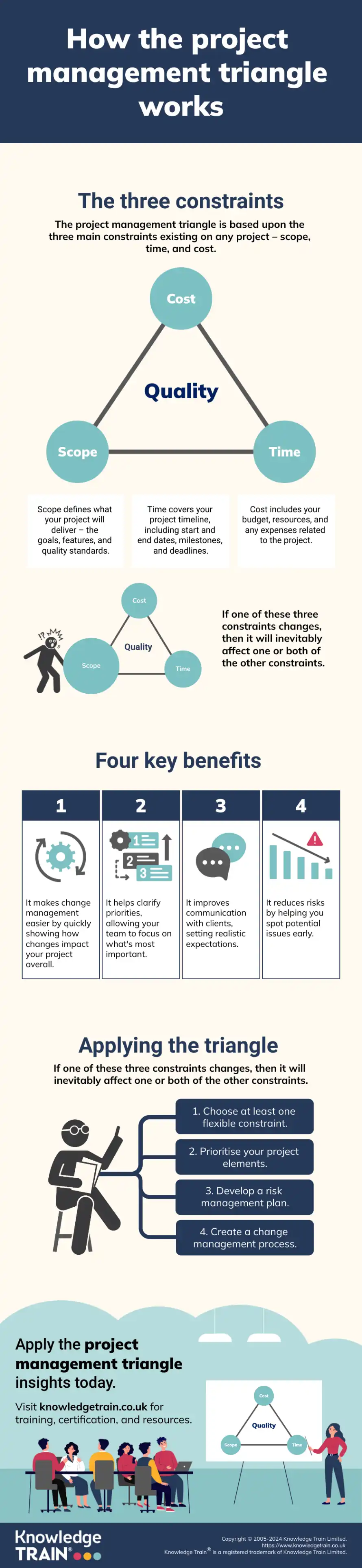
Scope, time and cost move together, so every change needs a conscious trade-off.Learn the fundamentals of artificial intellegence.
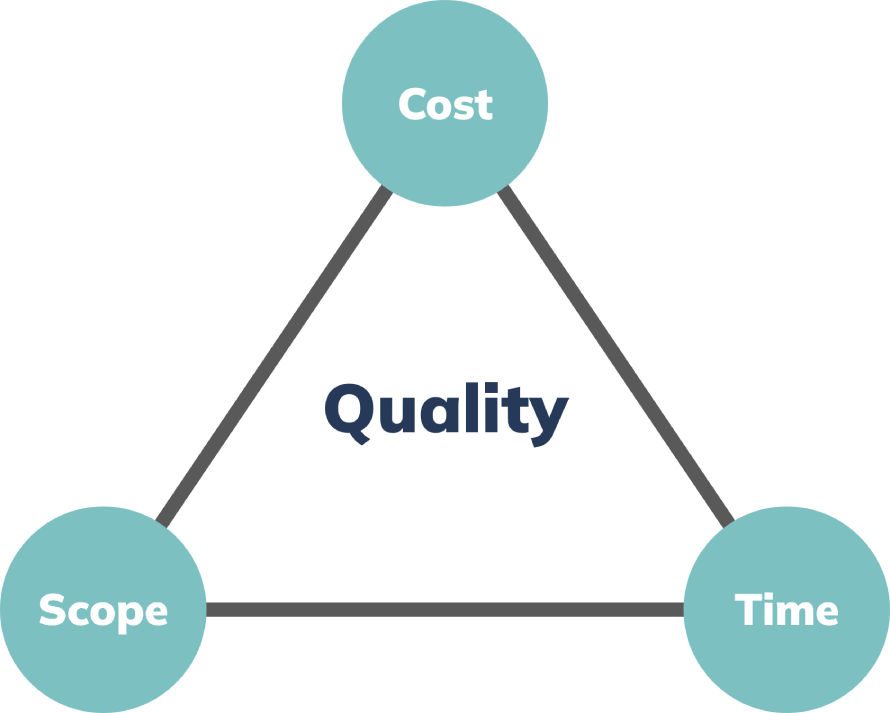
- Any shift in scope, schedule, or budget typically forces an adjustment in at least one other constraint.AI Project Governance Framework (AIPGF)
- Imbalances often show up as rushed work, under-resourcing, or overambitious deliverables that reduce quality.Foundation
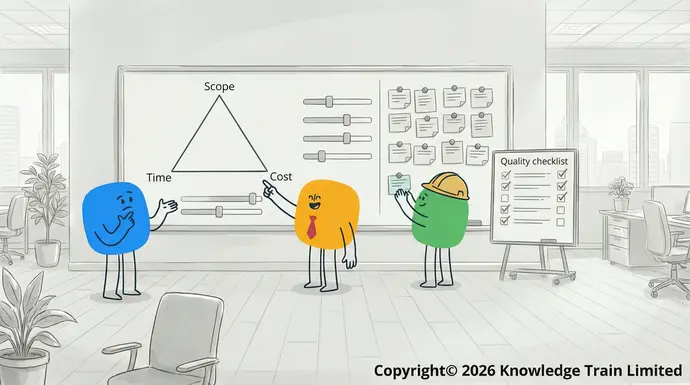
- Pick at least one flexible constraint early so you can respond to issues without losing control.Learn the fundamentals of the governance framework.
- Use prioritisation and formal change control to prevent scope creep and keep decisions objective.Practitioner
- Monitor risks and progress continuously, and communicate trade-offs clearly to stakeholders.Includes Foundation & Practitioner combined option.
. This will make it possible for the team to quickly identify important elements in the project, direct resources to important tasks and make trade-offs as required based on the project goals.
Improved client communication
The triangle is a helpful Specialist: CDS communication tool3-day ITIL Specialist: Create, Deliver and Support (CDS) course. to both communicate with and educate clients. The project managers can use the triangle to show the project’s constraints to the clients, visualise how changes would affect them, and set realistic expectations regarding project deliverables.IT Learning Library (ITLL)™
Risk reductionBUSINESS LEARNING LIBRARY (BLL)™
Utilising the triangle will help in Agile Learning Library (ALL)™managing risksBusiness Analysis Learning Library (BALL)™. This is possible because this will help the team to predict potential problems earlier in the process, have a contingency plan, and balance the risks in all three constraints.Compliance Learning Library (CLL)™
The use of the project management triangle allows for IT Learning Library (ITLL)™managersBusiness solutions to make decisions in a balanced manner. As such, it becomes possible to deal with complex projects with great ease._blank
Managing the project management trianglePRINCE2 AGILE COURSES
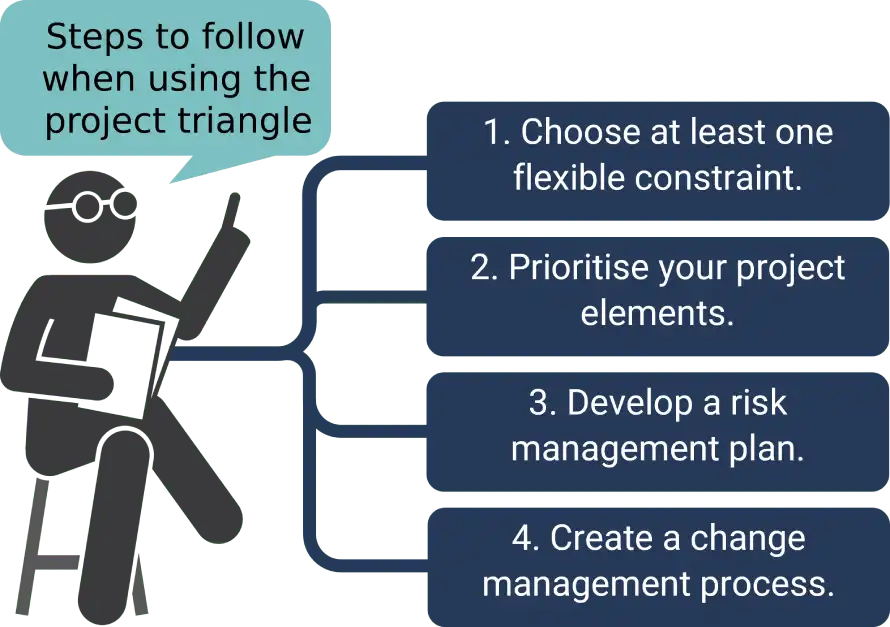
Maintaining the balance of the project management triangle requires strategic decisions and careful trade-offs between scope, time, and cost. Here are some tips to help:Select your preferred training course below:
Choose at least one flexible constraint
One constraint should be identified as more flexible than the others. This allows some wiggle room when dealing with changes or issues. Ask yourself:BETTER BUSINESS CASES COURSES
- Which constraint is easiest or least impactful to change?Select your preferred training course below:
- Are stakeholders willing to adjust scope, extend deadlines, or increase budget if necessary?
- How will increased flexibility in one constraint impact the other two?P3O COURSES
Identifying a flexible constraint up-front allows for better risk management and issue resolution.Select your preferred training course below:
Prioritise features and requirements
It is important to carefully evaluate the importance of each project deliverable. This will help you focus on what is essential to project success. Create a comprehensive list of features and requirements, then:WORKSHOPS
- Rank or score each based on value and importanceSelect your preferred workshop below:
- Clearly define “must-have” vs. “nice-to-have” features
- Leverage prioritisation to inform trade-off decisions.AGILE QUALIFICATIONS
This prioritisation process allows for objective trade-off discussions if needed.Select your preferred qualification.
Develop a risk management plan
Proactively identifying and managing risks will help avoid imbalances in the triangle. A AGILE PROJECT MANAGEMENT COURSESrisk managementSelect your preferred training course below: plan should include:PRINCE2 AGILE COURSES
- Identification of risks that could impact any of the constraintsSelect your preferred training course below:
- Risk scoring based on probability and impact
- Detailed contingency plans for high-priority risksSCRUM COURSES
- A monitoring process to reassess risks throughout the project.Select your preferred training course below:
Risk management ensures prevention of imbalances before they happen.AGILE BUSINESS ANALYSIS COURSES
Create a change management planSelect your preferred training course below:
Change is inevitable on projects. A change management planBUSINESS ANALYSIS QUALIFICATIONS provides a process for considering how changes impact the constraints. A plan should include:Select your preferred qualification.
- A system for submitting, reviewing, and approving changes
- Procedures for assessing change impact on each constraintBCS BUSINESS ANALYSIS COURSES
- Approval thresholds based on change type and sizeSelect your preferred training course below:
- Communication plans for approved changes
A structured change management process helps to prevent imbalances.AGILE BUSINESS ANALYSIS COURSES
Match management methodology to priority constraintsSelect your preferred training course below:
The project management methodology used should complement the project’s constraints. Consider:
- Waterfall methodologiesCHANGE MANAGEMENT QUALIFICATIONS like traditional or predictive project management focus on upfront planning and are best suited for fixed-scope projects where time and cost can be more flexible.Select your preferred qualification.
- Agile methodologies like Scrum or Kanban emphasise iterative development and are best for projects where scope may need to be flexible or change over time.APMG CHANGE MANAGEMENT COURSES
- Lean approachesSelect your preferred training course below: prioritise efficiency and cost control and are useful when budget is the main constraint.
Choosing the right approach from the beginning aligns with the key constraints.PROGRAMME MANAGEMENT QUALIFICATIONS
Follow the tips above to help manage the project management triangle and balance constraints throughout your project. The most important thing is to continuously monitor and maintain alignment of the three sides. Assess the status of scope, time, and cost regularly to identify imbalances. Be willing to make informed decisions and trade-offs as necessary. And communicate clearly with stakeholders about any changes to plans or constraints.Select your preferred qualification.
Strategies for balancing constraints
Managing constraints effectively requires specific strategies for each side of the project management triangle. Here are some tips for balancing scope, time, cost and quality:MSP COURSES
Scope management techniquesSelect your preferred training course below:
When managing project scope, you can try these tips:
- Define project boundariesPMI COURSES: Clearly outline the scope of the project and its deliverables at the beginning.Select your preferred training course below:
- Scope change control the project scope.PRINCE2 COURSES
- Monitor for scope creepSelect your preferred training course below:: Regularly review project requirements to ensure they align with the defined scope.
- PrioritisationAPM COURSES: Use a prioritisation method, such as Select your preferred training course below:MoSCoW , to determine which features are essential, desirable, optional, or not required.AGILE PROJECT MANAGEMENT COURSES
Time management approachesSelect your preferred training course below:
When managing project time, you can try these tips:
- Critical pathPRINCE2 AGILE COURSES: Identify the tasks that must be completed on time for the project to stay on schedule.Select your preferred training course below:
- Resource leveling : Optimise the use of resources to avoid overloading or underutilisation.BUSINESS CASE COURSES
- TimeboxingSelect your preferred training course below:: Set a fixed time period for specific tasks or project phases.
- Agile sprintsAGILE COURSES: Break the project into short, focused work cycles with specific goals.Select your self-paced training course topic.
Cost control methods
When managing project cost, you can try these tips:AGILE PROJECT MANAGEMENT COURSES
- Earned value managementSelect your preferred training course below:: Track the project’s progress in relation to its budget and schedule.
- Cost baselinePRINCE2 AGILE COURSES: Create a detailed budget for each phase of the project.Select your preferred training course below:
- Forecasting : Regularly estimate the future costs of the project based on current performance and trends.SCRUM COURSES
- Vendor managementSelect your preferred training course below:: Negotiate favourable terms and monitor supplier costs.
Quality assurance practicesLEAN SIX SIGMA COURSES
When managing project quality, you can try these tips:Select your preferred training course below:
- Quality standards : Define specific, measurable quality criteria for the project deliverables.BUSINESS ANALYST COURSES
- Continuous testingSelect your self-paced training course topic.: Implement regular quality checks throughout the project lifecycle.
- Peer reviewBCS BUSINESS ANALYST COURSES: Leverage the expertise of team members to identify and address quality issues.Select your preferred training course below:
- Customer feedback : Regularly collect and incorporate stakeholder feedback on project deliverables.CHANGE MANAGEMENT COURSES
Through the implementation of these methods, project managers can successfully navigate and mitigate trade-offs between the competing constraints of scope, time, cost, and quality. However, it is important to note that constraint management is an iterative process that necessitates continuous monitoring and adjustment in response to changing project dynamics.Select your self-paced training course topic.
Tools for managing the project management triangle
Software can help you keep track of the project management triangle and ensure your project management is top-notch. Here are some of the best project management software to consider:APMG CHANGE MANAGEMENT COURSES
Project management software optionsSelect your preferred training course below:
ConclusionAWARDS
The project management triangle is a simple yet powerful tool for understanding and managing project constraints such as We don’t go seeking awards, but here are two of the awards we have received for our training.scope , time Request a quote, and cost . By learning this concept, project managers can make informed decisions when trade-offs are required and ensure that they deliver high-quality results.
We hope that our blog post on the project management triangle has provided you with a clear and concise understanding of the concept. Remember, project management is not just about executing tasks but also involves communication with stakeholders, ongoing monitoring and adjustment of project parameters, team collaboration, and accountability, and continuous process improvement. Balancing these constraints is critical for project success, regardless of the industry or project type. As the case studies have shown, the effective application of the project management triangle can lead to exceptional outcomes.
We encourage you to apply these principles to your projects and experience the benefits of successful project management. With the right mindset, tools, and techniques, you will be able to navigate through challenges, meet stakeholder expectations, and consistently deliver successful outcomes. Embrace the project management triangle as an invaluable part of your project management toolkit.+44 (0)207 148 5985
FAQs
What is the iron triangle in project management?[email protected]
The iron triangle is another name for the project management triangle, emphasising the importance of balancing scope, time, and cost.
How does changing one constraint affect the others in the project management triangle?
Changing one constraint typically impacts the other two, requiring adjustments to maintain balance and quality.
Can the project management triangle be applied to all types of projects?
Yes, the project management triangle is a versatile concept that can be applied to various industries and projects.
What are some signs that a project’s constraints are out of balance?
Signs of imbalance may include frequent scope changes, missed deadlines, budget overruns or quality issues.
How often should project managers review and adjust the project management triangle?United Kingdom
Regular reviews are crucial, especially at significant milestones or when major changes occur.
What role does innovation play in managing the project management triangle?
Innovation can help optimise processes, potentially improving all constraints simultaneously.
Infographic