Project management triangleINFORMATION TECHNOLOGY (IT)

Key takeaways
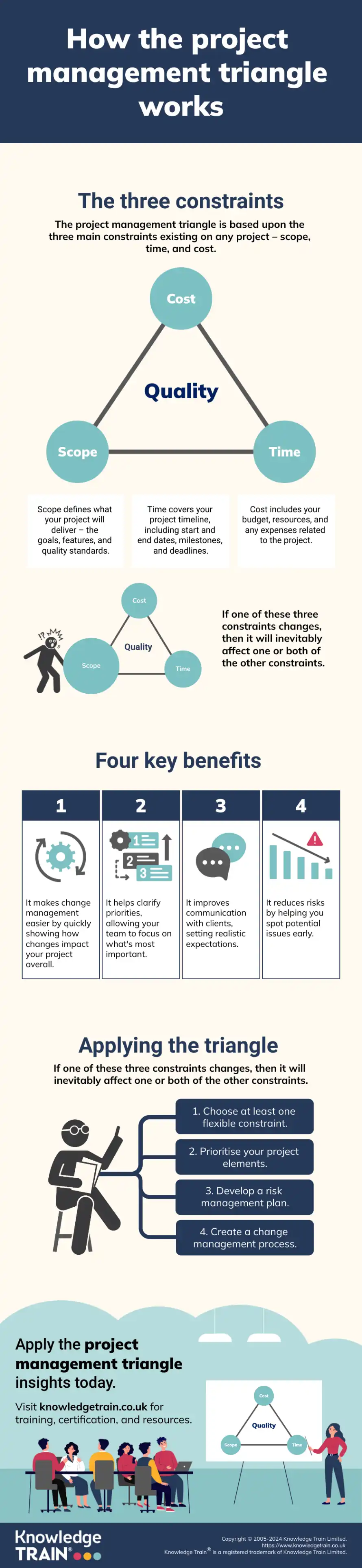
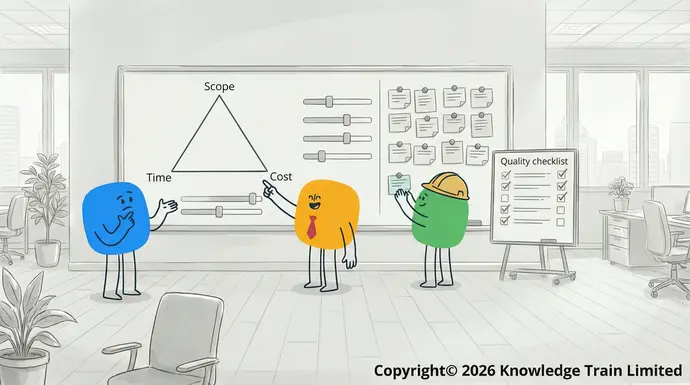
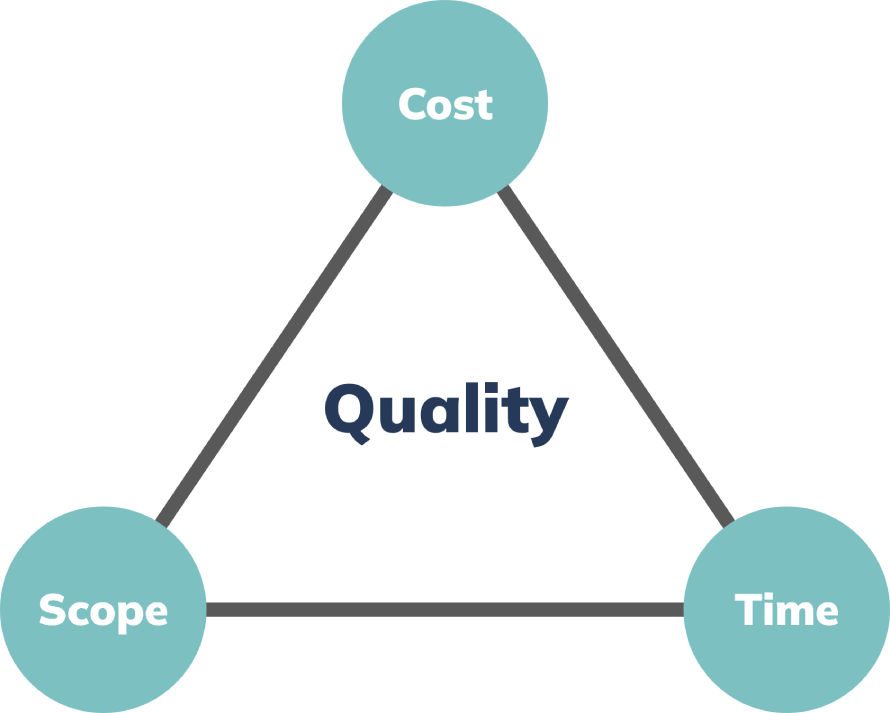
Scope, time and cost move together, so every change needs a conscious trade-off.
- Any shift in scope, schedule, or budget typically forces an adjustment in at least one other constraint.
Scope management techniquesKnowledge Train is an MSP Accredited Training Organization.
When managing project scope, you can try these tips:
- Define project boundariesKnowledge Train is a PRINCE2 Accredited Training Organization.: Clearly outline the scope of the project and its deliverables at the beginning.
- Scope change controlKnowledge Train is an AgilePM Accredited Training Organization.
Quality assurance practices
When managing project quality, you can try these tips:
- Quality standards: Define specific, measurable quality criteria for the project deliverables.
- Continuous testing: Implement regular quality checks throughout the project lifecycle.
- Peer review: Leverage the expertise of team members to identify and address quality issues.
- Customer feedback: Regularly collect and incorporate stakeholder feedback on project deliverables.
- Request a quotePrioritise budget allocation for critical project components.
Balancing constraints may sometimes lead to quality issues in deliverables.
Solutions
- Establish and communicate clear quality standards at the beginning of the project.+44 (0)207 148 5985
- Implement regular quality checks throughout the project lifecycle.
- Involve stakeholders in continuous feedback loops.[email protected]
- Allocate resources for testing and quality assurance processes.
With preparation of ways to address these hurdles, you will be one step closer to coping with the strain on the project management triangle. Keep in mind that this is where some creative strategising can help you maintain control of all these factors. It’s good to frequently ask “how are things going” and be willing to switch things around to keep them in balance.
Best practices for implementing the project management triangle
Best practices for implementing the project management triangle include the following:
Regular monitoring and adjustments
Another important aspect of the project management triangle is Searchmonitoring and adjusting . Project managers need to keep a close eye on the project and make adjustments as needed to keep it on track. There are several best practices for monitoring and adjusting, including the following:
- Use a tracking system to monitor the project. This will help you to keep track of progress and adjust as needed.
- Review the project plan on a regular basis. This will help you to stay on track and make changes as necessary.
- Adjust the plan when necessary. If you find that you are off track, you can always make adjustments to get back on track.
- Decisions based on information to revise project plans.United Kingdom
Team collaboration and accountabilityAustria
Project managers can also foster collaboration and teamwork among team members by holding them accountable for their part of the work. When team members know that they will be held accountable for their work, they are more likely to collaborate with others to complete the project successfully. There are several best practices for collaborating and holding team members accountable, including the following:Belgium
- Assign clear roles and responsibilities to each team member. This will help everyone to understand what they need to do and be held accountable for their part of the project.Bulgaria
- Encourage team members to collaborate with each other. This can be done by setting up regular team meetings and encouraging team members to communicate with each other.Croatia
- Track team members’ progress and hold them accountable for their work. This can be done by regularly reviewing each team member’s progress and providing feedback.Cyprus
- Recognise and reward efforts that support successful constraint management.Czech Republic
Continuous improvementDenmark
Adopt a culture of Estoniacontinuous improvementFinland when working with the project triangle.France
- Review the project after completion to determine lessons learnedGermany
- Evaluate what worked and didn’t work for finding the balance between the constraintsGreece
- Promote team members to share ideas for process improvementsIreland
- Stay updated on emerging project management methodologies and tools.Italy
Incorporating these best practices can help project managers to learn the project management triangle. However, success will depend on dedication, flexibility, and the ability to learn from both successes and failures.Latvia
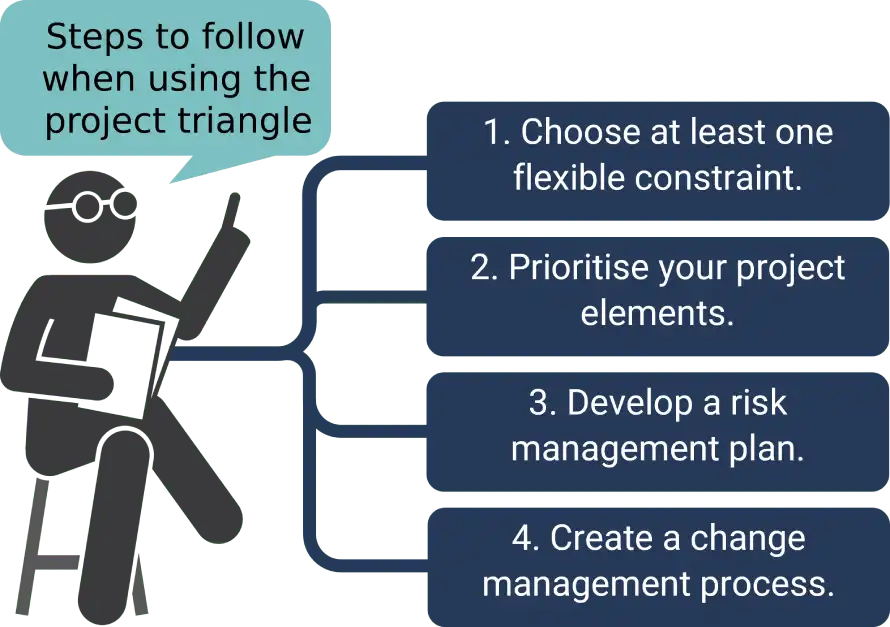
Applying the project management triangleLithuania
To help us see how we can do this, it’s worth looking at some examples of best practice in real-world situations. We will take three case studies below and see how things were managed in each of them.Luxemburg
Large-scale IT projectMalta
A global corporation launched a Netherlandsworldwide ERP implementationPoland. The Project Manager in this case struggled to ensure the best balance between the different project triangle dimensions.Portugal
Key measures include prioritised the most important core functionalities to manage scope, implemented a phased rollout to manage time and cost constraints, and utilised change management processes to assess and evaluate new requirements.Romania
ResultSlovakia: The project delivered under budget, with minimal impact on time, and fulfilled all essential business requirements.Slovenia
Construction projectSpain
A commercial Swedenskyscraper building constructionOther countries project faced unexpected geological conditions which created a major risk to the project triangle.Home
Key measures include reallocated budget from non-essential features to resolve foundation issues, accelerated other construction phases to make up for initial delays, and negotiated with stakeholders to adjust project scope without compromising quality.
ResultAgile: The building was completed safely, with a minor delay and a slight increase in the budget.Agile project management
Product development initiative
A tech startup wanted to launch a new software productAgile project management: Frameworks, benefits and how it works in a highly competitive market, but it struggled to strike the right balance between innovation and the pressure to get the product to market in time.
Key measures include employed an Simon BuehringAgile 29 Apr 2026methodology to manage scope flexibly, focused on developing a Minimum Viable Product (MVP) for the initial release and utilised customer feedback to prioritise further feature development after launch.
Result : The product was able to be launched in time, within the budget, and has gained a high level of market share quickly due to its core functionality and the improvements that have been iteratively made since the launch.
These examples illustrate successful applications of the project triangle in diverse industries and projects. They show how effective management of scope, time, and cost can overcome challenges and deliver value.