Key takeaways
Scope, time and cost move together, so every change needs a conscious trade-off.Manage options+44 (0)207 148 5985
- Any shift in scope, schedule, or budget typically forces an adjustment in at least one other constraint.Manage services
- Imbalances often show up as rushed work, under-resourcing, or overambitious deliverables that reduce quality.Manage {vendor_count} vendorsOr chat with us using the link at the bottom of the screen.
- Pick at least one flexible constraint early so you can respond to issues without losing control.Read more about these purposesContact us with questions about the courses on this page, or about which project management certification or training is best for you.
- Use prioritisation and formal change control to prevent scope creep and keep decisions objective. Finance FAQs
- Monitor risks and progress continuously, and communicate trade-offs clearly to stakeholders.AcceptContact
Introduction, PRINCE2
The ®project management triangle Agile, RESILIA, also known as the triple constraint model, is a concept that visualises the constraints of ®scope, and the Swirl logo are registered trademarks of the PeopleCert group. Used under licence from PeopleCert. All rights reserved. AgilePM, ®time and AgileBA, and ®cost are registered trademarks of Agile Business Consortium Limited. All rights reserved. The APMG International AgilePM and Swirl Device logo, APMG International AgileBA and Swirl Device Logo, APMG International Change Management and APMG International Better Business Cases and Swirl Device logo are trademarks of The APM Group Limited, used under permission of The APM Group Limited. All rights reserved. Better Business Cases™ is a trademark of Her Majesty’s Treasury. All rights reserved. DevOps Foundation in ®project management is a registered mark of the DevOps Institute. “PMI”, “PMBOK. It highlights the interconnected nature of these three aspects in delivering a successful project.®
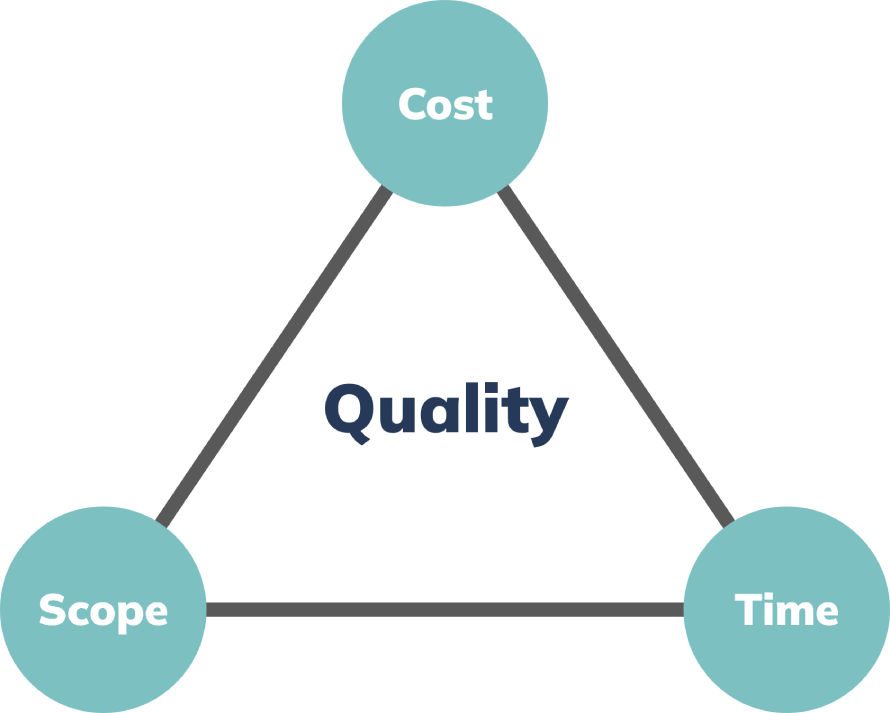
The triangle model is a crucial tool for project managers to understand and balance the competing demands of a Guide”, “PMP” and “CAPM” are registered marks of Project Management Institute, Inc. Knowledge Train Scrum Essentials™, Business Learning Library (BLL)™, Business Analysis Learning Library (BALL)™, Agile Learning Library (ALL)™, IT Learning Library (ITLL)™, and Compliance Learning Library (CLL)™ are trademarks of Knowledge Train Limited. All rights reserved.projectKnowledge Train Ltd is an Introducer Appointed Representative of NewDay Cards Ltd for the Newpay finance product provided by NewDay Ltd. NewDay Cards Ltd acts as a credit broker, not a lender. We will introduce you exclusively to Newpay finance products provided by NewDay Limited under this Introducer Appointed Representative arrangement. Finance available from other lenders is not covered by this arrangement. NewDay Ltd and Newday Cards Ltd are authorised and regulated by the Financial Conduct Authority (ref nos 690292 and 682417 respectively).. The scope refers to the project’s requirements, objectives, and deliverables. Time refers to the schedule and deadlines. Cost encompasses the budget and resources. The challenge is to optimise all three to meet project goals.
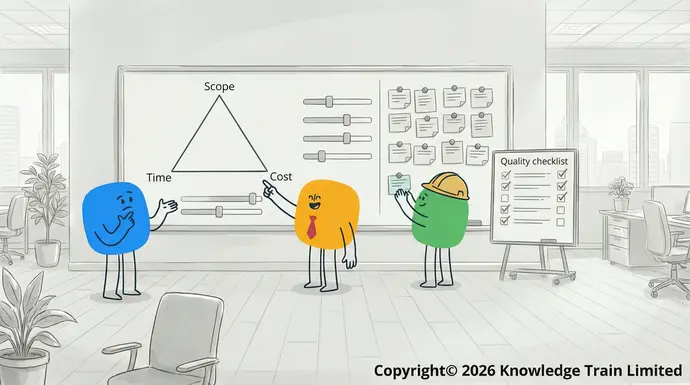
Each corner of the triangle is dependent on the other two. A change in one element typically results in a change in at least one other. By understanding and managing these constraints, project teams can make informed decisions and adjustments to ensure project success.
The project management triangle is a fundamental concept that helps project managers visualise and optimise the key constraints of any project. By balancing scope, time, and cost, project teams can deliver successful outcomes that meet stakeholder expectations.
Understanding the project management triangleSearch
The three constraints explained
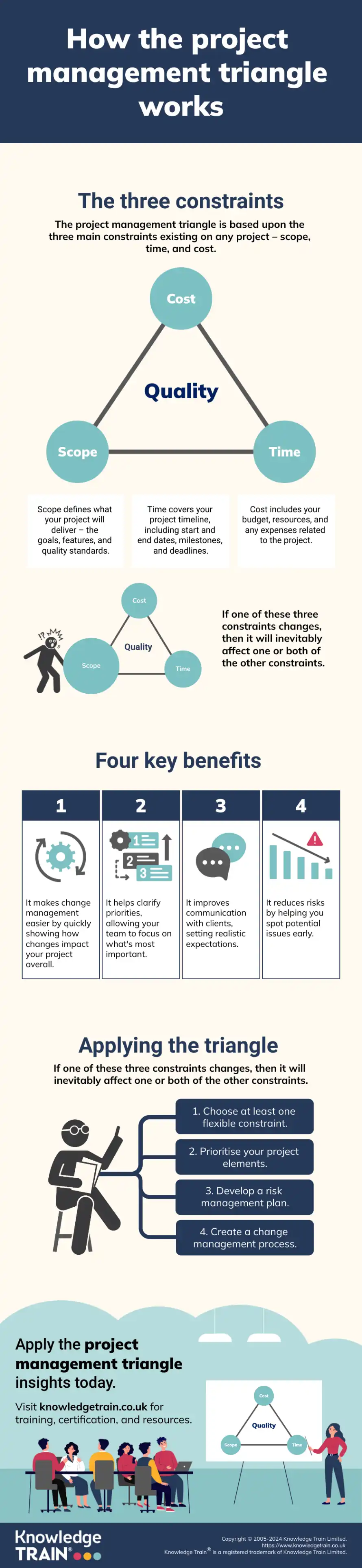
The project management triangle is made up of three main constraints: scope , time and cost . Let’s have a detailed look at each of these.
The balance of scope, time and cost also has an impact on the To provide the best experiences, we use technologies like cookies to store and/or access device information. Consenting to these technologies will allow us to process data such as browsing behavior or unique IDs on this site. Not consenting or withdrawing consent, may adversely affect certain features and functions.quality of the project outcomes. If the three constraints are well-balanced, the project is more likely to achieve high-quality results. On the other hand, if there is an imbalance in any of the constraints, the quality of the project may be compromised. For example:
- A tight deadline may lead to a rushed project, resulting in lower quality outputs.
- A limited budget may result in a project being understaffed or under-resourced, which may also affect quality.
- A project with an overambitious scope can strain resources and time, leading to poor results.Functional
Successful project management involves finding the right balance and making trade-offs between the three constraints while maintaining the desired level of quality. By understanding the impact of these constraints on each other, project managers can make informed decisions to lead the project to a successful outcome.
Benefits of using the project management triangle
Utilising the project management triangle provides some distinct benefits to the project team and stakeholders. These are as follows.Functional
Easier change management
The triangle model helps to Always active make changes easier . This is because if a change arises, the project managers can easily evaluate how this change will affect the scope, time and cost, decide, as such it helps to quickly evaluate a change request, understand the ripple effects, and make an informed decision on change.
Priority clarification
Visualising the three constraints helps to clarify priorities . This will make it possible for the team to quickly identify important elements in the project, direct resources to important tasks and make trade-offs as required based on the project goals.
Improved client communicationThe technical storage or access is strictly necessary for the legitimate purpose of enabling the use of a specific service explicitly requested by the subscriber or user, or for the sole purpose of carrying out the transmission of a communication over an electronic communications network.
The triangle is a helpful communication tool to both communicate with and educate clients. The project managers can use the triangle to show the project’s constraints to the clients, visualise how changes would affect them, and set realistic expectations regarding project deliverables.
Risk reduction
Utilising the triangle will help in Preferencesmanaging risks . This is possible because this will help the team to predict potential problems earlier in the process, have a contingency plan, and balance the risks in all three constraints.
The use of the project management triangle allows for managersPreferences to make decisions in a balanced manner. As such, it becomes possible to deal with complex projects with great ease.
Managing the project management triangle
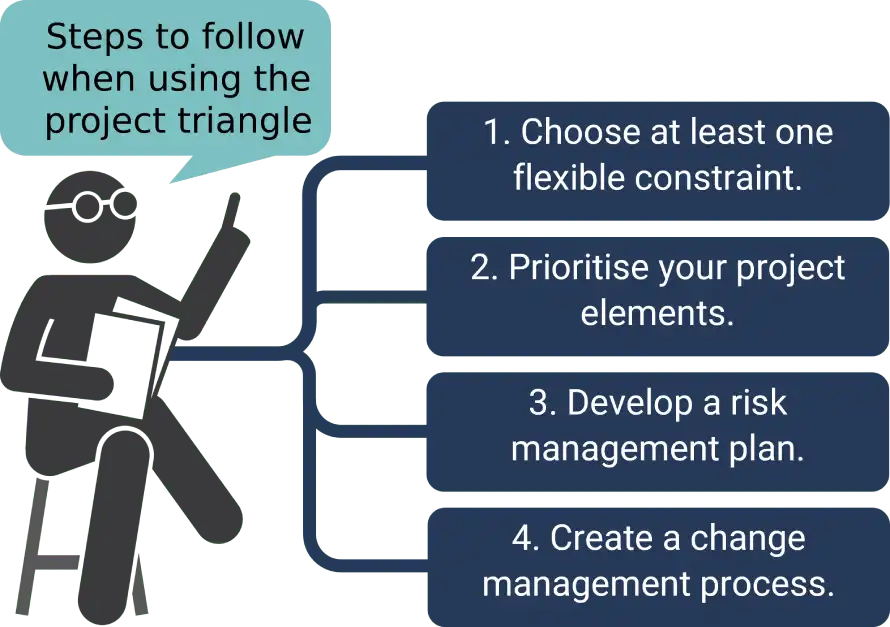
Maintaining the balance of the project management triangle requires strategic decisions and careful trade-offs between scope, time, and cost. Here are some tips to help:
Choose at least one flexible constraint
One constraint should be identified as more flexible than the others. This allows some wiggle room when dealing with changes or issues. Ask yourself:
- Which constraint is easiest or least impactful to change?
- Are stakeholders willing to adjust scope, extend deadlines, or increase budget if necessary?
- How will increased flexibility in one constraint impact the other two?
Identifying a flexible constraint up-front allows for better risk management and issue resolution.The technical storage or access that is used exclusively for statistical purposes.
Prioritise features and requirements
It is important to carefully evaluate the importance of each project deliverable. This will help you focus on what is essential to project success. Create a comprehensive list of features and requirements, then:The technical storage or access that is used exclusively for anonymous statistical purposes. Without a subpoena, voluntary compliance on the part of your Internet Service Provider, or additional records from a third party, information stored or retrieved for this purpose alone cannot usually be used to identify you.
- Rank or score each based on value and importance
- Clearly define “must-have” vs. “nice-to-have” features
- Leverage prioritisation to inform trade-off decisions.
This prioritisation process allows for objective trade-off discussions if needed.
Develop a risk management plan
Proactively identifying and managing risks will help avoid imbalances in the triangle. A Marketingrisk management plan should include:
- Identification of risks that could impact any of the constraintsMarketing
- Manage {vendor_count} vendors
- Approval thresholds based on change type and sizeRead more about these purposes
- Communication plans for approved changes
A structured change management process helps to prevent imbalances.Accept
Match management methodology to priority constraints
The project management methodology used should complement the project’s constraints. Consider:Deny
- Waterfall methodologies like traditional or predictive project management focus on upfront planning and are best suited for fixed-scope projects where time and cost can be more flexible.View preferences
Common challenges and solutionsManage consent
Scope creepManage consent
Scope creep involves changes or expansion in the project’s scope after it has already started. This can lead to an increase in resources, time, and effort needed to complete the project.
Solutions
- Establish a formal change control process to manage scope changes effectively.
- Clearly define project scope and requirements during the planning phase.
- Communicate regularly with stakeholders to manage expectations.
- Implement a prioritisation system for new requests and changes.
Time constraints
Projects often face tight deadlines, which can put pressure on the team and the quality of work.
Solutions
- Use critical path analysis to identify and focus on essential tasks.
- Implement time-boxing techniques to improve focus and productivity.
- Consider parallel processing of tasks where possible.
- Negotiate for deadline extensions when necessary.
Budget limitations
Limited budgets can restrict resources, impacting the project’s scope and quality.
Solutions
- Conduct thorough cost estimation during the planning phase.
- Implement earned value management (EVM) to track project cost performance.
- Explore cost-effective alternatives for resources.
- Prioritise budget allocation for critical project components.
Balancing constraints may sometimes lead to quality issues in deliverables.
Solutions
- Establish and communicate clear quality standards at the beginning of the project.
- Implement regular quality checks throughout the project lifecycle.
- Involve stakeholders in continuous feedback loops.
- Allocate resources for testing and quality assurance processes.
With preparation of ways to address these hurdles, you will be one step closer to coping with the strain on the project management triangle. Keep in mind that this is where some creative strategising can help you maintain control of all these factors. It’s good to frequently ask “how are things going” and be willing to switch things around to keep them in balance.
Best practices for implementing the project management triangle
Best practices for implementing the project management triangle include the following:
Stakeholder communication
One of the most important aspects of effectively implementing the project management triangle is communicating with stakeholders. Project managers should communicate regularly with stakeholders to keep them informed and manage their expectations. It can also help to keep stakeholders engaged and on board with the project. There are several best practices for communicating with stakeholders, including the following:
- Schedule regular meetings with stakeholders to discuss the project.
- Provide stakeholders with a visual representation of the triangle. This can help them to understand the trade-offs that are being made.
- Use plain language when communicating with stakeholders. Avoid jargon and technical terms that may be confusing.
- Encourage stakeholders to ask questions and share their concerns.
Regular monitoring and adjustments
Another important aspect of the project management triangle is monitoring and adjusting. Project managers need to keep a close eye on the project and make adjustments as needed to keep it on track. There are several best practices for monitoring and adjusting, including the following:
- Use a tracking system to monitor the project. This will help you to keep track of progress and adjust as needed.
- Review the project plan on a regular basis. This will help you to stay on track and make changes as necessary.
- Adjust the plan when necessary. If you find that you are off track, you can always make adjustments to get back on track.
- Decisions based on information to revise project plans.
Team collaboration and accountability
Project managers can also foster collaboration and teamwork among team members by holding them accountable for their part of the work. When team members know that they will be held accountable for their work, they are more likely to collaborate with others to complete the project successfully. There are several best practices for collaborating and holding team members accountable, including the following:
- Assign clear roles and responsibilities to each team member. This will help everyone to understand what they need to do and be held accountable for their part of the project.
- Encourage team members to collaborate with each other. This can be done by setting up regular team meetings and encouraging team members to communicate with each other.
- Track team members’ progress and hold them accountable for their work. This can be done by regularly reviewing each team member’s progress and providing feedback.
- Recognise and reward efforts that support successful constraint management.
Continuous improvement
Adopt a culture of continuous improvement when working with the project triangle.
- Review the project after completion to determine lessons learned
- Evaluate what worked and didn’t work for finding the balance between the constraints
- Promote team members to share ideas for process improvements
- Stay updated on emerging project management methodologies and tools.
Incorporating these best practices can help project managers to learn the project management triangle. However, success will depend on dedication, flexibility, and the ability to learn from both successes and failures.
Applying the project management triangle
To help us see how we can do this, it’s worth looking at some examples of best practice in real-world situations. We will take three case studies below and see how things were managed in each of them.
Large-scale IT project
A global corporation launched a worldwide ERP implementation. The Project Manager in this case struggled to ensure the best balance between the different project triangle dimensions.
Key measures include prioritised the most important core functionalities to manage scope, implemented a phased rollout to manage time and cost constraints, and utilised change management processes to assess and evaluate new requirements.
Result: The project delivered under budget, with minimal impact on time, and fulfilled all essential business requirements.
Construction project
A commercial skyscraper building construction project faced unexpected geological conditions which created a major risk to the project triangle.
Key measures include reallocated budget from non-essential features to resolve foundation issues, accelerated other construction phases to make up for initial delays, and negotiated with stakeholders to adjust project scope without compromising quality.
Result: The building was completed safely, with a minor delay and a slight increase in the budget.
Product development initiative
A tech startup wanted to launch a new software product in a highly competitive market, but it struggled to strike the right balance between innovation and the pressure to get the product to market in time.
Key measures include employed an Agile methodology to manage scope flexibly, focused on developing a Minimum Viable Product (MVP) for the initial release and utilised customer feedback to prioritise further feature development after launch.
Result: The product was able to be launched in time, within the budget, and has gained a high level of market share quickly due to its core functionality and the improvements that have been iteratively made since the launch.
These examples illustrate successful applications of the project triangle in diverse industries and projects. They show how effective management of scope, time, and cost can overcome challenges and deliver value.
Conclusion
The project management triangle is a simple yet powerful tool for understanding and managing project constraints such as scope, time, and cost. By learning this concept, project managers can make informed decisions when trade-offs are required and ensure that they deliver high-quality results.
We hope that our blog post on the project management triangle has provided you with a clear and concise understanding of the concept. Remember, project management is not just about executing tasks but also involves communication with stakeholders, ongoing monitoring and adjustment of project parameters, team collaboration, and accountability, and continuous process improvement. Balancing these constraints is critical for project success, regardless of the industry or project type. As the case studies have shown, the effective application of the project management triangle can lead to exceptional outcomes.
We encourage you to apply these principles to your projects and experience the benefits of successful project management. With the right mindset, tools, and techniques, you will be able to navigate through challenges, meet stakeholder expectations, and consistently deliver successful outcomes. Embrace the project management triangle as an invaluable part of your project management toolkit.
FAQs
What is the iron triangle in project management?
The iron triangle is another name for the project management triangle, emphasising the importance of balancing scope, time, and cost.
How does changing one constraint affect the others in the project management triangle?
Changing one constraint typically impacts the other two, requiring adjustments to maintain balance and quality.
Can the project management triangle be applied to all types of projects?
Yes, the project management triangle is a versatile concept that can be applied to various industries and projects.
What are some signs that a project’s constraints are out of balance?
Signs of imbalance may include frequent scope changes, missed deadlines, budget overruns or quality issues.
How often should project managers review and adjust the project management triangle?
Regular reviews are crucial, especially at significant milestones or when major changes occur.
What role does innovation play in managing the project management triangle?
Innovation can help optimise processes, potentially improving all constraints simultaneously.
Infographic