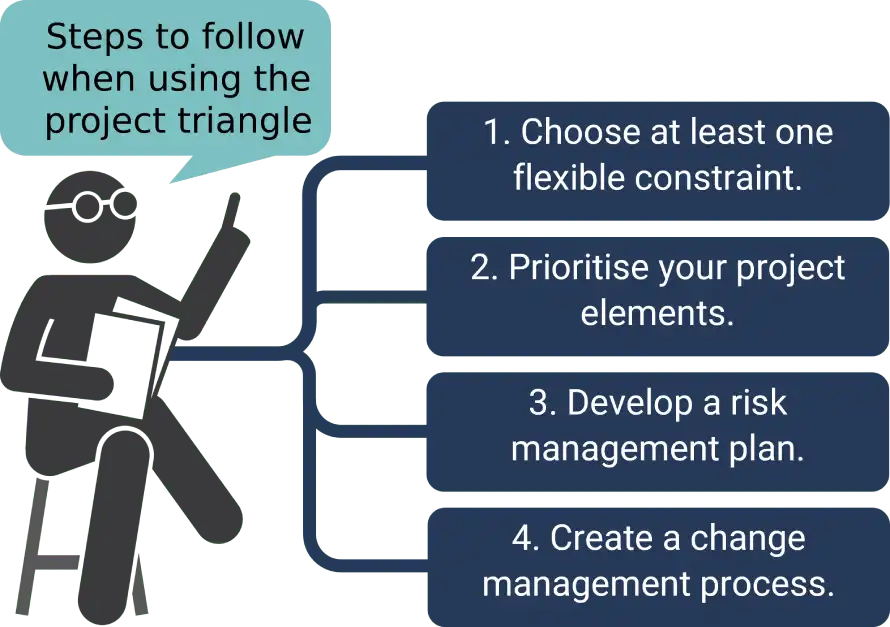
plan should include:Practitioner
- Identification of risks that could impact any of the constraintsIncludes Foundation & Practitioner combined option.
- Risk scoring based on probability and impactPRINCE2
- Detailed contingency plans for high-priority risks®
- A monitoring process to reassess risks throughout the project. Agile
Risk managementFoundation ensures prevention of imbalances before they happen.Learn the fundamentals of the PRINCE2 Agile method.
Create a change management planPractitioner
Change is inevitable on projects. A Includes Foundation & Practitioner combined option.change management planScrum provides a process for considering how changes impact the constraints. A plan should include:Scrum Essentials
- A system for submitting, reviewing, and approving changesSelf-paced training course to learn the essentials of Scrum.
- Procedures for assessing change impact on each constraintScrum Master
- Approval thresholds based on change type and sizeChoose Scrum Alliance or Scrum.org Scrum Master training courses.
- Communication plans for approved changesScrum Product Owner
A structured change management process helps to prevent imbalances.Choose Scrum Alliance or Scrum.org Product Owner training courses.
Match management methodology to priority constraintsAgileBA
The project management methodology used should complement the project’s constraints. Consider:®
- Waterfall methodologies – Agile Business Analysis like traditional or predictive project management focus on upfront planning and are best suited for fixed-scope projects where time and cost can be more flexible.Foundation
- Agile methodologiesLearn the fundamentals of Agile Business Analysis. like Scrum or Kanban emphasise iterative development and are best for projects where scope may need to be flexible or change over time.Practitioner
- Lean approaches4-day course including Foundation. prioritise efficiency and cost control and are useful when budget is the main constraint.Lean Six Sigma
Choosing the right approach from the beginning aligns with the key constraints.Yellow Belt
Follow the tips above to help manage the project management triangle and balance constraints throughout your project. The most important thing is to continuously monitor and maintain alignment of the three sides. Assess the status of scope, time, and cost regularly to identify imbalances. Be willing to make informed decisions and trade-offs as necessary. And communicate clearly with stakeholders about any changes to plans or constraints.Self-paced training course to gain LSS Yellow Belt.
Strategies for balancing constraintsPMI
Managing constraints effectively requires specific strategies for each side of the project management triangle. Here are some tips for balancing scope, time, cost and quality:®
Scope management techniquesPMI-ACP
When managing project scope, you can try these tips:Self-paced course to prepare you for the exam (exam not included).
- Define project boundariesKanban: Clearly outline the scope of the project and its deliverables at the beginning.Estimating for Agile Foundation
- Scope change controlAgile Learning Library (ALL)™the project scope.Learn the fundamentals of business analysis.
- Monitor for scope creepModelling Business Processes : Regularly review project requirements to ensure they align with the defined scope.Gain practitioner certificate in modelling business processes.
- PrioritisationBusiness Analysis Practices : Use a prioritisation method, such as Gain practitioner certificate in business analysis practices.MoSCoWRequirements Engineering , to determine which features are essential, desirable, optional, or not required.Gain practitioner certificate in requirements engineering.
Time management approachesBusiness Analysis International Diploma
- Practitioner : Set a fixed time period for specific tasks or project phases.4-day course including Foundation.
- Agile sprintsPMICHANGE MANAGEMENT
Cost control methodsAPMG Change Management
When managing project cost, you can try these tips:
- Earned value management
- Select your preferred training course below:
- Customisation options : Flexibility to adapt the software to your project management methodologies and processesAPM COURSES
- Mobile accessibilitySelect your preferred training course below:: Mobile applications or responsive interfaces for on-the-go project management.
With the right tool and these essential features, project managers will be in a much better position to maintain the constraints of the project management triangle. Software solutions can enhance project visibility, foster better communication and support data-driven decisions throughout the project lifecycle.AGILE PROJECT MANAGEMENT COURSES
Common challenges and solutions
Scope creepPRINCE2 AGILE COURSES
Scope creepSelect your preferred training course below: involves changes or expansion in the project’s scope after it has already started. This can lead to an increase in resources, time, and effort needed to complete the project.
SolutionsSCRUM COURSES
- Establish a formal change control process to manage scope changes effectively.Select your preferred training course below:
- BUSINESS CASE COURSESReview the project plan on a regular basis. This will help you to stay on track and make changes as necessary.
- Adjust the plan when necessary. If you find that you are off track, you can always make adjustments to get back on track.Select your preferred training course below:
- Decisions based on information to revise project plans.
Team collaboration and accountabilityAGILE COURSES
Project managers can also foster collaboration and teamwork among team members by holding them accountable for their part of the work. When team members know that they will be held accountable for their work, they are more likely to collaborate with others to complete the project successfully. There are several best practices for collaborating and holding team members accountable, including the following:Select your self-paced training course topic.
- Assign clear roles and responsibilities to each team member. This will help everyone to understand what they need to do and be held accountable for their part of the project.
- Encourage team members to collaborate with each other. This can be done by setting up regular team meetings and encouraging team members to communicate with each other.AGILE PROJECT MANAGEMENT COURSES
- Track team members’ progress and hold them accountable for their work. This can be done by regularly reviewing each team member’s progress and providing feedback.Select your preferred training course below:
- Recognise and reward efforts that support successful constraint management.
Continuous improvementPRINCE2 AGILE COURSES
Adopt a culture of Select your preferred training course below:continuous improvement when working with the project triangle.SCRUM COURSES
- Review the project after completion to determine lessons learnedSelect your preferred training course below:
- Evaluate what worked and didn’t work for finding the balance between the constraints
- Promote team members to share ideas for process improvementsLEAN SIX SIGMA COURSES
- Stay updated on emerging project management methodologies and tools.Select your preferred training course below:
Incorporating these best practices can help project managers to learn the project management triangle. However, success will depend on dedication, flexibility, and the ability to learn from both successes and failures.
Applying the project management triangleBUSINESS ANALYST COURSES
To help us see how we can do this, it’s worth looking at some examples of best practice in real-world situations. We will take three case studies below and see how things were managed in each of them.Select your self-paced training course topic.
Large-scale IT project
A global corporation launched a BCS BUSINESS ANALYST COURSESworldwide ERP implementationSelect your preferred training course below:. The Project Manager in this case struggled to ensure the best balance between the different project triangle dimensions.
Key measures include prioritised the most important core functionalities to manage scope, implemented a phased rollout to manage time and cost constraints, and utilised change management processes to assess and evaluate new requirements.CHANGE MANAGEMENT COURSES
ResultSelect your self-paced training course topic.: The project delivered under budget, with minimal impact on time, and fulfilled all essential business requirements.
Construction projectAPMG CHANGE MANAGEMENT COURSES
A commercial Select your preferred training course below:skyscraper building construction project faced unexpected geological conditions which created a major risk to the project triangle.PROGRAMME MANAGEMENT COURSES
Key measures include reallocated budget from non-essential features to resolve foundation issues, accelerated other construction phases to make up for initial delays, and negotiated with stakeholders to adjust project scope without compromising quality.Select your self-paced training course topic.
Result : The building was completed safely, with a minor delay and a slight increase in the budget.MSP COURSES
Product development initiativeSelect your preferred training course below:
A tech startup wanted to launch a new software productIT QUALIFICATIONS in a highly competitive market, but it struggled to strike the right balance between innovation and the pressure to get the product to market in time.Select your preferred qualification.
Key measures include employed an Agile ITIL COURSESmethodologySelect your preferred training course below: to manage scope flexibly, focused on developing a Minimum Viable Product (MVP) for the initial release and utilised customer feedback to prioritise further feature development after launch.
ResultIT QUALIFICATIONS: The product was able to be launched in time, within the budget, and has gained a high level of market share quickly due to its core functionality and the improvements that have been iteratively made since the launch.Select your preferred qualification.
ConclusionSelect your preferred workshop below:
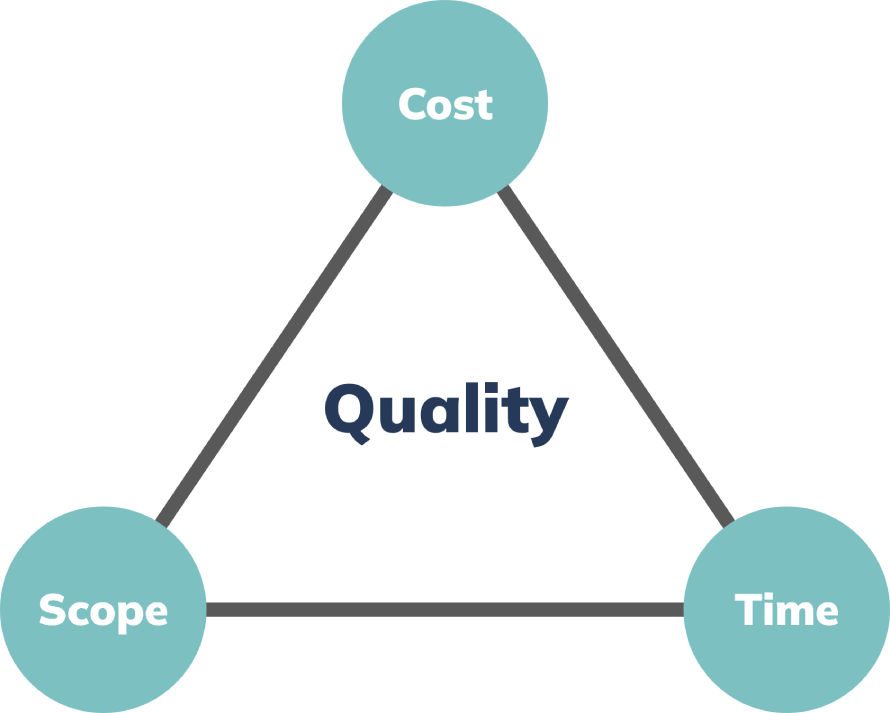
The project management triangle is a simple yet powerful tool for understanding and managing project constraints such as scopeKnowledge Train is a PRINCE2 Accredited Training Organization., timeKnowledge Train is an AgilePM Accredited Training Organization., and costKnowledge Train is a PRINCE2 Agile Accredited Training Organization.. By learning this concept, project managers can make informed decisions when trade-offs are required and ensure that they deliver high-quality results.
We hope that our blog post on the project management triangle has provided you with a clear and concise understanding of the concept. Remember, project management is not just about executing tasks but also involves communication with stakeholders, ongoing monitoring and adjustment of project parameters, team collaboration, and accountability, and continuous process improvement. Balancing these constraints is critical for project success, regardless of the industry or project type. As the case studies have shown, the effective application of the project management triangle can lead to exceptional outcomes.Knowledge Train is a Better Business Cases Accredited Training Organization.
We encourage you to apply these principles to your projects and experience the benefits of successful project management. With the right mindset, tools, and techniques, you will be able to navigate through challenges, meet stakeholder expectations, and consistently deliver successful outcomes. Embrace the project management triangle as an invaluable part of your project management toolkit.
FAQsKnowledge Train is a P3O Accredited Training Organization.
What is the iron triangle in project management?
The iron triangle is another name for the project management triangle, emphasising the importance of balancing scope, time, and cost.Knowledge Train is an AgilePM Accredited Training Organization.
How does changing one constraint affect the others in the project management triangle?
Changing one constraint typically impacts the other two, requiring adjustments to maintain balance and quality.Knowledge Train is a PRINCE2 Agile Accredited Training Organization.
Can the project management triangle be applied to all types of projects?
Yes, the project management triangle is a versatile concept that can be applied to various industries and projects.Knowledge Train is an Agile BA Accredited Training Organization.
What are some signs that a project’s constraints are out of balance?
Signs of imbalance may include frequent scope changes, missed deadlines, budget overruns or quality issues.BCS accredited training partner for Business Analysis.
How often should project managers review and adjust the project management triangle?
Regular reviews are crucial, especially at significant milestones or when major changes occur.Knowledge Train is an Agile BA Accredited Training Organization.
What role does innovation play in managing the project management triangle?
Innovation can help optimise processes, potentially improving all constraints simultaneously.Knowledge Train is a Change Management Accredited Training Organization.
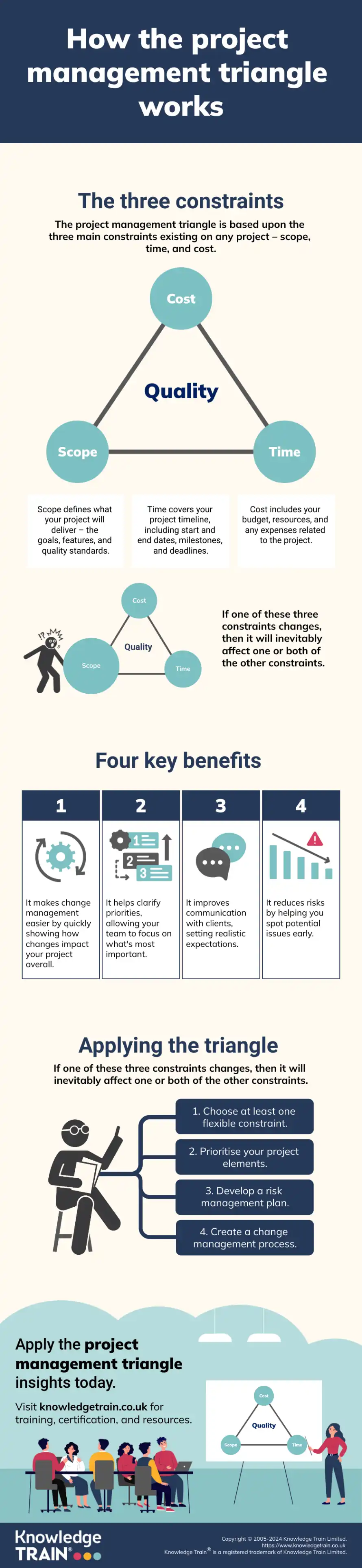
Infographic