Project management triangle29 Apr 2026

IntroductionOrganisation type
The Professional association (professional body for project management)project management triangleCountry, also known as the triple constraint model, is a concept that visualises the constraints of United KingdomscopeHeadquarters, Buckinghamshire, England (UK)timeMission, and To advance the discipline of project management and support project professionals and organisations.costCore services in Professional membership, qualifications and certification, events and community, publications and guidance, Continuing Professional Development (CPD)project managementFlagship qualifications. It highlights the interconnected nature of these three aspects in delivering a successful project.APM Project Fundamentals Qualification (PFQ), APM Project Management Qualification (PMQ), Chartered Project Professional (ChPP)
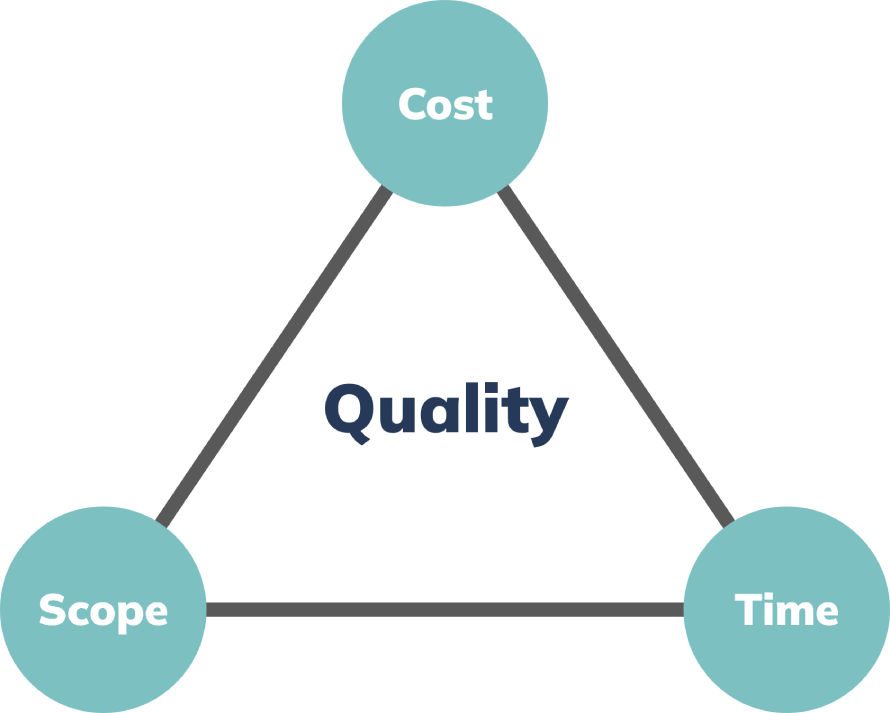
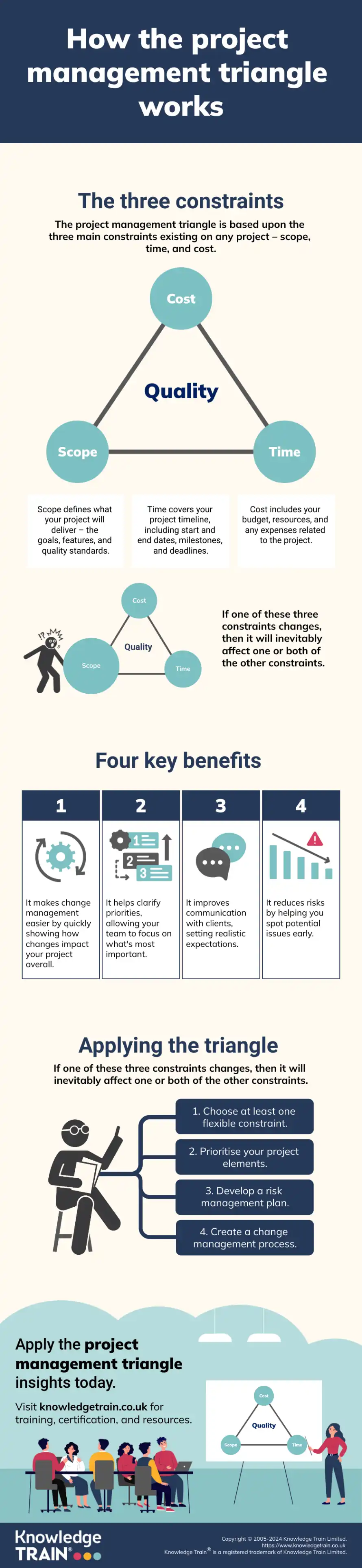
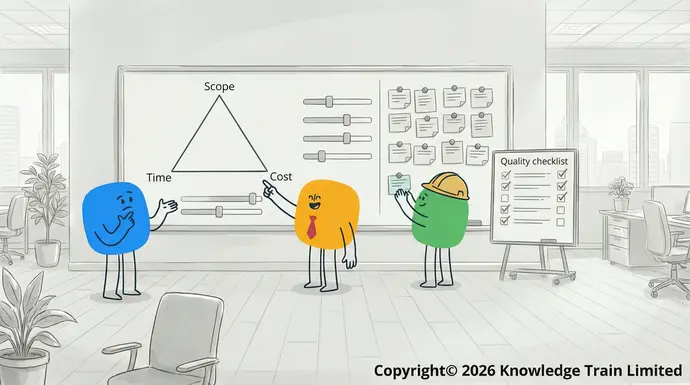
The triangle model is a crucial tool for project managers to understand and balance the competing demands of a Membership typesprojectStudent, Associate, Full, Fellow (grade availability and criteria vary). The scope refers to the project’s requirements, objectives, and deliverables. Time refers to the schedule and deadlines. Cost encompasses the budget and resources. The challenge is to optimise all three to meet project goals.Official website
Each corner of the triangle is dependent on the other two. A change in one element typically results in a change in at least one other. By understanding and managing these constraints, project teams can make informed decisions and adjustments to ensure project success.https://www.apm.org.uk/
The project management triangle is a fundamental concept that helps What APM does for project management in the UK
- Identification of risks that could impact any of the constraintsMembership
- Risk scoring based on probability and impactAPM membership (professional membership) provides a way to demonstrate commitment to the profession and access support for career development. Membership criteria and naming can change over time, but grades typically align to experience and contribution.
- Detailed contingency plans for high-priority risksTypical APM membership grades
- A monitoring process to reassess risks throughout the project.Student
Risk management: For people in education who are building foundational knowledge. ensures prevention of imbalances before they happen.Associate
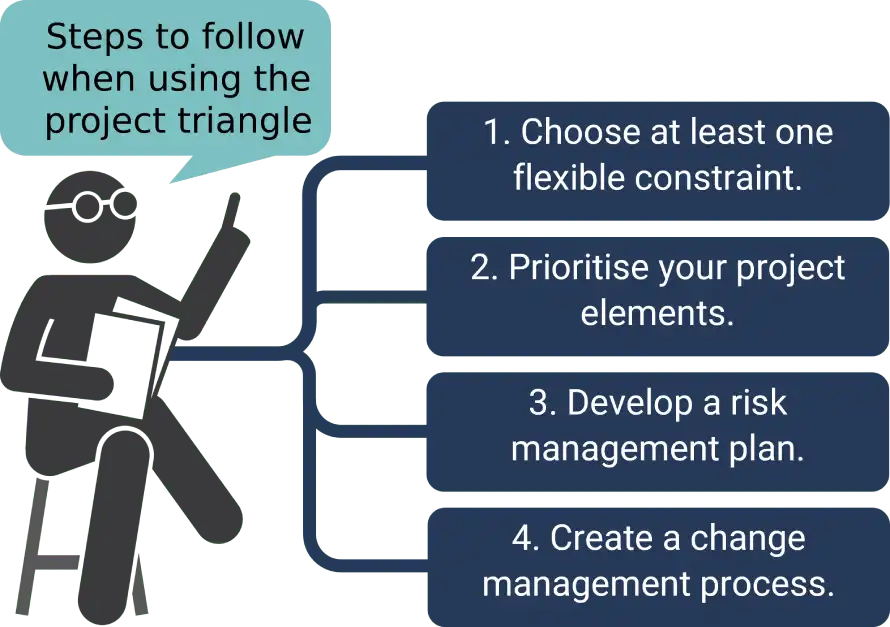
Create a change management plan: For early career professionals and those developing competence.
Change is inevitable on projects. A Fullchange management plan: For experienced practitioners who meet defined experience and professionalism requirements. provides a process for considering how changes impact the constraints. A plan should include:Fellow
- A system for submitting, reviewing, and approving changes: Senior recognition for significant contribution and leadership in the profession.
- Procedures for assessing change impact on each constraintCommon member benefits
- Approval thresholds based on change type and sizeAccess to learning resources that support
- Communication plans for approved changesContinuing Professional Development (CPD)
A structured change management process helps to prevent imbalances..
Match management methodology to priority constraintsProfessional recognition and use of post nominal designations where applicable.
The project management methodology used should complement the project’s constraints. Consider:Networking through events, branches, and special interest groups.
- Waterfall methodologiesPublications and guidance supporting better project delivery and governance. like traditional or predictive project management focus on upfront planning and are best suited for fixed-scope projects where time and cost can be more flexible.Career support, including frameworks and pathways for project roles.
- Agile methodologiesChartered status and what it means like Scrum or Kanban emphasise iterative development and are best for projects where scope may need to be flexible or change over time.APM holds
- Lean approacheschartered status (chartered body) prioritise efficiency and cost control and are useful when budget is the main constraint. as the professional body for project management in the UK. In general, chartered status signals formal recognition and a public interest role in maintaining standards, professionalism, and development routes within a discipline.
Choosing the right approach from the beginning aligns with the key constraints.For individuals, chartered recognition is commonly associated with assessed competence, professional behaviours, and continuing development rather than only passing a knowledge exam.
Follow the tips above to help manage the project management triangle and balance constraints throughout your project. The most important thing is to continuously monitor and maintain alignment of the three sides. Assess the status of scope, time, and cost regularly to identify imbalances. Be willing to make informed decisions and trade-offs as necessary. And communicate clearly with stakeholders about any changes to plans or constraints.APM vs PMI
Strategies for balancing constraintsSome people compare APM with the
Managing constraints effectively requires specific strategies for each side of the project management triangle. Here are some tips for balancing scope, time, cost and quality:Project Management Institute (
Scope management techniquesPMI
When managing project scope, you can try these tips:)
- Resource leveling
- The Association for Project Management (APM) is the chartered professional body for project: Negotiate favourable terms and monitor supplier costs.
Quality assurance practices
When managing project quality, you can try these tips:
- Quality standards
Subscribe nowKey features to look for in project management tools
When choosing a project management tool, consider these vital features and capabilities:
- Resource allocation: Features and tools to optimise team and resource utilisation{"@context":"https://schema.org","@type":"WebPage","name":"Association for Project Management (APM): What It Is","url":"https://www.knowledgetrain.co.uk/project-management/association-for-project-management-apm","description":"Learn what the UK Association for Project Management (APM) is, its chartered status, memberships, Body of Knowledge, and qualifications.","significantLink":"https://www.knowledgetrain.co.uk/project-management/association-for-project-management-apm","mainEntity":{"@type":"Article","headline":"What is the Association for Project Management (APM)?","about":[{"@type":"DefinedTerm","name":"Association for Project Management","sameAs":["https://en.wikipedia.org/wiki/Association_for_Project_Management","https://www.wikidata.org/wiki/Q4804041"]},{"@type":"DefinedTerm","name":"Project management","sameAs":["https://en.wikipedia.org/wiki/Project_management","https://www.wikidata.org/wiki/Q170584"]},{"@type":"DefinedTerm","name":"Professional association","sameAs":["https://en.wikipedia.org/wiki/Professional_association","https://www.wikidata.org/wiki/Q193441"]}],"mentions":[{"@type":"DefinedTerm","name":"APM Body of Knowledge","sameAs":["https://www.apm.org.uk/book-shop/apm-body-of-knowledge-7th-edition/","https://www.wikidata.org/wiki/Q106645155"]},{"@type":"DefinedTerm","name":"United Kingdom","sameAs":["https://en.wikipedia.org/wiki/United_Kingdom","https://www.wikidata.org/wiki/Q145"]},{"@type":"DefinedTerm","name":"Project Management Institute","sameAs":["https://en.wikipedia.org/wiki/Project_Management_Institute","https://www.wikidata.org/wiki/Q724606"]},{"@type":"DefinedTerm","name":"PMP (Project Management Professional)","sameAs":["https://en.wikipedia.org/wiki/Project_Management_Professional","https://www.wikidata.org/wiki/Q1766491"]},{"@type":"DefinedTerm","name":"PRINCE2","sameAs":["https://en.wikipedia.org/wiki/PRINCE2","https://www.wikidata.org/wiki/Q1521443"]},{"@type":"DefinedTerm","name":"Continuing professional development","sameAs":["https://en.wikipedia.org/wiki/Continuing_education","https://www.wikidata.org/wiki/Q516761"]},{"@type":"DefinedTerm","name":"Project governance","sameAs":["https://en.wikipedia.org/wiki/Project_governance","https://www.wikidata.org/wiki/Q7241946"]},{"@type":"DefinedTerm","name":"Stakeholder management","sameAs":["https://en.wikipedia.org/wiki/Stakeholder_(corporate)","https://www.wikidata.org/wiki/Q852835"]},{"@type":"DefinedTerm","name":"Programme management","sameAs":["https://en.wikipedia.org/wiki/Program_management","https://www.wikidata.org/wiki/Q7243124"]},{"@type":"DefinedTerm","name":"Portfolio management","sameAs":["https://en.wikipedia.org/wiki/Project_portfolio_management","https://www.wikidata.org/wiki/Q7243134"]},{"@type":"DefinedTerm","name":"Project manager","sameAs":["https://en.wikipedia.org/wiki/Project_manager","https://www.wikidata.org/wiki/Q188860"]},{"@type":"DefinedTerm","name":"Certification","sameAs":["https://en.wikipedia.org/wiki/Professional_certification","https://www.wikidata.org/wiki/Q3146405"]}]},"hasPart":{"@type":"FAQPage","mainEntity":[{"@type":"Question","name":"What does APM stand for in project management?","acceptedAnswer":{"@type":"Answer","text":"In project management, APM most commonly stands for the Association for Project Management, the United Kingdom based professional association for the project profession. Because APM is also used in other industries, it is worth confirming the context, especially in IT where APM can refer to Applications Performance Monitoring."}},{"@type":"Question","name":"What is the Association for Project Management (APM)?","acceptedAnswer":{"@type":"Answer","text":"The Association for Project Management (APM) is the chartered professional body for project management in the United Kingdom. It supports the profession through membership, CPD, standards and guidance such as the APM Body of Knowledge, and a qualifications framework that includes certifications like PFQ, PMQ, and Chartered Project Professional."}},{"@type":"Question","name":"What does APM do?","acceptedAnswer":{"@type":"Answer","text":"APM advances project management by setting professional expectations, providing qualifications and certification, supporting CPD, and publishing guidance on topics such as project governance and stakeholder management. It also connects members through events, communities, and resources that help improve project, programme, and portfolio delivery."}},{"@type":"Question","name":"Is APM a chartered body?","acceptedAnswer":{"@type":"Answer","text":"Yes. APM holds chartered status as the professional body for project management in the UK. Chartered status indicates formal recognition of a professional body’s role in promoting standards and competence. APM also provides professional recognition routes such as Chartered Project Professional (ChPP)."}},{"@type":"Question","name":"What qualifications does APM offer?","acceptedAnswer":{"@type":"Answer","text":"APM offers qualifications and certifications including the Project Fundamentals Qualification (PFQ), the Project Management Qualification (PMQ), and Chartered Project Professional (ChPP). These support development from beginner to experienced practitioner and align with APM guidance and the APM Body of Knowledge."}},{"@type":"Question","name":"How do I join APM membership?","acceptedAnswer":{"@type":"Answer","text":"You join by selecting a membership grade such as Student, Associate, Full, or Fellow and applying via the APM website. Requirements vary by grade and may include experience evidence and commitment to CPD for higher grades. Always check the latest criteria with APM before applying."}},{"@type":"Question","name":"Is APM equivalent to PMI or PMP?","acceptedAnswer":{"@type":"Answer","text":"APM and the Project Management Institute (PMI) are different professional bodies. PMP is a PMI certification, not an APM qualification. They are not direct equivalents; suitability depends on factors such as location, employer expectations, and whether you want UK chartered body alignment or a globally used certification route."}}]}}
- Reporting and analytics : Real-time project status and insights through intuitive dashboards and analyticsRelated articles
- Collaboration features : Shared workspaces, integrated communication tools and file-sharing capabilities for effective teamwork
- Integration capabilitie s: Compatibility with other software and tools used within your organisation
- Customisation options : Flexibility to adapt the software to your project management methodologies and processes
- Mobile accessibility : Mobile applications or responsive interfaces for on-the-go project management.
With the right tool and these essential features, project managers will be in a much better position to maintain the constraints of the project management triangle. Software solutions can enhance project visibility, foster better communication and support data-driven decisions throughout the project lifecycle.
Common challenges and solutions
Scope creep
Scope creep involves changes or expansion in the project’s scope after it has already started. This can lead to an increase in resources, time, and effort needed to complete the project.
Solutions
- Establish a formal change control process to manage scope changes effectively.
- Clearly define project scope and requirements during the planning phase.
- Communicate regularly with stakeholders to manage expectations.
- Implement a prioritisation system for new requests and changes.
Time constraints
Projects often face tight deadlines , which can put pressure on the team and the quality of work.Project management principles
Solutions
- Use critical path analysis to identify and focus on essential tasks.Knowledge Train
- Implement time-boxing techniques to improve focus and productivity.19 Feb 2026
- Consider parallel processing of tasks where possible.
- Negotiate for deadline extensions when necessary.Unlock the power of project management principles! Discover key insights to become a successful project leader and deliver on time and on budget.
Budget limitations
Limited budgets can restrict resources, impacting the project’s scope and quality.
Solutions
- Conduct thorough cost estimation during the planning phase.
- Implement earned value management (EVM) to track project cost performance.
- Explore cost-effective alternatives for resources.How to become a project management consultant
- Prioritise budget allocation for critical project components.
Balancing constraints may sometimes lead to Knowledge Trainquality issues19 Feb 2026 in deliverables.
SolutionsAre you ready to take the leap into project management consulting? Our guide will give you an overview of the steps and key job boards to land your first role. Kickstart your consulting career in project management now.
- Establish and communicate clear quality standards at the beginning of the project.
- Implement regular quality checks throughout the project lifecycle.
- Involve stakeholders in continuous feedback loops.
- Allocate resources for testing and quality assurance processes.
With preparation of ways to address these hurdles, you will be one step closer to coping with the strain on the project management triangle. Keep in mind that this is where some creative strategising can help you maintain control of all these factors. It’s good to frequently ask “how are things going” and be willing to switch things around to keep them in balance.
Best practices for implementing the project management triangle
Best practices for implementing the project management triangle include the following:
Stakeholder communicationGoogle Project Management Certificate
One of the most important aspects of effectively implementing the project management triangle is communicatingKnowledge Train with stakeholders. Project managers should communicate regularly with stakeholders to keep them informed and manage their expectations. It can also help to keep stakeholders engaged and on board with the project. There are several best practices for communicating with stakeholders, including the following:19 Feb 2026