AGILE BUSINESS ANALYSIS COURSESTo provide the best experiences, we use technologies like cookies to store and/or access device information. Consenting to these technologies will allow us to process data such as browsing behavior or unique IDs on this site. Not consenting or withdrawing consent, may adversely affect certain features and functions.AGILE QUALIFICATIONS

like traditional or predictive project management focus on upfront planning and are best suited for fixed-scope projects where time and cost can be more flexible.PMI COURSES APMG CHANGE MANAGEMENT COURSES
- Agile methodologiesSelect your preferred training course below:PreferencesSelect your preferred training course below:
- like Scrum or Kanban emphasise iterative development and are best for projects where scope may need to be flexible or change over time.
- Lean approachesPRINCE2 COURSES PROGRAMME MANAGEMENT QUALIFICATIONS
- prioritise efficiency and cost control and are useful when budget is the main constraint.Select your preferred training course below: Select your preferred qualification.
- Choosing the right approach from the beginning aligns with the key constraints.
Select your preferred training course below:
DenySCRUM COURSES Select your preferred training course below:View preferences LEAN SIX SIGMA COURSESSave preferencesSelect your preferred training course below: View preferencesBUSINESS ANALYST COURSES{title}Select your self-paced training course topic.{title} {title}
- : Real-time project status and insights through intuitive dashboards and analytics
Collaboration features
: Shared workspaces, integrated communication tools and file-sharing capabilities for effective teamwork
Integration capabilities: Compatibility with other software and tools used within your organisation
Customisation options
: Flexibility to adapt the software to your project management methodologies and processesMobile accessibility: Mobile applications or responsive interfaces for on-the-go project management.
- With the right tool and these essential features, project managers will be in a much better position to maintain the constraints of the project management triangle. Software solutions can enhance project visibility, foster better communication and support data-driven decisions throughout the project lifecycle.
- Enhance your skills with our expert-led courses
Introduction to Project Management course
£499 +vat
See all dates
Instructor-ledProject Management Essentials
£999 +vat See all dates
Common challenges and solutions
Scope creepScope creep involves changes or expansion in the project’s scope after it has already started. This can lead to an increase in resources, time, and effort needed to complete the project.
SolutionsEstablish a formal change control process to manage scope changes effectively.Clearly define project scope and requirements during the planning phase.
Managing the project management triangleKnowledge Train is an AgilePM Accredited Training Organization.Balancing constraints may sometimes lead to AXELOS Peoplecert accredited training organisation for ITIL (IT Infrastructure Library).
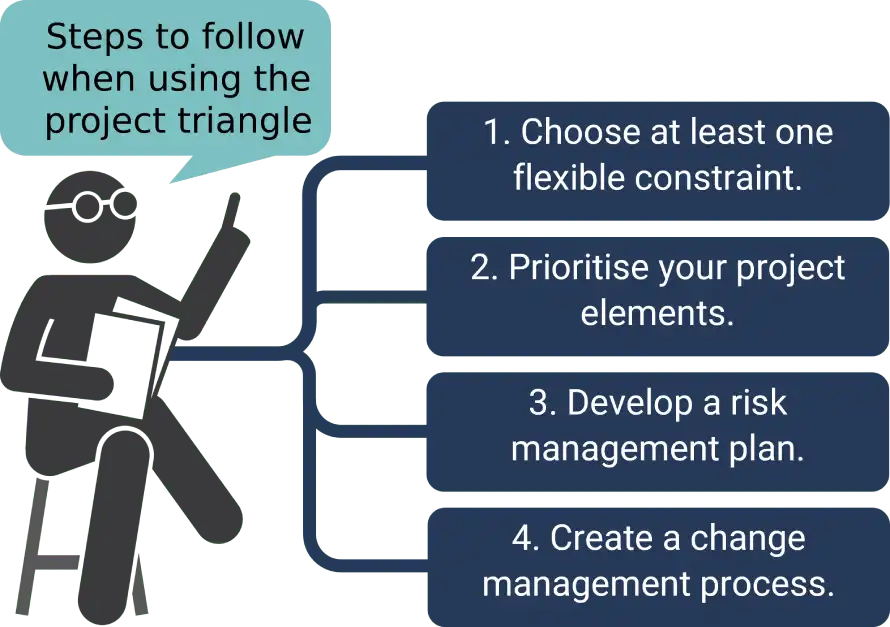
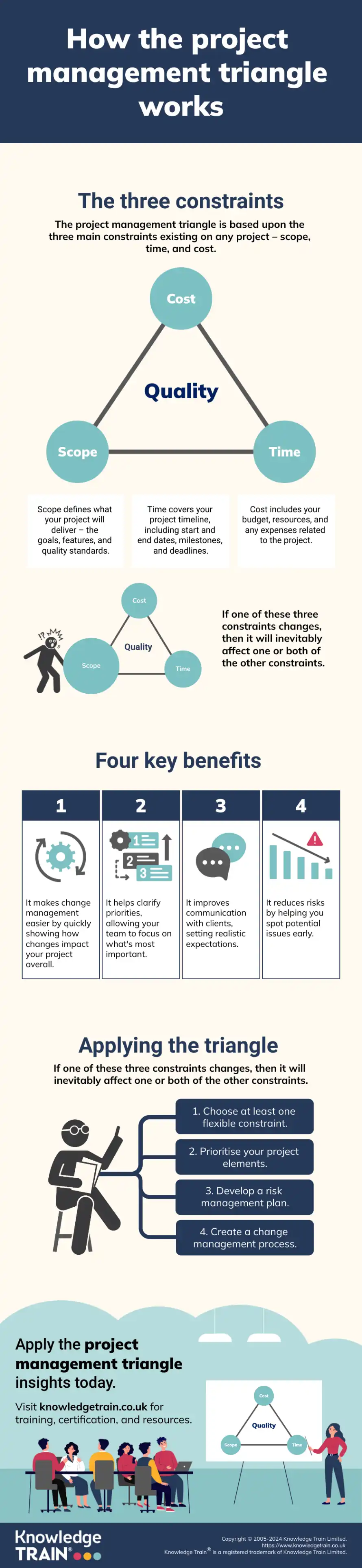
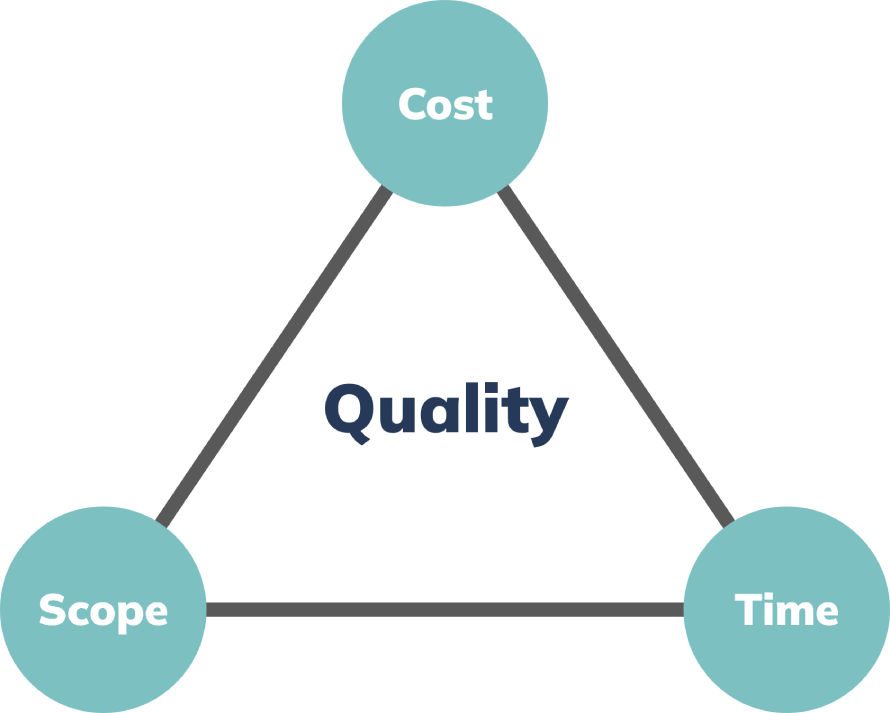
Maintaining the balance of the project management triangle requires strategic decisions and careful trade-offs between scope, time, and cost. Here are some tips to help: quality issues
Choose at least one flexible constraintKnowledge Train is a PRINCE2 Agile Accredited Training Organization. in deliverables.AXELOS Peoplecert accredited training organisation for ITIL (IT Infrastructure Library).
One constraint should be identified as more flexible than the others. This allows some wiggle room when dealing with changes or issues. Ask yourself: Solutions
- Which constraint is easiest or least impactful to change?Knowledge Train is a Lean Six Sigma Accredited Training Organization.Establish and communicate clear quality standards at the beginning of the project.Knowledge Train is an AIPGF Accredited Training Organization.
- Are stakeholders willing to adjust scope, extend deadlines, or increase budget if necessary? Implement regular quality checks throughout the project lifecycle.
- How will increased flexibility in one constraint impact the other two?BCS accredited training partner for Business Analysis.Involve stakeholders in continuous feedback loops.Knowledge Train is an AIPGF Accredited Training Organization.
Identifying a flexible constraint up-front allows for better risk management and issue resolution. Allocate resources for testing and quality assurance processes.
Prioritise features and requirementsKnowledge Train is a Change Management Accredited Training Organization.With preparation of ways to address these hurdles, you will be one step closer to coping with the strain on the project management triangle. Keep in mind that this is where some creative strategising can help you maintain control of all these factors. It’s good to frequently ask “how are things going” and be willing to switch things around to keep them in balance.BCS accredited training partner for Business Analysis.
It is important to carefully evaluate the importance of each project deliverable. This will help you focus on what is essential to project success. Create a comprehensive list of features and requirements, then: Best practices for implementing the project management triangle
- Rank or score each based on value and importanceKnowledge Train is an MSP Accredited Training Organization.Best practices for implementing the project management triangle include the following:WHAT YOU WILL GET
- Clearly define “must-have” vs. “nice-to-have” features Stakeholder communicationOur courses and workshops include:
- Leverage prioritisation to inform trade-off decisions.AXELOS Peoplecert accredited training organisation for ITIL (IT Infrastructure Library). One of the most important aspects of effectively implementing the project management triangle is Certification exam(s) where applicable
This prioritisation process allows for objective trade-off discussions if needed. communicatingAccredited training course materials
Develop a risk management planAXELOS Peoplecert accredited training organisation for ITIL (IT Infrastructure Library). with stakeholders. Project managers should communicate regularly with stakeholders to keep them informed and manage their expectations. It can also help to keep stakeholders engaged and on board with the project. There are several best practices for communicating with stakeholders, including the following:Expert, experienced trainers to support you
Proactively identifying and managing risks will help avoid imbalances in the triangle. A Schedule regular meetings with stakeholders to discuss the project.Course manual where applicable.risk managementKnowledge Train is an AIPGF Accredited Training Organization.Provide stakeholders with a visual representation of the triangle. This can help them to understand the trade-offs that are being made. plan Use plain language when communicating with stakeholders. Avoid jargon and technical terms that may be confusing.SELF-PACED ONLINE TRAINING COURSES should include:Encourage stakeholders to ask questions and share their concerns.Knowledge Train is an AIPGF Accredited Training Organization.Self-paced online training courses (e-learning) include:
- Identification of risks that could impact any of the constraintsRegular monitoring and adjustments Certification exam(s) where applicable
- Risk scoring based on probability and impactAnother important aspect of the project management triangle is BCS accredited training partner for Business Analysis.Accredited training course materials
- Detailed contingency plans for high-priority risksmonitoring and adjusting Support from expert, experienced trainers
- A monitoring process to reassess risks throughout the project.. Project managers need to keep a close eye on the project and make adjustments as needed to keep it on track. There are several best practices for monitoring and adjusting, including the following:WHAT YOU WILL GETLatest educational technology.
Risk managementUse a tracking system to monitor the project. This will help you to keep track of progress and adjust as needed.Our courses and workshops include: ensures prevention of imbalances before they happen.Review the project plan on a regular basis. This will help you to stay on track and make changes as necessary.Certification exam(s) where applicableBUSINESS SOLUTIONS
Create a change management planAdjust the plan when necessary. If you find that you are off track, you can always make adjustments to get back on track.Accredited training course materials
Change is inevitable on projects. A Decisions based on information to revise project plans.Expert, experienced trainers to support you change management planTeam collaboration and accountabilityCourse manual where applicable.TO HELP ORGANISATIONS IMPROVE provides a process for considering how changes impact the constraints. A plan should include:Project managers can also foster collaboration and teamwork among team members by holding them accountable for their part of the work. When team members know that they will be held accountable for their work, they are more likely to collaborate with others to complete the project successfully. There are several best practices for collaborating and holding team members accountable, including the following: We offer solutions to help improve team performance including:
- A system for submitting, reviewing, and approving changesAssign clear roles and responsibilities to each team member. This will help everyone to understand what they need to do and be held accountable for their part of the project.SELF-PACED ONLINE TRAINING COURSESConsultancy services
- Procedures for assessing change impact on each constraintEncourage team members to collaborate with each other. This can be done by setting up regular team meetings and encouraging team members to communicate with each other.Self-paced online training courses (e-learning) include:Staff development
- Approval thresholds based on change type and sizeTrack team members’ progress and hold them accountable for their work. This can be done by regularly reviewing each team member’s progress and providing feedback.Certification exam(s) where applicableCompliance training
- Communication plans for approved changesRecognise and reward efforts that support successful constraint management.Accredited training course materialsApprenticeship training
A structured change management process helps to prevent imbalances.Continuous improvementSupport from expert, experienced trainersCustom e-Learning development
Match management methodology to priority constraintsAdopt a culture of Latest educational technology.
continuous improvement
- when working with the project triangle.BUSINESS SOLUTIONSReview the project after completion to determine lessons learned
- Evaluate what worked and didn’t work for finding the balance between the constraints Promote team members to share ideas for process improvementsTO HELP ORGANISATIONS IMPROVE
- Lean approachesStay updated on emerging project management methodologies and tools.We offer solutions to help improve team performance including: prioritise efficiency and cost control and are useful when budget is the main constraint.Incorporating these best practices can help project managers to learn the project management triangle. However, success will depend on dedication, flexibility, and the ability to learn from both successes and failures.Consultancy services
Choosing the right approach from the beginning aligns with the key constraints.Applying the project management triangleStaff developmentCONTACT US
Follow the tips above to help manage the project management triangle and balance constraints throughout your project. The most important thing is to continuously monitor and maintain alignment of the three sides. Assess the status of scope, time, and cost regularly to identify imbalances. Be willing to make informed decisions and trade-offs as necessary. And communicate clearly with stakeholders about any changes to plans or constraints.To help us see how we can do this, it’s worth looking at some examples of best practice in real-world situations. We will take three case studies below and see how things were managed in each of them.Compliance training
Strategies for balancing constraintsLarge-scale IT projectApprenticeship training
Managing constraints effectively requires specific strategies for each side of the project management triangle. Here are some tips for balancing scope, time, cost and quality:A global corporation launched a Custom e-Learning development
Scope management techniquesworldwide ERP implementation
When managing project scope, you can try these tips:. The Project Manager in this case struggled to ensure the best balance between the different project triangle dimensions.
- Define project boundariesKey measures include prioritised the most important core functionalities to manage scope, implemented a phased rollout to manage time and cost constraints, and utilised change management processes to assess and evaluate new requirements.Find out moreName: Clearly outline the scope of the project and its deliverables at the beginning.Result
- Scope change control: The project delivered under budget, with minimal impact on time, and fulfilled all essential business requirements. A commercial
- skyscraper building construction project faced unexpected geological conditions which created a major risk to the project triangle.
- Key measures include reallocated budget from non-essential features to resolve foundation issues, accelerated other construction phases to make up for initial delays, and negotiated with stakeholders to adjust project scope without compromising quality.Result: The building was completed safely, with a minor delay and a slight increase in the budget.Product development initiative
A tech startup wanted to launch a
new software product
- in a highly competitive market, but it struggled to strike the right balance between innovation and the pressure to get the product to market in time.Key measures include employed an
- Agile methodology
- to manage scope flexibly, focused on developing a Minimum Viable Product (MVP) for the initial release and utilised customer feedback to prioritise further feature development after launch.Result
- : The product was able to be launched in time, within the budget, and has gained a high level of market share quickly due to its core functionality and the improvements that have been iteratively made since the launch.These examples illustrate successful applications of the project triangle in diverse industries and projects. They show how effective management of scope, time, and cost can overcome challenges and deliver value.
Enhance your skills with our expert-led courses
- Instructor-ledIntroduction to Project Management course
- £499 +vat
- See all dates