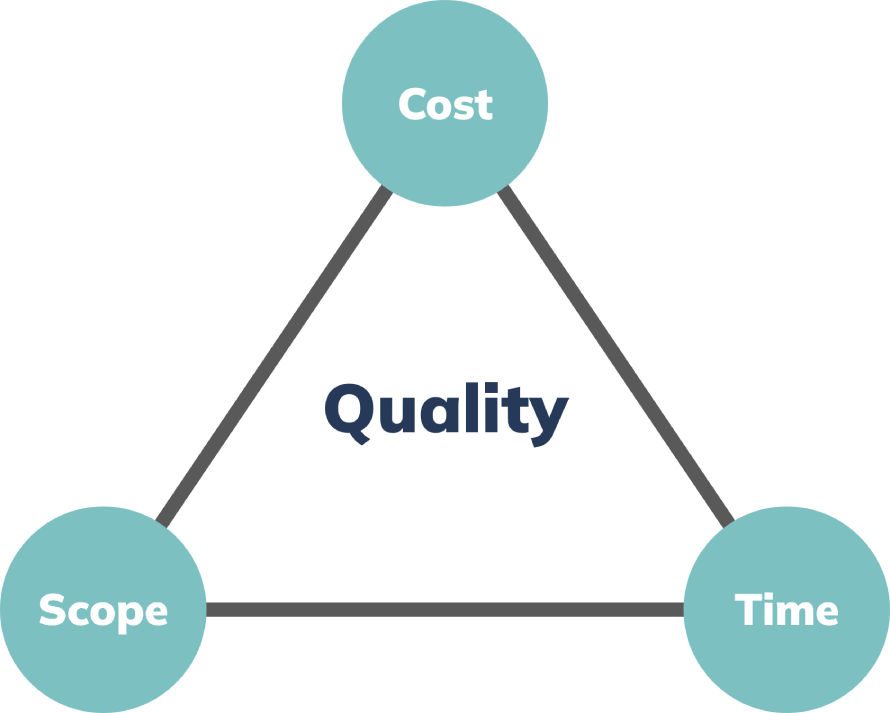
projectLEAN SIX SIGMA COURSES. The scope refers to the project’s requirements, objectives, and deliverables. Time refers to the schedule and deadlines. Cost encompasses the budget and resources. The challenge is to optimise all three to meet project goals.Select your preferred training course below:
Each corner of the triangle is dependent on the other two. A change in one element typically results in a change in at least one other. By understanding and managing these constraints, project teams can make informed decisions and adjustments to ensure project success.
The project management triangle is a fundamental concept that helps BUSINESS ANALYST COURSESproject managers Select your self-paced training course topic.visualise and optimise the key constraints of any project. By balancing scope, time, and cost, project teams can deliver successful outcomes that meet stakeholder expectations.
Understanding the project management triangleBCS BUSINESS ANALYST COURSES
The three constraints explainedSelect your preferred training course below:
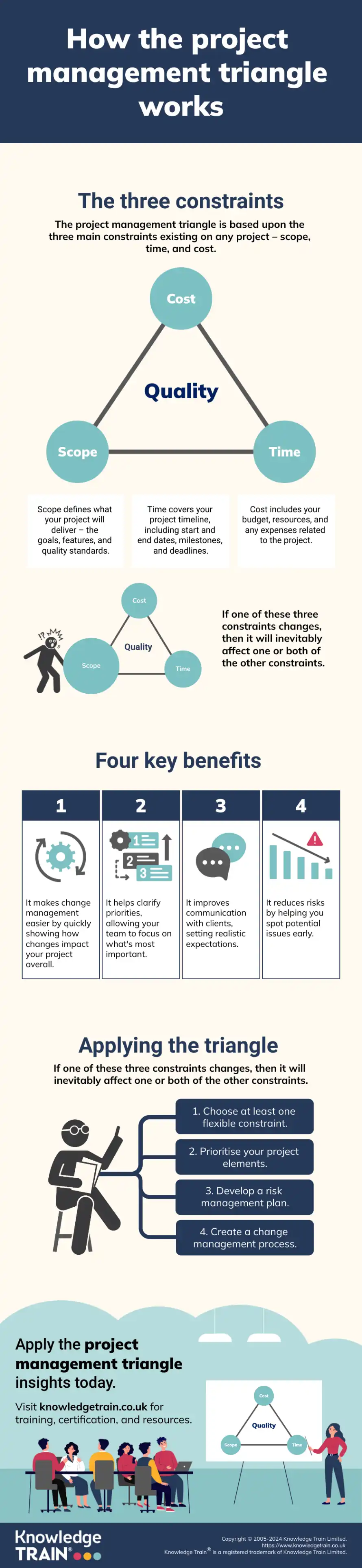
The project management triangle is made up of three main constraints: scopeCHANGE MANAGEMENT COURSES, Select your self-paced training course topic.time and APMG CHANGE MANAGEMENT COURSEScostSelect your preferred training course below:. Let’s have a detailed look at each of these.
- ScopePROGRAMME MANAGEMENT COURSES: Scope refers to the boundaries, objectives and deliverables of a project. It includes the goals and requirements of the project, as well as the specific features, functionalities and quality standards.Select your self-paced training course topic.
- Time : The time constraint of a project refers to its duration and schedule. It involves factors such as the project start and end dates, milestones and deadlines, as well as the sequencing and dependencies of tasks.MSP COURSES
- CostSelect your preferred training course below:: The cost constraint relates to the financial and resource aspects of a project. This includes the budget allocated to the project as well as the human resources and labour costs, and equipment and material expenses.
Relationship between constraintsIT QUALIFICATIONS
The three constraints of scope, time and cost are interconnected and can impact each other. Changes to one constraint will likely influence the other constraints. For example, an increase in scope will often require additional time and resources, whereas a reduction in time may increase costs or decrease scope. Similarly, a reduction in budget may affect the project scope or timeline.Select your preferred qualification.
Project managers must carefully balance these constraints throughout the project lifecycle.ITIL COURSES
Impact on project qualitySelect your preferred training course below:
The balance of scope, time and cost also has an impact on the qualityIT QUALIFICATIONS of the project outcomes. If the three constraints are well-balanced, the project is more likely to achieve high-quality results. On the other hand, if there is an imbalance in any of the constraints, the quality of the project may be compromised. For example:Select your preferred qualification.
- A tight deadline may lead to a rushed project, resulting in lower quality outputs.
- A limited budget may result in a project being understaffed or under-resourced, which may also affect quality.ITIL COURSES
- A project with an overambitious scope can strain resources and time, leading to poor results.Select your preferred training course below:
Successful project management involves finding the right balance and making trade-offs between the three constraints while maintaining the desired level of quality. By understanding the impact of these constraints on each other, project managers can make informed decisions to lead the projectLEARNING LIBRARIES to a successful outcome.Select your preferred training course topic.
Benefits of using the project management triangle
Utilising the project management triangle provides some distinct benefits to the project team and stakeholders. These are as follows.AI QUALIFICATIONS & WORKSHOPS
Easier change managementSelect your preferred qualification or workshop.
The triangle model helps to make changes easierAIPGF COURSES. This is because if a change arises, the project managers can easily evaluate how this change will affect the scope, time and cost, decide, as such it helps to quickly evaluate a change request, understand the ripple effects, and make an informed decision on change.Select your preferred training course below:
Priority clarification
Visualising the three constraints helps to BCS AI COURSESclarify prioritiesSelect your preferred training course below:. This will make it possible for the team to quickly identify important elements in the project, direct resources to important tasks and make trade-offs as required based on the project goals.
Improved client communicationAIPGF COURSES
The triangle is a helpful Select your preferred training course below:communication tool to both communicate with and educate clients. The project managers can use the triangle to show the project’s constraints to the clients, visualise how changes would affect them, and set realistic expectations regarding project deliverables.AI WORKSHOPS
Risk reductionSelect your preferred workshop below:
Utilising the triangle will help in managing risksKnowledge Train is a PRINCE2 Accredited Training Organization.. This is possible because this will help the team to predict potential problems earlier in the process, have a contingency plan, and balance the risks in all three constraints.
The use of the project management triangle allows for Knowledge Train is an AgilePM Accredited Training Organization.managers to make decisions in a balanced manner. As such, it becomes possible to deal with complex projects with great ease.Knowledge Train is a PRINCE2 Agile Accredited Training Organization.
- the project scope.
- Monitor for scope creep : Regularly review project requirements to ensure they align with the defined scope.
- Prioritisation : Use a prioritisation method, such as MoSCoWCONTACT US, to determine which features are essential, desirable, optional, or not required.
Time management approaches
When managing project time, you can try these tips:
- Critical path : Identify the tasks that must be completed on time for the project to stay on schedule.
- Resource levelingName: Optimise the use of resources to avoid overloading or underutilisation.
- Timeboxing : Set a fixed time period for specific tasks or project phases.Email
- Agile sprints
- ClickUpAWARDS: A feature-rich tool with robust Agile project support and time tracking and resource management features. ClickUp also provides multiple view options (list, board, Gantt, calendar) to cater to different preferences and project needs.We don’t go seeking awards, but here are two of the awards we have received for our training.
- Teamwork : A client-focused platform designed for team collaboration. It has a budget and expense tracking features, as well as risk management Request a quote and issue tracking tools for comprehensive project management.
Key features to look for in project management tools
When choosing a project management tool, consider these vital features and capabilities:
- Constraint tracking : The ability to track and manage scope, time and cost constraints concurrently+44 (0)207 148 5985
- Resource allocation