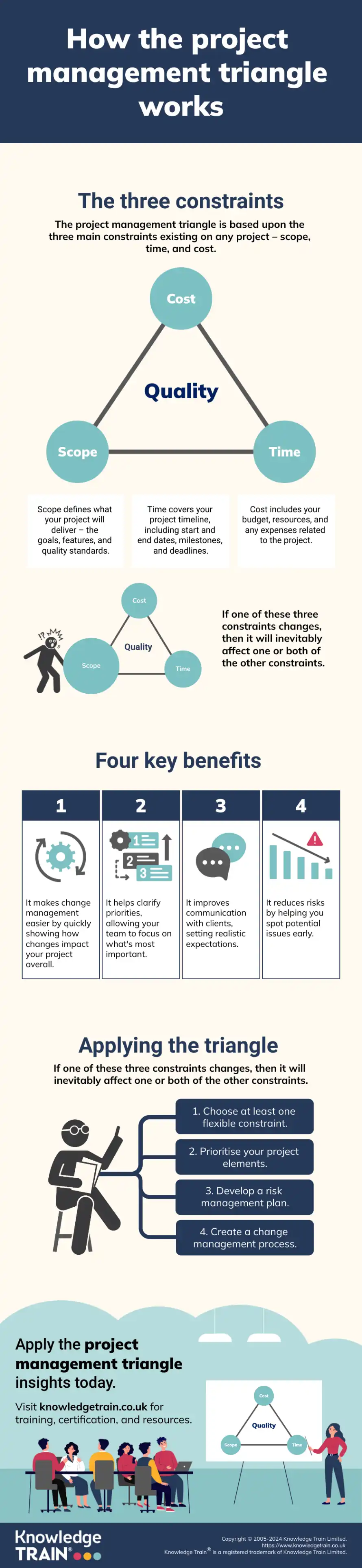
Project management triangle

Key takeaways – Agile Project Management
Scope, time and cost move together, so every change needs a conscious trade-off.Foundation
- Any shift in scope, schedule, or budget typically forces an adjustment in at least one other constraint.Learn the key principles of Agile Project Management.
- Imbalances often show up as rushed work, under-resourcing, or overambitious deliverables that reduce quality.Practitioner
- Pick at least one flexible constraint early so you can respond to issues without losing control.
IntroductionLearn how to use AI tools in everyday project work.
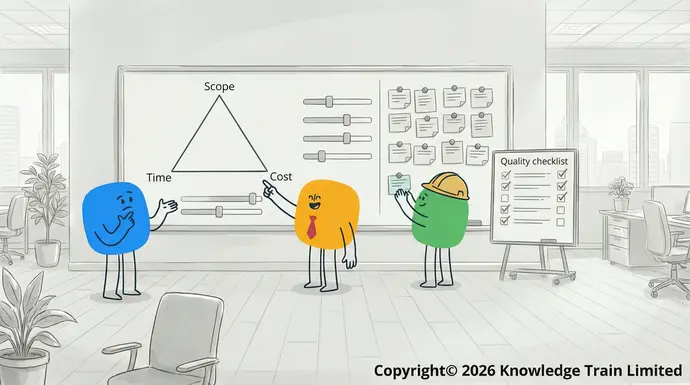
The ARTIFICIAL INTELLIGENCE (AI)project management triangleBCS AI, also known as the triple constraint model, is a concept that visualises the constraints of Foundation scopeLearn the fundamentals of artificial intellegence., AI Project Governance Framework (AIPGF)timeFoundation , and Learn the fundamentals of the governance framework.costPractitioner in Includes Foundation & Practitioner combined option.project managementWorkshops. It highlights the interconnected nature of these three aspects in delivering a successful project.AI in Project Management
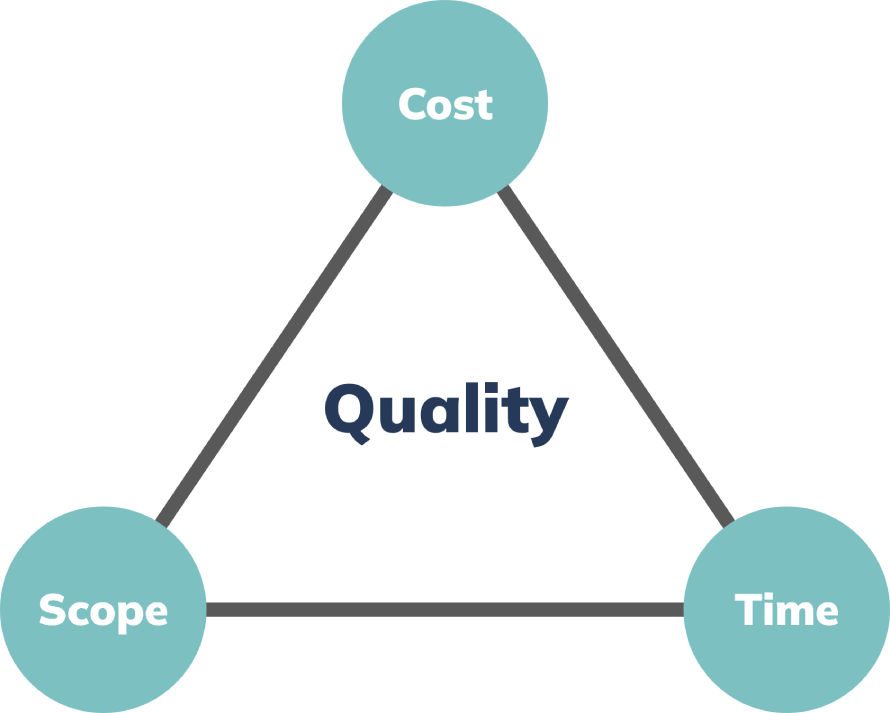
The triangle model is a crucial tool for project managers to understand and balance the competing demands of a Learn how to use AI tools in everyday project work.projectAGILE. The scope refers to the project’s requirements, objectives, and deliverables. Time refers to the schedule and deadlines. Cost encompasses the budget and resources. The challenge is to optimise all three to meet project goals.AgilePM
Each corner of the triangle is dependent on the other two. A change in one element typically results in a change in at least one other. By understanding and managing these constraints, project teams can make informed decisions and adjustments to ensure project success.®
The project management triangle is a fundamental concept that helps – Agile Project Managementproject managers Foundation visualise and optimise the key constraints of any project. By balancing scope, time, and cost, project teams can deliver successful outcomes that meet stakeholder expectations.Learn the key principles of Agile Project Management.
Understanding the project management trianglePractitioner
Includes Foundation & Practitioner combined option.
- ScopeScrum: Scope refers to the boundaries, objectives and deliverables of a project. It includes the goals and requirements of the project, as well as the specific features, functionalities and quality standards.Scrum Essentials
- TimeSelf-paced training course to learn the essentials of Scrum.: The time constraint of a project refers to its duration and schedule. It involves factors such as the project start and end dates, milestones and deadlines, as well as the sequencing and dependencies of tasks.Scrum Master
- CostChoose Scrum Alliance or Scrum.org Scrum Master training courses.: The cost constraint relates to the financial and resource aspects of a project. This includes the budget allocated to the project as well as the human resources and labour costs, and equipment and material expenses.Scrum Product Owner
Relationship between constraintsChoose Scrum Alliance or Scrum.org Product Owner training courses.
The three constraints of scope, time and cost are interconnected and can impact each other. Changes to one constraint will likely influence the other constraints. For example, an increase in scope will often require additional time and resources, whereas a reduction in time may increase costs or decrease scope. Similarly, a reduction in budget may affect the project scope or timeline.AgileBA
Project managers® must carefully balance these constraints throughout the project lifecycle. – Agile Business Analysis
Impact on project qualityFoundation
The balance of scope, time and cost also has an impact on the Learn the fundamentals of Agile Business Analysis.qualityPractitioner of the project outcomes. If the three constraints are well-balanced, the project is more likely to achieve high-quality results. On the other hand, if there is an imbalance in any of the constraints, the quality of the project may be compromised. For example:4-day course including Foundation.
- A tight deadline may lead to a rushed project, resulting in lower quality outputs.Lean Six Sigma
- A limited budget may result in a project being understaffed or under-resourced, which may also affect quality.Yellow Belt
- A project with an overambitious scope can strain resources and time, leading to poor results.Self-paced training course to gain LSS Yellow Belt.
Successful project management involves finding the right balance and making trade-offs between the three constraints while maintaining the desired level of quality. By understanding the impact of these constraints on each other, project managers can make informed decisions to lead the PMIproject® to a successful outcome.PMI-ACP
Benefits of using the project management triangleSelf-paced course to prepare you for the exam (exam not included).
Business Analysis Practices The triangle is a helpful communication toolGain practitioner certificate in business analysis practices. to both communicate with and educate clients. The project managers can use the triangle to show the project’s constraints to the clients, visualise how changes would affect them, and set realistic expectations regarding project deliverables.Requirements Engineering
Risk reductionGain practitioner certificate in requirements engineering.
Utilising the triangle will help in Business Analysis International Diploma managing risksAll 4 courses bundled into this Diploma certification package.. This is possible because this will help the team to predict potential problems earlier in the process, have a contingency plan, and balance the risks in all three constraints.AgileBA
The use of the project management triangle allows for ®managers – Agile Business Analysis to make decisions in a balanced manner. As such, it becomes possible to deal with complex projects with great ease.Foundation training
Managing the project management trianglePractitioner
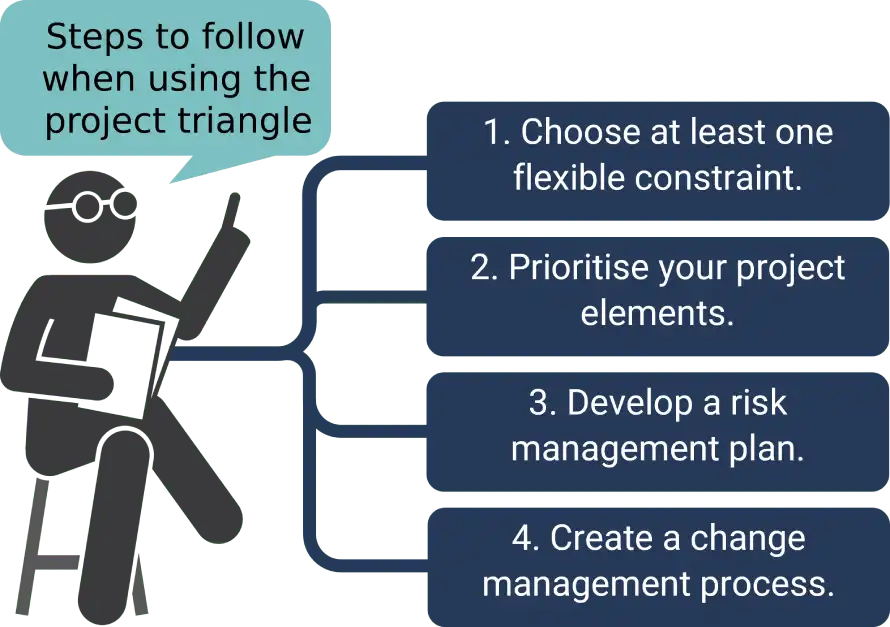
Maintaining the balance of the project management triangle requires strategic decisions and careful trade-offs between scope, time, and cost. Here are some tips to help:Includes Foundation & Practitioner combined option.
Choose at least one flexible constraintINFORMATION TECHNOLOGY (IT)
One constraint should be identified as more flexible than the others. This allows some wiggle room when dealing with changes or issues. Ask yourself:ITIL
- Which constraint is easiest or least impactful to change?®
- Are stakeholders willing to adjust scope, extend deadlines, or increase budget if necessary?Foundation
- How will increased flexibility in one constraint impact the other two?Learn the fundamentals of ITIL service management.
Identifying a flexible constraint up-front allows for better risk management and issue resolution.Strategist DPI
Prioritise features and requirements3-day ITIL Strategist: Direct, Plan & Improve (DPI) course.
It is important to carefully evaluate the importance of each project deliverable. This will help you focus on what is essential to project success. Create a comprehensive list of features and requirements, then:Specialist: DSV
- Clearly define “must-have” vs. “nice-to-have” features
- Leverage prioritisation to inform trade-off decisions.
- the project scope.
- Monitor for scope creepAGILE QUALIFICATIONS: Regularly review project requirements to ensure they align with the defined scope.Select your preferred qualification.
- Prioritisation : Use a prioritisation method, such as AGILE PROJECT MANAGEMENT COURSESMoSCoWSelect your preferred training course below:, to determine which features are essential, desirable, optional, or not required.
Time management approachesPRINCE2 AGILE COURSES
When managing project time, you can try these tips:Select your preferred training course below:
- Critical path : Identify the tasks that must be completed on time for the project to stay on schedule.SCRUM COURSES
- Resource levelingSelect your preferred training course below:: Optimise the use of resources to avoid overloading or underutilisation.
- TimeboxingAGILE BUSINESS ANALYSIS COURSES: Set a fixed time period for specific tasks or project phases.Select your preferred training course below:
- Agile sprints : Break the project into short, focused work cycles with specific goals.BUSINESS ANALYSIS QUALIFICATIONS
Cost control methodsSelect your preferred qualification.
When managing project cost, you can try these tips:
- Earned value managementBCS BUSINESS ANALYSIS COURSES: Track the project’s progress in relation to its budget and schedule.Select your preferred training course below:
- Cost baseline : Create a detailed budget for each phase of the project.AGILE BUSINESS ANALYSIS COURSES
- ForecastingSelect your preferred training course below:: Regularly estimate the future costs of the project based on current performance and trends.
- Vendor managementCHANGE MANAGEMENT QUALIFICATIONS: Negotiate favourable terms and monitor supplier costs.Select your preferred qualification.
Quality assurance practices
When managing project quality, you can try these tips:APMG CHANGE MANAGEMENT COURSES
- Quality standardsSelect your preferred training course below:: Define specific, measurable quality criteria for the project deliverables.
- Continuous testingPROGRAMME MANAGEMENT QUALIFICATIONS: Implement regular quality checks throughout the project lifecycle.Select your preferred qualification.
- Peer review : Leverage the expertise of team members to identify and address quality issues.MSP COURSES
- Customer feedbackSelect your preferred training course below:: Regularly collect and incorporate stakeholder feedback on project deliverables.
Through the implementation of these methods, project managers can successfully navigate and mitigate trade-offs between the competing constraints of scope, time, cost, and quality. However, it is important to note that constraint management is an iterative process that necessitates continuous monitoring and adjustment in response to changing project dynamics.PMI COURSES
Tools for managing the project management triangleSelect your preferred training course below:
Software can help you keep track of the project management triangle and ensure your project management is top-notch. Here are some of the best project management software to consider:
Project management software optionsPMI COURSES
- Monday.comSelect your preferred training course below:: A flexible platform suitable for multiple project types and management styles. With Visual boards for easy task tracking and prioritisation, it’s one of the best software for project management, and it also has customisable workflows for specific project requirements.
- ClickUpPRINCE2 COURSES: A feature-rich tool with robust Agile project support and time tracking and resource management features. ClickUp also provides multiple view options (list, board, Gantt, calendar) to cater to different preferences and project needs.Select your preferred training course below:
- Teamwork : A client-focused platform designed for team collaboration. It has a budget and expense tracking features, as well as APM COURSESrisk managementSelect your preferred training course below:
- AGILE PROJECT MANAGEMENT COURSESs: Compatibility with other software and tools used within your organisationSelect your preferred training course below:
- Customisation options : Flexibility to adapt the software to your project management methodologies and processesPRINCE2 AGILE COURSES
- Mobile accessibilitySelect your preferred training course below:: Mobile applications or responsive interfaces for on-the-go project management.
With the right tool and these essential features, project managers will be in a much better position to maintain the constraints of the project management triangle. Software solutions can enhance project visibility, foster better communication and support data-driven decisions throughout the project lifecycle.SCRUM COURSES
Common challenges and solutions
Scope creepMSP COURSES
Scope creepSelect your preferred training course below: involves changes or expansion in the project’s scope after it has already started. This can lead to an increase in resources, time, and effort needed to complete the project.
SolutionsIT QUALIFICATIONS
- Establish a formal change control process to manage scope changes effectively.Select your preferred qualification.
- Clearly define project scope and requirements during the planning phase.
- Communicate regularly with stakeholders to manage expectations.ITIL COURSES
- Implement a prioritisation system for new requests and changes.Select your preferred training course below:
Time constraints
Projects often face IT QUALIFICATIONStight deadlinesSelect your preferred qualification., which can put pressure on the team and the quality of work.
SolutionsITIL COURSES
- Use critical path analysis to identify and focus on essential tasks.Select your preferred training course below:
- Implement time-boxing techniques to improve focus and productivity.
- Consider parallel processing of tasks where possible.LEARNING LIBRARIES
- Negotiate for deadline extensions when necessary.Select your preferred training course topic.
Budget limitations
Limited budgetsAI QUALIFICATIONS & WORKSHOPS can restrict resources, impacting the project’s scope and quality.Select your preferred qualification or workshop.
Solutions
- Conduct thorough cost estimation during the planning phase.AIPGF COURSES
- Implement earned value management (EVM) to track project cost performance.Select your preferred training course below:
- Explore cost-effective alternatives for resources.
- Prioritise budget allocation for critical project components.BCS AI COURSES
quality issues in deliverables.AIPGF COURSES
- Knowledge Train is an AgilePM Accredited Training Organization.
- Stay updated on emerging project management methodologies and tools.
Incorporating these best practices can help project managers to learn the project management triangle. However, success will depend on dedication, flexibility, and the ability to learn from both successes and failures. Knowledge Train is a PRINCE2 Agile Accredited Training Organization.
Applying the project management triangle
To help us see how we can do this, it’s worth looking at some examples of best practice in real-world situations. We will take three case studies below and see how things were managed in each of them. Knowledge Train is a Lean Six Sigma Accredited Training Organization.
Large-scale IT project
A global corporation launched a BCS accredited training partner for Business Analysis.worldwide ERP implementation . The Project Manager in this case struggled to ensure the best balance between the different project triangle dimensions. Knowledge Train is a Change Management Accredited Training Organization.
Key measures include prioritised the most important core functionalities to manage scope, implemented a phased rollout to manage time and cost constraints, and utilised change management processes to assess and evaluate new requirements.
Result Knowledge Train is an MSP Accredited Training Organization.: The project delivered under budget, with minimal impact on time, and fulfilled all essential business requirements.
Construction project AXELOS Peoplecert accredited training organisation for ITIL (IT Infrastructure Library).
A commercial skyscraper building construction AXELOS Peoplecert accredited training organisation for ITIL (IT Infrastructure Library). project faced unexpected geological conditions which created a major risk to the project triangle.
Key measures include reallocated budget from non-essential features to resolve foundation issues, accelerated other construction phases to make up for initial delays, and negotiated with stakeholders to adjust project scope without compromising quality. Knowledge Train is an AIPGF Accredited Training Organization.
Result : The building was completed safely, with a minor delay and a slight increase in the budget. Knowledge Train is an AIPGF Accredited Training Organization.
Product development initiative
A tech startup wanted to launch a BCS accredited training partner for Business Analysis.new software product in a highly competitive market, but it struggled to strike the right balance between innovation and the pressure to get the product to market in time. WHAT YOU WILL GET
Key measures include employed an Our courses and workshops include:Agile Certification exam(s) where applicablemethodology Accredited training course materials to manage scope flexibly, focused on developing a Minimum Viable Product (MVP) for the initial release and utilised customer feedback to prioritise further feature development after launch. Expert, experienced trainers to support you
Result Course manual where applicable.: The product was able to be launched in time, within the budget, and has gained a high level of market share quickly due to its core functionality and the improvements that have been iteratively made since the launch.
These examples illustrate successful applications of the project triangle in diverse industries and projects. They show how effective management of scope, time, and cost can overcome challenges and deliver value. SELF-PACED ONLINE TRAINING COURSES
CONTACT US
Name
Phone
How can we help?
Submit