RAID in project management

Key takeawaysSelect your preferred training course below:
RAID helps teams anticipate uncertainty and manage it in a structured, visible way.
- Capture risks, assumptions, issues, and dependencies in a single RAID log that is reviewed and updated regularly.LEAN SIX SIGMA COURSES
- Prioritise items by likelihood and impact so time and budget go to the highest exposure areas.Select your preferred training course below:
- Turn high-priority RAID items into clear SMART actions with named owners and deadlines.
- Use RAID updates to improve stakeholder confidence through transparent, routine communication.BUSINESS ANALYST COURSES
- Keep RAID lightweight for smaller projects to avoid overhead and paralysis by analysis.Select your self-paced training course topic.
- Knowledge Train is a PRINCE2 Agile Accredited Training Organization.
Validating assumptions is an ongoing process that should take place throughout the project lifecycle. Project managers should ensure assumptions are well-documented and reviewed regularly to verify their continued validity.
IssuesKnowledge Train is a Better Business Cases Accredited Training Organization.
5. Developing action plans
For high-priority items, develop strategies to address them and assign responsibilities. Ensure that each action plan is specific, measurable, achievable, relevant, and time-bound (SMART).CONTACT US
Tools and techniques for RAID analysis
RAID logs and templates
RAID logs are simple tools that can be created using spreadsheets or specialised templates. They provide a structured format for recording and updating RAID elements throughout the project lifecycle.
Software solutions for RAID management
Many project management toolsName offer integrated RAID functionality, which can help streamline the analysis process and facilitate real-time collaboration among team members.
Best practices for ongoing RAID monitoring
Regular review and updatesEmail
Schedule periodic RAID reviews to ensure their continued relevance and accuracy.
Encourage team members to report new RAID items as they are identified to maintain an up-to-date risk profile.
Stakeholder communication strategiesPhone
Share RAID updates in project status reports and address significant items in stakeholder meetings to ensure alignment and transparency.
By following these steps and utilising the appropriate tools and techniques, you can successfully implement RAID analysis in your projects. This will help you make better-informed decisions, mitigate risksHow can we help?
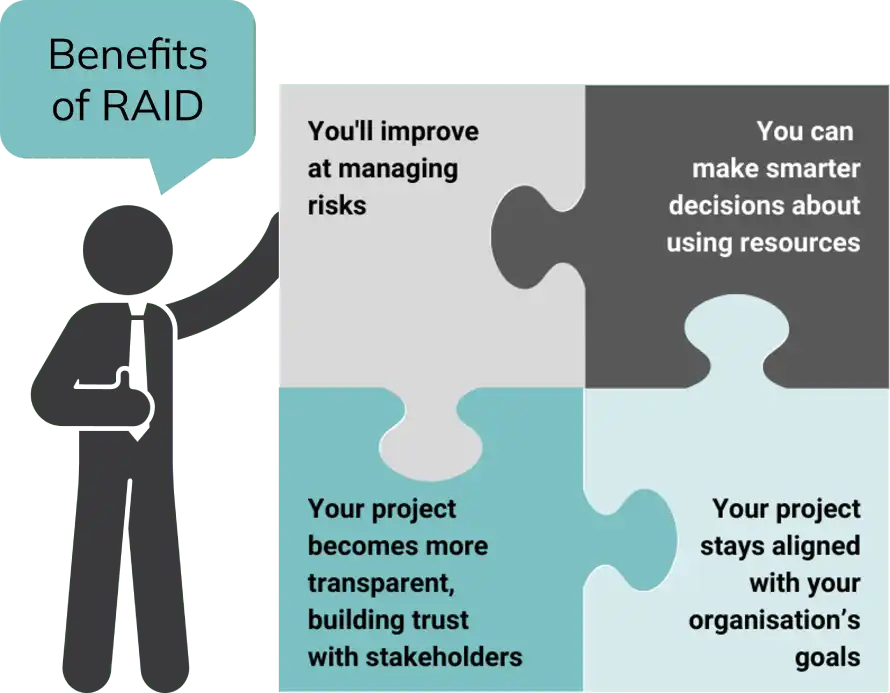
akeholder confidence
RAID analysis can also enhance transparency and stakeholder confidence in a project by:
- Sharing a clear and comprehensive overview of the project status and challengesAWARDS
- Enabling regular and proactive updates to the stakeholdersWe don’t go seeking awards, but here are two of the awards we have received for our training.
- Demonstrating a proactive and responsible approach to project management . Request a quote
This transparency builds trust and confidence among stakeholders, enhancing overall project support.
Better alignment with organisational strategies
RAID analysis can help in aligning projects with the organisational strategies and priorities by:
- Identifying potential conflicts or synergies between the project and the organisational objectives, policies, or initiatives+44 (0)207 148 5985
- Identifying opportunities for collaboration or support from other projects, programmes, or departments
- Supporting strategic decision-making at the project and portfolio levels.[email protected]
RAID analysis is a simple yet powerful tool that can help project managers and teams in delivering successful outcomes and creating value for their organisations.
Performing in-depth RAID analyses and maintaining RAID logs require dedicated time and resources, including:
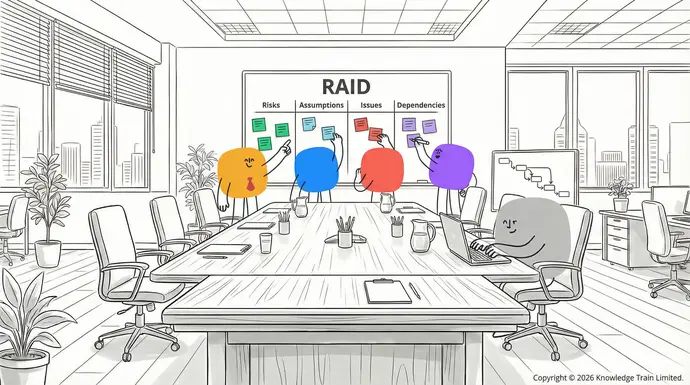
- Regular team meetings and brainstorming sessions
- Documentation and updates to the RAID log
- Ongoing monitoring and review of risks, assumptions, issues, and dependencies.
These activities can put a strain on teams with limited capacity or tight deadlines.
Risk of outdated information
RAID logs must be updated regularly to reflect the current state of the project. Without consistent maintenance, the analysis could become outdated, leading to:
- Team members making decisions based on inaccurate or obsolete informationSearch
- Emergence of new risks, issues, or dependencies that are not accounted for in the RAID log What is Agile? Agile Methodology, Principles, and Frameworks
- New risks or issues may not be recognised.
Overreliance on RAID analysis
There’s a risk of becoming too focused on RAID analysis, which can lead to several negative outcomes, such as:
- “Paralysis by analysis,” where over-analysis of risks, assumptions, issues, and dependencies hinders progress
- Neglect of other crucial aspects of project management, such as team dynamics, customer engagement, or process improvements United Kingdom
- Reduced agility and flexibility in responding to unexpected events or changes. Austria
Real-world applications of RAID Portugal
To provide a more practical understanding of how RAID analysis can be applied, we will investigate some examples from different industries. Romania
Case studies across different industries Slovakia
Construction project example Slovenia
A large construction project for an office building implemented RAID analysis: Spain
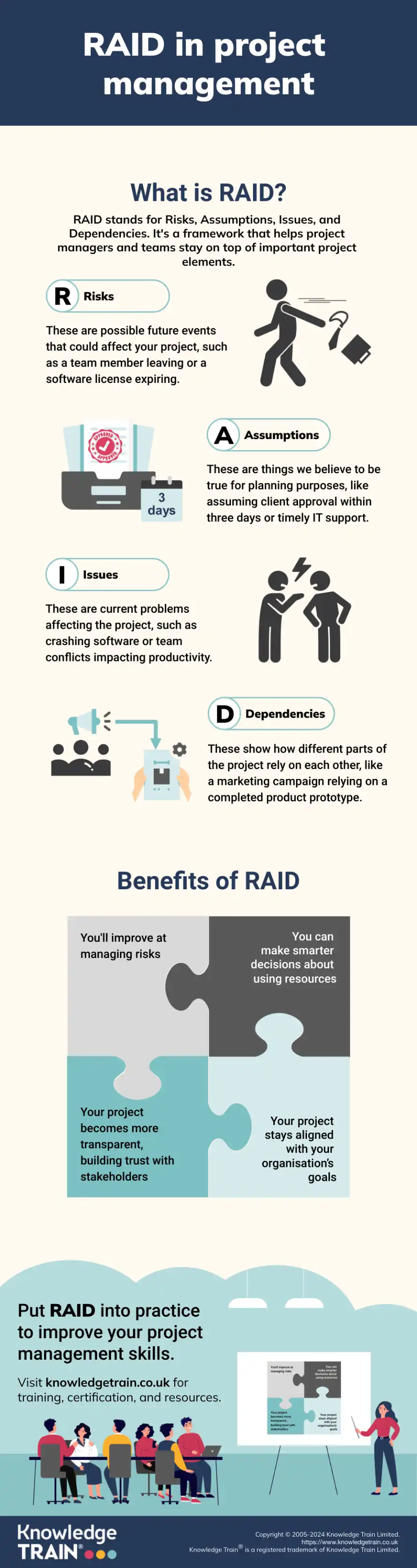
- Risks Sweden: Potential weather delays and supply chain disruptions were identified. Other countries
- Assumptions Home: Soil conditions were documented based on initial surveys. Project management
- Issues : Unexpected archaeological findings during excavation were addressed.
- Dependencies Project management: fundamentals, methodologies and best practices: Dependencies between construction phases were mapped.
The RAID analysis helped the team anticipate and mitigate various challenges, contributing to the project’s on-time completion. Simon Buehring
Software development project example 28 Apr 2026
A fintech startup used RAID analysis in the development of a new mobile banking application:
- Risks : Identified potential security vulnerabilities and regulatory changes.
- Assumptions : Clarified user interface preferences based on market research.
- Issues : Tackled integration problems with legacy banking systems.
- Dependencies : Outlined critical path for feature development and testing.
RAID analysis enabled the team to prioritise security measures and adapt to changing regulations seamlessly.
Event management project example
A global conference organiser implemented RAID for a major international summit:
- Risks : Anticipated potential travel restrictions and venue capacity changes.
- Assumptions : Documented expected attendance based on previous years’ data.
- Issues : Addressed last-minute speaker cancellations.
- Dependencies : Mapped relationships between various event elements (e.g., catering, technology).
RAID analysis facilitated quick adaptation to changing circumstances, ensuring a successful event.
Lessons learned and key takeaways from case studies Copied!
These case studies demonstrate that RAID analysis: Key takeaways
- Enhances adaptability across diverse project types. Strong project delivery comes from clear lifecycle control, the right framework, and disciplined communication.
- Facilitates proactive problem-solving and risk mitigation. Project management guides a temporary endeavour through initiating, planning, executing, monitoring and controlling, and closing.
- Improves communication and alignment among project stakeholders. Match methodology to context: Agile suits changing needs, while Waterfall and PRINCE2 fit defined scope and governance.
- Supports successful project outcomes in challenging environments. Clear roles, especially sponsor, stakeholders, and project manager, reduce conflict and speed decisions.
By applying RAID principles, project managers can significantly improve their ability to navigate complex projects and deliver successful results. Use practical tools like Gantt charts, critical path, and software dashboards to manage time, cost, and risk.
Integrating RAID with other project management methodologies Courses and certifications build leadership, communication, and analytical skills that improve career prospects and delivery outcomes.
RAID elements can be tailored to fit the processes of numerous other project management strategies.
RAID and Agile Project Management
When Agile methodologies Contents are in play, RAID elements can be tailored to fit iterative cycles:
- Integrate RAID topics into sprint planning
- Treat RAID logs as dynamic artifacts, evolving over the sprint’s duration Contents
- Synchronise RAID assessments with retrospectives for ongoing risk management What is project management? refinement.
- Initiatingcontinuous : Defining the project at a broad level, setting risk monitoring business case techniques. , and identifying stakeholders.
Potential developments in RAID frameworks Planning
Future developments in RAID frameworks may encompass: : Establishing the scope, objectives, detailed schedule, risk management plan, budget, deliverables, and resource allocation.
- Environmental and social factors in risk assessment Executing
- Integration with : Coordinating people and resources, as well as meeting established milestones and deliverables.sustainability metrics Monitoring and controlling
- Adaptation for : Tracking, reviewing, and regulating progress and performance, managing changes, and ensuring project stays on schedule and within scope.remote and distributed teams. Closing
Conclusion : Finalising all activities, handing over deliverables to the user/customer, releasing resources, and capturing
RAID analysis serves as a valuable tool in project management, empowering us to handle lessons learnedrisks ., Project management methodologies & frameworksassumptions Multiple methodologies and models structure how , projectsissues are managed:, and Agile methodologydependencies : effectively. By staying abreast of future trends and leveraging emerging technologies, we can enhance our RAID methodologies and drive project success. We invite you to explore RAID analysis and embrace its benefits for improved project management outcomes. Agile
FAQsStakeholders
What does RAID stand for in project management?: Individuals or groups affected by the project or who can impact its outcome, such as clients, suppliers, and team members.
RAID is an acronym that stands for Risks, Assumptions, Issues, and Dependencies, and it is a tool that is used to get a better and more complete oversight of all things project-related. Project team
How often should I update my RAID log? : Specialists responsible for delivering project tasks and deliverables.
A RAID log is a working document and should be updated as necessary. A good practice is to update your RAID log at least once a week or after a milestone has been achieved. Project sponsor
Can RAID analysis be used in small projects? : Provides financial resources and strategic guidance.
Yes, although the level of detail may be adjusted according to the project’s size and complexity. Project board/steering committee
What’s the difference between a risk and an issue in RAID? : High-level governance and decision making.
Risks are uncertain events that may happen in the future. Issues, on the other hand, are problems that are already happening and are having an impact on the project. Effective stakeholder management and clear team communication are essential for project success. The project manager must align interests, resolve conflicts, and support collaborative team dynamics.
How do I prioritise items in a RAID analysis? Essential project management skills
Prioritisation can be done based on the probability of occurrence and the impact that an event will have on the project. Risk matrices are a good tool for this purpose. The
Is RAID analysis suitable for all types of projects? skills required by project managers
RAID analysis can be used for all project types, but it should be adapted to the project’s specific needs and methodologies. are varied.
How can I involve my team in the RAID analysis process? Skill
Involve your team members in regular brainstorming sessions and make it easy for them to provide updates on RAID-related matters. Description
What are some common mistakes to avoid when implementing RAID? Leadership
Avoid making the process too complicated, not updating the RAID log regularly, and not taking action on identified risks, assumptions, issues, or dependencies. Inspiring and guiding teams towards common goals.
How does RAID analysis improve stakeholder communication? Communication
RAID can be used to provide stakeholders with a structured approach for addressing project challenges, risks, and strategies. Conveying information clearly among stakeholders and team members.
Can RAID analysis help with project budgeting and resource allocation? Risk management
Yes, RAID can provide valuable insights for budgeting and resource allocation by identifying potential risks and dependencies in the project. Identifying, analysing, and mitigating risks.
Infographic Scheduling