Agile
Agile project management
- Agile project management: Frameworks, benefits and how it works
- Simon Buehring
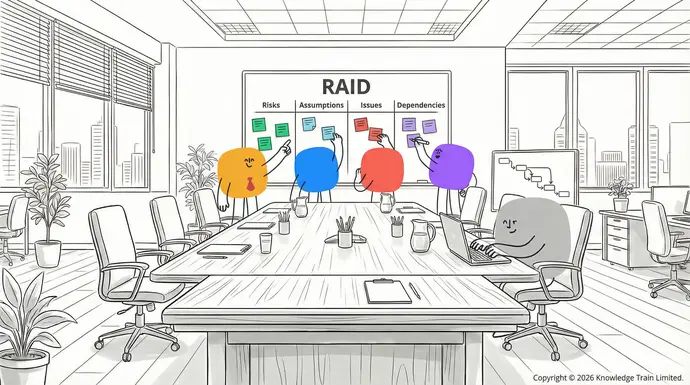
Lightweight governance, change management and technical debt controls help Agile scale without losing quality.
Contents Contents What is Agile project management? The Agile Manifesto: Values and principles Key Agile frameworks and methodologies
Agile vs traditional (waterfall) project management
Key roles and concepts in Agile projects Benefits of Agile project management
Challenges and limitations
Real-world applications and use cases
Related resources
FAQsWhat is Agile project management?Agile project management is an iterative approach to planning, executing, and
- delivering projects
- by breaking work into small, manageable increments known as iterations or sprints. Rather than following a strict linear plan,
- Agile
focuses on adaptability, team collaboration, and continuous delivery of value to stakeholders. Agile principles emphasise close communication, incremental progress, and regular feedback cycles to enhance quality and meet customer needs.
The Agile Manifesto: Values and principles
The Agile Manifesto, as they provide a basis for decision-making and help to highlight areas of uncertainty within a project. Some examples of project assumptions include: underpins Agile project management, defining four core values and twelve guiding principles. These foster a culture of collaboration, adaptability, and response to change.
- Availability of specific resourcesAgile Manifesto core values
- Stakeholder supportIndividuals and interactions over processes and tools
- Stable market conditions.Working software (or product) over comprehensive documentation
Validating assumptions is an ongoing process that should take place throughout the project lifecycle. Project managers should ensure assumptions are well-documented and reviewed regularly to verify their continued validity.Customer collaboration over contract negotiation
IssuesResponding to change over following a plan
Issues in project management refer to problems or obstacles that have already occurred and are currently affecting the project’s progress. Identifying and categorising issues early on is crucial for effective issue management and helps in minimising their impact on the project. Some ways to identify and categorise issues include:Twelve principles of Agile
- Regular team meetingsCustomer satisfaction through early and continuous delivery
- Progress reportsWelcome changing requirements, even late in development
- Stakeholder feedback.Deliver working products frequently
Once identified, project managers should establish a structured approach for issue resolution, which may include:Close, daily cooperation between business people and developers
- Clear ownership assignmentBuild
- Root cause analysisprojects
- Action plan development. around motivated individuals
Resolving issues in a timely manner is essential for keeping the project on track and within budget. Project managers should ensure that issues are addressed as soon as they are identified, and their resolutions are well-documented for future reference.Face-to-face conversation as the best form of communication
DependenciesWorking product as the primary measure of progress
Dependencies in project management refer to the relationships between various project tasks or activities, where the start or completion of one task is reliant on another. Recognising and managing these dependencies is crucial to project planning, scheduling, and execution. Some examples of project dependencies include:Sustainable development pace
- Mandatory dependencies (logical relationships between tasks)Continuous attention to technical excellence and good design
- Discretionary dependencies (preferred sequences of tasks)Simplicity – the art of maximising the amount of work not done – is essential
- External dependencies (dependencies on factors outside of Self-organising teams produce the best results project controlRegular reflections for continuous improvement ).Key Agile frameworks and methodologies
Some methods for managing dependencies include:Agile
- Mapping dependencies encompasses various frameworks, each with its own practices and terminology. The most widely used Agile frameworks were designed for more efficient product delivery, rather than
- Using project management project management software. They include
- Communicating with stakeholders.Scrum
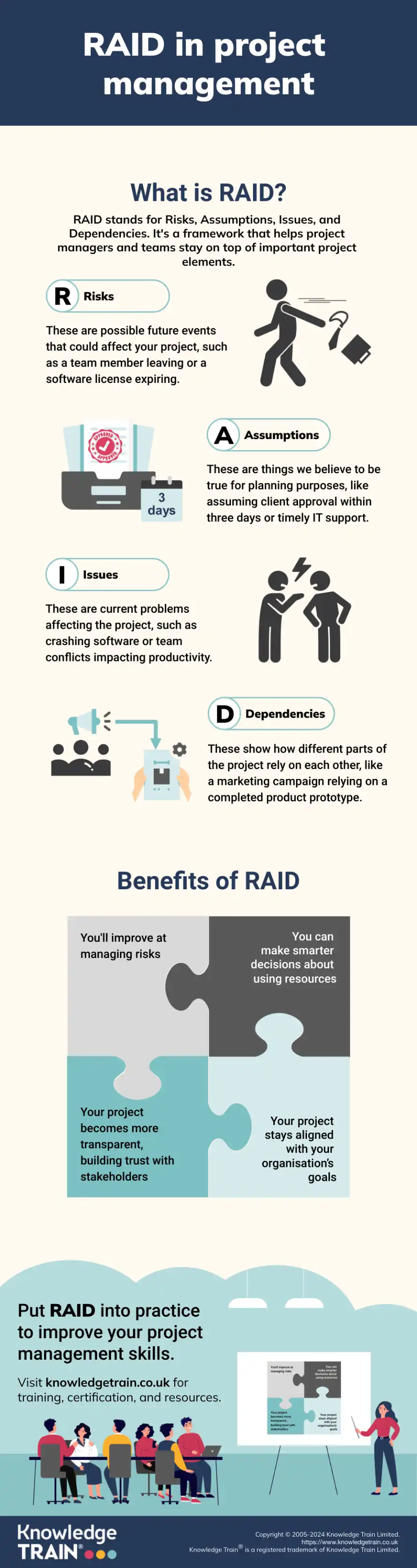
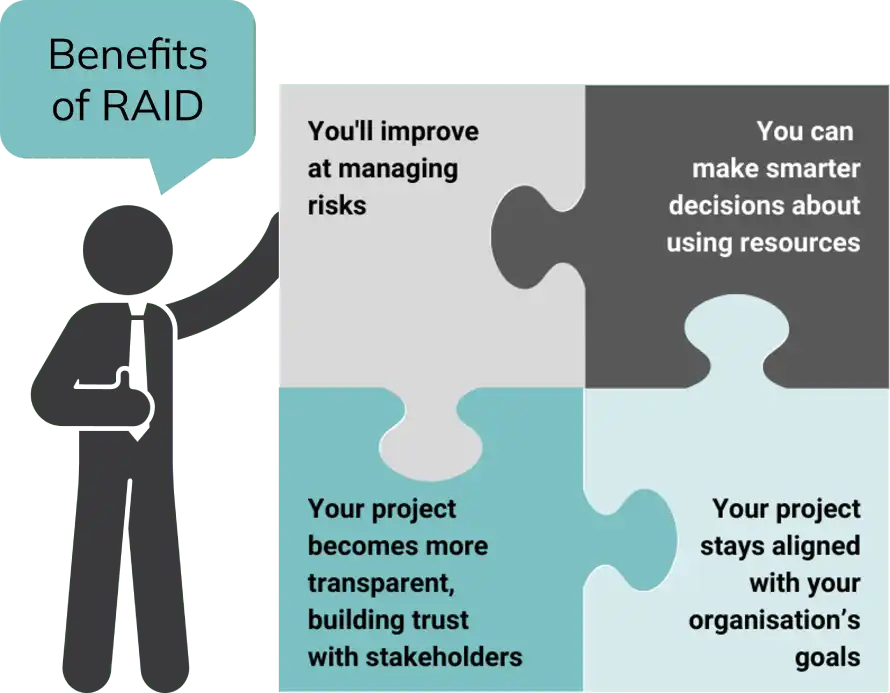
By understanding and implementing the RAID framework in project management, project managers can gain a more comprehensive view of their projects, allowing them to better anticipate and manage potential risks, assumptions, issues, and dependencies. With the right tools and techniques, RAID can help to improve the overall success of your projects and provide a more structured approach to managing complex projects., Kanban, Lean, and Extreme Programming (XP):
Implementing RAID analysis in projectsLean
RAID analysis is a project management technique used to identify and manage potential risks, assumptions, issues, and dependencies in a project. Effective implementation of RAID analysis can help project teams make informed decisions, mitigate risks, and enhance project success. In this blog, we will explore how to implement RAID analysis in your projects successfully.Main focus:
Five steps guide to conducting a RAID analysis Elimination of waste, maximising value, continuous improvement
1. Defining project scope and objectivesCore elements:
Start by defining the project scope and objectives. This will help you focus your RAID analysis on the most relevant elements. Value stream mapping, optimised flow, customer focus
2. Organising brainstorming sessionsAdvantages:
Bring together your project team to brainstorm potential risks, assumptions, issues, and dependencies. Improved efficiency, reduced delays, enhanced quality
Encourage open communication and diverse perspectives to ensure all relevant elements are captured.Extreme Programming (XP)
3. Categorising and documenting findingsMain focus:
Use a Technical excellence, frequent releases, customer involvement RAID logCore practices: to record and categorise the elements identified during the brainstorming session. Ensure that each item is properly categorised and described in sufficient detail. Pair programming, test-driven development, continuous integration,
4. Prioritising RAID elementsuser stories
Evaluate the impact and likelihood of each item to determine its priority. Consider using a prioritisation matrix to visualise and rank RAID elements.Advantages:
5. Developing action plans Rapid feedback, high product quality, adaptability to change
For high-priority items, develop strategies to address them and assign responsibilities. Ensure that each action plan is specific, measurable, achievable, relevant, and time-bound (SMART).Comparison: Scrum, Kanban, Lean, XP
Tools and techniques for RAID analysisFramework
RAID logs and templatesMain focus
RAID logs are simple tools that can be created using spreadsheets or specialised templates. They provide a structured format for recording and updating RAID elements throughout the project lifecycle.Key practice
Software solutions for RAID managementTeam structure
Many Best use case project management toolsScrum offer integrated RAID functionality, which can help streamline the analysis process and facilitate real-time collaboration among team members.Time-boxed iterations (Sprints)
Best practices for ongoing RAID monitoringPredefined roles and events
Regular review and updatesCross-functional
Schedule periodic RAID reviews to ensure their continued relevance and accuracy.Complex projects needing structure
Encourage team members to report new RAID items as they are identified to maintain an up-to-date risk profile.Kanban
Stakeholder communication strategiesVisual workflow & limits
Share RAID updates in project status reports and address significant items in stakeholder meetings to ensure alignment and transparency.Kanban board, WIP limits
By following these steps and utilising the appropriate tools and techniques, you can successfully implement RAID analysis in your projects. This will help you make better-informed decisions, mitigate Flexible roles risksOngoing support/operations Lean
Eliminate waste
Value stream mappingAnyProcess improvement, efficiency
XP
Technical best practices
- Pair programming, TDD
- Small, tech-focused teams
- Software projects needing quality
Agile vs traditional (waterfall) project management
The
- contrasts this with its focus on flexible planning, iterative progress, and stakeholder feedback throughout:
Project Management Lessons Learned | Knowledge Train
Simon Buehring
19 Feb 2026
Learn about DSDM principles through our visual guide and see their response to traditional process flaws. Scroll for more insights.
Scrum: A visual guide
Simon Buehring
19 Feb 2026
New to Scrum? Our visual guide explains the methodology clearly. Download the accompanying poster to share with your team.