
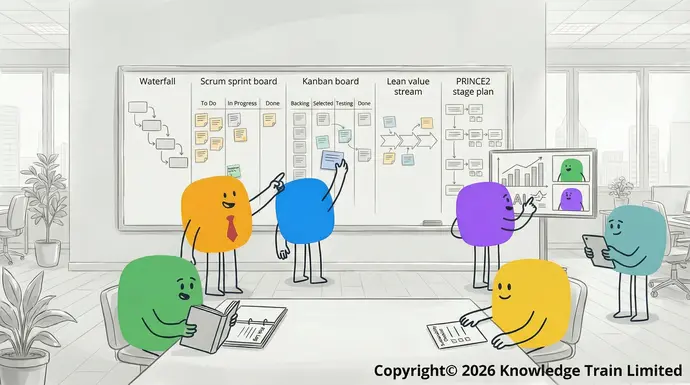
project management framework is a set of principles, processes and procedures that are used to manage a project. Project management frameworks provide a structured and systematic approach to project management and are often used as a guide or template for project managers.
Frameworks are commonly used by organisations seeking to stay competitive and consist of everything needed for project execution: from start to finish. They are valuable tools for effective project management.
In this article, we’ll discuss the main components of project management frameworks, popular project management frameworks and their key characteristics, and how to determine and implement the most suitable framework for your project, as well as the common challenges and emerging trends of these frameworks.The technical storage or access is necessary for the legitimate purpose of storing preferences that are not requested by the subscriber or user.
Frameworks are used for a wide range of projects, from simple and small in scope to complex and large in size. They help to increase efficiency, improve resource allocation, minimise risks, and help to boost success rates. By using the right project management framework , organisations can make sure that their projects
- Performance monitoringThe technical storage or access that is used exclusively for statistical purposes.
- Project closure.
- Project control cycleThe technical storage or access that is used exclusively for anonymous statistical purposes. Without a subpoena, voluntary compliance on the part of your Internet Service Provider, or additional records from a third party, information stored or retrieved for this purpose alone cannot usually be used to identify you.: This element of project management principles is the cycle of controlling and monitoring a project from its start through to the end of the lifecycle. It involves developing the plan, monitoring, reporting actual progress, assessing progress against the plan, recognising deviations, and taking corrective action as necessary.
- Tools and templates : This element of project management principles is concerned with the use of tools and templates to support a project. This could include a project plan , risk log, performance report, etc.
Key benefits of using a frameworkMarketing
- Accept is a sequential project management framework that progresses through a series of phases, such as requirements, design, implementation, verification, and maintenance. In the waterfall framework, each phase must be completed before the next one can begin, and testing is performed at the end of the project.
Pros and cons
- Pros: Easy to understand, well documentedDeny
- Cons: Inflexible, difficult to change requirements, testing is performed too late.
Best use casesView preferences
- Waterfall can be used for software development projectsSave preferences, where the requirements are well-understood and unlikely to change during the project, or for hardware development projects, such as those in the automotive industry.
Agile frameworksView preferences
Scrum{title}
- Cons: Requires skilled and experienced team members, difficult to scale.
Best use cases
- Scrum can be used in software development projects, product development projects, and other projects where the requirements are not well-defined or where there is a need for frequent updates and client feedback.
Kanban
Definition and key characteristics
- Kanban is an Agile framework that visualises the workflow and helps teams optimise work in progress (WIP) by using a board with cards representing tasks or work items.
Pros and cons
- Pros: Visualise workflow, reduce WIP, increase efficiency
- Cons: May lack structure for complex projects, requires discipline to maintain.
Best use cases
- Kanban can be used in projects where work is continuous and there is a steady stream of tasks to be completed, such as support or maintenance work, or in projects where teams are trying to improve their current processes and workflows.
Lean
Definition and key characteristics
- Lean is a framework that aims to optimise value while minimising waste in project processes, with a focus on streamlining and simplifying the project workflow.
Pros and cons
- Pros: Increases efficiency, reduces costs, improves quality
- Cons: Requires cultural shift, can be difficult to implement in some industries.
Best use cases
- Lean can be used in manufacturing or production projects, as well as in healthcare or service industries where there is a need to improve efficiency and reduce waste.
Popular frameworks
PRINCE2
Definition and key characteristics
- PRINCE2 is a structured project management method that provides processes and principles for managing a project in a controlled environment.
Pros and cons
- Pros: Highly structured, scalable, business justification is emphasised
- Cons: Can be bureaucratic, requires a lot of documentation.
Best use cases
- PRINCE2 can be used for large, complex projects, especially in government or highly regulated industries, or for projects where there is a need for a high degree of control and governance.
It’s important to note that these are just some of the most popular project management frameworks, and that there are many other frameworks available that may be more suitable for your specific project or organisation.
Choosing the right project management framework
Selecting the appropriate project management framework for your organisation is essential for successful project delivery. It provides a structured approach, guiding you through the various stages of a project. This article explores factors to consider when choosing a framework and provides a six-step process to help you make an informed decision.
Factors to consider
- Project complexity and size: Larger projects may benefit from more structured frameworks like PRINCE2, while smaller or less complex projects can thrive under Agile methodologies.
- Industry and technological environment: Consider the specific requirements of your industry and the technological landscape. Some sectors may demand more rigorous documentation and regulatory compliance, influencing your framework choice.
- Team experience and preferences: Assess your team’s expertise and their preference for certain frameworks. Their input can be valuable in ensuring the selected approach aligns with their working style.
- Stakeholder requirements: Understand the needs and expectations of key stakeholders. Some frameworks, like PRINCE2, place a strong emphasis on stakeholder engagement and communication.
- Project goals and constraints: Consider the objectives, timeline, and budget of your projects. Certain frameworks may better align with your project’s goals and constraints.
Five steps to select a framework
- Assess project needs and constraints: Evaluate the project’s objectives, scope, and limitations. This will help narrow down the frameworks that are a good fit.
- Evaluate team capabilities: Assess your team’s skills and experience. Determine if they have prior exposure to any frameworks or if training will be necessary.
- Consider organisational culture: Choose a framework that aligns with your organisation’s culture and values. An approach that complements your culture will be more readily adopted.
- Analyse available resources: Look at the tools, software, and resources available to your team. Some frameworks may require specific tools or software.
- Pilot test and gather feedback: Implement the chosen framework on a small scale or for a short period. Collect feedback from the team and stakeholders to gauge its effectiveness.
Following these steps and considering the listed factors will guide you in selecting a project management framework that best suits your organisation’s needs. It is important to remember that the chosen framework may evolve over time, and flexibility is key.
Implementing a project management framework
Preparation phase
- Training and education: Ensure that team members receive comprehensive training on the selected framework. This includes understanding its principles, processes, and tools.
- Tool selection and setup: Choose software tools that are compatible with the framework. Set up the tools to mirror your organisation’s unique processes and workflows.
Rollout strategy
- Phased approach vs full implementation: Decide whether to implement the framework gradually (phased approach) or all at once (full implementation). Consider your organisation’s size and project complexity.
- Monitoring and adjusting: Continuously monitor the framework’s effectiveness and make necessary adjustments based on feedback and results.
Common challenges and solutions
- Resistance to change: Overcome resistance by clearly communicating the benefits of the new framework and involving team members in the decision-making process.
- Lack of alignment with existing processes: Carefully map out how the new framework integrates with existing processes and address any conflicts.
- Inadequate resources or support: Ensure that the implementation is adequately resourced and supported by the organisation’s leadership.
Implementing a project management framework requires careful planning and execution. By addressing these key areas, you can increase the chances of successful adoption and reap the benefits of improved project management practices.
Future trends in project management frameworks
As the field of project management continues to evolve, several emerging trends are expected to shape the future of project management frameworks. Here are three key trends to watch out for:
Artificial intelligence and machine learning integration
Artificial intelligence (AI) and machine learning (ML) are increasingly being integrated into project management tools and platforms. These technologies can automate resource allocation, perform risk assessments, and provide predictive analytics, leading to better decision-making and project outcomes.
Increased focus on remote and distributed teams
The shift towards remote work and the rise of distributed teams have prompted the development of frameworks that support these new working arrangements. This includes the use of collaboration tools, virtual project rooms, and asynchronous communication methods to ensure effective teamwork.
Emphasis on sustainability and social responsibility
Project management frameworks are also beginning to incorporate principles of sustainability and social responsibility. This trend reflects a growing awareness of the environmental and social impact of projects. Frameworks may include guidelines for measuring and reducing a project’s carbon footprint and social impact.
Conclusion
Project management frameworks provide structure and guidance for managing projects effectively. We have discussed various factors to consider when selecting a framework and provided a six-step process to help you choose the right one. We have also covered the key aspects of implementing a project management approach, future trends in the field, and the differences between frameworks and methodologies.
Remember that the process of selecting and implementing a project management framework is not set in stone. You should continually assess its effectiveness and make adjustments as necessary. As your organisation grows and adapts to new trends, be open to refining your approach to project management. By doing so, you can ensure that your chosen framework continues to serve your team’s needs and contributes to successful project outcomes.
FAQs
What is the difference between a project management framework and a methodology?
A project management framework is an overarching structure that guides you through the various stages of a project, while a methodology refers to a specific set of practices, processes, and tools used to manage projects. A framework can incorporate one or more methodologies.
Can I use multiple project management frameworks within my organisation?
Yes, you can use multiple project management frameworks in your organisation. In fact, many organisations use a combination of frameworks to suit different types of projects or team preferences.
How often should I review and update our project management framework?
It is recommended to review and update your project management framework annually or after major projects. However, you may need to adjust more frequently if you encounter recurring issues or changes in your organisation’s needs.
Are there any industry-specific project management frameworks?
Yes, some project management frameworks are tailored to specific industries. For example, the construction industry often uses the Construction Extension to the PMBOK Guide. Research to see if there are any industry-specific frameworks that may benefit your organisation.
How can I measure the effectiveness of a project management framework?
You can measure the effectiveness of a project management framework by tracking key performance indicators (KPIs) such as project success rates, adherence to project timelines and budgets, stakeholder satisfaction, and team productivity.
What role does technology play in implementing a project management framework?
Technology plays a crucial role in implementing a project management framework. Project management software can help automate processes, facilitate communication, and provide real-time data for better decision-making. Choose software that aligns with your chosen framework and meets your organisation’s needs.