
Key takeawaysNetherlands
PRINCE2 Agile keeps delivery predictable by fixing some constraints and flexing others.Poland
- Set clear tolerances for time, cost, scope, quality, risk, and benefits so decision rights and escalation points are unambiguous.Portugal
- Traditional management by exception can trade one tolerance against another, but agile timeboxes remove time tolerance.Romania
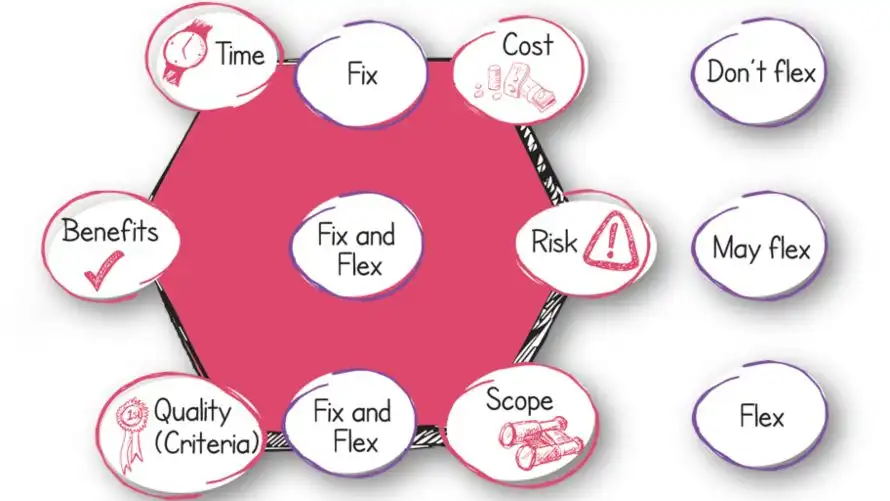
- In PRINCE2 Agile, time and cost are fixed, so delivery pressure is handled by flexing scope rather than extending deadlines or adding spend.Slovakia
- Use the hexagon to agree what is fixed, flexible, or variable, and protect quality while embracing change.Slovenia
- Keep teams stable and prioritise ruthlessly so customers get early value without needing everything upfront.Spain
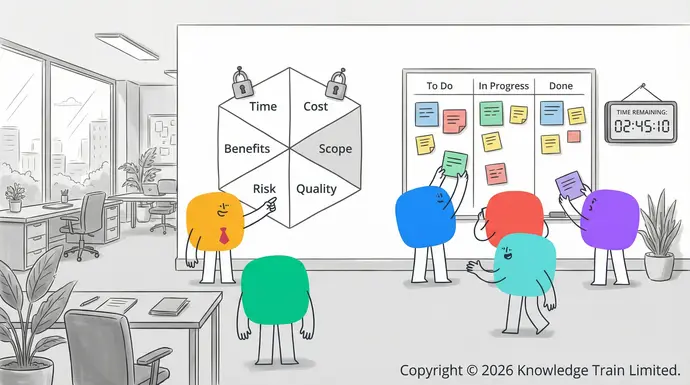
th edition , PRINCE2 Agile incorporates the six performance aspects in PRINCE2, namely time, cost, scope, quality, risk, and benefits.
Setting tolerances
In PRINCE2’s approach, establishing tolerances for each of these six performance dimensions is paramount. By doing so, it sets clear boundaries and clarifies who holds decision-making authority. To illustrate, if a project manager is given certain tolerances by the project board and it’s anticipated that these might be surpassed, this situation is termed an ‘exception’. Such exceptions warrant an immediate escalation to the project board for appropriate action.
Dealing with exceptions
As a project unfolds and when deviations from the agree performance aspects begin to occur, PRINCE2 provides the tools to deal with such situations in the form of ‘ management by exception ’. This allows a Copied!project managerKey takeaways to tap into the tolerances of one performance dimension to address challenges in another, as long as no tolerances are breached in the process. For instance, if there’s a delay in project timelines, the project manager could potentially allocate more budget (drawing from the cost tolerance) to bring in extra resources to catch up.ADKAR makes change stick by guiding individuals through a clear sequence of milestones.
In essence, within the Build PRINCE2 frameworkAwareness, the strategic use of one performance aspect to balance out challenges in another is a standard practice. with clear, consistent communication and visible leadership support.
Fixing time and costGrow
Agile projects are differentDesire
In the realm of by addressing WIIFM, involving staff early, and recognising change champions.agile project managementProvide , the dynamics differ significantly from traditional methods. In the agile realm, work is planned in iterations (or cycles), often referred to as sprints. These sprints operate within set durations, creating fixed windows for work completion. Work for the sprint is planned based upon a prioritised set of requirements (commonly known as a backlog containing Knowledgeuser stories through tailored training, mentoring, and easy access to reference materials.).Convert
Hence, in the agile framework, time is non-negotiable; there’s an absolute commitment to ensuring all tasks wrap up by the sprint’s conclusion. Tasks are organized based on a hierarchy of needs, usually captured as Knowledgeuser stories into on a backlog. This means that in agile projects, time tolerance is zero which limits the room to manoeuvre for a Abilityproject manager with practice, coaching, and performance-based feedback. when deviations from the plan start to occur.Use
Dealing with challenges to time by flexing scopeReinforcement
When unforeseen challenges arise in an agile setup, the solution isn’t to stretch the time but to refine the scope of work within the timebox. The mantra is straightforward: tackle the essentials first. Once the highest priority tasks are completed, the team can then focus on the next highest priority items, and if time permits, address the next highest priority elements. to sustain new behaviours via celebration, metrics, regular reviews, and adaptive improvements.
Cost and team stability in Agile
Similarly, there is also zero cost tolerance in agile projects. The underlying assumption is that the team’s composition remains stable, especially within the span of a sprint. This stability is pivotal for maintaining momentum and ensuring ongoing collaboration.
So, whereas in traditional project managementContents a project manager might react to deviations from the plan by spending more money on resources (e.g.. paying overtime or adding more staff) within the permitted cost tolerance, that option is not available within PRINCE2 Agile .Contents
Instead, just as in the case of time tolerance, challenges are dealt with by varying the scope of what is delivered within the timebox. This distinct approach underscores the commitment of PRINCE2 Agile to flexibility, adaptability, and delivering value consistently.
: Building the motivation to participate.
1. Be on time and hit deadlines.Knowledge
No matter what, time is non-negotiable, so deadlines are always met which brings significant benefits.: Acquiring the necessary information and skills.
2. Protect the level of quality.Ability
By delivering to the level of quality expected by the users results in a total lower cost of ownership over the product’s lifetime.: Implementing new skills and behaviours.
3. Embrace change.Reinforcement
Change always happens, so expect change, and embrace change. By doing so, it enables a more accurate final product.: Sustaining the change over time.
4. Keep teams stable.These elements work in sequence, with each building upon the previous ones. For instance, it’s difficult to create genuine desire for change without first establishing awareness of why the change is needed. Similarly, knowledge can only be effectively absorbed once someone has the desire to learn. This sequential nature is crucial for successful implementation.
Avoid the temptation to add or remove staff from a team during a timebox because stable teams are the most efficient.This model’s purpose is to facilitate a smooth transition by focusing on the psychological aspects of change. By addressing these individual milestones, the ADKAR model reduces stress and enhances overall productivity. Its structured approach ensures that all critical elements of change are methodically covered, minimising confusion. Consequently, organisations can navigate the challenges of transformation with greater confidence and success.
5. Accept that the customer doesn’t need everything.In summary, the ADKAR model serves as a comprehensive guide for
Accept that the customer doesn’t need everything they think they want in the early stages of a project. By accepting this, you can be flexible on the scope of what is delivered.managing change
: Monitor engagement levels during change-related activities.
At the crux of PRINCE2 Agile lies the transformative concept of ‘fixing and flexing’. It’s a strategy that guarantees timely delivery by project teams while ensuring there’s no compromise on quality. Instead of rigidly sticking to a predefined scope, the scope becomes the variable, adapting based on evolving requirements and real-world challenges.Interviews
This adaptive approach empowers the : Conduct one-on-one discussions to explore individual concerns and motivations.project delivery