
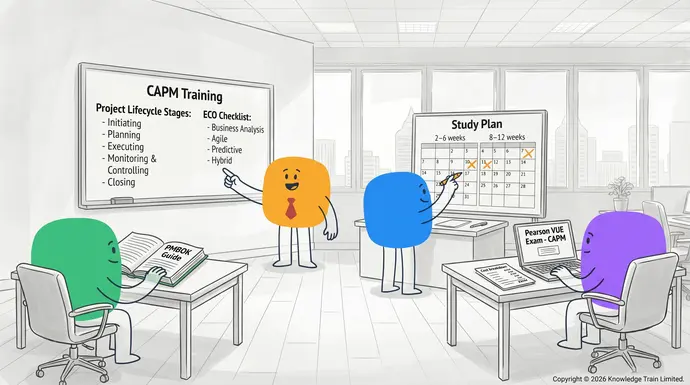
- CAPM validates fundamentals across predictive, hybrid and agile delivery, plus core areas like risk, schedule, cost, quality and stakeholders.
- It suits project coordinators, junior project managers and PMO support roles who want a shared language and stronger confidence with artefacts.
- Eligibility depends on PMI’s current education and training hour requirements, so check official criteria before paying or booking.
- The exam follows the CAPM Exam Content Outline and is delivered via Pearson VUE at a test centre or online where available.
- Use the ECO as your study map, practise timed questions, and choose a fast-track or steady plan based on your timeline.
Quick facts
| ItemMarketing | CAPM quick answer |
|---|---|
| Issuer | Project Management Institute (PMI) |
| Full name | Certified Associate in Project Management (CAPM) |
| Who it is for | Entry level and early career project management roles (for example, project coordinator, PMO analyst, associate project manager) |
| Exam lengthThe technical storage or access is required to create user profiles to send advertising, or to track the user on a website or across several websites for similar marketing purposes. | |
| Number of questions Manage options | 150 (per PMI)Manage services |
| Key domainsManage {vendor_count} vendors | Domains are defined in the Read more about these purposes CAPM Exam Content Outline (ECO) and include predictive, agile and business analysis related content areasAccept |
| Delivery | Pearson VUE test centre or online proctored examDeny |
| Typical cost range | Exam fee varies for PMI members vs non members (see cost table below; always check PMI for current pricing)View preferences |
| Renewal or validity basics | CAPM is a PMI certification with renewal rules set by PMI. Always confirm current continuing certification requirements / renewal rules on the PMI website before you plan timelines.Save preferences |
What is CAPM certification?
The View preferences Certified Associate in Project Management (CAPM){title} is designed to validate baseline knowledge of {title} project management fundamentals{title} , terminology, and best practice. It commonly aligns to concepts found in the
| 3 hours (PMI published exam duration). | |
| Number of questions | 150 (PMI published). |
| Delivery options | Pearson VUE test centre or online proctored exam (availability depends on location and PMI rules). |
| Policies (ID, breaks, rules) | Follow PMI and Pearson VUE candidate rules for identification, security checks, permitted items, and breaks. Rules differ for test centres vs online proctoring. |
CAPM cost breakdown
CAPM costs depend on whether you hold PMI membership , whether you need training, and whether you require a retake. Prices change, so use this as a planning guide and confirm live pricing on PMI’s CAPM page before purchase.
See: PMI CAPM certification (fees and policies)
| Cost item | What to expect | Notes |
|---|---|---|
| PMI membership (optional) | Annual membership fee set by PMI | |
as your study map, then reinforce with PMBOK Guide aligned learning. The plans below assume you will practise timed questions and regularly revisit weak areas such as risk management, schedule management, cost management, quality management, and stakeholder management.
Fast track plan (2 to 6 weeks)
- Week 1: Read the ECO end to end. Build notes on project lifecycle, roles, and key documents. Start light practice questions.
- Week 2: Predictive (waterfall) methodologies focus: schedule management, cost management, quality management. Do 2 timed practice sets.
- Week 3 : Agile project management focus: agile roles, planning cadence, and delivery concepts. Add stakeholder management scenarios.
- Week 4 : Business analysis fundamentals: requirements, traceability, and change control linkages. Add risk management and issue handling questions.
- Week 5 : Mixed review by ECO domains. Take 1 full mock exam under time pressure and analyse errors.
- Week 6 : Final revision: formulae and terminology refresh, targeted drills for weak topics, then one final timed set 48 to 72 hours before exam day.
Steady plan (8 to 12 weeks)
- Weeks 1 to 2 : Foundations. Learn project management fundamentals and the project lifecycle. Create a glossary and flashcards.
- Weeks 3 to 4 : Predictive focus. Deepen schedule management and cost management, then quality management and stakeholder management. Weekly quiz and review log.
- Weeks 5 to 6 : Risk management and communications related scenarios. Build a one page summary per ECO domain.
- Weeks 7 to 8 : Agile project management. Compare agile vs predictive (waterfall) approaches and practise situational questions.
- Weeks 9 to 10 : Business analysis fundamentals. Requirements concepts, validation, and change impacts. Add mixed domain practice sets.
- Weeks 11 to 12 : Exam readiness. Take 2 full mock exams, review wrong answers by domain, and finalise test day plan for Pearson VUE (test centre or online proctored exam).
CAPM vs PMP vs PRINCE2
If you are comparing credentials, choose based on your experience level, the methodologies used in your organisation, and role expectations. CAPM is usually positioned before PMP because PMP requires substantial project management experience.
| Credential | Best fit audience | Typical prerequisites | Difficulty (relative) | Typical roles |
|---|---|---|---|---|
| CAPM (PMI) | Entry level and early career | Education plus PMI required project management training hours | Foundational to intermediate | Project coordinator, junior project manager, PMO analyst |
| Project Management Professional (PMP) (PMI) | Experienced project managers | Significant project leadership experience plus training (per PMI) | Advanced | Project manager, senior project manager, programme roles |
| PRINCE2 | Project professionals in PRINCE2 environments | Varies by level ( Foundation vs Practitioner ) | Foundational to intermediate | Project support, project manager, project assurance roles |