
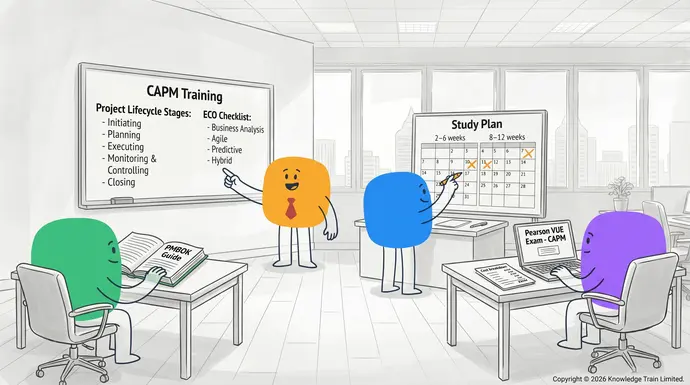
Quick facts
| Item | CAPM quick answer |
|---|---|
| Issuer | Project Management Institute (PMI) |
| Full name | Certified Associate in Project Management (CAPM) |
| Who it is for | Entry level and early career project management roles (for example, project coordinator, PMO analyst, associate project manager)Copied! |
| Exam lengthKey takeaways | 3 hours (per PMI)Waterfall is a linear delivery model that suits stable, well-specified work but struggles when change is frequent. |
| Number of questionsWaterfall runs through fixed phases, and each phase is completed and documented before the next begins. | 150 (per PMI)It works best when requirements are clear, unlikely to change, and acceptance criteria can be agreed upfront. |
| Key domainsStrong documentation and upfront planning support predictable costs, resourcing, and stakeholder reporting. | Domains are defined in the Late feedback can increase the risk of building the wrong thing and discovering issues near the end.CAPM Exam Content Outline (ECO)Regulated and high-compliance environments often prefer waterfall for traceability and control of change. and include predictive, agile and business analysis related content areasSuccess depends on rigorous requirements capture, formal change control, and thorough testing and QA. |
| Delivery | Pearson VUE test centre or online proctored exam |
| Typical cost range | Exam fee varies for PMI members vs non members (see cost table below; always check PMI for current pricing)Contents |
| Renewal or validity basics | CAPM is a PMI certification with renewal rules set by PMI. Always confirm current continuing certification requirements / renewal rules on the PMI website before you plan timelines. |
What is CAPM certification?Contents
The Certified Associate in Project Management (CAPM)Introduction to the waterfall method is designed to validate baseline knowledge of project management fundamentalsWaterfall phases, terminology, and best practice. It commonly aligns to concepts found in the PMBOK Guide and the job task coverage defined in the Benefits of the waterfall methodCAPM Exam Content Outline (ECO)
- The quality management, and waterfall methodstakeholder management of project management is a
- Introduction level sequential approachbusiness analysis fundamentals to a that often intersect with project deliveryproject
Who should get CAPM?. The phases of this methodology are completed one after another in the following order:
CAPM is most relevant if you are aiming to enter or progress in project work and want a structured foundation before moving on to advanced certifications such as the Requirements elicitationProject Management Professional (PMP)Design.Implementation
Typical job titles that match CAPMVerification include:Maintenance.
- Project coordinatorEach of these steps should be completed and fully documented before the next step is taken. This linear approach is most known for the following characteristics:
- Junior project managerRigid structure
- PMO analyst or PMO administratorComprehensive documentation
- Associate project managerClear milestones
- Project assistant or delivery supportPredictable timelines.
Typical outcomesWaterfall method is the opposite of the include improved shared language, more confidence with project artefacts, and credibility when applying for entry level roles that request exposure to PMI aligned practices.Agile approach
CAPM eligibility requirements. It is less flexible and works on a fixed scope. Traditional waterfall method was not designed to be iterative like the Agile methodology. Waterfall project is best for software products and projects that have well-defined requirements that will not change much. It is good for software with certain endpoints and certain regulatory compliance checks needed for the software to function.
PMI publishes the definitive CAPM eligibility criteria. Use PMI’s Waterfall phasesCAPM pageWaterfall as your primary source and apply exactly as stated there. is a
Eligibility checkliststructured
- Education prerequisite:, sequential approach that includes distinct phases with each phase building on the output of the previous phase. In this subsection, we will cover the phases in a waterfall lifecycle. Meet PMI’s stated minimum education requirement for CAPM (confirm the exact wording on PMI’s CAPM page).Requirements elicitation
- Project management training hours:In this phase, the team gathers and documents all project requirements. This includes defining the project scope and objectives, identifying stakeholders and their expectations, and creating a Complete the required number of hours of project management education/training as specified by PMI.detailed specification
- Agreement to policies: document. Accept PMI’s certification and exam policies during the PMI application (certification application).System design
- Documentation readiness:Based on the requirements, the team designs the system architecture, user interface, database schemas, and detailed technical specifications. Be prepared to provide training details and to comply with any audit requests.Implementation
Note:During this phase, developers write code according to the design specifications, adhere to coding standards and best practices, and create unit tests for individual components. Eligibility rules can change. Always rely on PMI’s current published requirements before you pay or book.Verification
How to get CAPM certifiedTesters rigorously evaluate the system by executing test cases based on requirements, performing integration and system testing, identifying and reporting bugs, and verifying bug fixes and retesting.
- Confirm eligibilityAfter testing is complete, the team:: Read PMI’s current CAPM requirements and confirm your education and training hours meet the criteria.Prepares the production environment
- Create a PMI accountMigrates data if needed: Set up or sign in to your account on the PMI website.Deploys the system to users
- Submit your PMI application (certification application)Provides user training and documentation.
CAPM cost breakdown
CAPM costs depend on whether you hold See all datesPMI membershipLimitations of the waterfall method, whether you need training, and whether you require a retake. Prices change, so use this as a planning guide and confirm live pricing on PMI’s CAPM page before purchase.The waterfall method is a structured approach to
See:project management that follows a linear sequence of phases. However, it has some limitations.PMI CAPM certification (fees and policies)Limited flexibility for changes
| Cost itemThe | What to expectstructured approach | Notes of waterfall can make changes challenging once a phase is completed. This rigidity can lead to difficulties in adapting to new requirements, costly revisions if requirements change mid-project and can inhibit creativity and innovation during the development process. |
|---|---|---|
| PMI membership (optional)Delayed feedback and product validation | Annual membership fee set by PMIThe linear nature of the waterfall methodology means that user feedback and validation of the product often come late in the process. This delay can result in missed opportunities to address market needs, reduced chances of early validation of the product and increased risk of developing features that users don’t want. | Membership may reduce exam fees and provides access to PMI resources. Confirm current UK pricing on PMI.Potential for longer delivery times |
| CAPM exam feeWaterfall methodology can result in longer delivery times due to the extensive upfront planning. This approach can lead to delays in delivering working software to end-users and slower time-to-market compared to more iterative approaches. | Different member vs non member pricingChallenges with customer collaboration | Check current fees on PMI (pricing varies by membership status).Waterfall may present obstacles by restricting customer collaboration after the requirements phase. This can lead to limited stakeholder input and a potential mismatch between the final product and the evolving needs of the customer. |
| Retake fee (if applicable)Risk of late-stage issues and rework | Set by PMIThe | Retake rules and fees are defined by PMI policy for the current exam cycle.linear progression |
| Training course may result in: | Varies widely by provider and formatKey issues to be identified late in the development process | Expect a range based on live vs online, tutor support, and included practice exams. Ensure the course counts towards PMI’s required training hours.The need for costly and time-consuming rework |
Study planChallenges in addressing fundamental issues near the end of the project.
Use the These limitations of Waterfall reveal why it may not be appropriate for all types of projects, especially those with dynamic requirements or in rapidly changing markets. Identifying these drawbacks allows CAPM Exam Content Outline (ECO)project managers as your study map, then reinforce with to make informed decisions on when to explore alternative approaches or adapt the waterfall model to mitigate these risks.PMBOK GuideWaterfall vs Agile methods aligned learning. The plans below assume you will practise timed questions and regularly revisit weak areas such as risk management, schedule management, cost management, quality management, and stakeholder management.Waterfall and
| Hierarchical team structure | Foundational to intermediateSpecialised roles with limited cross-functional work. | Project coordinator, junior project manager, PMO analystAgile | ||
| Project Management Professional (PMP) (PMI)Self-organising, cross-functional teams | Experienced project managersEmphasises collaboration and shared responsibility. | Significant project leadership experience plus training (per PMI)Risk management and quality control | AdvancedWaterfall | Project manager, senior project manager, programme rolesUpfront risk identification and mitigation planning |
| PRINCE2Quality control primarily at project end. | Project professionals in AgilePRINCE2Continuous risk assessment and mitigation environmentsOngoing quality control through regular testing and reviews. | Varies by level (Each has its advantages and disadvantages. Waterfall provides structure and predictability, making it well-suited for projects with well-defined requirements and stable environments. FoundationAgile vs offers flexibility and adaptability, making it ideal for projects with evolving requirements or uncertain outcomes. The decision to use Practitionerwaterfall or Agile) depends on several factors, such as project complexity, team dynamics, and organisational culture. | Foundational to intermediateWhen to use the waterfall method | Project support, project manager, project assurance rolesAgile methodologies |
Official links have become popular in recent years, but the waterfall approach still has its place in certain situations. Let’s explore how and when waterfall can be successfully used.
- PMI CAPM certification (requirements, fees, exam basics)Projects with well-defined requirements
- PMI CAPM exam preparation and CAPM Exam Content Outline (ECO)This methodology works best when:
- Pearson VUE for PMI (exam delivery and scheduling guidance)Requirements are known and unlikely to change
- PMI membershipStakeholders have a clear vision of the desired outcome
FAQsThe scope of the project is well-defined from the beginning.
What is CAPM certification?Industries with strict regulatory compliance
CAPM stands for Certified Associate in Project Management and it is issued by the Project Management Institute (PMI). It validates project management fundamentals aligned to the CAPM Exam Content Outline (ECO). CAPM is most commonly aimed at entry level or early career professionals who work on projects or support a PMO.Regulated industries
Who is eligible for CAPM? such as healthcare and medical device development, aerospace and defence and financial services with strict compliance requirements often adopt the waterfall methodology. These fields often require extensive documentation and adherence to specific protocols.
Eligibility is set by PMI and is based on meeting the published education requirement plus completing PMI’s required project management training hours. Because PMI can update criteria, check the official CAPM page before applying. You will confirm your details through the PMI application (certification application) process.Large-scale, complex projects with fixed timelines
How hard is the CAPM exam?Waterfall is often used for large projects that have many interconnected components, lengthy development cycles and strict deadlines and budget constraints. Infrastructure projects or large-scale enterprise-wide system implementations are examples of projects where waterfall is often used.
Difficulty depends on your familiarity with the project lifecycle, predictive (waterfall) methodologies, agile project management, and business analysis fundamentals. Candidates often find it manageable with a structured plan that follows the CAPM ECO and enough timed practice questions. Avoid relying on pass rate claims and focus on coverage, practice, and exam technique.Projects with limited customer involvement during development
Is CAPM worth it?Projects that don’t need much customer involvement during the project
CAPM can be worth it if you need a recognised baseline credential to support applications for junior project roles or PMO roles. It can also help create a pathway towards PMP by building vocabulary and structured understanding of risk management, schedule management, cost management, quality management, and stakeholder management. Value depends on your role goals, employer expectations, and whether PMI aligned certification is requested in your sector.Waterfall can be used when:
CAPM vs PMP: what’s the difference?The only customer interaction is at the start and finish
CAPM targets entry level professionals and focuses on project management fundamentals and ECO based knowledge. PMP is aimed at experienced project managers and typically requires substantial project leadership experience, with an exam that tests advanced judgement. If you are early in your career, CAPM is often the more accessible starting point before PMP.Little or no user involvement is required in the development cycle
How much does CAPM cost?The needs of the user are clear and stable.
CAPM cost varies by PMI membership status, plus any training you purchase to meet the required training hours. PMI also sets retake fees if you need another attempt. For current prices, use PMI’s official CAPM page because fees can change.This method is effective when requirements are well understood upfront and do not change over time, as it follows a
How long does CAPM last / how do you renew?linear approach
CAPM renewal and continuing certification requirements are set by PMI and can change over time. Check PMI’s current CAPM policy pages to confirm validity periods and whether professional development reporting is required. Plan renewal early so your certification remains in good standing..
How many questions and how long is the exam?Selecting waterfall for appropriate projects can lead to timely execution and successful project delivery. However, it’s important to carefully evaluate project characteristics and organisational requirements before adopting this methodology. When applied judiciously, waterfall offers a structured framework for managing complex projects with predictable outcomes.
PMI states the CAPM exam includes 150 questions with a 3 hour time limit. The exam is delivered through Pearson VUE either at a test centre or via an online proctored exam where available. Always confirm current exam details on PMI’s CAPM page and the Pearson VUE programme page before exam day.Enhance your skills with our expert-led courses