
Key takeaways
A strong business case turns a proposal into a decision by making value, costs, and risk explicit. The technical storage or access that is used exclusively for statistical purposes.
- Use a business case when resources are limited and there are credible alternatives, including a do-nothing baseline.APM qualification cost
- Make roles clear: an author drafts, finance and risk challenge, and an executive sponsor owns benefits and alignment. The technical storage or access that is used exclusively for anonymous statistical purposes. Without a subpoena, voluntary compliance on the part of your Internet Service Provider, or additional records from a third party, information stored or retrieved for this purpose alone cannot usually be used to identify you.
- Anchor the case in a measurable baseline, defined objectives, and KPIs so outcomes can be tracked after delivery.Simon Buehring
- Compare options transparently using full costs, quantified benefits, and appraisal methods such as ROI, NPV, IRR, and payback.20 Mar 2026
- Separate risks, assumptions, constraints, and dependencies, and include mitigations and a post-implementation review plan.
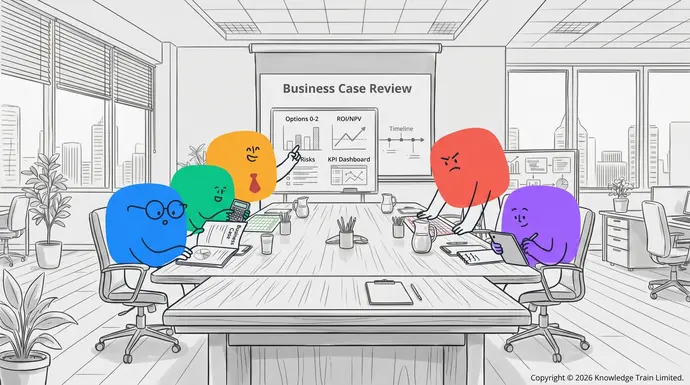
Definition {title}
In project and investment contexts, a business case is a documented rationale for undertaking a course of action. It typically sets out the {title}problem Manage Consent or opportunity To provide the best experiences, we use technologies like cookies to store and/or access device information. Consenting to these technologies will allow us to process data such as browsing behavior or unique IDs on this site. Not consenting or withdrawing consent, may adversely affect certain features and functions., defines measurable objectives, evaluates options analysis (alternatives) , and recommends a preferred option supported by evidence. It is commonly used to obtain approval for resources and funding and to establish a baseline for benefits realisation and performance measurement using Functionalkey performance indicators (KPIs) .
For a general definition and background, see the reference overview of the concept of a business case on Wikipedia . Functional
When to use a business case
A business case is most useful when there is a meaningful decision to be made and competing ways to allocate limited resources. Common situations include: Always active
- New investments such as software, equipment, facilities, or hiring.
- Change initiatives such as process improvement, automation, or organisational redesign.
- Project approval when funding depends on demonstrating value and feasibility.
- Regulatory or risk-driven workGive us a call The technical storage or access is strictly necessary for the legitimate purpose of enabling the use of a specific service explicitly requested by the subscriber or user, or for the sole purpose of carrying out the transmission of a communication over an electronic communications network. where costs are clear but benefits are mainly risk reduction.
- Competing priorities where +44 (0)207 148 5985 opportunity cost (what you give up by choosing one option) is material.Or chat with us using the link at the bottom of the screen. Preferences
Many organisations require a business case before progressing from idea to funded delivery, particularly where governance frameworks and portfolio management are in place.Contact us with questions about the courses on this page, or about which project management certification or training is best for you.
Who creates and who approves a business caseFinance FAQs
Ownership and approvals vary by organisation, but a typical model looks like this:Contact
- AuthorCookies Preferences : a project manager, product manager, business analyst, or subject matter expert drafts the business case with input from finance and operational teams.Privacy
- Accountable ownerTerms : the Customer Support executive sponsor (often a senior stakeholder) is accountable for the case, ensuring it aligns with strategy and that benefits are owned.[email protected]
- ReviewersJoin Our Team : finance teams validate costs and investment appraisal; risk and compliance functions challenge risks[email protected] The technical storage or access is necessary for the legitimate purpose of storing preferences that are not requested by the subscriber or user. and controls; procurement validates supplier assumptions. Copyright © 2005-2026 Knowledge Train Limited.
- Approvers Registered in UK: 5566983. : a steering group, investment committee, portfolio board, or senior leadership approves the recommended option and budget. Registered VAT: GB872413526.
Clear stakeholder roles reduce rework and ensure that assumptions, constraints, and delivery responsibilities are agreed early. Knowledge Train
Key components of a business case® Statistics
A well-structured business case is easy to scan and trace from problem to recommendation. Most high-performing cases include the following components: is a registered trademark of Knowledge Train Limited.
- Problem or opportunity 20 Old Bailey, London, EC4M 7AN, England, United Kingdom. : what is happening now, why it matters, and what will happen if nothing changes (the baseline). Knowledge Train are experts in project management, PRINCE2, agile and change management training and certification. Choose from a full range of instructor-led and self-paced
- Objectivesproject management courses Statistics : what success looks like, including measurable targets and timeframes., a
- Scope and constraintsPRINCE2 course : what is included and excluded, plus constraints such as time, budget, technical limitations, and regulatory requirements., or an
- Stakeholdersagile project management course : who is affected, who must contribute, and who will own benefits. to boost your career.
- Options analysis (alternatives)PRINCE2 : a shortlist of credible options, including a do-nothing or do-minimum baseline where appropriate.®
- Recommended option, MSP The technical storage or access that is used exclusively for statistical purposes. : which option is proposed and why it is preferred.®
- Benefits, ITIL The technical storage or access that is used exclusively for anonymous statistical purposes. Without a subpoena, voluntary compliance on the part of your Internet Service Provider, or additional records from a third party, information stored or retrieved for this purpose alone cannot usually be used to identify you. : quantified and non-quantified benefits, and how they support strategy.®
- Costs, P3O : one-off and ongoing costs (capital and operational), including training, support, and change management.®
- Investment appraisal, PRINCE2 : methods such as ® return on investment (ROI) Agile, RESILIA Marketing , ® net present value (NPV), and the Swirl logo are registered trademarks of the PeopleCert group. Used under licence from PeopleCert. All rights reserved. AgilePM , ® internal rate of return (IRR) and AgileBA Marketing , and ® payback period are registered trademarks of Agile Business Consortium Limited. All rights reserved. The APMG International AgilePM and Swirl Device logo, APMG International AgileBA and Swirl Device Logo, APMG International Change Management and APMG International Better Business Cases and Swirl Device logo are trademarks of The APM Group Limited, used under permission of The APM Group Limited. All rights reserved. Better Business Cases™ is a trademark of Her Majesty’s Treasury. All rights reserved. DevOps Foundation .®
- Risks is a registered mark of the DevOps Institute. “PMI”, “PMBOK : key risks, mitigations, and residual risk.®
- Assumptions and dependencies Guide”, “PMP” and “CAPM” are registered marks of Project Management Institute, Inc. Knowledge Train Scrum Essentials™, Business Learning Library (BLL)™, Business Analysis Learning Library (BALL)™, Agile Learning Library (ALL)™, IT Learning Library (ITLL)™, and Compliance Learning Library (CLL)™ are trademarks of Knowledge Train Limited. All rights reserved. : what must be true for the case to succeed and what it relies on (for example, data quality or supplier delivery).Knowledge Train Ltd is an Introducer Appointed Representative of NewDay Cards Ltd for the Newpay finance product provided by NewDay Ltd. NewDay Cards Ltd acts as a credit broker, not a lender. We will introduce you exclusively to Newpay finance products provided by NewDay Limited under this Introducer Appointed Representative arrangement. Finance available from other lenders is not covered by this arrangement. NewDay Ltd and Newday Cards Ltd are authorised and regulated by the Financial Conduct Authority (ref nos 690292 and 682417 respectively).
- Implementation plan The technical storage or access is required to create user profiles to send advertising, or to track the user on a website or across several websites for similar marketing purposes.: phases, milestones, resourcing approach, and indicative timeline.
- Metrics and KPIs Manage options: how progress and outcomes will be measured, including benefits tracking. Manage services
- Governance and approval Manage {vendor_count} vendors: decision points, review cadence, and post-implementation review plan.Search Read more about these purposes
How to write a business case
- Define the decision to be made Accept: state what approval is requested (funding, people, procurement authority) and by when.
- Describe the current state and baseline Deny: quantify today’s performance, costs, cycle times, or risks so improvement can be measured.
- Set objectives and success criteria View preferences: define outcomes and KPIs, including benefits ownership and expected timing.
- Identify feasible options Save preferences
- Net present value (NPV) Always active
The technical storage or access is strictly necessary for the legitimate purpose of enabling the use of a specific service explicitly requested by the subscriber or user, or for the sole purpose of carrying out the transmission of a communication over an electronic communications network.
| Preferences | ||
|---|---|---|
| Preferences | ||
| Request a quote | Estimate value of displaced work and include in narrative or sensitivity |
Risks, assumptions, constraints and dependencies[email protected]
Decision-makers need to understand what could undermine delivery or benefits. Good business cases separate: The technical storage or access is necessary for the legitimate purpose of storing preferences that are not requested by the subscriber or user.
- Assumptions +44 (0)207 148 5985 : statements treated as true for planning (for example, adoption rates or volume growth).Courses
- ConstraintsPROJECT MANAGEMENT : fixed limits (for example, deadlines, budget caps, mandated technology).PRINCE2
- Dependencies®Statistics : external items required for success (for example, data migration readiness, vendor delivery, approvals).Foundation
- RisksLearn the fundamentals of the PRINCE2 method. : uncertain events that could harm outcomes (for example, low user adoption, security gaps, scope creep).Practitioner
Risks and mitigations (example)Includes Foundation & Practitioner combined option.Statistics
| RiskAssociation for Project Management (APM) | ImpactProject Fundamentals Qualification (PFQ) | MitigationStart your APM project management career. | OwnerProject Management Qualification (PMQ) |
|---|---|---|---|
| Low user adoptionAdvance your APM project management expertise. | Benefits not realised, process reworkProject Risk Single Certificate Level 1 | Change management plan, training, champions, KPI trackingEnhance your project risk management skills. | Executive sponsor and operations leadAgilePMThe technical storage or access that is used exclusively for statistical purposes. |
| Data quality issues® | |||
Includes Foundation & Practitioner combined option. PRINCE2
The technical storage or access is strictly necessary for the legitimate purpose of enabling the use of a specific service explicitly requested by the subscriber or user, or for the sole purpose of carrying out the transmission of a communication over an electronic communications network.®
- Agile
- Foundation
- Learn the fundamentals of the PRINCE2 Agile method.
- Practitioner
PreferencesIncludes Foundation & Practitioner combined option.
- Scrum
- Scrum Essentials
| Recommends an option and seeks approval based on value and risk. Agile3-day ITIL Specialist: Drive Stakeholder Value (DSV) course. | Assesses whether an option can be done, and under what conditions.Foundation Specialist: CDS |
| May include feasibility findings as evidence.Learn the fundamentals of the PRINCE2 Agile method.3-day ITIL Specialist: Create, Deliver and Support (CDS) course. | Often precedes or feeds into the business case.Practitioner IT Learning Library (ITLL)™ |
Governance and lifecycleIncludes Foundation & Practitioner combined option.BUSINESS LEARNING LIBRARY (BLL)™
Business cases commonly follow a lifecycle so that approvals are controlled and benefits are validated:ScrumAgile Learning Library (ALL)™
- DraftScrum Essentials Business Analysis Learning Library (BALL)™: initial rationale, early estimates, and a shortlist of options.Self-paced training course to learn the essentials of Scrum.Compliance Learning Library (CLL)™
- ReviewScrum Master IT Learning Library (ITLL)™: finance and subject experts challenge costs, benefits, and assumptions; risks and constraints are refined.Choose Scrum Alliance or Scrum.org Scrum Master training courses.Business solutions
- ApprovalScrum Product Owner _blank
Most business cases include: the problem or opportunity, objectives, options analysis, the recommended option, benefits and costs, ROI/NPV/IRR and payback period, risks, assumptions, constraints and dependencies, stakeholders and executive sponsor details, an implementation plan, KPIs, and governance and approval steps.Self-paced training course to gain LSS Yellow Belt.PRINCE2 COURSES
How long should a business case be?PMISelect your preferred training course below:
Length depends on complexity and risk. Many internal business cases are 2 to 10 pages plus appendices for calculations and evidence. The key is that decision-makers can understand the recommendation, numbers, risks, and obligations quickly.®
Who approves a business case?PMI-ACP APM COURSES
Approval is usually given by a governance body such as a steering group, investment committee, portfolio board, or senior leadership team. The executive sponsor is typically accountable for endorsing the case and ensuring benefits owners and stakeholders commit to delivery and measurement.Self-paced course to prepare you for the exam (exam not included).Select your preferred training course below:
What is the difference between a business case and a business plan?Kanban
A business case justifies a specific initiative and asks for approval, focusing on options, value, and risk. A business plan describes how an organisation, product, or business unit will operate and grow, covering market approach, operating model, and broader financial forecasts.Estimating for Agile FoundationAGILE PROJECT MANAGEMENT COURSES
How do you calculate ROI and NPV in a business case?Agile Learning Library (ALL)™Select your preferred training course below:
ROI is commonly calculated as (total benefits minus total costs) divided by total costs over a defined period. NPV discounts future cash flows using a chosen discount rate and sums them with the initial investment; a positive NPV indicates value under the model. Document the discount rate, time horizon, and key assumptions, and consider sensitivity analysis.BUSINESS ANALYSIS
What makes a business case compelling?BCS Business AnalysisPRINCE2 AGILE COURSES
A compelling business case has a clear baseline, credible options analysis, transparent assumptions and constraints, realistic costs and benefits with sources, an explicit risk and mitigation plan, and measurable KPIs with named benefits owners. It also explains opportunity cost and shows how governance will control change.Business Analysis Foundation Select your preferred training course below:
When is a business case required?Learn the fundamentals of business analysis.
A business case is often required when requesting funding, committing significant resources, changing customer-facing services, or introducing material operational or compliance risk. It is also commonly required for projects that compete for prioritisation in a portfolio.Modelling Business Processes BETTER BUSINESS CASES COURSES