Business case: definition, purpose, structure, and examples

Key takeaways
A strong business case turns a proposal into a decision by making value, costs, and risk explicit.
- Use a business case when resources are limited and there are credible alternatives, including a do-nothing baseline.
- Make roles clear: an author drafts, finance and risk challenge, and an executive sponsor owns benefits and alignment.
- Anchor the case in a measurable baseline, defined objectives, and KPIs so outcomes can be tracked after delivery.
- Compare options transparently using full costs, quantified benefits, and appraisal methods such as ROI, NPV, IRR, and payback.
- Separate risks, assumptions, constraints, and dependencies, and include mitigations and a post-implementation review plan.
Definition
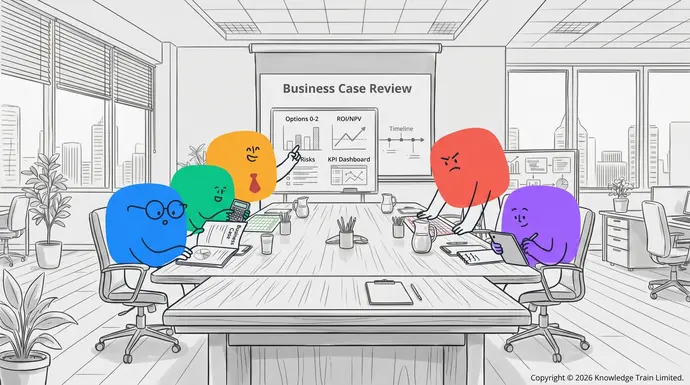
In project and investment contexts, a business case is a documented rationale for undertaking a course of action. It typically sets out the problem or opportunity , defines measurable objectives, evaluates options analysis (alternatives) , and recommends a preferred option supported by evidence. It is commonly used to obtain approval for resources and funding and to establish a baseline for benefits realisation and performance measurement using key performance indicators (KPIs) .
For a general definition and background, see the reference overview of the concept of a business case on Wikipedia .
When to use a business case
A business case is most useful when there is a meaningful decision to be made and competing ways to allocate limited resources. Common situations include:
- New investments such as software, equipment, facilities, or hiring. Request a quote
- Change initiatives such as process improvement, automation, or organisational redesign.
- Project approval[email protected] when funding depends on demonstrating value and feasibility.
- Regulatory or risk-driven work +44 (0)207 148 5985 where costs are clear but benefits are mainly risk reduction.Courses
- Competing prioritiesPROJECT MANAGEMENT where PRINCE2opportunity cost® (what you give up by choosing one option) is material.Foundation
Many organisations require a business case before progressing from idea to funded delivery, particularly where governance frameworks and portfolio management are in place.Learn the fundamentals of the PRINCE2 method.
Who creates and who approves a business casePractitioner
Ownership and approvals vary by organisation, but a typical model looks like this:Includes Foundation & Practitioner combined option.
- AuthorAssociation for Project Management (APM): a project manager, product manager, business analyst, or subject matter expert drafts the business case with input from finance and operational teams.Project Fundamentals Qualification (PFQ)
- Accountable ownerStart your APM project management career.: the Project Management Qualification (PMQ) executive sponsorAdvance your APM project management expertise. (often a senior stakeholder) is accountable for the case, ensuring it aligns with strategy and that benefits are owned.Project Risk Single Certificate Level 1
- ReviewersEnhance your project risk management skills.: finance teams validate costs and investment appraisal; risk and compliance functions challenge AgilePMrisks® and controls; procurement validates supplier assumptions. – Agile Project Management
- ApproversFoundation : a steering group, investment committee, portfolio board, or senior leadership approves the recommended option and budget.Learn the key principles of Agile Project Management.
Clear stakeholder roles reduce rework and ensure that assumptions, constraints, and delivery responsibilities are agreed early.Practitioner
Key components of a business caseIncludes Foundation & Practitioner combined option.
A well-structured business case is easy to scan and trace from problem to recommendation. Most high-performing cases include the following components:PRINCE2
- Problem or opportunity®: what is happening now, why it matters, and what will happen if nothing changes (the baseline). Agile
- ObjectivesFoundation : what success looks like, including measurable targets and timeframes.Learn the fundamentals of the PRINCE2 Agile method.
- Scope and constraintsPractitioner : what is included and excluded, plus constraints such as time, budget, technical limitations, and regulatory requirements.Includes Foundation & Practitioner combined option.
- StakeholdersAI Project Governance Framework (AIPGF): who is affected, who must contribute, and who will own benefits.Foundation
- Options analysis (alternatives)Learn the fundamentals of the governance framework.: a shortlist of credible options, including a do-nothing or do-minimum baseline where appropriate.Practitioner
- Recommended optionIncludes Foundation & Practitioner combined option.: which option is proposed and why it is preferred.Better Business Cases
- Foundation : quantified and non-quantified benefits, and how they support strategy.Learn the fundamentals of Better Business cases.
- CostsPractitioner : one-off and ongoing costs (capital and operational), including training, support, and change management.Includes Foundation & Practitioner combined option.
- Investment appraisalP3O: methods such as ®return on investment (ROI)Foundation , Learn the fundamentals of the P3O project management office.net present value (NPV)Practitioner , Includes Foundation & Practitioner combined option.internal rate of return (IRR)Workshops, and Introduction to Project Management payback period1-day workshop to learn the basics of project management..Project Management Essentials
- Risks2-day workshop to learn how to manage projects without getting certified.: key risks, mitigations, and residual risk.Writing Business Cases
- Assumptions and dependenciesHalf-day workshop to learn to write robust business cases.: what must be true for the case to succeed and what it relies on (for example, data quality or supplier delivery).AI in Project Management
- Implementation planLearn how to use AI tools in everyday project work.: phases, milestones, resourcing approach, and indicative timeline.ARTIFICIAL INTELLIGENCE (AI)
- Metrics and KPIsBCS AI: how progress and outcomes will be measured, including benefits tracking.Foundation
- Governance and approvalLearn the fundamentals of artificial intellegence.: decision points, review cadence, and post-implementation review plan.AI Project Governance Framework (AIPGF)
How to write a business caseFoundation
- Define the decision to be madeLearn the fundamentals of the governance framework.: state what approval is requested (funding, people, procurement authority) and by when.Practitioner
- Describe the current state and baselineIncludes Foundation & Practitioner combined option.: quantify today’s performance, costs, cycle times, or risks so improvement can be measured.Workshops
- Set objectives and success criteriaAI in Project Management : define outcomes and KPIs, including benefits ownership and expected timing.Learn how to use AI tools in everyday project work.
- Identify feasible optionsAGILE
Yellow Belt , and internal rate of returnSelf-paced training course to gain LSS Yellow Belt..PMI
Benefits vs costs (simple structure)®
| CategoryPMI-ACP | ExamplesSelf-paced course to prepare you for the exam (exam not included). | How to quantifyKanban |
|---|---|---|
| BenefitsEstimating for Agile Foundation | Time saved, fewer errors, faster sales cycle, improved complianceAgile Learning Library (ALL)™ | Labour cost reduction, avoided rework, revenue uplift, avoided penaltiesBUSINESS ANALYSIS |
| CostsBCS Business Analysis | Licences, implementation, training, change management, supportBusiness Analysis Foundation | Quotes, internal day rates, vendor contracts, total cost of ownershipLearn the fundamentals of business analysis. |
| Opportunity costModelling Business Processes | Delay to another project, diverted staff timeGain practitioner certificate in modelling business processes. | Estimate value of displaced work and include in narrative or sensitivityBusiness Analysis Practices |
Risks, assumptions, constraints and dependenciesGain practitioner certificate in business analysis practices.
Decision-makers need to understand what could undermine delivery or benefits. Good business cases separate:Requirements Engineering
- AssumptionsGain practitioner certificate in requirements engineering.: statements treated as true for planning (for example, adoption rates or volume growth).Business Analysis International Diploma
- ConstraintsAll 4 courses bundled into this Diploma certification package.: fixed limits (for example, deadlines, budget caps, mandated technology).AgileBA
- Dependencies®: external items required for success (for example, data migration readiness, vendor delivery, approvals). – Agile Business Analysis
- RisksFoundation training : uncertain events that could harm outcomes (for example, low user adoption, security gaps, scope creep).Learn the fundamentals of Agile Business Analysis.
Risks and mitigations (example)Practitioner
| Risk4-day course including Foundation. | ImpactPMI | Mitigation® | OwnerPMI-PBA |
|---|---|---|---|
| Low user adoptionSelf-paced course to prepare you for the exam (exam not included). | Executive sponsor and operations lead | ||
| Data quality issues | Errors, low trust in reporting | Data profiling, cleansing, acceptance criteria | Data owner |
| Supplier delivery delay | Timeline slippage, higher costsAPMG Change Management | Milestone-based contract, contingency, parallel workstreamsFoundation | Project managerLearn the fundamentals of enterprise change management. |
Example business casePractitioner
Under the stated assumptions, the business case supports approval because value is positive, payback is short, and risks can be mitigated through adoption and data-quality controls. In practice, include sensitivity analysis (best case, expected, worst case) for decision confidence.Select your preferred training course below:
Further business case examplesAGILE PROJECT MANAGEMENT COURSES are available on our web site.Select your preferred training course below:
Business case template
Use this template as a starting point. Keep language factual and include sources for material numbers.PRINCE2 AGILE COURSES
Download a Select your preferred training course below:business case template from our web site.BETTER BUSINESS CASES COURSES
1. Summary and decision requestSelect your preferred training course below:
- Decision required
- Recommended optionP3O COURSES
- Funding/resources requestedSelect your preferred training course below:
- Target decision date
2. Background and contextWORKSHOPS
- Post-implementation review date and method
Business case vs business plan
These documents are related but serve different purposes. Clarifying the difference helps prevent rework and mismatched expectations.APM COURSES
Business case vs business planSelect your preferred training course below:
| Business case | Business planAGILE PROJECT MANAGEMENT COURSES |
|---|---|
| Justifies a specific investment, change, or project.Select your preferred training course below: | Explains how a business or product will operate and grow over time. |
| Centres on options analysis, investment appraisal, and approval.PRINCE2 AGILE COURSES | Centres on market, strategy, operations, and financial forecasts.Select your preferred training course below: |
| Often used for internal governance and funding decisions. | Often used for external funding, partners, or internal planning.BUSINESS CASE COURSES |
| Includes KPIs for benefits realisation and post-implementation review.Select your preferred training course below: | Includes broader performance targets and business milestones. |
Business case vs project charterAGILE COURSES
| Business caseSelect your self-paced training course topic. | Project charter |
|---|---|
| Explains why the work should be done and whether it is worth doing.AGILE PROJECT MANAGEMENT COURSES | Authorises the project to start and defines roles, scope, and high-level plan.Select your preferred training course below: |
| Focuses on value, options, costs, benefits, and decision-making. | SCRUM COURSES |
Business case vs feasibility studyLEAN SIX SIGMA COURSES
| Business caseSelect your preferred training course below: | Feasibility study |
|---|---|
| Recommends an option and seeks approval based on value and risk.BUSINESS ANALYST COURSES | Assesses whether an option can be done, and under what conditions.Select your self-paced training course topic. |
| May include feasibility findings as evidence. | Often precedes or feeds into the business case.BCS BUSINESS ANALYST COURSES |
Governance and lifecycleSelect your preferred training course below:
Business cases commonly follow a lifecycle so that approvals are controlled and benefits are validated:
- DraftCHANGE MANAGEMENT COURSES: initial rationale, early estimates, and a shortlist of options.Select your self-paced training course topic.
- Review : finance and subject experts challenge costs, benefits, and assumptions; risks and constraints are refined.APMG CHANGE MANAGEMENT COURSES
- ApprovalSelect your preferred training course below:: stakeholders and an executive sponsor endorse the recommendation; funding and authority are granted.
- Delivery updatesPROGRAMME MANAGEMENT COURSES: the implementation plan is tracked; changes that affect benefits or costs are assessed against the approved case.Select your self-paced training course topic.
- Post-implementation review : benefits realisation and KPIs are evaluated against the baseline; lessons learned inform future decision-making.MSP COURSES
Strong governance improves transparency and reduces the chance that a business case becomes a one-off document that is never revisited.Select your preferred training course below:
FAQs
What is a business case?IT QUALIFICATIONS
A business case is a structured justification for a proposed investment, change, or project. It supports decision-making by comparing options and explaining expected benefits, costs, risks, assumptions, and the plan for implementation and measurement.Select your preferred qualification.
What should a business case include?
Most business cases include: the problem or opportunity, objectives, options analysis, the recommended option, benefits and costs, ROI/NPV/IRR and payback period, risks, assumptions, constraints and dependencies, stakeholders and executive sponsor details, an implementation plan, KPIs, and governance and approval steps.ITIL COURSES
How long should a business case be?Select your preferred training course below:
Length depends on complexity and risk. Many internal business cases are 2 to 10 pages plus appendices for calculations and evidence. The key is that decision-makers can understand the recommendation, numbers, risks, and obligations quickly.
Who approves a business case?IT QUALIFICATIONS
Approval is usually given by a governance body such as a steering group, investment committee, portfolio board, or senior leadership team. The executive sponsor is typically accountable for endorsing the case and ensuring benefits owners and stakeholders commit to delivery and measurement.Select your preferred qualification.
What is the difference between a business case and a business plan?
A business case justifies a specific initiative and asks for approval, focusing on options, value, and risk. A business plan describes how an organisation, product, or business unit will operate and grow, covering market approach, operating model, and broader financial forecasts.ITIL COURSES
How do you calculate ROI and NPV in a business case?Select your preferred training course below:
ROI is commonly calculated as (total benefits minus total costs) divided by total costs over a defined period. NPV discounts future cash flows using a chosen discount rate and sums them with the initial investment; a positive NPV indicates value under the model. Document the discount rate, time horizon, and key assumptions, and consider sensitivity analysis.
What makes a business case compelling?LEARNING LIBRARIES
A compelling business case has a clear baseline, credible options analysis, transparent assumptions and constraints, realistic costs and benefits with sources, an explicit risk and mitigation plan, and measurable KPIs with named benefits owners. It also explains opportunity cost and shows how governance will control change.Select your preferred training course topic.
When is a business case required?
A business case is often required when requesting funding, committing significant resources, changing customer-facing services, or introducing material operational or compliance risk. It is also commonly required for projects that compete for prioritisation in a portfolio.AI QUALIFICATIONS & WORKSHOPS