
- : how progress and outcomes will be measured, including benefits tracking.CCPM considers resource constraints, while CPM focuses solely on task dependenciesSubscribe now
- Governance and approvalManage {vendor_count} vendorsCCPM uses buffer time at the project level, rather than padding individual tasks : decision points, review cadence, and post-implementation review plan.Read more about these purposesCCPM aims to reduce multitasking and encourage early task completion.Related articles
How to write a business case Both methods can provide useful insights for optimising project schedules and enhancing overall project management efficiency.
- Define the decision to be madeAcceptTools for project scheduling : state what approval is requested (funding, people, procurement authority) and by when. If you’re going to be doing project scheduling on a regular basis, you might find it useful to consider using specialist software to help you with this. A quick search online will pull up a range of tools. Some popular options include:
- Describe the current state and baselineDenyProject management software options : quantify today’s performance, costs, cycle times, or risks so improvement can be measured. Jira
- Set objectives and success criteriaView preferences: : define outcomes and KPIs, including benefits ownership and expected timing. Agile project management
- Identify feasible optionsSave preferences software with customisable workflows and reporting. : include at least a baseline option and 1 to 3 credible alternatives; capture key constraints. Microsoft Project
- Estimate benefitsView preferences: Software for creating detailed project schedules and resource management. : quantify savings, revenue uplift, risk reduction, or service improvements; link to benefits realisation plans.{title}Other popular options
- Estimate full costs{title}: Trello, Asana, Basecamp, etc. All these offer various levels of functionality and can accommodate a range of project sizes. : include acquisition, implementation, training, transition, and ongoing running costs; note opportunity cost where relevant.{title}Key features to look for in scheduling software
- Run financial appraisalManage ConsentWhen it comes to choosing a scheduling software, there are some key features that you should ensure it has. Here are some of the most critical ones:Which is better, PMI-ACP: calculate ROI, NPV, IRR, and payback period; document discount rate and major assumptions. Gantt chart creation and customisation®
- Assess risks, assumptions, and dependenciesTo provide the best experiences, we use technologies like cookies to store and/or access device information. Consenting to these technologies will allow us to process data such as browsing behavior or unique IDs on this site. Not consenting or withdrawing consent, may adversely affect certain features and functions.Resource management or PMI-PMP: rate likelihood and impact, define mitigations, and identify decision-critical unknowns. Task dependencies®
- Recommend the preferred option Real-time collaboration?: provide a clear recommendation and explain trade-offs (value, risk, feasibility, timing). Integration with other business tools
- Outline the implementation plan and governance Reporting and analytics.Simon Buehring: include timeline, milestones, responsibilities, and a post-implementation review to validate outcomes.FunctionalIf you can find a tool that covers all these bases, you’ll be well on your way to more streamlined and effective project scheduling.19 Feb 2026
A more detailed guide to Enhance your skills with our expert-led courses writing a business case Debating between PMI-ACP® or PMI-PMP®? This article discusses the merits of both, helping you choose the right qualification for your career outside of Europe. Read more. is on our web site.
Financial analysis methods
Business cases often combine narrative justification with investment appraisal. Common methods include:FunctionalSelf-paced
- Return on investment (ROI) APM PFQ blended online : a simple ratio comparing net benefits to costs. It is easy to communicate, but can hide timing and risk. Always active
- Payback period £749 +vat : how long it takes for cumulative benefits to repay the initial investment. Useful for liquidity constraints, but ignores value after payback and time value of money.
- Net present value (NPV) PMP vs PRINCE2: discounts future cash flows back to today using a discount rate, reflecting the time value of money. A positive NPV indicates value creation under the model assumptions.
- Internal rate of return (IRR)Self-paced Simon Buehring: the discount rate at which NPV equals zero. It supports comparison between investments, but can be misleading with non-standard cash flows.PRINCE2 Agile Practitioner (with Foundation) self-paced online 19 Feb 2026
Background explanations for these appraisal concepts are available from reference sources for The technical storage or access is strictly necessary for the legitimate purpose of enabling the use of a specific service explicitly requested by the subscriber or user, or for the sole purpose of carrying out the transmission of a communication over an electronic communications network. cost–benefit analysis£1,399 +vat Compare PRINCE2 and PMP® certifications to understand their differences and determine which might be better for your career path. Discover more by reading on., net present value , and internal rate of returnSelf-pacedPreferences .AgilePM Practitioner (with Foundation) self-paced online
Benefits vs costs (simple structure)
| Category£1,299 +vat | ExamplesBest practices for effective project schedulingPreferencesProject management degrees in the UK | How to quantifyAs with all things, there are several best practices you can follow that will help you improve the quality of your project scheduling. Here are some of the most important ones: |
|---|---|---|
| BenefitsCollaborate with team members Knowledge Train | Time saved, fewer errors, faster sales cycle, improved complianceGet your team involved in the scheduling process. Their input can be invaluable in terms of providing more accurate estimates for task durations and helping you to identify potential issues. This approach can also be helpful in terms of getting your team to 20 Mar 2026 | Labour cost reduction, avoided rework, revenue uplift, avoided penaltiesbuy-in |
| Costs to the schedule. Looking to further your career with a project management degree from a UK university? Our guide will walk you through the best project management degrees available and help you find the perfect degree to help you take your career to the next level. | Licences, implementation, training, change management, supportBreak large tasks into smaller, manageable pieces | Quotes, internal day rates, vendor contracts, total cost of ownershipBreak complex tasks into smaller and more manageable subtasks. This method, called |
| Opportunity costWork Breakdown StructureThe technical storage or access is necessary for the legitimate purpose of storing preferences that are not requested by the subscriber or user. | Delay to another project, diverted staff time (WBS), makes it easier to estimate the time, track progress, and allocate resources. | Estimate value of displaced work and include in narrative or sensitivityConsider dependencies and constraints |
Risks, assumptions, constraints and dependenciesIdentify and document all task dependencies and project constraints. This will help you to avoid scheduling conflicts and ensure that activities are logically sequenced.
Decision-makers need to understand what could undermine delivery or benefits. Good business cases separate:Build in buffer time for unexpected delays
- AssumptionsInclude StatisticsProject management steps: statements treated as true for planning (for example, adoption rates or volume growth).buffer time
- Constraints in your schedule to account for potential delays and unforeseen events. This will give you more flexibility in your schedule and help to avoid missed deadlines. Knowledge Train: fixed limits (for example, deadlines, budget caps, mandated technology).Regularly update and communicate schedule changes 19 Feb 2026
- DependenciesUpdate your schedule regularly and communicate any changes to stakeholders. Schedule Statistics : external items required for success (for example, data migration readiness, vendor delivery, approvals).reviews Project management is crucial for success. Discover the essential phases and elevate your skills to ensure projects from start to finish deliver exceptional outcomes.
- Risks are a critical part of the overall scheduling process and can help you to identify potential problems early on. : uncertain events that could harm outcomes (for example, low user adoption, security gaps, scope creep).Following these best practices will help you to create better project schedules and ultimately lead to better project outcomes.
Risks and mitigations (example)Common challenges in project scheduling
| RiskNo matter how hard we try, it’s unlikely that we won’t encounter a few bumps when planning and managing a schedule. By being aware of the following common issues that typically affect project schedules, we will be more prepared and able to identify and address any we might encounter along the way. | ImpactInaccurate time estimates | MitigationThe biggest and most common cause for schedule slippage is making incorrect estimates, both too optimistically and too conservatively. As with all estimates, we should refer to | OwnerhistoricThe technical storage or access that is used exclusively for statistical purposes. |
|---|---|---|---|
| Low user adoption People in PRINCE2: Free ebook | Benefits not realised, process reworkdataThe technical storage or access that is used exclusively for anonymous statistical purposes. Without a subpoena, voluntary compliance on the part of your Internet Service Provider, or additional records from a third party, information stored or retrieved for this purpose alone cannot usually be used to identify you. | Change management plan, training, champions, KPI tracking, as well as include the team and subject matter experts to provide an input on time estimates. Simon Buehring | Executive sponsor and operations leadScope creep 21 Apr 2026 |
| Data quality issuesScope creep can easily affect the schedule by adding new requirements into a project that are not fully evaluated and understood, that require uncommitted resources, or that are not approved. | Errors, low trust in reportingResource conflictsUnderstand the people aspect of PRINCE2 with our free ebook. Ideal for those preparing for the PRINCE2 Foundation course. | Data profiling, cleansing, acceptance criteriaResource allocation problems are common on projects where the same resources are shared among multiple projects and activities. To resolve resource overallocation or conflicts, we can use | Data ownerresource levelling Marketing |
| Supplier delivery delay techniques to smoothen the demand for resources. | Timeline slippage, higher costsUnexpected risks and issues | Milestone-based contract, contingency, parallel workstreamsIssues can unexpectedly appear despite your best-planned schedules. Prepare a detailed | Project managerrisk management plan Marketing |
Example business case that will help you address potential problems and issues on time.
Scenario:If you identify these issues and incorporate the ways to mitigate them into your project management process, you will become a better scheduler, and your projects will reach completion more successfully.What soft skills do project managers need? A mid-sized service business proposes implementing a CRM to reduce manual admin, improve sales follow-up, and increase conversion rates.Conclusion
Assumptions and baselineProject scheduling
- The technical storage or access is required to create user profiles to send advertising, or to track the user on a website or across several websites for similar marketing purposes.
- and overall project success. Keep refining your techniques and you’ll be well on your way to learning the art of project scheduling.Manage options
Enhance your skills with our expert-led coursesManage services
| Manage {vendor_count} vendors | Read more about these purposes | |
|---|---|---|
| Self-pacedAccept | APM PFQ blended online | Deny |
| £749 +vat | View preferences | |
| Save preferences | Self-paced | PRINCE2 Agile Practitioner (with Foundation) self-paced onlineView preferences |
{title}
- £1,399 +vat{title} {title}
- Manage consent Manage consent
- Self-pacedAgilePM Practitioner (with Foundation) self-paced online
- £1,299 +vat
FAQs
- How often should I update my project schedule?Your schedule should be updated on a regular basis, ideally weekly or after major milestones or changes.
- What’s the difference between a milestone and a task in project scheduling?A task is a specific work item, while a milestone is a significant point or event in the project.
- How can I handle unexpected delays in my project schedule?Reassess priorities, reallocate resources if necessary and communicate changes to stakeholders as soon as possible.
- Is it better to use software or manual methods for project scheduling?Software is usually more efficient and accurate, particularly for complex projects.
How do I prioritise tasks within a project schedule?Consider dependencies, resource availability and overall impact on project objectives.
Subscribe to our exclusive offers and promotions Subscribe now
{"@context":"https://schema.org","@type":"ImageObject","contentUrl":"https://www.knowledgetrain.co.uk/training-courses/work-breakdown-structure-example-1.webp","description":"Example of a Work Breakdown Structure (WBS)","license":"https://www.knowledgetrain.co.uk/license","acquireLicensePage":"https://www.knowledgetrain.co.uk/license","creditText":"Knowledge Train","uploadDate":"2024-10-16T09:00:58.000Z","copyrightNotice":"© 2024 Knowledge Train Limited. All rights reserved.","creator":{"@type":"Organization","name":"Knowledge Train","url":"https://www.knowledgetrain.co.uk"}} {"@context":"https://schema.org","@type":"ImageObject","contentUrl":"https://www.knowledgetrain.co.uk/training-courses/project-network-diagram-example-1.webp","description":"Example of a network diagram","license":"https://www.knowledgetrain.co.uk/license","acquireLicensePage":"https://www.knowledgetrain.co.uk/license","creditText":"Knowledge Train","uploadDate":"2024-10-16T09:00:58.000Z","copyrightNotice":"© 2024 Knowledge Train Limited. All rights reserved.","creator":{"@type":"Organization","name":"Knowledge Train","url":"https://www.knowledgetrain.co.uk"}}
- {"@context":"https://schema.org","@type":"ImageObject","contentUrl":"https://www.knowledgetrain.co.uk/training-courses/gantt-chart-example-1.webp","description":"Example of a Gantt chart","license":"https://www.knowledgetrain.co.uk/license","acquireLicensePage":"https://www.knowledgetrain.co.uk/license","creditText":"Knowledge Train","uploadDate":"2024-10-16T09:00:58.000Z","copyrightNotice":"© 2024 Knowledge Train Limited. All rights reserved.","creator":{"@type":"Organization","name":"Knowledge Train","url":"https://www.knowledgetrain.co.uk"}}
- {"@context":"https://schema.org","@type":"ImageObject","contentUrl":"https://www.knowledgetrain.co.uk/training-courses/critical-path-method-example-1.webp","description":"Example of a Critical Path Method (CPM)","license":"https://www.knowledgetrain.co.uk/license","acquireLicensePage":"https://www.knowledgetrain.co.uk/license","creditText":"Knowledge Train","uploadDate":"2024-10-16T09:00:58.000Z","copyrightNotice":"© 2024 Knowledge Train Limited. All rights reserved.","creator":{"@type":"Organization","name":"Knowledge Train","url":"https://www.knowledgetrain.co.uk"}}
{"@context":"https://schema.org","@type":"ImageObject","contentUrl":"https://www.knowledgetrain.co.uk/training-courses/critical-chain-example.webp","description":"Example of a Critical Chain Project Management (CCPM)","license":"https://www.knowledgetrain.co.uk/license","acquireLicensePage":"https://www.knowledgetrain.co.uk/license","creditText":"Knowledge Train","uploadDate":"2024-10-16T09:00:58.000Z","copyrightNotice":"© 2024 Knowledge Train Limited. All rights reserved.","creator":{"@type":"Organization","name":"Knowledge Train","url":"https://www.knowledgetrain.co.uk"}}
- Related articles
4. Scope, constraints and dependencies
- In scope
- Out of scope
- Constraints (budget, time, technology, compliance)
- Dependencies (data, suppliers, approvals)
5. Stakeholders and governance
- Executive sponsorAn introduction to PRINCE2 Agile – webinar with Andrew Kell
- Key stakeholders
- Decision-making forum (board/committee)Sevcan Yasa
- Reporting cadence19 Feb 2026
6. Options analysis (alternatives)
- Option 0: do nothing / do minimumJoin Andrew Kell in a webinar exploring the integration of PRINCE2 and Agile methodologies. Ideal for professionals looking to adapt their project management approach.
- Option 1
- Option 2
- Evaluation criteria (value, risk, feasibility, time to benefit)
7. Recommended option and rationale
- Why this option is preferred
- Trade-offs accepted
8. Benefits, costs and investment appraisal
- Benefits (quantified and qualitative) PRINCE2 7th Edition – What’s different?
- Costs (one-off and ongoing)
- Opportunity cost considerations Simon Buehring
- ROI 19 Feb 2026
- NPV (discount rate and period)
- IRRGive us a callExplore the changes in PRINCE2 7th edition and why they are significant for project management professionals. Discover the updates by reading more.
- Payback period
9. Risks and mitigations
- Top risks+44 (0)207 148 5985
- Mitigations and owners
- Residual riskOr chat with us using the link at the bottom of the screen.
10. Implementation planContact us with questions about the courses on this page, or about which project management certification or training is best for you.
- Approach and phasesFinance FAQs
- High-level timeline and milestonesContactPRINCE2 popularity
- Resourcing planCookies
- Change managementPrivacySimon Buehring
11. Review planTerms19 Feb 2026
- How KPIs will be trackedCustomer Support
- Post-implementation review date and method Explore the rising global popularity of PRINCE2 and its benefits for project management professionals. Scroll down for updates and an insightful infographic.
Business case vs business plan[email protected]
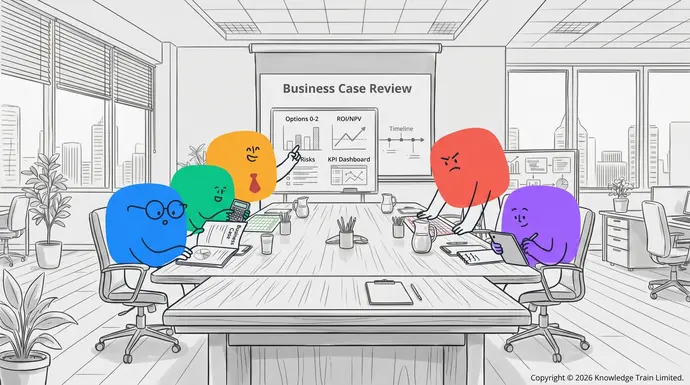
These documents are related but serve different purposes. Clarifying the difference helps prevent rework and mismatched expectations.Join Our Team
Business case vs business plan
| Business case[email protected] | Business plan Copyright © 2005-2026 Knowledge Train Limited. |
|---|---|
| Justifies a specific investment, change, or project. Registered in UK: 5566983. | Explains how a business or product will operate and grow over time. Registered VAT: GB872413526. |
| Centres on options analysis, investment appraisal, and approval. Knowledge TrainRisk management on projects | Centres on market, strategy, operations, and financial forecasts.® |
| Often used for internal governance and funding decisions. is a registered trademark of Knowledge Train Limited. Knowledge Train | Often used for external funding, partners, or internal planning. 20 Old Bailey, London, EC4M 7AN, England, United Kingdom.19 Feb 2026 |
| Includes KPIs for benefits realisation and post-implementation review. Knowledge Train are experts in project management, PRINCE2, agile and change management training and certification. Choose from a full range of instructor-led and self-paced | Includes broader performance targets and business milestones.project management coursesDiscover how risk management on projects contributes to project success. Learn proven strategies to mitigate risks and increase the chance of achieving your project goals. |
Business case vs project charter, a
| Business casePRINCE2 course | Project charter, or an |
|---|---|
| Explains why the work should be done and whether it is worth doing.agile project management course | Authorises the project to start and defines roles, scope, and high-level plan. to boost your career. |
| Focuses on value, options, costs, benefits, and decision-making.PRINCE2 | Focuses on delivery authority, governance, and initial project boundaries.® |
Business case vs feasibility study, MSPFive Case Model for business cases
| Business case® | Feasibility study, ITILSimon Buehring |
|---|---|
| Recommends an option and seeks approval based on value and risk.®19 Feb 2026 | Assesses whether an option can be done, and under what conditions., P3O |
| May include feasibility findings as evidence.®Explore the Five Case Model, a comprehensive framework for solving business problems. Enhance your understanding of its structured approach by reading further. | Often precedes or feeds into the business case., PRINCE2 |
Governance and lifecycle®
Business cases commonly follow a lifecycle so that approvals are controlled and benefits are validated: Agile, RESILIA
- Draft® : initial rationale, early estimates, and a shortlist of options., and the Swirl logo are registered trademarks of the PeopleCert group. Used under licence from PeopleCert. All rights reserved. AgilePM
- Review® : finance and subject experts challenge costs, benefits, and assumptions; risks and constraints are refined. and AgileBA
- Approval®How to pass your Foundation-level exam in PRINCE2: stakeholders and an executive sponsor endorse the recommendation; funding and authority are granted. are registered trademarks of Agile Business Consortium Limited. All rights reserved. The APMG International AgilePM and Swirl Device logo, APMG International AgileBA and Swirl Device Logo, APMG International Change Management and APMG International Better Business Cases and Swirl Device logo are trademarks of The APM Group Limited, used under permission of The APM Group Limited. All rights reserved. Better Business Cases™ is a trademark of Her Majesty’s Treasury. All rights reserved. DevOps Foundation
- Delivery updates®Simon Buehring: the implementation plan is tracked; changes that affect benefits or costs are assessed against the approved case. is a registered mark of the DevOps Institute. “PMI”, “PMBOK19 Feb 2026
- Post-implementation review® : benefits realisation and KPIs are evaluated against the baseline; lessons learned inform future decision-making. Guide”, “PMP” and “CAPM” are registered marks of Project Management Institute, Inc. Knowledge Train Scrum Essentials™, Business Learning Library (BLL)™, Business Analysis Learning Library (BALL)™, Agile Learning Library (ALL)™, IT Learning Library (ITLL)™, and Compliance Learning Library (CLL)™ are trademarks of Knowledge Train Limited. All rights reserved.Maximise your chances of passing your Foundation-level exam in PRINCE2 with our targeted revision tips. Read on for effective study strategies.
Strong governance improves transparency and reduces the chance that a business case becomes a one-off document that is never revisited.Knowledge Train Ltd is an Introducer Appointed Representative of NewDay Cards Ltd for the Newpay finance product provided by NewDay Ltd. NewDay Cards Ltd acts as a credit broker, not a lender. We will introduce you exclusively to Newpay finance products provided by NewDay Limited under this Introducer Appointed Representative arrangement. Finance available from other lenders is not covered by this arrangement. NewDay Ltd and Newday Cards Ltd are authorised and regulated by the Financial Conduct Authority (ref nos 690292 and 682417 respectively).
FAQs
What is a business case?
A business case is a structured justification for a proposed investment, change, or project. It supports decision-making by comparing options and explaining expected benefits, costs, risks, assumptions, and the plan for implementation and measurement.
What should a business case include?
Most business cases include: the problem or opportunity, objectives, options analysis, the recommended option, benefits and costs, ROI/NPV/IRR and payback period, risks, assumptions, constraints and dependencies, stakeholders and executive sponsor details, an implementation plan, KPIs, and governance and approval steps.
How long should a business case be?Search
Length depends on complexity and risk. Many internal business cases are 2 to 10 pages plus appendices for calculations and evidence. The key is that decision-makers can understand the recommendation, numbers, risks, and obligations quickly. What is the best project management certification in 2026?
Who approves a business case?
Approval is usually given by a governance body such as a steering group, investment committee, portfolio board, or senior leadership team. The executive sponsor is typically accountable for endorsing the case and ensuring benefits owners and stakeholders commit to delivery and measurement. Simon Buehring
What is the difference between a business case and a business plan? 20 Mar 2026
A business case justifies a specific initiative and asks for approval, focusing on options, value, and risk. A business plan describes how an organisation, product, or business unit will operate and grow, covering market approach, operating model, and broader financial forecasts.
How do you calculate ROI and NPV in a business case? Confused about which project management certification to pursue? Compare the most recognized certifications and find the best fit for your career.
ROI is commonly calculated as (total benefits minus total costs) divided by total costs over a defined period. NPV discounts future cash flows using a chosen discount rate and sums them with the initial investment; a positive NPV indicates value under the model. Document the discount rate, time horizon, and key assumptions, and consider sensitivity analysis.
What makes a business case compelling?
A compelling business case has a clear baseline, credible options analysis, transparent assumptions and constraints, realistic costs and benefits with sources, an explicit risk and mitigation plan, and measurable KPIs with named benefits owners. It also explains opportunity cost and shows how governance will control change.
When is a business case required?Request a quote
A business case is often required when requesting funding, committing significant resources, changing customer-facing services, or introducing material operational or compliance risk. It is also commonly required for projects that compete for prioritisation in a portfolio.