HM Treasury Green Book – what is it?United Kingdom

Key takeawaysItaly
The Green Book guides UK public sector decisions towards demonstrable public value for money.Latvia
- Start with a clear rationale and objectives set by decision-makers, then test multiple ways to meet them.Lithuania
- Appraise options using objective evidence, weighing costs, benefits and risks across society, not just the sponsoring organisation.Luxemburg
- Build a longlist from the service need, then document why options are included or excluded before shortlisting.Malta
- Select the preferred option by comparing against business as usual, including unquantifiable impacts and long-term sustainability.Netherlands
- Plan monitoring and evaluation from the outset, using baseline data to learn and improve future proposals.
- Use the Five Case Model to align strategy, social value, commercial deal, public finance impact and delivery realism.
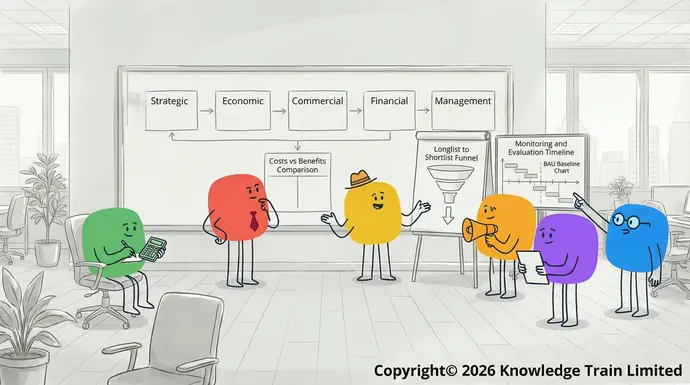
Longlist and shortlist
To determine the best course of action, proposals should be approached from the viewpoint of the necessary service rather than preconceived solutions or asset creation. This prevents narrow thinking and missed opportunities.Developing project management skills
Longlist analysis
The longlist analysis and shortlist selection should take place through a workshop involving key experts and stakeholders, incorporating research findings, expert advice, and stakeholder knowledge. With proper preparation and involvement, a wide range of service scopes, delivery methods, designs, funding options, and potential unintended effects can be efficiently appraised. The reasoning behind each option’s inclusion or exclusion must be recorded and referenced as part of the longlist appraisal process.Conclusion
Shortlist appraisal
In shortlist appraisal, the estimated costs and benefits of a proposed intervention are carefully evaluated, including the cost of associated risks and FAQsrisk management . This stage takes into consideration the trade-off between costs and benefits from the perspective of UK society, not just the public sector or originating institution.Infographic
For example, a proposal to improve acute care services by extending an NHS building would consider the impact on the local health economy, not just the organization making the proposal. The appraisal should consider the flow of services provided to the public by central and local government, and aim to deliver joined-up, optimal public services. This understanding should guide the choice of costs and benefits used in appraisal.Introduction
Selecting the optimal option for public value for moneyWork Breakdown Structure
When developing a proposal, the “business need” must be identified. The Green Book provides methods for evaluating costs vs benefits of shortlisted options to rank them. A comparison with the current situation should consider the additional cost of non-monetary benefits and significant unquantifiable risks. The justification of proposals is based on the wider policy or program they are part of, optimizing cost efficiency when social costs and benefits are not calculable. (
For example, a railway signalling system must deliver according to the program’s specifications and its benefits should not be apportioned to just the signalling component.WBS
The final decision on the preferred option should be made considering the public value for money. This means weighing the costs and benefits, including the unquantifiable ones, to ensure that the chosen option delivers the most value to society. The Green Book provides guidance on how to determine the public value for money and make an informed decision.)
It is important to remember that the final decision should not only consider the immediate benefits and costs, but also consider the long-term impact of the chosen option. The decision-makers should consider the sustainability and scalability of the option and ensure that it is in line with the wider policy or program objectives.Resource plan
Selecting the preferred option requires careful consideration of the costs and benefits, as well as the public value for money. The Green Book provides guidance on how to make an informed decision and ensure that the chosen option delivers the most value to society in the long run.Milestones and deliverables.
Monitoring and evaluationUse a recognised
Monitoring and evaluation are crucial components of any proposal. Monitoring involves collecting data during and after implementation to track progress and inform evaluation. The data collected must be compared to the business-as-usual (BAU) to ensure that the set objectives are realistic and performance can be accurately monitored and evaluated. project management approaches
Evaluation, on the other hand, is the systematic assessment of a proposal’s design, implementation, and outcomes. It tests if the proposal is working as expected, if the costs and benefits were anticipated, and if there were any significant unintended consequences. Evaluation also assesses the implementation process and any changes made., like
All proposals must contain provisions for monitoring and evaluation, both during and after implementation. This not only helps in ensuring the success of the proposal but also provides valuable lessons that can be used to improve the design and delivery of future proposals. In short, monitoring and evaluation play a crucial role in the continuous improvement of proposals.Agile
The Five Case Model: A Universal Framework or
The Five Case Model is a comprehensive approach for making decisions on the use of public resources. It involves considering five dimensions, known as the “five cases,” that offer different perspectives on a proposal.waterfall
The model requires cross-disciplinary collaboration between policy, analysis, commercial, financial, and delivery professionals. The dimensions must be developed together to ensure they are interconnected. The , to inform the structure of your plan.Five Case ModelEffective time management techniques is a universal framework that accommodates any investment or spending proposal, considering its unique features expressed as objectives or constraints.Effective time management is crucial to maintaining control over a
The Green Book recommends using the Five Case Model when developing the projectbusiness case. Here are some techniques that you may want to utilise: for a spending proposal. The Five Cases (or dimensions) cover all aspects of an investment proposal’s viability and success.Critical Path Method (CPM)
- Strategic Dimension – outlines the need for change and expected outcomes.Gantt charts
- Economic Dimension – assesses social value versus Business as Usual.Time-boxing
- Commercial Dimension – examines the feasibility of a commercial deal.Progress tracking and reporting.
- Financial Dimension – analyses the proposal’s impact on public finances.Risk management
- Management Dimension – evaluates the realism and robustness of delivery plans.Identifying potential risks
The dimensions must be considered together to ensure a well-rounded evaluation of a proposal’s viability and success.Risk management is an essential part of
Conclusionproject management
The Green Book is a key guide for public sector decision-makers as it provides a comprehensive framework for appraisal and evaluation of public sector proposals. It outlines the . To create a successful risk register, you should first identify possible threats to the project. Methods you could use include:Five Case modelSWOT analysis