Five Case Model for business cases

- Separate social value from affordability by treating economic and financial cases as complementary, not interchangeable.Contents
- Prove deliverability with clear governance, milestones, resources, and live risk and benefits registers with monitoring plans.
IntroductionIf you want a competitive edge in the project manager job market, a good place to start is with an
The certification in Agile5 Case Model. With so many options available however, it can be difficult to find which is best for you. is part of the best practice guidance issued by HM Treasury on behalf of the United Kingdom government. It is recommended to be used by the guidance issued in We’ve created a list of HMT Green BookAgile qualifications (central government guidance on appraisal and evaluation), so you can easily pick the one most relevant to your industry, role and level of experience.[1]Why get an Agile project management certification.There has been a marked increase in the use of
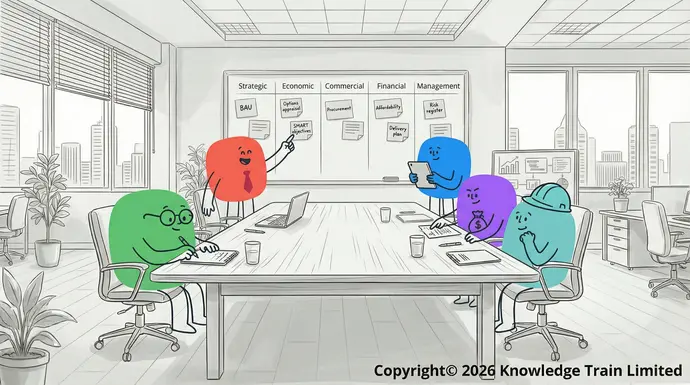
The 5 Case Model consists of 5 key dimensions: the Strategic Case, Economic Case, Commercial Case, Financial Case, and Management Case. These dimensions work together to provide a comprehensive analysis of a business problem, making it an effective tool for decision-makers.Agile methodologies
This article provides an overview of the 5 Case Model, its benefits, and how it can be applied in real-world business cases. To learn in detail how to use the 5 Case Model develop business cases, in all sectors:Better Business Cases training3 of every 4 businesses report using Agile approaches on a regular basis will teach you how to apply the Five Case Model in practice.[1]
Self-paceddimensionAgilePM Practitioner (with Foundation) self-paced online of the 5 Case Model is crucial in determining the “business as usual” scenario, which provides a benchmark against which proposed changes can be compared. This understanding must be quantified and well-defined, even when continuing without changes is not a viable option.
SMART objectives£1,299 +vat
In the strategic dimension, external constraints and dependencies are considered, such as legal, ethical, political, and technological factors, as well as necessary infrastructure that is beyond the control of the proposal. The proposal’s expected outcome is defined by a small number of SMART objectives, which must be Specific, Measurable, Achievable, Realistic, and Time-limited. These objectives drive the rest of the model, serving as the basis for option creation and the appraisal process in the economic dimension.
RationaleInstructor-led
The objectives must reflect the rationale for the proposal and be expressed in terms of the expected change in service provision, expressed numerically. This helps in refining the objectives and enables them to be monitored and evaluated effectively. The programme objectives should directly align with the proposal’s objectives, providing a clear understanding of the expected outcomes.AgilePM Foundation course
Strategic assessment
The 5 Case Business Model offers several benefits to organisations that use it for business case analysis. Some of the key benefits include:PRINCE2 or Agile
- Improved problem-solving.The 5 Case Model provides a structured approach to problem-solving, making it easier to understand and resolve complex business problems. practices as say, a PRINCE2 Foundation course or AgilePM Foundation course.
- Enhanced decision-making.The model helps decision-makers make informed decisions by providing a comprehensive analysis of a problem and its potential solutions.This course is better suited to those who already have a general understanding of PRINCE2 and Agile and want to learn how to improve the
- Better communication.The 5 Case Model improves communication between stakeholders by providing a clear and consistent approach to problem-solving. This helps to reduce misunderstandings and improve collaboration.PRINCE2 method
- Increased credibility.The model provides a thorough and well-supported analysis of business problems and solutions, increasing the credibility of the decision-making process and the recommendations that are made. with the addition of contemporary Agile practices.
- Repeatable approach.The 5 Case Model provides a consistent and repeatable approach to problem-solving, reducing the risk of making poor decisions and increasing the chances of success.AgilePM Foundation
The 5 Case Model offers numerous benefits to organisations that use it for business case analysis. From improved problem-solving to increased credibility, it is a valuable tool for decision-makers looking to make informed decisions and achieve their goals.The APMG Agile PM qualifications equip candidates with the tools and knowledge required to apply the AgilePM method to working
In the healthcare industry, the Five Case Model has been used to analyse and resolve issues related to patient care and hospital operations. For example, it has been used to evaluate options for improving the efficiency of the discharge process and to make recommendations for reducing re-admissions., the Agile PM course trains you in the use and application of practical
Manufacturingproject management tools
In the manufacturing industry, the Five Case Model has been used to analyse and resolve problems related to production and supply chain management. For example, it has been used to evaluate options for reducing waste and increasing efficiency in the production process. and roles.
GovernmentAgilePM is based on the
In the government sector, the Five Case Model has been used to analyse and resolve a wide range of problems, including policy issues, infrastructure planning, and resource allocation. For example, it has been used to evaluate options for improving public transportation and to make recommendations for reducing traffic congestion.Dynamic Systems Development Method
Finance (DSDM) and has guidance in the form of the AgilePM handbook from the Agile Business Consortium.
In the finance industry, the Five Case Model has been used to analyse and resolve problems related to investment and AgilePM training cover all vital aspects of DSDM product development including the project lifecycle, development roles, quality assurance, KPI’s and much more!risk managementAgilePM is an iterative approach to product development that focuses on setting short-term goals interspersed with regular assessment points.. For example, it has been used to evaluate options for managing financial risk and to make recommendations for optimising investment portfolios.There are no prerequisites for an
The Five Case Model has been successfully applied in a variety of industries and business situations to analyse and solve complex problems. Whether it’s in healthcare, manufacturing, government, or finance, the model has proven to be a valuable tool for decision-makers looking to make informed decisions and achieve their goals.Agile PM Foundation
Conclusion course.
In conclusion, the 5 Case Model provides a structured and effective approach to analysing and solving complex business problems. By following the 5-step process of defining the problem, identifying objectives, evaluating options, gathering evidence, and making recommendations, decision-makers can make informed decisions and achieve their goals.PSM I
The 5 Case Model has been successfully applied in a variety of industries and business situations and has proven to be a valuable tool for decision-makers looking to navigate complex challenges. Whether you’re working in healthcare, manufacturing, government, finance, or another industry, the 5 Case Model is a powerful tool for making data-driven decisions and achieving your goals.Professional Scrum Master I courses are the entry-level
References
[1] HM Treasury. (2022). The Green Book – Central Government Guidance on Appraisal and Evaluation. Retrieved from https://assets.publishing.service.gov.uk/government/uploads/system/uploads/attachment_data/file/1063330/Green_Book_2022.pdfInstructor-led