What is Information Technology?

Key takeaways
Information Technology links systems, data and teams to deliver secure, scalable services.
- IT combines hardware, software, networks, databases and security controls to manage and protect information.
- Its value comes from automation, faster collaboration, and better decisions through analytics and AI.
- Cybersecurity needs continuous monitoring, patching, access control, backups, and rehearsed incident response.
- Cloud and automation improve scalability, resilience and cost efficiency when matched to clear priorities.
- Measure outcomes with KPIs such as uptime, mean time to recovery, user satisfaction and cost per transaction.
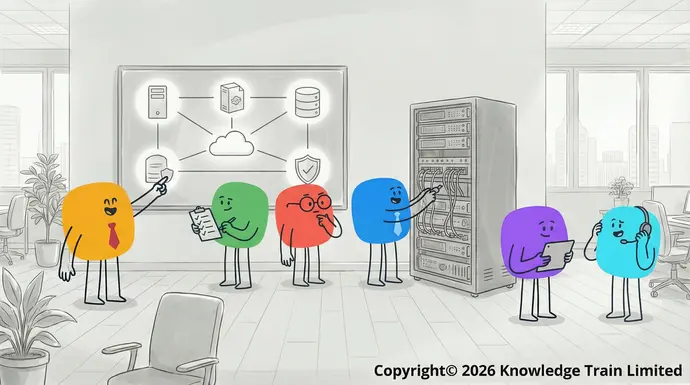
Definition of Information Technology
Information technology (IT) encompasses the use, development, and maintenance of computer systems, software, networks, and data for the storage, retrieval, transmission, and secure management of information. It is a foundational discipline enabling digital communication, business processes, and the secure handling of data in today’s world.
Main components of IT
- Hardware: The physical devices involved in computing such as desktops, laptops, servers, storage devices, and peripherals.
- Software: Programmes and applications running on computers and devices, including operating systems, business applications, and databases.
- Networks: Systems that connect hardware devices, enabling data sharing and communication, such as local area networks (LAN), wide area networks (WAN), and the internet.
- Data: Digital information, which may be numbers, texts, images, audio, or video, processed and analysed by IT systems.
- Databases: Organised collections of data, enabling efficient storage, retrieval, and management through database management systems (DBMS).
- Internet technologies: Protocols and platforms enabling global connectivity, web services, cloud computing, and e-commerce.
- Cybersecurity: Practices and technologies designed to protect information, systems, and networks from threats or unauthorised access.
Applications and uses of IT
Information technology has transformed many areas of society and industry. Key areas of application include:
- Business applications: Automation of processes, decision support, customer relationship management, enterprise resource planning, and e-commerce.
- Healthcare: Electronic health records, telemedicine, diagnostic tools using artificial intelligence (AI), and secure data exchange between providers and patients.
- Education: Online learning environments, digital classrooms, educational management systems, and adaptive learning platforms.
- Government: E-government services, digital identity, public records management, and online citizen services.
- Daily life: Internet access via mobile devices, social media, online banking, smart home technologies, and digital entertainment.
IT examples
| Example | Description | IT Components Involved |
|---|---|---|
| Cloud computing | On-demand access to computing resources and services over the internet | Hardware, software, networks, internet, data centres |
| Cybersecurity tools | Systems for protecting networks and data (e.g. firewalls, encryption) | Software, networks, information security, authentication, hardware |
| E-commerce platforms | Websites and apps for online shopping and transactions | Internet technologies, software, databases, networks |
| Office productivity software | Apps for document creation, spreadsheets, and presentations | Software, hardware, cloud services |
| Telecommunications systems | Voice, video, and data communications across large distances | Networks, hardware, software, data, telecommunications |
| Artificial intelligence applications | AI-powered analytics, voice assistants, and machine learning tools | Software, data, networks, algorithms, hardware |
History of IT
The foundations of information technology can be traced to the development of early computational devices and theoretical computer science in the mid-20th century. The invention of the electronic computer in the 1940s, the introduction of mainframes and minicomputers, and later the personal computer revolution in the 1970s and 1980s marked significant milestones.
The emergence of networking technologies, including the internet, in the late 20th century enabled unprecedented global connectivity. The evolution of software, data management, and communication protocols drove the digital transformation of organisations. In recent decades, IT has embraced cloud computing, telecommunications, cybersecurity, and artificial intelligence to meet growing demands for efficiency, mobility, and information security.
Importance of IT
IT is essential for modern society and the global economy. It enables rapid information sharing, process automation, global collaboration, data-driven decision-making, and secure communications. Digital transformation initiatives rely on IT to deliver innovation, competitive advantage, and improved public services. Cybersecurity and information security are now crucial for protecting critical infrastructure and safeguarding privacy in an increasingly interconnected world.
IT careers
Careers in IT span areas such as systems analysis, project management, software development, network administration, cybersecurity, IT support, data management, and artificial intelligence. Professionals may work across sectors, supporting digital transformation and ensuring the reliable operation of information systems. Required skills range from technical proficiency in hardware and software to abilities in project management and problem-solving.
Future trends in IT
The future of IT will be shaped by advances in artificial intelligence, machine learning, cloud computing, big data analytics, quantum computing, and enhanced cybersecurity solutions. Digital transformation across industries is set to accelerate, with increased focus on sustainability, automation, and digital ethics. The integration of IT with IoT (Internet of Things), blockchain, and 5G telecommunications will further expand its influence and applications.
FAQs
What is the difference between Information Technology (IT) and Information and Communications Technology (ICT)?
Information technology (IT) refers to the use of computers, software, networks, and systems to manage and process information. Information and communications technology (ICT) is a broader term that includes IT as well as communication technologies like telephony, broadcasting, and the internet, emphasising the convergence of information processing and communication.
What are some examples of information technology?
Examples include computer systems, cloud computing platforms, business applications, cybersecurity tools, databases, telecommunications, and artificial intelligence applications.
Why is information technology important?
Information technology is essential for modern communication, efficient business operations, data management, innovation, and secure access to services. It supports economic growth, digital transformation, and enhances everyday life.
What careers are available in information technology?
IT careers include software development, network administration, cybersecurity, data analysis, project management, information systems management, support roles, and emerging jobs in artificial intelligence and machine learning.
What are the future trends in information technology?
Key trends include the growth of artificial intelligence, big data, cloud computing, quantum computing, advanced cybersecurity, and integrating IT with new technologies like IoT and 5G.