iency and innovation. By fostering a holistic understanding of processes, it enables teams to optimise workflows and reduce waste. This comprehensive view encourages creative problem-solving and the development of innovative solutions. As a result, organisations are better equipped to adapt to changing environments and seize new opportunities.Select your preferred training course below:
Enhanced collaboration
The model also promotes enhanced collaboration by breaking down silos and encouraging open communication. By aligning team members around a shared vision, it fosters trust and mutual respect. This collaborative culture improves information flow and accelerates decision-making. As teams work together more effectively, they achieve collective goals and drive organisational success.SCRUM COURSES
Challenges and limitationsSelect your preferred training course below:
Implementation barriers
Despite its benefits, adopting system thinking presents several implementation barriers. Organisations often face resistance from employees accustomed to traditional methods. The shift to a more interconnected approach requires changes in mindset and behaviour, which can be difficult to achieve. Additionally, the complexity of system thinking may overwhelm those unfamiliar with its principles.LEAN SIX SIGMA COURSES
Overcoming resistanceSelect your preferred training course below:
To overcome resistance, organisations can employ several strategies. Providing comprehensive training and support helps employees understand the value of system thinking. Encouraging small-scale pilot projects allows teams to experience its benefits firsthand. Leadership plays a crucial role in modelling the desired behaviours and reinforcing the importance of the new approach. By creating a supportive environment, organisations can cultivate a system thinking culture.
In conclusion, while implementing Senge’s model can enhance efficiency, innovation, and collaboration, it requires overcoming significant challenges. By addressing these barriers and fostering a culture of openness and learning, organisations can realise the full potential of system thinking. This transformation not only improves performance but also contributes to a more resilient and adaptable organisational culture.BUSINESS ANALYST COURSES
Case studies and real-world examplesSelect your self-paced training course topic.
Successful implementations
Corporate examplesBCS BUSINESS ANALYST COURSES
Several companies have successfully integrated Senge’s system thinking model into their operations. For instance, Royal Dutch Shell applied systems thinking through scenario planning in the 1970s and 1980s, which helped them prepare for major oil market changes. Similarly, Unilever adopted system thinking to improve sustainability practices, resulting in significant reductions in waste and resource consumption.Select your preferred training course below:
Sector-specific applications
In the healthcare sector, system thinking has been applied to streamline patient care pathways, improving outcomes and reducing costs. Educational institutions have also embraced this model to foster collaborative learning environments, enhancing both teaching methods and student engagement. These sector-specific applications demonstrate the versatility of Senge’s model across different fields.CHANGE MANAGEMENT COURSES
Lessons learnedSelect your self-paced training course topic.
Key takeaways
The key takeaway from these examples is the importance of aligning the organisation’s vision with system thinking principles. Successful implementations often involve a strong commitment from leadership and a willingness to challenge existing mental models. Organisations that foster a culture of learning and open communication tend to reap the most benefits.APMG CHANGE MANAGEMENT COURSES
By focusing on the interconnectedness of processes, companies can achieve improved efficiency and innovation. Moreover, the psychological benefits, such as reduced stress and increased job satisfaction, contribute to a more positive organisational culture. These lessons highlight the potential of Senge’s model to transform diverse workplace settings.Select your preferred training course below:
Conclusion
Summary of key pointsPROGRAMME MANAGEMENT COURSES
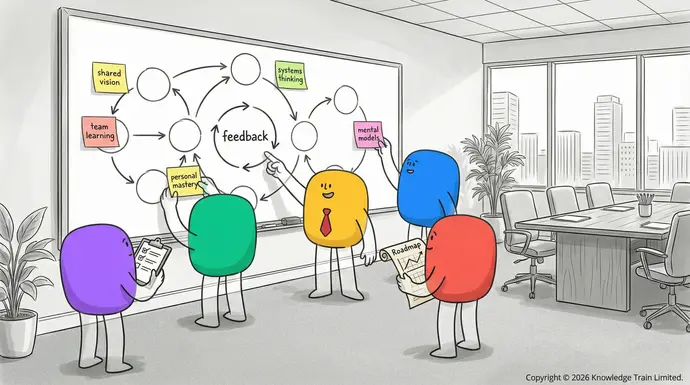
Senge’s system thinking model offers a holistic framework that enhances efficiency, innovation, and collaboration. By integrating personal mastery, mental models, shared vision, team learning, and systems thinking, organisations can address complex challenges effectively.Select your self-paced training course topic.
Future outlook
The future of system thinking in organisational development is promising. As businesses navigate increasing complexity, this model’s principles will become even more relevant. By fostering a culture of continuous learning and adaptability, organisations can not only improve performance but also enhance employee well-being, leading to sustainable success.MSP COURSES
FAQsSelect your preferred training course below:
What is Senge’s system thinking model?
A framework for understanding organisational complexity through five interconnected disciplines. The model emphasises how personal mastery, mental models, shared vision, team learning, and systems thinking work together to create sustainable IT QUALIFICATIONSorganisational changeSelect your preferred qualification..
How can system thinking improve organisational performance?ITIL COURSES
By enhancing efficiency, collaboration, and innovation. The approach helps organisations identify root causes of problems, understand feedback loops, and develop more sustainable solutions through holistic analysis.Select your preferred training course below:
What are the challenges in implementing Senge’s model?
Resistance to change and the need for mindset shifts. Organisations often struggle with moving from event-oriented thinking to recognising patterns and systemic structures, requiring sustained leadership commitment and cultural transformation.IT QUALIFICATIONS
Can Senge’s model be applied in small businesses?Select your preferred qualification.
Yes, it is adaptable to different organisational sizes. Small businesses can particularly benefit from systems thinking by understanding interconnections between different business functions and making more informed strategic decisions.
What are some real-world examples of system thinking?ITIL COURSES
Royal Dutch Shell applied systems thinking for scenario planning in oil market changes. Other examples include Unilever’s sustainability initiatives and healthcare organisations improving patient care through systems approaches. These cases demonstrate how systems thinking can lead to better strategic planning and operational improvements.Select your preferred training course below:
How does system thinking affect decision-making processes?
It promotes informed and sustainable decisions. Systems thinking helps leaders consider long-term consequences, understand feedback loops, and recognise how different parts of the organisation influence each other before making strategic choices.LEARNING LIBRARIES
What role does “The fifth discipline” play in system thinking?Select your preferred training course topic.
It outlines the core principles of Senge’s model. Published in 1990, the book introduces the five disciplines and explains how systems thinking integrates them to create lasting organisational learning and change.
InfographicAI QUALIFICATIONS & WORKSHOPS
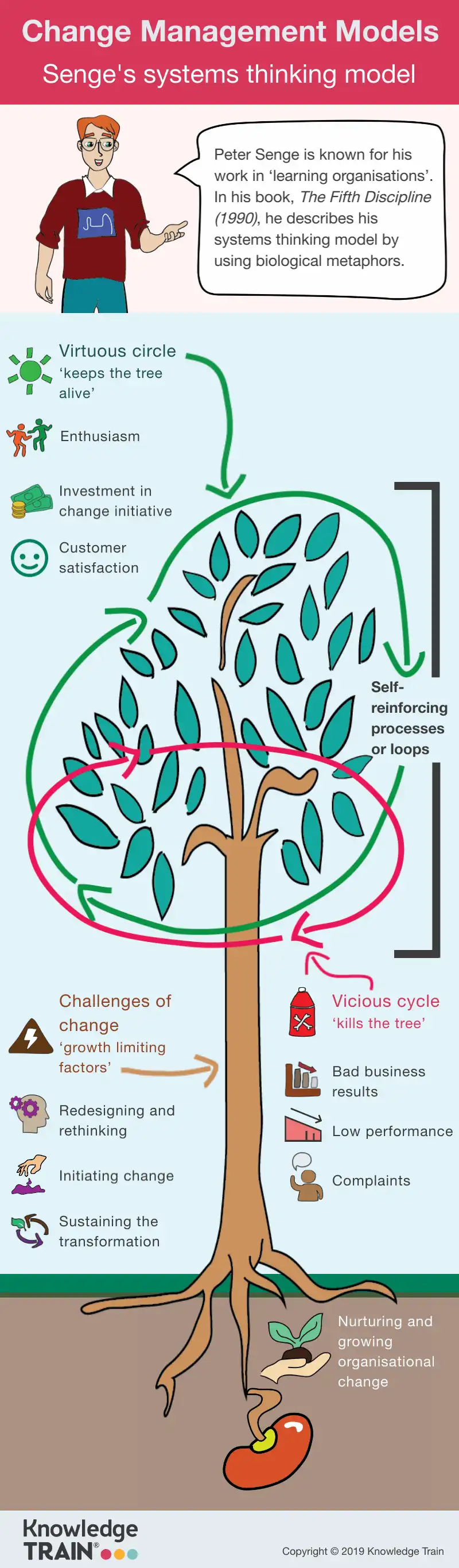
Peter Senge Select your preferred qualification or workshop.change management model has been captured in this infographic.AIPGF COURSES