Key takeawaysWORKSHOPS
Senge’s model improves change outcomes by treating organisations as connected systems, not isolated events.Select your preferred workshop below:
- Systems thinking links the other four disciplines and helps reveal feedback loops, delays, and recurring patterns.
- Personal mastery and clear shared vision create alignment and motivation during change.AGILE QUALIFICATIONS
- Challenging mental models reduces bias and makes new ways of working easier to adopt.Select your preferred qualification.
- Team learning strengthens problem-solving through dialogue, discussion, and fewer defensive routines.
- Implementation works best with leadership role-modelling, training, and small pilots that prove value.AGILE PROJECT MANAGEMENT COURSES
Introduction to Senge’s system thinking modelAPMG CHANGE MANAGEMENT COURSES
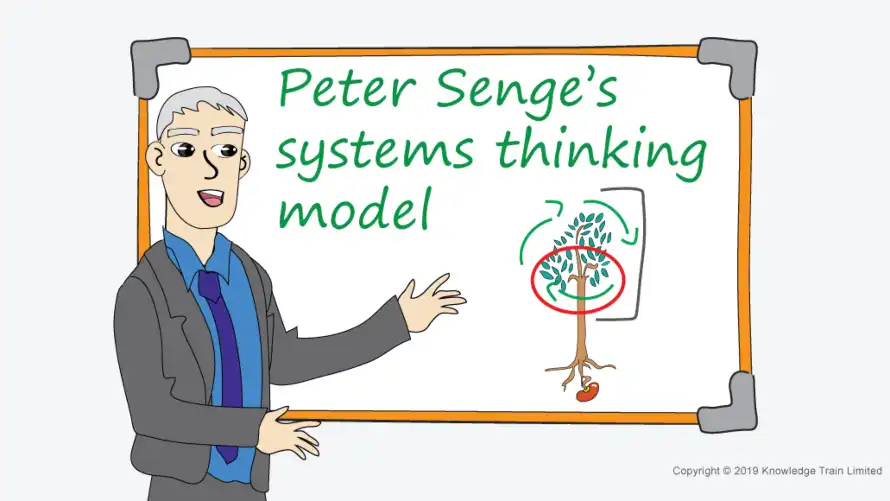
Overview of system thinkingSelect your preferred training course below:
Definition and significance
System thinking is a holistic approach to understanding how various parts of an organisation interrelate. It focuses on recognising patterns and interdependencies rather than isolated events. This approach is crucial in today’s organisational contexts because it allows leaders to foresee long-term consequences and make informed decisions. By considering the broader picture, organisations can address complex problems more effectively and sustainably.PROGRAMME MANAGEMENT QUALIFICATIONS
Historical backgroundSelect your preferred qualification.
Systems thinking emerged from General Systems Theory developed by Ludwig von Bertalanffy in the 1940s and cybernetics by Norbert Wiener. These foundations shaped modern systems thinking approaches in organisations. Pioneers in management theory recognised that understanding these interactions is essential for fostering innovation and resilience. As a result, system thinking became integral to modern management practices.
Introduction to Peter SengeMSP COURSES
About Peter SengeSelect your preferred training course below:
Peter Senge is a renowned scholar and author in the field of management. He is a senior lecturer at MIT, and his work has revolutionised how organisations approach learning and change. Senge’s research emphasises the importance of creating learning organisations that continuously adapt and grow.PMI COURSES
The fifth disciplineSelect your preferred training course below:
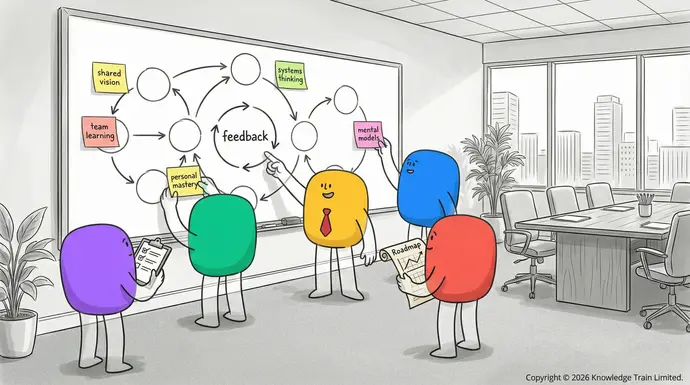
In his seminal book, “The fifth discipline,” Senge outlines five key disciplines necessary for building a learning organisation. These include personal mastery, mental models, shared vision, team learning, and systems thinking. His work highlights how these disciplines can transform organisational culture, enhancing efficiency and strategic thinking.
Core principles of Senge’s modelPMI COURSES
Understanding the five disciplinesSelect your preferred training course below:
Personal mastery
Personal mastery centres on recognising the gap between current reality and personal vision. This gap creates ‘creative tension’ which drives individual growth and learning. It requires both clarifying what matters and seeing current reality clearly. In the context of system thinking, personal mastery encourages individuals to see their role within a larger system. This self-awareness helps them contribute more effectively to organisational goals.
Mental modelsPRINCE2 COURSES
Mental models are deeply ingrained assumptions that influence how we understand the world. Senge incorporated Chris Argyris’s ‘ladder of inference’ alongside the ‘left-hand column’ technique to examine these assumptions. These tools help organisations identify and challenge limiting beliefs. By examining and challenging mental models, individuals and teams can eliminate biases and embrace new perspectives. This process is crucial for fostering open-mindedness and adaptability.Select your preferred training course below:
Shared vision
A shared vision is a collective aspiration that provides direction and purpose. It unifies team members, motivating them to work towards common goals. When everyone in an organisation shares the same vision, it creates a sense of belonging and commitment. This alignment enhances collaboration and drives consistent efforts across all levels.APM COURSES
Team learningSelect your preferred training course below:
Team learning develops through dialogue and discussion. Senge emphasises two distinct practices: dialogue (free exploration of complex issues) and discussion (where different views are presented and defended). This discipline requires managing defensive routines that undermine collective learning. By learning together, teams can solve problems more effectively and innovate continuously. This discipline emphasises the importance of knowledge sharing and encourages a culture of mutual support.
Systems thinkingAGILE PROJECT MANAGEMENT COURSES
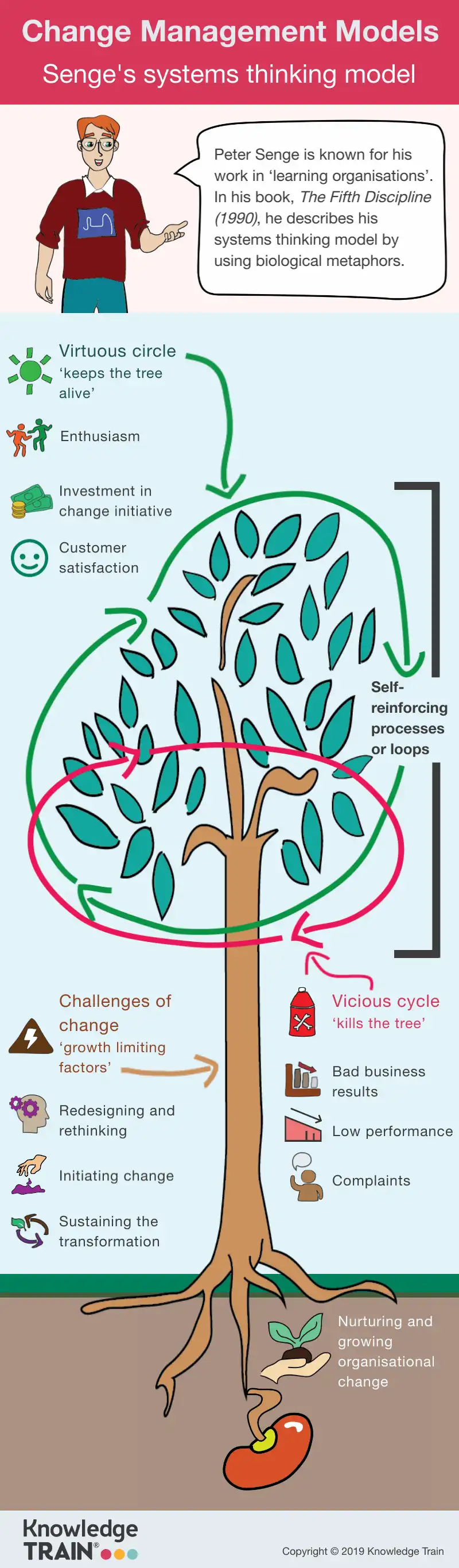
Systems thinking, which Senge named ‘The Fifth Discipline’ in his 1990 book, integrates the other four disciplines. It examines how systems interconnect and change over time through feedback loops, system archetypes and delays. By recognising patterns and relationships, organisations can address root causes rather than symptoms. Systems thinking provides a comprehensive framework for analysing complex issues, making it the cornerstone of Senge’s model.Select your preferred training course below:
Interconnectedness of the disciplines
Synergistic effectsPRINCE2 AGILE COURSES
The integration of these five disciplines leads to synergistic effects that enhance organisational effectiveness. When combined, they provide a holistic approach to tackling challenges. Each discipline complements the others, creating a dynamic interplay that fosters resilience and adaptability. This synergy helps organisations navigate complex environments more successfully.Select your preferred training course below:
| Discipline | Key benefitBUSINESS CASE COURSES |
| Personal masterySelect your preferred training course below: | Enhances individual contribution |
| Mental modelsAGILE COURSES | Promotes open-mindednessSelect your self-paced training course topic. |
| Shared vision | Unifies and motivates teamsAGILE PROJECT MANAGEMENT COURSES |
| Systems thinkingPRINCE2 AGILE COURSES | Addresses root causes of problemsSelect your preferred training course below: |
change managementSelect your preferred training course below:. For example, a shared vision aligns organisational efforts, while team learning accelerates problem-solving. Systems thinking ensures that decisions consider long-term impacts. By applying these principles, organisations can improve efficiency and innovation.
IT QUALIFICATIONS
System thinking plays a crucial role in strategic planning by offering a comprehensive view of organisational dynamics. It encourages leaders to consider the long-term effects of their decisions. By recognising patterns and feedback loops, organisations can develop robust strategies that anticipate potential challenges. This approach ensures that plans are adaptable and aligned with the organisation’s vision.Select your preferred qualification.
Change management
In the realm of ITIL COURSESchange managementSelect your preferred training course below:, system thinking provides a framework for understanding the complexities of organisational transitions. It helps identify underlying causes of resistance and facilitates smoother implementation of change initiatives. By focusing on relationships and interdependencies, leaders can craft strategies that address concerns and engage stakeholders effectively. This holistic view reduces disruptions and enhances the success of change efforts.