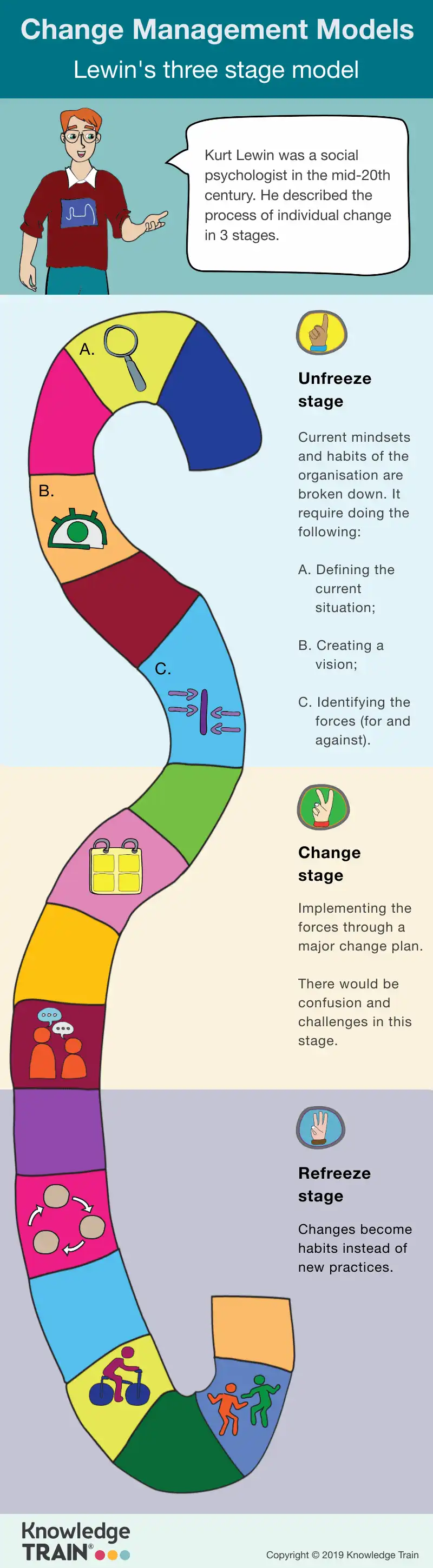
The essentials of Lewin’s change model for successful change management

Key takeawaysCopied!
Lewin’s model helps organisations manage change by focusing on both process and psychology.Key takeaways
- Unfreezing works best when characters communicate clearly, involve stakeholders early, and challenge the status quo to reduce resistance.ITSM offers multiple entry points and clear progression across technical, project, and business pathways.
- Changing succeeds when training, coaching, and practical support help characters adopt new ways of working.ITSM focuses on designing, delivering, and improving IT services by aligning technology, characters, and processes to business needs.
- Feedback loops during implementation surface issues early and keep the transition on track.ITIL is the most recognised baseline qualification and is widely referenced in job descriptions.
- Refreezing makes change stick through reinforcement, aligned policies, and cultural integration.Common entry roles include Service Desk Technician and IT Project Support, with progression into management or specialist tracks.
- Lewin’s simplicity is a strength, but fast moving environments may need more iterative or combined approaches such as Kotter or ADKAR.Technical starters can move from IT Support Technician or IT Architect into specialist support, project, or programme leadership roles.
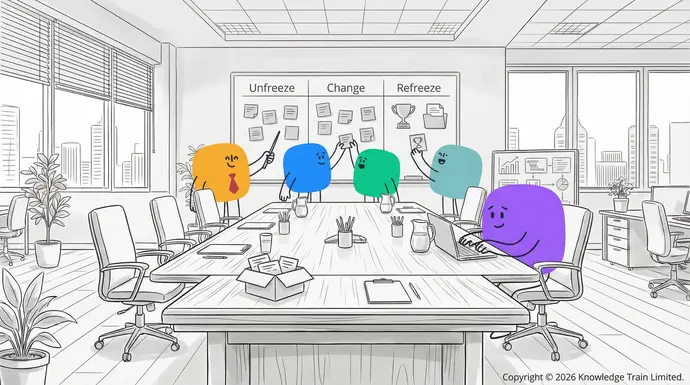
Introduction
In today’s competitive environment, change management plays a crucial role in ensuring that organisations adapt effectively to shifting markets and technological advancements. Successful change management allows businesses to transform, innovate, and remain relevant. One of the most respected frameworks in this field is Instructor-ledKurt Lewin’s change modelITIL 4 Foundation course, which offers a structured approach to implementing change. Developed in 1947, Lewin’s model breaks down the complex process of change into three distinct stages: unfreezing£1,599 +vat, , and refreezing . This model is significant for its psychological foundation, which addresses human resistance to change by promoting stress reduction and enhancing acceptance. By understanding and applying Lewin’s principles, organisations can navigate the challenges of change more effectively, ensuring smoother transitions and sustained improvements, ultimately leading to a more resilient and adaptable business environment.Instructor-led
Overview of Lewin’s change modelITIL 4 Strategist Direct, Plan & Improve (DPI)
Kurt Lewin’s change model£1,799 +vat is a widely recognised framework for managing organisational changeSee all dates. It breaks down the process into three distinct stages: What is ITSM?unfreezingITSM stands for IT service management and ITSM teams or individuals perform a vital function within organisations. They focus on managing the development, design and delivery of effective IT services, either in-house or to meet customer needs. ITSM staff achieve this by ensuring the technology, people and processes match the requirements of their organisation or customer, [1]changing., and To help manage these strategies, ITSM teams normally use best practice methods such as refreezingITIL. Each stage addresses specific aspects of change management, providing a comprehensive roadmap for organisations aiming to navigate transitions effectively.. You’ll find
Historically, Lewin developed this model in 1947, a period marked by an increased focus on scientific approaches to psychology. His model remains relevant today due to its simplicity and emphasis on the psychological aspects of change, such as reducing resistance and promoting acceptance. In an era where change is constant, Lewin’s model offers a structured yet flexible approach, allowing organisations to adapt and thrive.ITIL
Unfreezing very commonly mentioned on job descriptions. This is because ITIL is the most widely adopted ITSM method in the world, used by companies like IBM, Microsoft, Boeing, Sony and Barclays Bank
The [2]unfreezing. You can learn the ITIL method by doing an accredited stage is critical in preparing an organisation for change. It involves creating awareness about the necessity for transformation and challenging existing norms and behaviours. The primary goal is to reduce resistance by showing the benefits of change and the drawbacks of maintaining the status quo. This stage often involves:ITIL Foundation
- Communication course.: Open and transparent communication helps employees understand the reasons for change. It reduces uncertainty and anxiety, fostering a supportive environment where individuals are more willing to let go of old habits.As the IT world moves towards automation and closer collaboration between IT service and IT development departments, the benefits of new movements such as
- Leadership engagementDevOps: Leaders play a crucial role in modelling desired behaviours and attitudes. Their involvement is essential in building trust and commitment to the change process. are also being realised by ITSM teams
- Stakeholder involvement[3]: Engaging key stakeholders early in the process ensures that their concerns are addressed, and their insights are incorporated into the change strategy. This involvement can lead to more innovative solutions and greater buy-in.. With the explosion of hacking and data breaches,
Psychologically, unfreezing helps individuals and groups prepare for change by breaking down existing mindsets and fostering a readiness to embrace new ideas. By addressing the emotional aspects of change, organisations can create a foundation for successful transformation.cyber security
Changing is also becoming vital for organisations, so methods such as RESILIA are becoming very useful too
The [4]changing. stage represents the transition from old behaviours to new practices. It is the phase where the actual change occurs, requiring careful planning and execution. This stage focuses on:
- ImplementationDownload this ebook: Introducing new processes, technologies, or structures requires clear guidance and support. Training programmes and resources should be made available to facilitate learning and adaptation.
- Support systemsDownload: Providing support through mentoring or coaching can help employees navigate the challenges of change. It ensures that they have the necessary skills and confidence to adopt new ways of working.
- Feedback mechanisms : Regular feedback allows for continuous improvement and adjustment. It helps identify areas of resistance or difficulty, enabling timely interventions to keep the change process on track.
During the changing stage, the emphasis is on enabling individuals to adopt new behaviours and integrate them into their daily routines. By focusing on both structural and human elements, organisations can ensure that change is effective and sustainable.What ITSM jobs are available?
RefreezingAccording to AXELOS, the authors of
The ITILrefreezing, there are many different ITSM roles which are available for people with stage is the final step, where new changes are solidified and integrated into the organisational culture. It ensures that the changes become permanent and prevents regression to old practices. Key aspects of refreezing include:ITIL certification
- Reinforcement : Recognising and rewarding employees who successfully adapt to change reinforces desired behaviours. It encourages others to follow suit and helps embed new norms.[5]
- Policy and procedure alignment. You will also find that some ITSM jobs are technical, whereas some are more business orientated.: Updating policies and procedures to reflect new practices ensures consistency and clarity. It provides a framework for maintaining changes over time.Entry level ITSM jobs, like the Service Desk Technician and IT Project Support roles, are a good starting point for further progression into a management role, such as the Service Desk Manager or
- Cultural integrationProject Manager: Embedding changes into the organisational culture requires ongoing effort and commitment. It involves aligning values, beliefs, and behaviours with the new direction.. You can also progress into cyber resilience and business management roles.
Refreezing is crucial for sustaining change, as it creates stability and reduces the likelihood of reverting to previous habits. By reinforcing new behaviours and aligning them with organisational goals, change becomes an integral part of the organisation’s identity.If you have technical knowledge or experience as a developer, you can start an IT service management career by entering an IT Support Technician role or IT Architect role. From there, you can move onto specialised support and
In conclusion, Lewin’s change model offers a structured approach to managing organisational change, addressing both the psychological and practical aspects of transformation. Its enduring relevance lies in its ability to guide organisations through the complexities of change, ensuring successful and lasting outcomes.project management roles
Advantages and disadvantages of Lewin’s change modelCommon ITSM job roles
Kurt Service Desk TechnicianLewin’sAverage salary: £16,000 to £35,000 per year force field analysis and three-stage model of change are renowned for their simplicity and clarity, making them accessible tools for organisations navigating change. One of its primary strengths is its straightforward three-stage process – Sometimes called a Help Desk Technician or Support Technician, this ITSM job involves helping users with software or hardware problems. They are the first point of contact for users, who will contact the technician via phone, email or live chat. Technicians might provide support in-house for an organisation’s employees, or they might provide support for a company’s customers.unfreezingTo enter this ITSM role, you will need effective communication skills, sound understanding of the products you’re supporting, a customer-driven approach and good problem-solving skills. A degree isn’t necessary, but solid computing knowledge, customer service experience and maybe a college course will look good on your CV. You can also do apprenticeships, [6]changing., and How you can progressrefreezingAfter gaining experience within this role, you can progress onto higher level ITSM jobs, such as the Application Support Analyst, Service Desk Manager or IT Project Manager roles. Professional ITSM qualifications, especially . This structure provides a clear roadmap for implementing change, helping organisations manage transitions systematically. Additionally, the model emphasises the psychological aspects of change, such as reducing stress and enhancing acceptance, which fosters a supportive environment for transformation.ITIL Foundation
However, despite these advantages, Lewin’s model is not without criticism. A notable limitation is its planned approach to change, which some argue oversimplifies emergent and continuous organisational change processes. In today’s dynamic business environment, change often requires flexibility and adaptability, which a linear model may not sufficiently address. Critics also point out that the model assumes a relatively static environment, whereas many organisations face continuous or overlapping changes that demand more iterative processes., will help you enter any of these higher level ITSM jobs.
Furthermore, while Lewin’s model is effective in highlighting the human element of change, it may not fully account for technological advancements and rapid market shifts that influence contemporary PRINCE2change management and . Therefore, while Lewin’s change model provides a foundational framework, organisations may need to adapt it or integrate it with other models to address the multifaceted nature of change in today’s world.AgilePM
Real-world applications of Lewin’s change model can help you get into the IT Project Manager role.
Lewin’s change model has been successfully applied across various sectors, demonstrating its versatility and effectiveness. These applications provide valuable insights into how organisations can manage transformation effectively.IT Project Support
Example 1: Application in a corporate settingAverage salary: £27,500 per year
In a leading technology firm, Lewin’s model guided a transition to This ITSM role involves providing administrative support to the project or programme team. You will also be involved in basic agile project managementproject management. During the . This is a back office role, not customer-facing. There is a lot of data collection and file management involved, and it provides a solid starting point for anyone wanting to be an IT Project Manager.unfreezingAccording to IT Jobs Watch, IT Project Support roles can around £27,500 in the UK stage, management identified the need for agility to stay competitive. Workshops and discussions were held to prepare employees for the shift. In the [7]changing. Good organisation skills are a definite plus, as you’ll be working with files and documents. People with some experience in an office environment will stand a better chance of entering project support phase, [8]agile methodologies. A degree isn’t necessary, but were introduced through training programmes, supported by mentors to ease the transition. The professional certificationrefreezing, like stage involved integrating these practices into the company culture, reinforced by regular feedback sessions.PRINCE 2
- Outcome or : The move resulted in improved project delivery times and enhanced team collaboration.Agile Project Management
- Lesson , will make you stand out from the rest.: Clear communication and support systems are crucial for overcoming resistance.How you can progress
Example 2: Implementation in healthcareAs mentioned above, this ITSM job is a fantastic way to become an IT Project Manager, as you will gain on-the-job experience. If you would prefer to manage front-line staff in a customer service environment, you can also progress into a Service Desk Manager role, in which case you will need strong computing knowledge and
A hospital implemented Lewin’s model to transition from paper-based to electronic medical records. The ITIL certificationunfreezing.Average salary: £17,000 to £35,000 per yearchangingThis is a more technical ITSM job as it involves identifying and fixing hardware and software issues. Such issues will normally be escalated by service desk staff, and if it’s happening right there and then, will need fixing promptly. This adds a fair bit of pressure to the role. This ITSM role also requires excellent IT knowledge – your day might involve maintaining networks, running tests to see whether issues have been fixed, installing new software or upgrades, replacing hardware or creating new user accounts. stage, training sessions were conducted to familiarise staff with the new system. The According to Prospects refreezing[9] stage ensured the new process was standard practice, with ongoing technical support provided. IT Support Technicians can earn anything up to £35,000 a year in the UK. A degree isn’t necessary, but qualifications can give you an advantage. Getting ITIL certified can help you provide better support and continually improve your support skills. You can also complete Microsoft, Cisco, Linux or Oracle training to prove your technical expertise. Gaining work experience is highly recommended.
- OutcomeHow you can progress: This change increased efficiency and accuracy in patient record management.You can develop this career by specializing in a certain area of
- LessonIT: Continuous support and training are vital for successful technological adoption. and becoming either an Application Support Specialist, Hardware Support Specialist or Network Support Specialist. Again, ITIL can help you enter any of these roles. A qualification called RESILIA is also beneficial for the Network Support Specialist role. This will equip you with cyber resilience skills.
Example 3: Educational institutionsIT Architect
A university applied Lewin’s model to innovate its teaching methodologies. Average salary: £57,806 per yearUnfreezingIT Architects form a crucial part of the ITSM team. In consultation with the organisation’s stakeholders, they are responsible for designing IT solutions that increase efficiency, reduce costs or solve business problems. They often specialize in a certain area of IT and often lead development teams. Quite a bit of research and analysis will be required, alongside good planning and leadership skills. involved recognising the limitations of traditional teaching. The According to PayScale, IT Architects are some of the best-paid jobs in ITSM earning almost £60,000 a year in the UK changing[10] phase saw the introduction of digital tools and interactive techniques. . To become an IT Architect, you will need to have experience working in a development or testing role. An architect role is also easier to get into if you have a computer science or business information systems degreeRefreezing[11] embedded these new practices through policy changes and faculty workshops..
- OutcomeITIL qualifications can certainly help you enter this ITSM job, especially in terms of service design, strategy and planning. If you choose to specialize in cyber resilience, RESILIA is also a good qualification. As you will be involved in : Student engagement and learning outcomes improved significantly.projects
- Lesson, a qualification such as : Institutional support and policy alignment are key to sustaining educational change.APMG’s AgilePM
These examples highlight the model’s adaptability and the importance of addressing both human and structural elements in change initiatives. or
Comparing Lewin’s model with other change management theoriesPRINCE2
Kurt may also be useful.Lewin’s change modelHow you can progress is often compared with frameworks such as Typically, you can progress from this role to IT Project Manager, IT Programme Manager or Chief Technology Officer roles. Again, Kotter’s 8-step processAPMG’s Agile PM and and PRINCE2 can help you to get into a project management role, and ADKARMSP. Each model offers unique perspectives and methodologies for managing change within organisations. qualifications can help you get into a programme management role.
- Lewin’s modelITSM managerial roles is straightforward, focusing on three stages: unfreezing, changing, and refreezing. Its strength lies in its simplicity and emphasis on the psychological aspects of change, which can reduce stress and increase acceptance.The wonderful thing about an IT service management career is the excellent career progression. After gaining experience in one of the previously mentioned ITSM jobs, you can develop your career further within ITSM by specializing or moving into a managerial position.
- Kotter’s 8-step processFor example, Service Desk Technicians commonly move into Service Desk Manager roles, and IT Project Support normally step up into IT Project Manager roles. These are the logical next steps. However, some Service Desk Technicians choose to specialize and become an Application Support Specialist. Going down this path opens up ITSM career opportunities in cyber resilience and security. provides a more detailed approach, outlining specific steps like establishing a sense of urgency and creating short-term wins. This model is particularly useful for large-scale transformations requiring clear guidance and extensive communication.Let’s take a closer look at the ITSM jobs you can progress into.
- ADKARService Desk Manager focuses on individual change and is goal-oriented, emphasising Average salary: £45,000 per yearAwarenessThis is a common next job after being a Service Desk Technician. It involves daily management of the service desk team and ensuring customers leave satisfied. The Service Desk Manager achieves this by coaching and motivating their team, and ensuring effective processes are in place. They may also be involved in client management. ITIL and RESILIA qualifications can help you enter this role., How you can progressDesireAfter this job, you can enter an IT Change Manager, IT Operations Manager or Service Level Manager role., IT Change ManagerKnowledgePeople performing this role will manage, track and control changes to the software, hardware or IT system. They earn on average £55,000 per year according to JobsWatch. They authorize numerous small changes and ensure they are implemented properly, whilst large changes are normally discussed with the Change Advisory Board. The IT Change Manager is also responsible for establishing baselines and tracking revisions, understanding who changed what, and when., This role requires superb organisation and management skills. ITIL qualifications will help you enter the role, and you will also need experience using configuration management tools. After this role, you can specialize and become either a Release Manager or IT Configuration Manager. These two ITSM jobs delve deeper into IT infrastructure change, looking at the management of releases and configurations.AbilityIT Operations Managers, and Are responsible for leading the service desk and IT infrastructure teams, to ensure services and technologies are functioning properly. They monitor software/hardware and develop processes to ensure problems are solved quicklyReinforcement[12]. It is beneficial for understanding and managing personal impacts during organisational changes.. They typically earn around £60,000 per year. ITIL qualifications are very helpful for this role, and RESILIA can help with boosting cyber resilience skills. You can progress and become a Business Relationship Manager or Chief Information Officer – two very senior ITSM roles.
Lewin’s model is preferred when a concise and psychologically grounded approach is needed. It is particularly effective in scenarios where resistance to change is prominent, and fostering a supportive environment is crucial. However, in complex or large-scale organisational transformations, Kotter’s detailed steps or ADKAR’s individual focus might offer additional advantages.Service Level Managers
Ultimately, the choice of model depends on the organisational context and the specific challenges faced. Integrating elements from different frameworks can often provide a more comprehensive strategy, catering to both structural and human elements of change.This is another high salaried position, with earnings of around £60,000 per year. Service Level Managers are effective communicators, responsible for designing and negotiating services that align with a customer’s service level targets. These services get outlined in contracts called Service Level Agreements (SLAs). They also monitor and analyse service levels. Again,
Influence tactics and work outcomes in change managementLead and plan programmes of change involving IT. This involves managing the risks, budgets, priorities and quality of multiple
The success of projectschange management. It is therefore a top level ITSM job, due to the amount of experience and skill required. They earn on average £75,000 per year. Gaining the efforts is significantly influenced by the tactics employed to guide and motivate individuals within an organisation. Effective MSPinfluence tactics qualification, along with are essential for ensuring that changes are not only implemented but also sustained over time. These tactics include clear communication, employee involvement, and positive reinforcement, all of which contribute to a supportive environment for change.ITIL certification
Research on work outcomes in relation to change efforts highlights the importance of these tactics. The analysis reveals that successful change initiatives often involve:, would benefit those interested in entering this role.
- Effective communicationBusiness Relationship Managers: Keeping communication channels open and transparent helps align employees with the change objectives. It reduces uncertainty and stress, fostering an environment where employees feel informed and valued.Earn on average around £50,000 a year and could be considered senior sales staff. They build relationships between the organisation and customers, making sure IT services meet the needs of the customer. They understand the IT services offered, and how they can help the customer. It is a role requiring good people skills and the ability to build trust.
- Employee involvementITIL certification: Actively involving employees in the change process enhances their commitment and ownership. It empowers them to contribute ideas and feedback, which can lead to more innovative solutions and smoother transitions. will help you enter this ITSM role, especially in terms of service strategy and improvement. The next step after this job would be a Supplier Relationship Manager.
- Positive reinforcementApplication Support Specialist: Recognising and rewarding employees who adapt well to change encourages continued compliance and motivation. This reinforcement helps embed new behaviours and norms into the organisational culture.Those with experience in technical ITSM roles, such as IT Support Technicians, can progress into this role easily. It involves focusing on applications and fixing issues when escalated from the service desk. They often use their expertise to train staff and advise the organisation too. Alternatively, IT Support Technicians with hardware or networking expertise can move into a Hardware or Network Support Specialist role instead. It depends what you want to specialize in.
Furthermore, the psychological benefits of these tactics, such as stress reduction and enhanced acceptance, cannot be overstated. By addressing the human aspect of change, organisations can mitigate resistance and build resilience among their workforce.ITIL certification
Ultimately, the strategic use of influence tactics in is essential for these roles, alongside excellent technical knowledge.change managementHow you can progress not only improves individual work outcomes but also contributes to the overall success of the organisation. By fostering an inclusive and supportive atmosphere, businesses can ensure that change is not just a temporary adjustment but a lasting transformation.After these roles, you can enter the cyber security ITSM career path. The next step would be as a Security Analyst.
ConclusionSecurity Analysts
In this article, we explored Earn on average £50,000 per year and perform a vital role within ITSM. They use software and diagnostics to prevent security breaches, designing solutions to strengthen the organisation’s network against attacks. They will have a deep understanding of cyber security and cyber resilience tools. They might also be involved in security training and defining the organisation’s security policies. Lewin’s change modelITIL certification, a foundational framework for implementing will help you enter this role, but RESILIA certification is highly recommended too.organisational changeAfter this role, you can progress into one of the numerous . The model’s three stages – unfreezing, changing, and refreezing – provide a structured approach that emphasises the psychological aspects of change, such as stress reduction and enhanced acceptance. We discussed its real-world applications across corporate settings, healthcare, and educational institutions, highlighting its adaptability and effectiveness. While Lewin’s model offers simplicity and clarity, it is essential to acknowledge its limitations, especially in dynamic environments requiring more iterative approaches. Comparing it with other frameworks like Kotter’s 8-Step Process and cyber security rolesADKAR within ITSM, such as a Cyber Resilience Manager, Cyber Resilience Consultant, IT Security Architect, Cyber Resilience Auditor. Again, RESILIA and ITIL will come in very useful for these ITSM job roles. reveals the need to tailor strategies to specific organisational contexts. Ultimately, understanding and implementing Lewin’s model can facilitate successful Top-tier ITSM jobschange managementThe highest ITSM roles would be the Chief Technology Officer, Chief Information Officer and Chief Information Security Manager. These are all executive roles which would see you making strategic decisions for your organisation. by addressing both human and structural elements, ensuring that transformations are sustainable and beneficial for organisations.The Chief Technology Officer effectively chooses the right technology for the business; the Chief Information Officer defines the organisation’s overall IT strategy, and the Chief Information Security Manager defines the overall security strategy.
FAQsAll are performed by experts with a great deal of experience and the right ITIL qualifications, having worked for some time in another ITSM role previously.
What are the key stages of Lewin’s change model?Enhance your skills with our expert-led courses
Lewin’s change model consists of three key stages: , Instructor-ledchangingITIL 4 Foundation course