- stage involved integrating these practices into the company culture, reinforced by regular feedback sessions.
- LessonOutcome: Clear communication and support systems are crucial for overcoming resistance.: The move resulted in improved project delivery times and enhanced team collaboration.
Example 2: Implementation in healthcareLesson
A hospital implemented Lewin’s model to transition from paper-based to electronic medical records. The : Clear communication and support systems are crucial for overcoming resistance.unfreezingExample 2: Implementation in healthcare phase involved addressing staff concerns through information sessions. During the A hospital implemented Lewin’s model to transition from paper-based to electronic medical records. The changingunfreezing stage, training sessions were conducted to familiarise staff with the new system. The phase involved addressing staff concerns through information sessions. During the refreezingchangingrefreezing
- Outcome stage ensured the new process was standard practice, with ongoing technical support provided.: This change increased efficiency and accuracy in patient record management.Outcome
- Lesson: This change increased efficiency and accuracy in patient record management.: Continuous support and training are vital for successful technological adoption.Lesson
Example 3: Educational institutions: Continuous support and training are vital for successful technological adoption.
A university applied Lewin’s model to innovate its teaching methodologies. Example 3: Educational institutionsUnfreezingA university applied Lewin’s model to innovate its teaching methodologies. involved recognising the limitations of traditional teaching. The Unfreezingchanging involved recognising the limitations of traditional teaching. The phase saw the introduction of digital tools and interactive techniques. changingRefreezing phase saw the introduction of digital tools and interactive techniques. embedded these new practices through policy changes and faculty workshops.Refreezing
- Outcome embedded these new practices through policy changes and faculty workshops.: Student engagement and learning outcomes improved significantly.
- Lesson: Institutional support and policy alignment are key to sustaining educational change.Outcome
These examples highlight the model’s adaptability and the importance of addressing both human and structural elements in change initiatives.: Student engagement and learning outcomes improved significantly.
Comparing Lewin’s model with other change management theoriesLesson
Kurt : Institutional support and policy alignment are key to sustaining educational change.Lewin’s change modelThese examples highlight the model’s adaptability and the importance of addressing both human and structural elements in change initiatives. is often compared with frameworks such as Comparing Lewin’s model with other change management theoriesKotter’s 8-step processKurt and Lewin’s change modelADKAR is often compared with frameworks such as . Each model offers unique perspectives and methodologies for managing change within organisations.Kotter’s 8-step process
- Lewin’s model and is straightforward, focusing on three stages: unfreezing, changing, and refreezing. Its strength lies in its simplicity and emphasis on the psychological aspects of change, which can reduce stress and increase acceptance.ADKAR
- Kotter’s 8-step process. Each model offers unique perspectives and methodologies for managing change within organisations. provides a more detailed approach, outlining specific steps like establishing a sense of urgency and creating short-term wins. This model is particularly useful for large-scale transformations requiring clear guidance and extensive communication.Lewin’s model
- ADKAR is straightforward, focusing on three stages: unfreezing, changing, and refreezing. Its strength lies in its simplicity and emphasis on the psychological aspects of change, which can reduce stress and increase acceptance. focuses on individual change and is goal-oriented, emphasising Kotter’s 8-step processAwareness provides a more detailed approach, outlining specific steps like establishing a sense of urgency and creating short-term wins. This model is particularly useful for large-scale transformations requiring clear guidance and extensive communication., ADKARDesire focuses on individual change and is goal-oriented, emphasising , AwarenessKnowledge, , DesireAbility, , and KnowledgeReinforcement, . It is beneficial for understanding and managing personal impacts during organisational changes.Ability
Lewin’s model is preferred when a concise and psychologically grounded approach is needed. It is particularly effective in scenarios where resistance to change is prominent, and fostering a supportive environment is crucial. However, in complex or large-scale organisational transformations, Kotter’s detailed steps or ADKAR’s individual focus might offer additional advantages., and
Ultimately, the choice of model depends on the organisational context and the specific challenges faced. Integrating elements from different frameworks can often provide a more comprehensive strategy, catering to both structural and human elements of change.Reinforcement
facilitates change by creating awareness of the need for transformation. It involves dismantling existing mindsets and behaviours, reducing resistance, and preparing employees psychologically for the upcoming changes. This stage is crucial for establishing a foundation for successful change.
Common challenges in the What are common challenges in the refreezing stage, and how can they be addressed?refreezingCommon challenges in the stage include reverting to old habits and lack of reinforcement. To address these, organisations can implement continuous support systems, provide ongoing training, and celebrate successes to reinforce new behaviours, ensuring they become part of the organisational norm.refreezing
How does Lewin’s change model compare to Kotter’s 8-step process? stage include reverting to old habits and lack of reinforcement. To address these, organisations can implement continuous support systems, provide ongoing training, and celebrate successes to reinforce new behaviours, ensuring they become part of the organisational norm.
While Lewin’s model offers a simple three-stage framework, How does Lewin’s change model compare to Kotter’s 8-step process?Kotter’s 8-Step ProcessWhile Lewin’s model offers a simple three-stage framework, provides a more detailed approach. Kotter’s model outlines specific steps such as creating urgency and building a guiding coalition. Lewin’s model is ideal for straightforward changes, whereas Kotter’s is suited for complex transformations requiring extensive communication.Kotter’s 8-Step Process
Can Lewin’s model be applied in small businesses? If so, how? provides a more detailed approach. Kotter’s model outlines specific steps such as creating urgency and building a guiding coalition. Lewin’s model is ideal for straightforward changes, whereas Kotter’s is suited for complex transformations requiring extensive communication.
Yes, Lewin’s model can be effectively applied in Can Lewin’s model be applied in small businesses? If so, how?small businessesYes, Lewin’s model can be effectively applied in . Its simplicity makes it accessible for limited resources. Small businesses can use it to prepare employees for change, implement new practices incrementally, and ensure that these changes are sustained through regular feedback and reinforcement. This approach helps maintain agility while fostering a culture of continuous improvement.small businesses
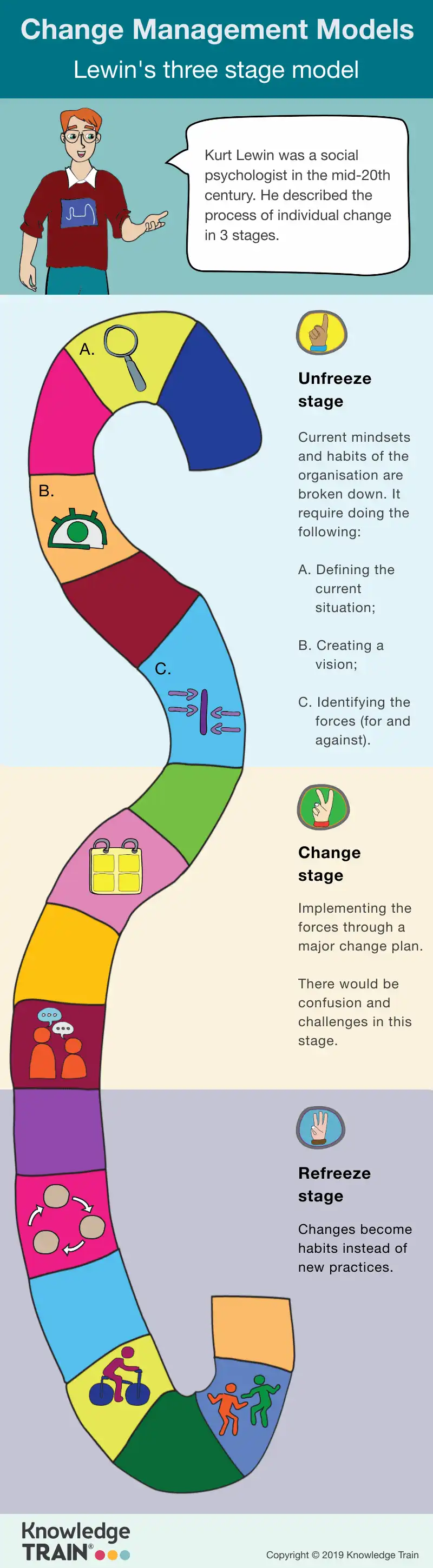
Infographic. Its simplicity makes it accessible for limited resources. Small businesses can use it to prepare employees for change, implement new practices incrementally, and ensure that these changes are sustained through regular feedback and reinforcement. This approach helps maintain agility while fostering a culture of continuous improvement.
Kurt Lewin’s Infographicchange managementKurt Lewin’s model has been summarised on this colourful infographic.change management