Key takeaways
Lewin’s model helps organisations manage change by focusing on both process and psychology.
- Unfreezing works best when characters communicate clearly, involve stakeholders early, and challenge the status quo to reduce resistance.
- Changing succeeds when training, coaching, and practical support help characters adopt new ways of working.Knowledge Train were flexible when I needed to move a session due to a clash at work. That kind of service made a big difference.
- Feedback loops during implementation surface issues early and keep the transition on track.Stephen J., Change Delivery Manager
- Refreezing makes change stick through reinforcement, aligned policies, and cultural integration.
- Lewin’s simplicity is a strength, but fast moving environments may need more iterative or combined approaches such as Kotter or ADKAR.
- APMG Change Management Practitioner
- Cultural integration course is best suited for:: Embedding changes into the organisational culture requires ongoing effort and commitment. It involves aligning values, beliefs, and behaviours with the new direction.Aspiring change managers
Refreezing is crucial for sustaining change, as it creates stability and reduces the likelihood of reverting to previous habits. By reinforcing new behaviours and aligning them with organisational goals, change becomes an integral part of the organisation’s identity.Key staff responsible for the design, development, and delivery of organisational change (including change project managers, senior responsible owners, operational line managers, and related roles).
In conclusion, Lewin’s change model offers a structured approach to managing organisational change, addressing both the psychological and practical aspects of transformation. Its enduring relevance lies in its ability to guide organisations through the complexities of change, ensuring successful and lasting outcomes.Does my APMG credential expire?
Is there any homework?agile methodologies were introduced through training programmes, supported by mentors to ease the transition. The refreezingDuring your stage involved integrating these practices into the company culture, reinforced by regular feedback sessions.instructor-led APMG Change Management class
- Outcome, our trainers will assign you homework of 1-2 hours at the end of each day.: The move resulted in improved project delivery times and enhanced team collaboration.Homework may include reading assignments, quizzes, and other beneficial revision exercises.
- LessonIf you are a student of an instructor-led virtual classroom course, you can take advantage of watching recordings of the training sessions for later review.: Clear communication and support systems are crucial for overcoming resistance.What is The Effective Change Manager’s Handbook?
Example 2: Implementation in healthcare
A hospital implemented Lewin’s model to transition from paper-based to electronic medical records. The unfreezingThe Effective Change Manager’s Handbook phase involved addressing staff concerns through information sessions. During the helps change managers understand the core principles, tools, and techniques of change management.changingThe handbook forms the basis of APMG Change Management. It is based on the comprehensive stage, training sessions were conducted to familiarise staff with the new system. The Change Management Body of Knowledge (CMBoKrefreezing™ stage ensured the new process was standard practice, with ongoing technical support provided.)
- Outcome created by the Change Management Institute.: This change increased efficiency and accuracy in patient record management.The guide details everything needed to define, practice, and introduce effective organisational change – from initial planning through to managing and sustaining gained benefits.
- LessonTopics covered include:: Continuous support and training are vital for successful technological adoption.The impact of Change
Example 3: Educational institutionsReadiness and sustainability
A university applied Lewin’s model to innovate its teaching methodologies. Stakeholder strategiesUnfreezingBenefits management involved recognising the limitations of traditional teaching. The FacilitationchangingEssential project management knowledge phase saw the introduction of digital tools and interactive techniques. Continuous learning and developmentRefreezingAnd many more. embedded these new practices through policy changes and faculty workshops.The Effective Change Manager’s Handbook is packed with guidance, strategies and models which change managers can use support any change initiatives.
- OutcomeStill have questions? Contact us by phone on 0207 148 5985, via live chat, email, or by completing the form below.: Student engagement and learning outcomes improved significantly.
- LessonHow to find us: Institutional support and policy alignment are key to sustaining educational change.Knowledge Train
These examples highlight the model’s adaptability and the importance of addressing both human and structural elements in change initiatives.20 Old Bailey, London, EC4M 7AN,
Comparing Lewin’s model with other change management theories England, United Kingdom.
ADKAR . Each model offers unique perspectives and methodologies for managing change within organisations.
- Lewin’s model is straightforward, focusing on three stages: unfreezing, changing, and refreezing. Its strength lies in its simplicity and emphasis on the psychological aspects of change, which can reduce stress and increase acceptance.
- Kotter’s 8-step processName provides a more detailed approach, outlining specific steps like establishing a sense of urgency and creating short-term wins. This model is particularly useful for large-scale transformations requiring clear guidance and extensive communication.
- ADKAR focuses on individual change and is goal-oriented, emphasising PhoneAwareness , DesireEmail{"@context":"https://schema.org","@type":"FAQPage","mainEntity":[{"@type":"Question","name":"What is APMG Change Management?","acceptedAnswer":{"@type":"Answer","text":"APMG Change Management is a certification that helps people manage and lead change in organisations. This certification covers different methods and strategies for successful change. It gives individuals the skills to handle various change situations effectively."}},{"@type":"Question","name":"What are the benefits of APMG Change Management certification?","acceptedAnswer":{"@type":"Answer","text":"Getting an APMG Change Management certification has many benefits. It can boost career advancement and professional growth. This certification is recognised globally, showing that you have the expertise to manage organisational change. It makes you more appealing to employers."}},{"@type":"Question","name":"Why choose APMG for change management?","acceptedAnswer":{"@type":"Answer","text":"APMG is known for its credibility and skill in certifying change management professionals. The organisation sets high standards and offers global recognition. This ensures that certified individuals are prepared to handle change initiatives successfully."}},{"@type":"Question","name":"What are the methodologies used in APMG Change Management?","acceptedAnswer":{"@type":"Answer","text":"APMG Change Management uses various methods and frameworks. These include structured processes and techniques to guide professionals through different stages of change. The approaches are designed to fit different organisational needs."}},{"@type":"Question","name":"What is the role of digital badges in APMG Change Management?","acceptedAnswer":{"@type":"Answer","text":"Digital badges are important in APMG Change Management. They provide recognition and visibility for certified professionals. These credentials help with professional development and allow individuals to show their expertise in managing change."}},{"@type":"Question","name":"What are the continuing professional development (CPD) opportunities?","acceptedAnswer":{"@type":"Answer","text":"Continuing professional development (CPD) opportunities with APMG provide ongoing learning and career growth. These courses improve skills and offer ways to keep enhancing knowledge in change management."}},{"@type":"Question","name":"What are the prerequisites for APMG Change Management certification?","acceptedAnswer":{"@type":"Answer","text":"To earn the APMG Change Management certification, you need to meet certain prerequisites. These requirements include having a foundational knowledge of change management concepts. Although specific training is not mandatory, it's helpful to undergo relevant training and courses to be eligible for the exam. Make sure you understand the necessary conditions and eligibility criteria before signing up."}},{"@type":"Question","name":"How to register for the APMG Change Management exam?","acceptedAnswer":{"@type":"Answer","text":"To register for the APMG Change Management exam, follow these simple registration steps:n1. Visit the official APMG website.n2. Navigate to the certification section.n3. Select the Change Management certification.n4. Fill in your personal details during the sign-up procedure.n5. Choose an examination date and time that suits you.n6. Complete the process by making the required payment.nThis straightforward enrollment procedure gets you ready for your certification exam."}},{"@type":"Question","name":"What study materials are recommended?","acceptedAnswer":{"@type":"Answer","text":"For thorough preparation, consider these essential study materials:n- Books: Look for recommended reading from APMG.n- Articles: Read online resources and articles related to change management.n- Online courses: Enrol in well-known online courses covering exam content.n- Study guides: Use guides specifically designed for APMG Change Management.n- Other resources: Reference learning materials and preparation aids available on the APMG website.nThese references will provide a complete understanding and help you succeed in the exam."}},{"@type":"Question","name":"How to implement change management in your organisation?","acceptedAnswer":{"@type":"Answer","text":"Implementing change management in your organisation involves several key steps:n1. Assess the current situation: Understand the need for change.n2. Develop a change management plan: Outline methodologies and strategies.n3. Communicate effectively: Make sure all stakeholders know about the changes.n4. Execute the plan: Follow the procedural steps.n5. Monitor progress: Track the changes and make adjustments as needed.nUsing these methods will help ensure a smooth change within your organisation."}},{"@type":"Question","name":"What are the common challenges in change management?","acceptedAnswer":{"@type":"Answer","text":"Common challenges in change management include:n- Resistance from employees: Reluctance to adopt new ways.n- Lack of clear vision: Not having a well-defined change strategy.n- Poor communication: Inadequate sharing of information.n- Insufficient resources: Lack of necessary tools or personnel.n- Inconsistent leadership: Unclear direction from those in charge.nRecognising these issues can help in creating strategies to overcome them."}},{"@type":"Question","name":"How to overcome resistance to change?","acceptedAnswer":{"@type":"Answer","text":"Overcoming resistance to change involves several strategies:n- Engage employees early: Involve them in the planning stages.n- Communicate clearly: Share the benefits and reasons for the change.n- Provide support: Offer training and resources to ease the transition.n- Address concerns: Listen to objections and respond to them.n- Highlight successes: Show positive results to build confidence.nUsing these tactics can reduce pushback and help with smoother implementation."}},{"@type":"Question","name":"How does Agile project management complement change management?","acceptedAnswer":{"@type":"Answer","text":"Agile project management complements change management by bringing flexibility and repeated steps. Agile methods promote ongoing improvement and allow for quick adjustments. This mix of Agile principles and change management helps organisations adapt quickly and effectively to new situations."}},{"@type":"Question","name":"What is the impact of cyber security on change management?","acceptedAnswer":{"@type":"Answer","text":"Cybersecurity impacts change management by making sure that data protection and information security are kept during changes. Putting strong digital safety measures in place lowers risks and keeps sensitive information safe. Looking at cybersecurity concerns is key for protecting the integrity of changes in an organisation."}},{"@type":"Question","name":"What are the best practices for using change management tools?","acceptedAnswer":{"@type":"Answer","text":"Using change management tools effectively requires following some best practices. First, ensure good communication to keep everyone informed. Use these tools to implement strategies, communicate risks, and assess the effectiveness of your practices. Remember to regularly update information to stay on top of any changes. By following these best practices, you can maximise the benefits of your tools."}},{"@type":"Question","name":"How to use data and analytics in change management?","acceptedAnswer":{"@type":"Answer","text":"Data and analytics are crucial in change management. They provide insights that can guide your decisions. Analysing data helps you understand performance and manage risks. Use tools to collect and analyse metrics, which can inform software development and improve overall results. Effective use of data and analytics leads to better performance and successful outcomes."}},{"@type":"Question","name":"What are the strategies for managing stakeholder expectations?","acceptedAnswer":{"@type":"Answer","text":"Managing stakeholder expectations involves clear communication and leadership. Use tools to align project goals with stakeholders' expectations. Regular updates, transparency, and feedback help manage and meet expectations. Implementing these strategies ensures satisfaction and successful outcomes in change management projects."}},{"@type":"Question","name":"Who are the key stakeholders in change management?","acceptedAnswer":{"@type":"Answer","text":"Key stakeholders in change management include leadership, project managers, and employees who influence or support the project. Stakeholder engagement is crucial for success. Involve everyone in their roles, and build good relationships. Collaboration and effective communication help achieve positive results in change management initiatives."}},{"@type":"Question","name":"How to conduct effective stakeholder communication?","acceptedAnswer":{"@type":"Answer","text":"Effective stakeholder communication is key to success in change management. Use various tools and methods to engage and inform stakeholders. Leadership should communicate clearly and regularly, using feedback channels to gather input from stakeholders. Strategies for effective communication include regular updates, meetings, and using multiple communication channels to reach everyone."}},{"@type":"Question","name":"What are the career opportunities in change management?","acceptedAnswer":{"@type":"Answer","text":"Change management offers many career opportunities for people interested in helping organisations. Careers in this field can include roles like change manager, change consultant, or organisational development specialist. Certifications can improve your job prospects and show your skills. The demand for skilled change managers is high and keeps growing globally. This offers great professional growth and many career paths."}},{"@type":"Question","name":"How to network with other change management professionals?","acceptedAnswer":{"@type":"Answer","text":"Networking is essential for growth in change management. Attend industry events and conferences, and join related organisations. Use LinkedIn to connect with peers and build your network. Engaging in peer groups and using networking strategies can increase your industry contacts and open new opportunities."}},{"@type":"Question","name":"What is the salary outlook for change managers?","acceptedAnswer":{"@type":"Answer","text":"The salary outlook for change managers is promising. Your compensation varies based on experience, industry, and location. Generally, change managers enjoy a competitive pay scale and strong earning potential. Staying informed about salary trends and industry standards can help you get better financial benefits and plan your career effectively."}},{"@type":"Question","name":"How to stay updated with latest innovations?","acceptedAnswer":{"@type":"Answer","text":"To stay updated with the latest innovations in change management, engage in continuous learning through resources like industry news, training programs, and webinars. Take part in professional development opportunities to keep your skills current and aligned with industry standards."}},{"@type":"Question","name":"How is change management applied in finance and banking?","acceptedAnswer":{"@type":"Answer","text":"In finance and banking, change management focuses on navigating complex rules and managing transformation projects. Effective change management reduces risks and ensures compliance with financial sector requirements. By handling projects and banking operations, change managers help maintain stability and growth."}}]}
Lewin’s model is preferred when a concise and psychologically grounded approach is needed. It is particularly effective in scenarios where resistance to change is prominent, and fostering a supportive environment is crucial. However, in complex or large-scale organisational transformations, Kotter’s detailed steps or ADKAR’s individual focus might offer additional advantages.
Ultimately, the choice of model depends on the organisational context and the specific challenges faced. Integrating elements from different frameworks can often provide a more comprehensive strategy, catering to both structural and human elements of change.{"@context":"http://schema.org","@type":"WebPage","headline":"APMG Change Management Training Courses Online","url":"https://www.knowledgetrain.co.uk/change-management/change-management-courses/apmg-change-management-course","significantLink":"https://apmg-international.com/product/change-management","about":[{"@type":"Thing","name":"certification","sameAs":["http://en.wikipedia.org/wiki/Professional_certification","https://www.google.com/search?&kgmid=/m/01vt2","https://www.wikidata.org/wiki/Q16023913"]},{"@type":"Thing","name":"change management","sameAs":["http://en.wikipedia.org/wiki/Change_management","https://www.google.com/search?&kgmid=/m/05qb9n6","https://www.wikidata.org/wiki/Q116348"]}],"mentions":[{"@type":"Thing","name":"Educational technology","sameAs":["https://en.wikipedia.org/wiki/Educational_technology","https://www.google.com/search?&kgmid=/m/067_f8"]},{"@type":"Thing","name":"Distance education","sameAs":["https://en.wikipedia.org/wiki/Distance_education","https://www.google.com/search?&kgmid=/m/02h32"]},{"@type":"Thing","name":"Change management","sameAs":["https://en.wikipedia.org/wiki/Change_management","https://www.google.com/search?&kgmid=/m/05qb9n6"]},{"@type":"Thing","name":"Learning","sameAs":["https://en.wikipedia.org/wiki/Learning","https://www.google.com/search?&kgmid=/m/0191f8"]},{"@type":"Thing","name":"Exam","sameAs":["https://en.wikipedia.org/wiki/Exam","https://www.google.com/search?&kgmid=/m/01gd1c"]},{"@type":"Thing","name":"Training","sameAs":["https://en.wikipedia.org/wiki/Training","https://www.google.com/search?&kgmid=/m/014jg3"]}]}
Influence tactics and work outcomes in change management
The success of change management efforts is significantly influenced by the tactics employed to guide and motivate individuals within an organisation. Effective Give us a callinfluence tactics are essential for ensuring that changes are not only implemented but also sustained over time. These tactics include clear communication, employee involvement, and positive reinforcement, all of which contribute to a supportive environment for change.
Research on work outcomes in relation to change efforts highlights the importance of these tactics. The analysis reveals that successful change initiatives often involve:+44 (0)207 148 5985
- Effective communication : Keeping communication channels open and transparent helps align employees with the change objectives. It reduces uncertainty and stress, fostering an environment where employees feel informed and valued.Or chat with us using the link at the bottom of the screen.
- Employee involvementContact us with questions about the courses on this page, or about which project management certification or training is best for you.: Actively involving employees in the change process enhances their commitment and ownership. It empowers them to contribute ideas and feedback, which can lead to more innovative solutions and smoother transitions.Finance FAQs
- Positive reinforcementContact: Recognising and rewarding employees who adapt well to change encourages continued compliance and motivation. This reinforcement helps embed new behaviours and norms into the organisational culture.Cookies
Furthermore, the psychological benefits of these tactics, such as stress reduction and enhanced acceptance, cannot be overstated. By addressing the human aspect of change, organisations can mitigate resistance and build resilience among their workforce.Privacy
Ultimately, the strategic use of influence tactics in Termschange managementCustomer Support not only improves individual work outcomes but also contributes to the overall success of the organisation. By fostering an inclusive and supportive atmosphere, businesses can ensure that change is not just a temporary adjustment but a lasting transformation.
Conclusion[email protected]
In this article, we explored Join Our TeamLewin’s change model , a foundational framework for implementing [email protected]organisational change Copyright © 2005-2026 Knowledge Train Limited. . The model’s three stages – unfreezing, changing, and refreezing – provide a structured approach that emphasises the psychological aspects of change, such as stress reduction and enhanced acceptance. We discussed its real-world applications across corporate settings, healthcare, and educational institutions, highlighting its adaptability and effectiveness. While Lewin’s model offers simplicity and clarity, it is essential to acknowledge its limitations, especially in dynamic environments requiring more iterative approaches. Comparing it with other frameworks like Kotter’s 8-Step Process and Registered in UK: 5566983. ADKAR Registered VAT: GB872413526. reveals the need to tailor strategies to specific organisational contexts. Ultimately, understanding and implementing Lewin’s model can facilitate successful Knowledge Trainchange management® by addressing both human and structural elements, ensuring that transformations are sustainable and beneficial for organisations. is a registered trademark of Knowledge Train Limited.
FAQs 20 Old Bailey, London, EC4M 7AN, England, United Kingdom.
What are the key stages of Lewin’s change model? Knowledge Train are experts in project management, PRINCE2, agile and change management training and certification. Choose from a full range of instructor-led and self-paced
Lewin’s change model consists of three key stages: project management coursesunfreezing, a , PRINCE2 coursechanging, or an , and agile project management courserefreezing to boost your career. . Unfreezing prepares the organisation for change by challenging the current state. Changing involves implementing new processes or behaviours. Refreezing solidifies these changes, integrating them into the organisational culture.PRINCE2
How does unfreezing facilitate change in organisations?®
Unfreezing, MSP facilitates change by creating awareness of the need for transformation. It involves dismantling existing mindsets and behaviours, reducing resistance, and preparing employees psychologically for the upcoming changes. This stage is crucial for establishing a foundation for successful change.®
What are common challenges in the refreezing stage, and how can they be addressed?, ITIL
Common challenges in the ®refreezing, P3O stage include reverting to old habits and lack of reinforcement. To address these, organisations can implement continuous support systems, provide ongoing training, and celebrate successes to reinforce new behaviours, ensuring they become part of the organisational norm.®
How does Lewin’s change model compare to Kotter’s 8-step process?, PRINCE2
While Lewin’s model offers a simple three-stage framework, ®Kotter’s 8-Step Process Agile, RESILIA provides a more detailed approach. Kotter’s model outlines specific steps such as creating urgency and building a guiding coalition. Lewin’s model is ideal for straightforward changes, whereas Kotter’s is suited for complex transformations requiring extensive communication.®
Can Lewin’s model be applied in small businesses? If so, how?, and the Swirl logo are registered trademarks of the PeopleCert group. Used under licence from PeopleCert. All rights reserved. AgilePM
Yes, Lewin’s model can be effectively applied in ®small businesses and AgileBA. Its simplicity makes it accessible for limited resources. Small businesses can use it to prepare employees for change, implement new practices incrementally, and ensure that these changes are sustained through regular feedback and reinforcement. This approach helps maintain agility while fostering a culture of continuous improvement.®
Infographic are registered trademarks of Agile Business Consortium Limited. All rights reserved. The APMG International AgilePM and Swirl Device logo, APMG International AgileBA and Swirl Device Logo, APMG International Change Management and APMG International Better Business Cases and Swirl Device logo are trademarks of The APM Group Limited, used under permission of The APM Group Limited. All rights reserved. Better Business Cases™ is a trademark of Her Majesty’s Treasury. All rights reserved. DevOps Foundation
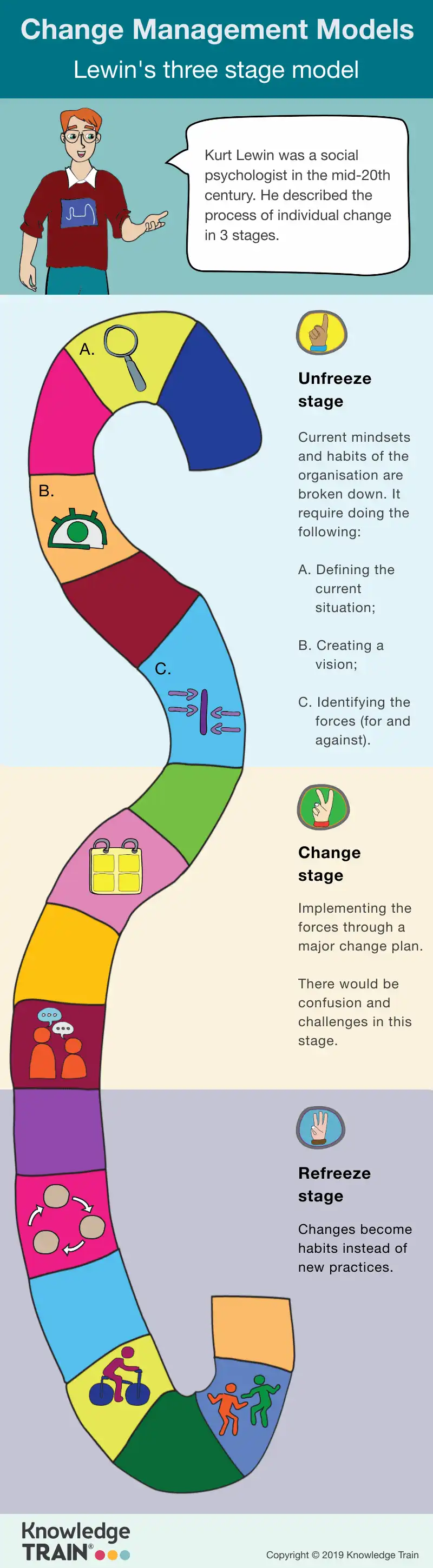
Kurt Lewin’s ®change management is a registered mark of the DevOps Institute. “PMI”, “PMBOK model has been summarised on this colourful infographic.®