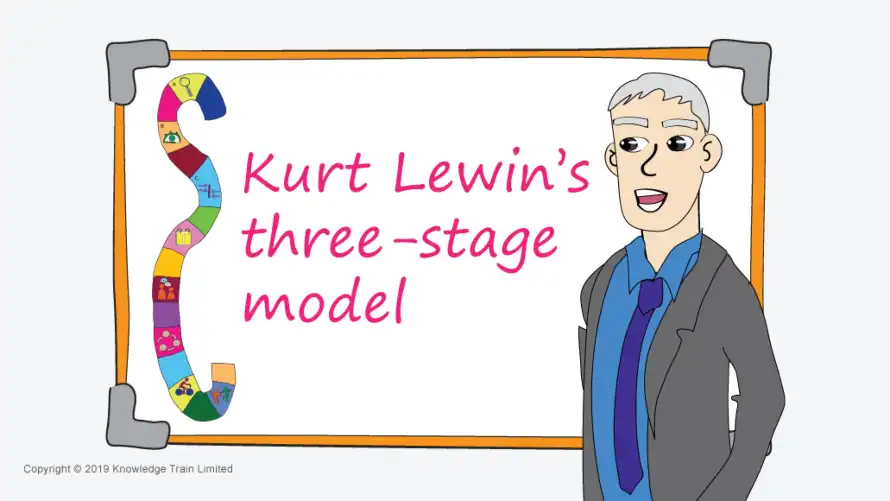
The essentials of Lewin’s change model for successful change management

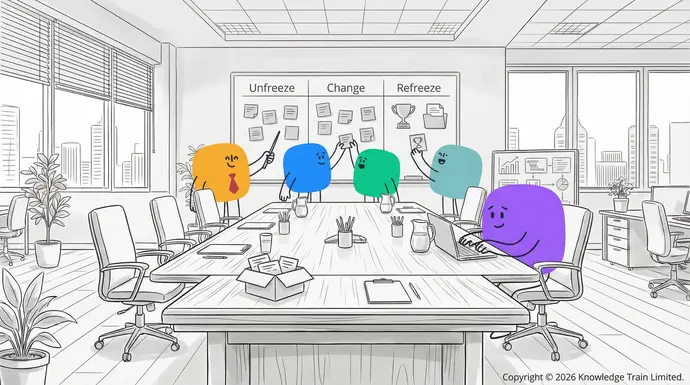
The unfreezing stage is critical in preparing an organisation for change. It involves creating awareness about the necessity for transformation and challenging existing norms and behaviours. The primary goal is to reduce resistance by showing the benefits of change and the drawbacks of maintaining the status quo. This stage often involves:
- Communication : Open and transparent communication helps employees understand the reasons for change. It reduces uncertainty and anxiety, fostering a supportive environment where individuals are more willing to let go of old habits.
- Leadership engagement : Leaders play a crucial role in modelling desired behaviours and attitudes. Their involvement is essential in building trust and commitment to the change process.
- Stakeholder involvement Request a quote: Engaging key stakeholders early in the process ensures that their concerns are addressed, and their insights are incorporated into the change strategy. This involvement can lead to more innovative solutions and greater buy-in.
Psychologically, unfreezing helps individuals and groups prepare for change by breaking down existing mindsets and fostering a readiness to embrace new ideas. By addressing the emotional aspects of change, organisations can create a foundation for successful transformation.
Changing[email protected]
- CoursesImplementation: Introducing new processes, technologies, or structures requires clear guidance and support. Training programmes and resources should be made available to facilitate learning and adaptation.PROJECT MANAGEMENT
- Support systemsPRINCE2: Providing support through mentoring or coaching can help employees navigate the challenges of change. It ensures that they have the necessary skills and confidence to adopt new ways of working.®
- Feedback mechanismsFoundation : Regular feedback allows for continuous improvement and adjustment. It helps identify areas of resistance or difficulty, enabling timely interventions to keep the change process on track.Learn the fundamentals of the PRINCE2 method.
During the changing stage, the emphasis is on enabling individuals to adopt new behaviours and integrate them into their daily routines. By focusing on both structural and human elements, organisations can ensure that change is effective and sustainable.Practitioner
RefreezingIncludes Foundation & Practitioner combined option.
The Association for Project Management (APM)refreezingProject Fundamentals Qualification (PFQ) stage is the final step, where new changes are solidified and integrated into the organisational culture. It ensures that the changes become permanent and prevents regression to old practices. Key aspects of refreezing include:Start your APM project management career.
- ReinforcementProject Management Qualification (PMQ) : Recognising and rewarding employees who successfully adapt to change reinforces desired behaviours. It encourages others to follow suit and helps embed new norms.Advance your APM project management expertise.
Advantages and disadvantages of Lewin’s change modelPractitioner
Kurt Includes Foundation & Practitioner combined option.Lewin’sWorkshops force field analysis and three-stage model of change are renowned for their simplicity and clarity, making them accessible tools for organisations navigating change. One of its primary strengths is its straightforward three-stage process – Introduction to Project Management unfreezing1-day workshop to learn the basics of project management., Project Management Essentials changing2-day workshop to learn how to manage projects without getting certified., and Writing Business Cases refreezingHalf-day workshop to learn to write robust business cases.. This structure provides a clear roadmap for implementing change, helping organisations manage transitions systematically. Additionally, the model emphasises the psychological aspects of change, such as reducing stress and enhancing acceptance, which fosters a supportive environment for transformation.AI in Project Management
However, despite these advantages, Lewin’s model is not without criticism. A notable limitation is its planned approach to change, which some argue oversimplifies emergent and continuous organisational change processes. In today’s dynamic business environment, change often requires flexibility and adaptability, which a linear model may not sufficiently address. Critics also point out that the model assumes a relatively static environment, whereas many organisations face continuous or overlapping changes that demand more iterative processes.Learn how to use AI tools in everyday project work.
Furthermore, while Lewin’s model is effective in highlighting the human element of change, it may not fully account for technological advancements and rapid market shifts that influence contemporary ARTIFICIAL INTELLIGENCE (AI)change managementBCS AI. Therefore, while Lewin’s change model provides a foundational framework, organisations may need to adapt it or integrate it with other models to address the multifaceted nature of change in today’s world.Foundation
Real-world applications of Lewin’s change modelLearn the fundamentals of artificial intellegence.
Lewin’s change model has been successfully applied across various sectors, demonstrating its versatility and effectiveness. These applications provide valuable insights into how organisations can manage transformation effectively.AI Project Governance Framework (AIPGF)
Example 1: Application in a corporate settingFoundation
In a leading technology firm, Lewin’s model guided a transition to Learn the fundamentals of the governance framework.agile project managementPractitioner . During the Includes Foundation & Practitioner combined option.unfreezingWorkshops stage, management identified the need for agility to stay competitive. Workshops and discussions were held to prepare employees for the shift. In the AI in Project Management changingLearn how to use AI tools in everyday project work. phase, AGILEagile methodologiesAgilePM were introduced through training programmes, supported by mentors to ease the transition. The ®refreezing – Agile Project Management stage involved integrating these practices into the company culture, reinforced by regular feedback sessions.Foundation
- OutcomeLearn the key principles of Agile Project Management.: The move resulted in improved project delivery times and enhanced team collaboration.Practitioner
- LessonIncludes Foundation & Practitioner combined option.: Clear communication and support systems are crucial for overcoming resistance.PRINCE2
Example 2: Implementation in healthcare®
A hospital implemented Lewin’s model to transition from paper-based to electronic medical records. The AgileunfreezingFoundation phase involved addressing staff concerns through information sessions. During the Learn the fundamentals of the PRINCE2 Agile method.changingPractitioner stage, training sessions were conducted to familiarise staff with the new system. The Includes Foundation & Practitioner combined option.refreezingScrum stage ensured the new process was standard practice, with ongoing technical support provided.Scrum Essentials
- OutcomeSelf-paced training course to learn the essentials of Scrum.: This change increased efficiency and accuracy in patient record management.Scrum Master
- LessonChoose Scrum Alliance or Scrum.org Scrum Master training courses.: Continuous support and training are vital for successful technological adoption.Scrum Product Owner
Example 3: Educational institutionsChoose Scrum Alliance or Scrum.org Product Owner training courses.
A university applied Lewin’s model to innovate its teaching methodologies. AgileBAUnfreezing® involved recognising the limitations of traditional teaching. The – Agile Business AnalysischangingFoundation phase saw the introduction of digital tools and interactive techniques. Learn the fundamentals of Agile Business Analysis.RefreezingPractitioner embedded these new practices through policy changes and faculty workshops.4-day course including Foundation.
- OutcomeLean Six Sigma: Student engagement and learning outcomes improved significantly.Yellow Belt
- LessonSelf-paced training course to gain LSS Yellow Belt.: Institutional support and policy alignment are key to sustaining educational change.PMI
These examples highlight the model’s adaptability and the importance of addressing both human and structural elements in change initiatives.®
Comparing Lewin’s model with other change management theoriesPMI-ACP
Kurt Self-paced course to prepare you for the exam (exam not included).Lewin’s change modelKanban is often compared with frameworks such as Estimating for Agile FoundationKotter’s 8-step processAgile Learning Library (ALL)™ and BUSINESS ANALYSISADKARBCS Business Analysis. Each model offers unique perspectives and methodologies for managing change within organisations.Business Analysis Foundation
- Lewin’s modelLearn the fundamentals of business analysis. is straightforward, focusing on three stages: unfreezing, changing, and refreezing. Its strength lies in its simplicity and emphasis on the psychological aspects of change, which can reduce stress and increase acceptance.Modelling Business Processes
- Kotter’s 8-step processGain practitioner certificate in modelling business processes. provides a more detailed approach, outlining specific steps like establishing a sense of urgency and creating short-term wins. This model is particularly useful for large-scale transformations requiring clear guidance and extensive communication.Business Analysis Practices
- ADKARGain practitioner certificate in business analysis practices. focuses on individual change and is goal-oriented, emphasising Requirements Engineering AwarenessGain practitioner certificate in requirements engineering., Business Analysis International Diploma DesireAll 4 courses bundled into this Diploma certification package., AgileBALearn the fundamentals of Agile Business Analysis.Ability, and Practitioner Reinforcement4-day course including Foundation.. It is beneficial for understanding and managing personal impacts during organisational changes.PMI
Lewin’s model is preferred when a concise and psychologically grounded approach is needed. It is particularly effective in scenarios where resistance to change is prominent, and fostering a supportive environment is crucial. However, in complex or large-scale organisational transformations, Kotter’s detailed steps or ADKAR’s individual focus might offer additional advantages.®
Ultimately, the choice of model depends on the organisational context and the specific challenges faced. Integrating elements from different frameworks can often provide a more comprehensive strategy, catering to both structural and human elements of change.PMI-PBA
Influence tactics and work outcomes in change managementSpecialist: CDS
The success of 3-day ITIL Specialist: Create, Deliver and Support (CDS) course.change managementIT Learning Library (ITLL)™ efforts is significantly influenced by the tactics employed to guide and motivate individuals within an organisation. Effective BUSINESS LEARNING LIBRARY (BLL)™influence tacticsAgile Learning Library (ALL)™ are essential for ensuring that changes are not only implemented but also sustained over time. These tactics include clear communication, employee involvement, and positive reinforcement, all of which contribute to a supportive environment for change.
Research on work outcomes in relation to change efforts highlights the importance of these tactics. The analysis reveals that successful change initiatives often involve:Business Analysis Learning Library (BALL)™
- Effective communicationCompliance Learning Library (CLL)™: Keeping communication channels open and transparent helps align employees with the change objectives. It reduces uncertainty and stress, fostering an environment where employees feel informed and valued.IT Learning Library (ITLL)™
- Employee involvementBusiness solutions: Actively involving employees in the change process enhances their commitment and ownership. It empowers them to contribute ideas and feedback, which can lead to more innovative solutions and smoother transitions.
- Positive reinforcement
, Select your preferred training course below:changing , and PRINCE2 AGILE COURSESrefreezingSelect your preferred training course below:. Unfreezing prepares the organisation for change by challenging the current state. Changing involves implementing new processes or behaviours. Refreezing solidifies these changes, integrating them into the organisational culture.
How does unfreezing facilitate change in organisations?BETTER BUSINESS CASES COURSES
UnfreezingSelect your preferred training course below: facilitates change by creating awareness of the need for transformation. It involves dismantling existing mindsets and behaviours, reducing resistance, and preparing employees psychologically for the upcoming changes. This stage is crucial for establishing a foundation for successful change.
What are common challenges in the refreezing stage, and how can they be addressed?P3O COURSES
Common challenges in the Select your preferred training course below:refreezing stage include reverting to old habits and lack of reinforcement. To address these, organisations can implement continuous support systems, provide ongoing training, and celebrate successes to reinforce new behaviours, ensuring they become part of the organisational norm.WORKSHOPS
How does Lewin’s change model compare to Kotter’s 8-step process?Select your preferred workshop below:
While Lewin’s model offers a simple three-stage framework, Kotter’s 8-Step ProcessAGILE QUALIFICATIONS provides a more detailed approach. Kotter’s model outlines specific steps such as creating urgency and building a guiding coalition. Lewin’s model is ideal for straightforward changes, whereas Kotter’s is suited for complex transformations requiring extensive communication.Select your preferred qualification.
Can Lewin’s model be applied in small businesses? If so, how?
Yes, Lewin’s model can be effectively applied in AGILE PROJECT MANAGEMENT COURSESsmall businessesSelect your preferred training course below:. Its simplicity makes it accessible for limited resources. Small businesses can use it to prepare employees for change, implement new practices incrementally, and ensure that these changes are sustained through regular feedback and reinforcement. This approach helps maintain agility while fostering a culture of continuous improvement.
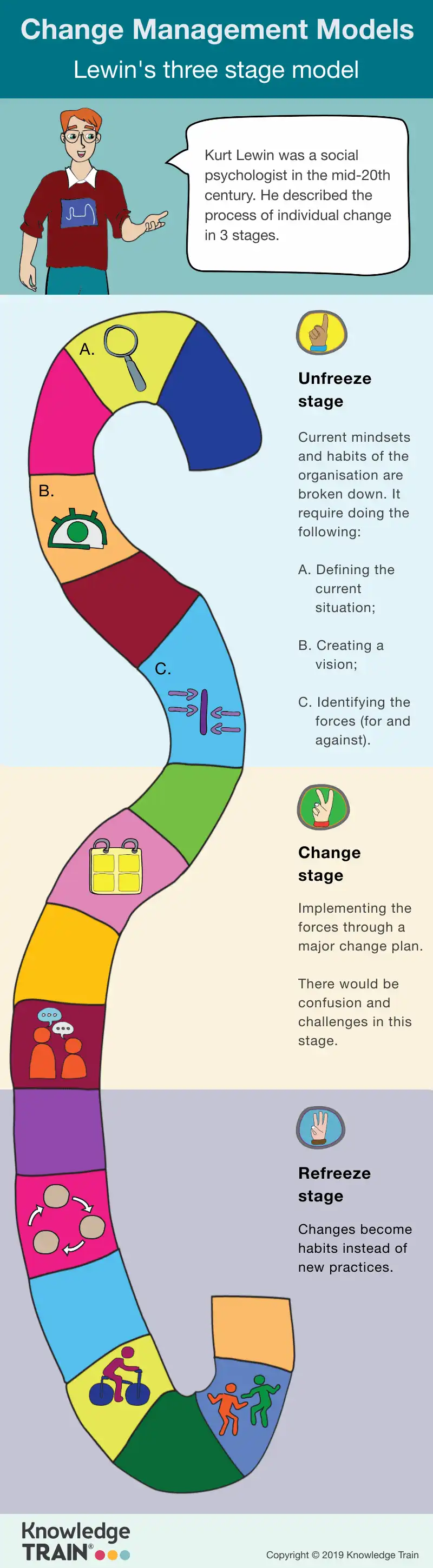
InfographicPRINCE2 AGILE COURSES
Kurt Lewin’s Select your preferred training course below:change management model has been summarised on this colourful infographic.SCRUM COURSES