How ADKAR can revolutionise your change management strategySelect your preferred qualification or workshop.

Key takeawaysKnowledge Train is a PRINCE2 Agile Accredited Training Organization.
ADKAR makes change stick by guiding individuals through a clear sequence of milestones.
- Build Knowledge Train is an Agile BA Accredited Training Organization.
- Knowledge Train is a PRINCE2 Agile Accredited Training Organization.Reinforcement to sustain new behaviours via celebration, metrics, regular reviews, and adaptive improvements.Knowledge Train is a Better Business Cases Accredited Training Organization.
Introduction to the ADKAR modelBCS accredited training partner for Business Analysis.
Understanding change management
In today’s constantly changing organisational landscape, WHAT YOU WILL GETchange managementOur courses and workshops include: is crucial. Organisations must adapt to remain competitive and relevant. Certification exam(s) where applicableChange managementAccredited training course materials provides a structured approach to transitioning individuals, teams, and whole organisations from a current state to a desired future state. The goal is to minimise resistance and maximise engagement. Here, the Expert, experienced trainers to support youADKARCourse manual where applicable. model shines as a strategic framework. It offers a clear, step-by-step process that leaders can use to guide their teams through change effectively.
Origins and purpose of ADKARSELF-PACED ONLINE TRAINING COURSES
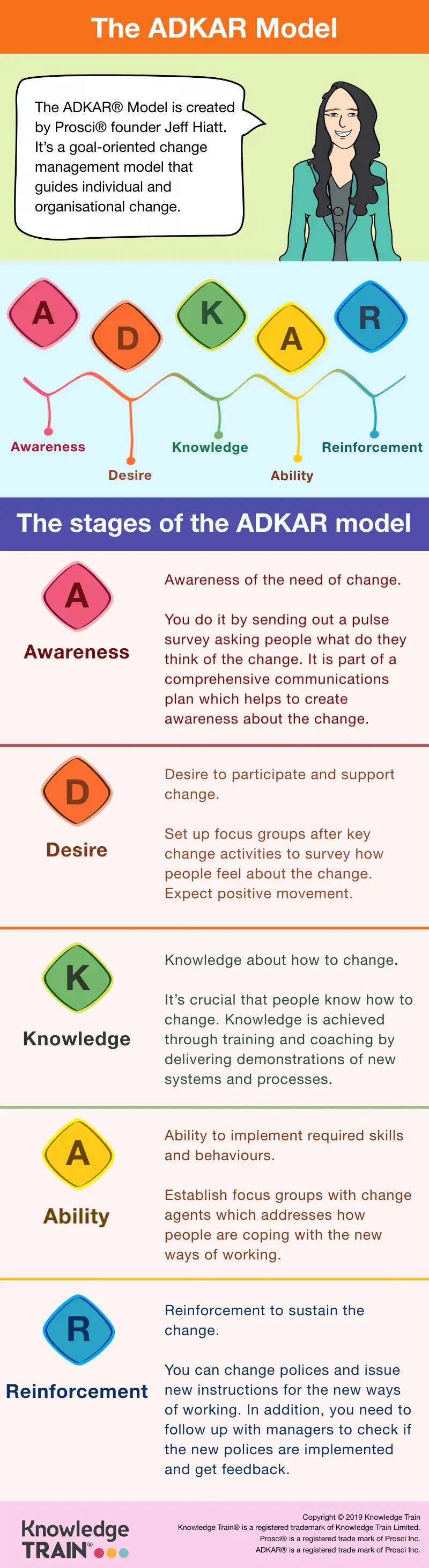
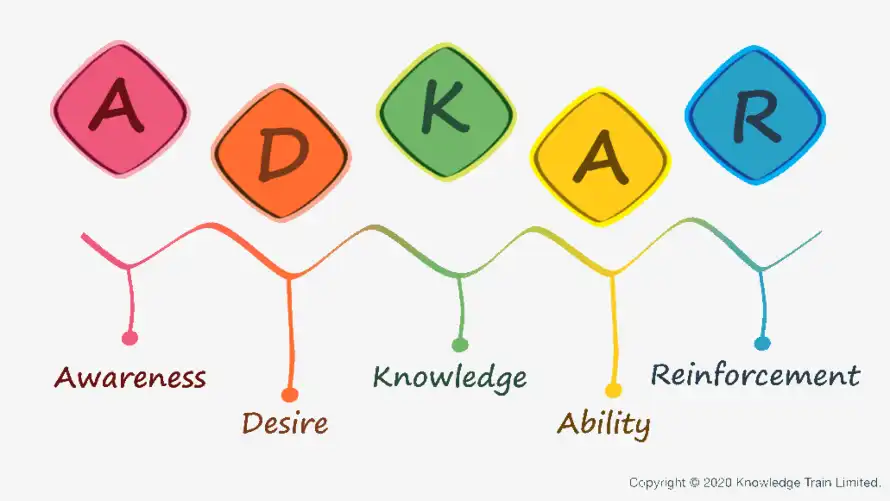
The ADKAR model was developed by Jeff Hiatt, founder of Prosci, through research conducted from 1994 to 2002. This research analysed the change patterns of over 700 organisations, leading to a practical, results-oriented approach to managing change at the individual level. Prosci’s research revealed that successful change occurs when Self-paced online training courses (e-learning) include:organisational change managementCertification exam(s) where applicable and individual change management intersect. It comprises five key elements: Accredited training course materialsAwarenessSupport from expert, experienced trainers, Latest educational technology.Desire , BUSINESS SOLUTIONSKnowledge , AbilityTO HELP ORGANISATIONS IMPROVE, and We offer solutions to help improve team performance including:ReinforcementConsultancy services. Each element represents a milestone that individuals must achieve to embrace and sustain change thoroughly.Staff development
- AwarenessCompliance training: Recognising the need for change.Apprenticeship training
- DesireCustom e-Learning development: Building the motivation to participate.
- Knowledge : Acquiring the necessary information and skills.Find out more
- Ability : Implementing new skills and behaviours.
- Reinforcement : Sustaining the change over time.
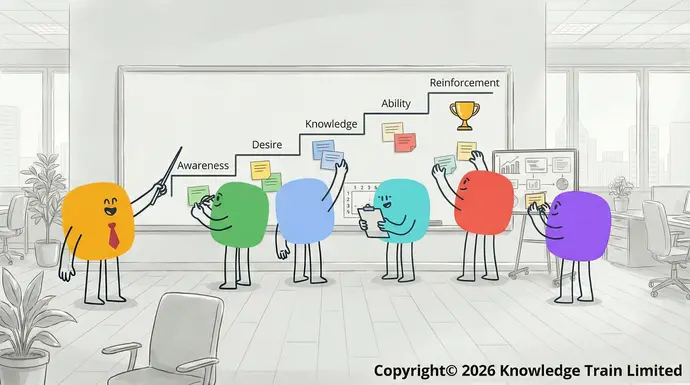
These elements work in sequence, with each building upon the previous ones. For instance, it’s difficult to create genuine desire for change without first establishing awareness of why the change is needed. Similarly, knowledge can only be effectively absorbed once someone has the desire to learn. This sequential nature is crucial for successful implementation.
This model’s purpose is to facilitate a smooth transition by focusing on the psychological aspects of change. By addressing these individual milestones, the ADKAR model reduces stress and enhances overall productivity. Its structured approach ensures that all critical elements of change are methodically covered, minimising confusion. Consequently, organisations can navigate the challenges of transformation with greater confidence and success.CONTACT US
In summary, the ADKAR model serves as a comprehensive guide for managing change . It aligns with the psychological needs of individuals, ensuring that change is not only implemented but also sustained effectively.
The five elements of the ADKAR model
Element 1: Awareness
The NameAwareness element is foundational in the ADKAR model. It ensures individuals recognise the necessity for change, setting the stage for subsequent actions. Without awareness, employees may resist or misunderstand the change initiative, leading to challenges in implementation.
Importance of awarenessEmail
Awareness is crucial as it creates a shared understanding of the change. It clarifies the reasons behind the shift, reducing anxiety and speculation. This understanding is vital for aligning individual goals with organisational objectives. When employees comprehend the need for change, they are more inclined to support it. This support eases the transition and lays a solid groundwork for the next elements.
Strategies to build awareness
Effective strategies to build awareness include:Phone
- Consistent communication : Use diverse channels such as emails, meetings, and digital platforms to convey the change message.
- Leadership involvementHow can we help?: Encourage leaders to endorse and communicate the change, enhancing credibility.
- Visual aids : Employ infographics and videos to simplify complex information.Submit
- Interactive sessions : Conduct workshops to discuss the change, allowing for questions and feedback.
These strategies help reduce uncertainty and foster a positive outlook towards change.OUR VALUES
Element 2: DesireOur 6 core values are everything we do. They include:
The IntegrityDesireDiversity element involves cultivating the motivation to participate in the change. It requires addressing both rational and emotional aspects to inspire individuals to engage willingly.Fairness
Creating desire for changeQuality
To inspire desire, organisations can:Innovation
- Highlight benefitsSocial responsibility: Clearly articulate the personal and organisational benefits of the change.
- Engage employeesSOCIAL RESPONSIBILITY: Involve them in planning and decision-making processes to create a sense of ownership.Some of the charities we have helped over the years:
- Recognise contributions
element focuses specifically on how to implement the change. This includes two critical types of knowledge: understanding how to change (the required skills, processes, and behaviours) and what to do during the transition state. This goes beyond just sharing information – it requires detailed training on new processes, systems, and roles that will be part of the change.
Knowledge acquisition+44 (0)207 148 5985
To facilitate knowledge acquisition:
- Structured training[email protected]: Provide comprehensive training programmes tailored to different learning styles.
- Mentorship : Pair employees with mentors to offer guidance and support.
- Self-paced learning : Use e-learning platforms for flexible, on-demand knowledge access.
Tools for knowledge transfer
Effective tools include:
- Workshops and seminarsUnited Kingdom: Offer hands-on experience and practical insights.
- Knowledge repositories : Maintain accessible databases for quick reference.
- Peer learning : Encourage knowledge sharing through peer networks.
These tools ensure that employees have the required knowledge to succeed.
Element 4: AbilitySearch
The Ability element represents the actual execution of the change – turning knowledge into action. Whilst Knowledge is about understanding how to change, Ability is about demonstrating performance in real-world conditions. This element often requires time for practice, coaching, and feedback as people develop proficiency in new skills or behaviours. Success in this element is measured by actual performance rather than just completing training.
Developing ability
Developing ability involves:
- Practical trainingUnited Kingdom: Conduct real-world exercises to build confidence.Austria
- Feedback loopsBelgium: Provide constructive feedback to refine skills.Bulgaria
- Supportive environmentCroatia: Create a culture that encourages experimentation and learning.Cyprus
Training and support systemsCzech Republic
Training and support systems are vital for ability development:Denmark
- Ongoing trainingEstonia: Offer continuous learning opportunities.Finland
- Access to resourcesFrance: Ensure availability of tools and materials needed for skill application.Germany
- Peer supportGreece: Foster a network of colleagues who can offer assistance and advice.Ireland
These systems bolster the ability to adapt successfully.Italy
Element 5: ReinforcementLatvia
The LithuaniaReinforcementLuxemburg element ensures that changes are sustained over time.Malta
Sustaining changeNetherlands
To sustain change:Poland
- Celebrate successesPortugal: Recognise achievements to reinforce positive behaviour.Romania
- Continuous feedbackSlovakia: Provide regular updates and feedback to maintain momentum.Slovenia
- Adjust strategiesSpain: Be flexible and willing to adapt strategies based on feedback.Sweden
Monitoring progressOther countries
Monitoring progress involves:Home
- Performance metricsAgile: Track key indicators to assess change impact.Agile Project Management
- Regular reviewsAgile Project Management Course: Schedule periodic evaluations to identify areas for improvement.Agile vs waterfall
- Feedback channels : Maintain open lines for employee input and suggestions.{"@context":"http://schema.org","@type":"BreadcrumbList","itemListElement":[{"@type":"ListItem","position":1,"name":"Home","item":"https://www.knowledgetrain.co.uk/"},{"@type":"ListItem","position":2,"name":"Agile","item":"https://www.knowledgetrain.co.uk/agile"},{"@type":"ListItem","position":3,"name":"Agile Project Management","item":"https://www.knowledgetrain.co.uk/agile/agile-project-management"},{"@type":"ListItem","position":4,"name":"Agile Project Management Course","item":"https://www.knowledgetrain.co.uk/agile/agile-project-management/agile-project-management-course"},{"@type":"ListItem","position":5,"name":"Agile vs waterfall","item":"https://www.knowledgetrain.co.uk/agile/agile-project-management/agile-project-management-course/agile-vs-waterfall"}]}
Through reinforcement, organisations can ensure that new behaviours become ingrained, leading to lasting success
- The manifesto created a rough guide for future software project development, underlining the principles the authors believed should be held paramount when approaching software development in the modern era.: Align awareness efforts with the strategic vision. Ensure that the need for change is communicated in a way that reflects organisational goals.Agile roles
- DesireContemporary agile approaches vary in scope and complexity. Since the creation of : Motivate employees by linking personal benefits to broader organisational aims.the Agile Manifesto
- Knowledge, agile methods have been adapted to suit a wide range of industries each with unique features and challenges. While some (e.g. : Tailor training programs to impart skills that directly contribute to achieving strategic goals.Scrum
- Ability) add their own unique roles to the mix, : Develop capabilities that are necessary for meeting long-term objectives.agile methods
- Reinforcement in general focus their attention on some key roles within the project development process.: Design reinforcement strategies that celebrate achievements aligned with organisational success.Users
This alignment ensures that change initiatives are not only implemented but also contribute meaningfully to the organisation’s mission.Agile project development research always begins with the users in mind. Users help define project goals and needs. They can also help refine a product by providing feedback to developers. By seeking user input throughout the agile development cycle, development teams can ensure that the final product is something users will understand and value.
Continuous improvementProduct owners
Continuous improvement is vital in refining the ADKAR process. It involves regularly assessing and enhancing each element to ensure effectiveness.Every project begins with the product owner. Owners are charged with detailing who the target users are, what problems they face, how the product can solve these problems and what criteria success will be measured by.
- Feedback loopsProduct owners: Establish mechanisms for collecting feedback at each element. Use surveys, interviews, and performance metrics to gather insights. work closely with development teams when planning to make sure everyone involved knows exactly what is being asked of them and how best to achieve the project goals.
- Regular reviewsDevelopers: Conduct periodic evaluations to identify strengths and areas for improvement within the ADKAR elements.Agile development teams operate differently from traditional waterfall development teams. Because agile works in short iterations, and because teams are tasked with developing a working product each iteration, development demands extensive cooperation and foresight. Agile teams must work in unison to complete end-to-end functioning products, as opposed to waterfall product development whereby each stage is completed, reviewed then passed on to the next team.
- Adaptive strategiesAgile development teams do not specialize in different disciplines, rather they include members who possess a wide range of skills and abilities. A single agile team may be comprised of designers, analysts, engineers and users.: Be willing to modify strategies based on feedback and evolving organisational needs.Enhance your skills with our expert-led courses
The psychological benefits of this approach are significant. Continuous improvement reduces stress and enhances confidence by ensuring that the change process is dynamic and responsive. Employees feel valued and understood, fostering a positive environment for sustained change. This iterative process not only refines the ADKAR model but also reinforces a culture of adaptability and growth within the organisation.