How ADKAR can revolutionise your change management strategy

Key takeaways
ADKAR makes change stick by guiding individuals through a clear sequence of milestones.
- Build Awareness with clear, consistent communication and visible leadership support.
- Grow Desire by addressing WIIFM, involving staff early, and recognising change champions.
- Provide Knowledge through tailored training, mentoring, and easy access to reference materials.
- Convert Knowledge into Ability with practice, coaching, and performance-based feedback.
- Use Reinforcement to sustain new behaviours via celebration, metrics, regular reviews, and adaptive improvements.
Introduction to the ADKAR model
Understanding change management
In today’s constantly changing organisational landscape, change management is crucial. Organisations must adapt to remain competitive and relevant. ADKAR: Navigating Change Management | Knowledge Train provides a structured approach to transitioning individuals, teams, and whole organisations from a current state to a desired future state. The goal is to minimise resistance and maximise engagement. Here, the ADKAR model shines as a strategic framework. It offers a clear, step-by-step process that leaders can use to guide their teams through change effectively.
Origins and purpose of ADKAR
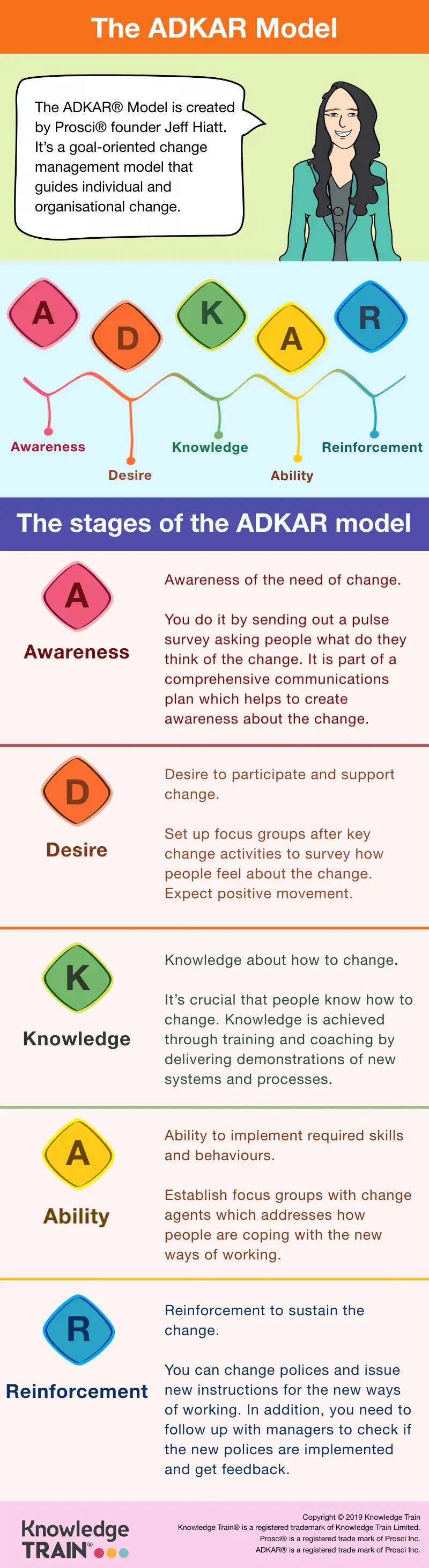
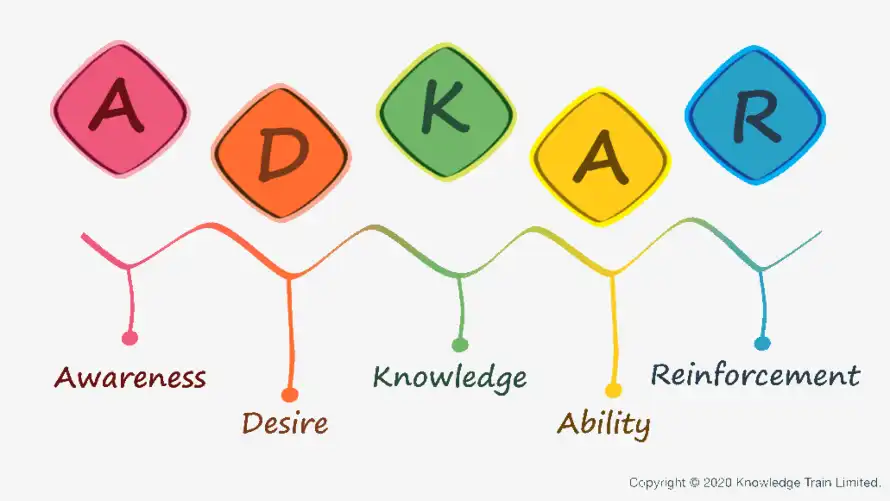
The ADKAR model was developed by Jeff Hiatt, founder of Prosci, through research conducted from 1994 to 2002. This research analysed the change patterns of over 700 organisations, leading to a practical, results-oriented approach to managing change at the individual level. Prosci’s research revealed that successful change occurs when organisational change management and individual change management intersect. It comprises five key elements: Awareness, Desire , Knowledge
- : Track key indicators to assess change impact.
- Regular reviews : Schedule periodic evaluations to identify areas for improvement.
- Feedback channels : Maintain open lines for employee input and suggestions.
Through reinforcement, organisations can ensure that new behaviours become ingrained, leading to lasting success
Implementing the ADKAR model in your organisation
Preparing for change
Implementing the ADKAR model requires careful preparation to ensure a smooth transition. Start by assessing the current organisational landscape. Identify areas where change is necessary and align them with strategic goals. It is critical to secure leadership support early on, as this endorsement sets the tone for the entire process.
Next, communicate the impending change effectively. Use clear and consistent messaging to build awareness and desire among employees. Establish a timeline with specific milestones to track progress. This structured approach helps to minimise confusion and ensures that all critical elements of change management are addressed.
Customising the model
Every organisation is unique, so customising the ADKAR model to fit specific needs is essential. Begin by analysing the organisational culture and existing processes. This understanding will guide how each element of the model is tailored.
- Awareness : Adapt communication strategies to suit the organisation’s culture, ensuring messages resonate with employees.
- Desire : Identify key motivators for different employee groups and leverage these to build desire.
- Knowledge
- : Develop targeted support systems that cater to varying levels of ability within the organisation.
- Reinforcement : Design reinforcement strategies that are relevant and meaningful to the organisation’s context.
By tailoring the model, organisations can address specific challenges and enhance the effectiveness of the change process.
Overcoming challenges
Implementing the ADKAR model is not without challenges. Common obstacles include resistance to change, lack of engagement, and inadequate resources. Addressing these issues requires proactive strategies.
- Resistance : Engage stakeholders early and involve them in decision-making processes. This involvement can reduce resistance and foster a sense of ownership.
- Engagement : Maintain open lines of communication and provide regular updates. Transparency builds trust and keeps employees engaged.
- Resources : Ensure that adequate resources, such as time and funding, are allocated to support the change initiative.
A key component of implementing ADKAR is using the ADKAR Assessment tool. This diagnostic instrument helps identify which elements are acting as barriers to change for individuals or groups. By rating each element on a scale of 1 to 5, change managers can pinpoint where additional focus is needed. For example, if Ability scores are low but Knowledge scores are high, this suggests the need for more practical application opportunities rather than additional training.
Psychologically, the structured approach of the ADKAR model reduces stress and enhances confidence among employees. By focusing on individual change, it ensures that employees are well-equipped to adopt new behaviours. This focus leads to sustained improvements and long-term success.
Best practices for each ADKAR element
Aligning goals with elements
Aligning organisational goals with the elements of the ADKAR model is essential for a cohesive change process. Begin by clearly defining your organisational objectives. Ensure that each of the ADKAR elements – Awareness, Desire, Knowledge, Ability, and Reinforcement – supports these objectives.
- Awareness : Align awareness efforts with the strategic vision. Ensure that the need for change is communicated in a way that reflects organisational goals.
- Desire : Motivate employees by linking personal benefits to broader organisational aims.
- Knowledge : Tailor training programs to impart skills that directly contribute to achieving strategic goals.
- Ability : Develop capabilities that are necessary for meeting long-term objectives.
- Reinforcement : Design reinforcement strategies that celebrate achievements aligned with organisational success.
This alignment ensures that change initiatives are not only implemented but also contribute meaningfully to the organisation’s mission.
Continuous improvement