- : Use diverse channels such as emails, meetings, and digital platforms to convey the change message.
- Leadership involvement: Encourage leaders to endorse and communicate the change, enhancing credibility.
- Visual aids : Employ infographics and videos to simplify complex information.The technical storage or access is strictly necessary for the legitimate purpose of enabling the use of a specific service explicitly requested by the subscriber or user, or for the sole purpose of carrying out the transmission of a communication over an electronic communications network.
- Interactive sessions : Conduct workshops to discuss the change, allowing for questions and feedback.
These strategies help reduce uncertainty and foster a positive outlook towards change.
Element 2: Desire
The PreferencesDesire element involves cultivating the motivation to participate in the change. It requires addressing both rational and emotional aspects to inspire individuals to engage willingly.
Creating desire for change
To inspire desire, organisations can:Preferences
- Highlight benefits : Clearly articulate the personal and organisational benefits of the change.
- Engage employees
These tools ensure that employees have the required knowledge to succeed.Marketing
Element 4: Ability
The Ability element represents the actual execution of the change – turning knowledge into action. Whilst Knowledge is about understanding how to change, Ability is about demonstrating performance in real-world conditions. This element often requires time for practice, coaching, and feedback as people develop proficiency in new skills or behaviours. Success in this element is measured by actual performance rather than just completing training.
Developing ability
Developing ability involves:
- Practical training : Conduct real-world exercises to build confidence.The technical storage or access is required to create user profiles to send advertising, or to track the user on a website or across several websites for similar marketing purposes.
- Feedback loops : Provide constructive feedback to refine skills.Manage options
- Supportive environmentManage services: Create a culture that encourages experimentation and learning.Manage {vendor_count} vendors
Save preferences
Element 5: Reinforcement
The View preferencesReinforcement{title}
Accept
Aligning organisational goals with the elements of the ADKAR modelDeny is essential for a cohesive change process. Begin by clearly defining your organisational objectives. Ensure that each of the ADKAR elements – Awareness, Desire, Knowledge, Ability, and Reinforcement – supports these objectives.
- AwarenessView preferences: Align awareness efforts with the strategic vision. Ensure that the need for change is communicated in a way that reflects organisational goals.
- DesireSave preferences: Motivate employees by linking personal benefits to broader organisational aims.
- KnowledgeView preferences: Tailor training programs to impart skills that directly contribute to achieving strategic goals.{title}
- Ability{title}: Develop capabilities that are necessary for meeting long-term objectives.{title}
- ReinforcementManage consent: Design reinforcement strategies that celebrate achievements aligned with organisational success.Manage consent
This alignment ensures that change initiatives are not only implemented but also contribute meaningfully to the organisation’s mission.
Continuous improvement
Continuous improvement is vital in refining the ADKAR process. It involves regularly assessing and enhancing each element to ensure effectiveness.
- Feedback loops: Establish mechanisms for collecting feedback at each element. Use surveys, interviews, and performance metrics to gather insights.
- Regular reviews: Conduct periodic evaluations to identify strengths and areas for improvement within the ADKAR elements.
- Adaptive strategies: Be willing to modify strategies based on feedback and evolving organisational needs.
The psychological benefits of this approach are significant. Continuous improvement reduces stress and enhances confidence by ensuring that the change process is dynamic and responsive. Employees feel valued and understood, fostering a positive environment for sustained change. This iterative process not only refines the ADKAR model but also reinforces a culture of adaptability and growth within the organisation.
Conclusion
Recap of the ADKAR model
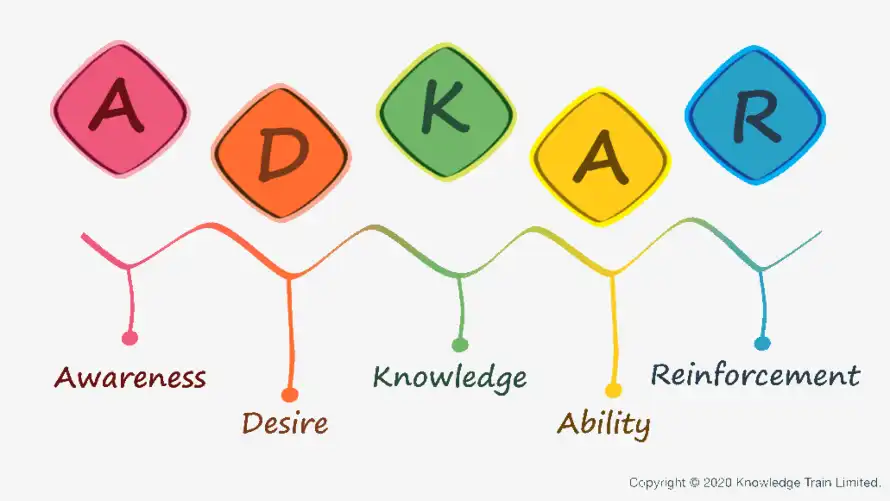
The ADKAR model offers a structured and effective framework for managing change within organisations. It comprises five pivotal elements: Awareness, Desire, Knowledge, Ability, and Reinforcement. Each element is crucial for guiding both leaders and employees through the change process. By systematically addressing these elements, organisations can ensure that all critical elements of change management are covered, minimising confusion and resistance. The model’s structured approach not only facilitates successful transitions but also fosters alignment with organisational goals.
Encouragement to adopt ADKAR
Adopting the ADKAR model can significantly enhance an organisation’s change management efforts. It provides a clear roadmap that supports both individual and organisational transformation. By following its principles, organisations can reduce stress and uncertainty while boosting employee engagement and commitment. The psychological benefits are substantial, as employees feel more informed, involved, and confident throughout the change process. Implementing ADKAR can lead to more sustainable and successful change initiatives, making it a valuable tool for any organisation striving for effective transformation.
FAQs
What is the ADKAR model?
The ADKAR model is a goal-oriented change management framework focusing on individual-level change. It comprises five elements: Awareness, Desire, Knowledge, Ability, and Reinforcement. These elements guide individuals in adopting and sustaining change within an organisation.
Why is awareness important in the ADKAR model?
Awareness is crucial because it helps individuals understand the necessity for change. It prepares them for the transition by clarifying the reasons behind it, thereby reducing resistance and confusion.
How can organisations measure the desire for change?
Organisations can assess desire through several methods, including surveys and interviews. Monitoring employee engagement levels also provides insights into their motivation to support the change.
What tools are effective for knowledge transfer in the ADKAR model?
Effective tools for knowledge transfer include workshops, training sessions, and e-learning platforms. These resources help ensure that employees acquire the necessary information and skills to adapt to change.
How can an organisation reinforce changes effectively?
Reinforcement is achieved through regular feedback and incentives. Continuous support mechanisms ensure that new behaviours are sustained over time, reducing stress and enhancing confidence among employees.
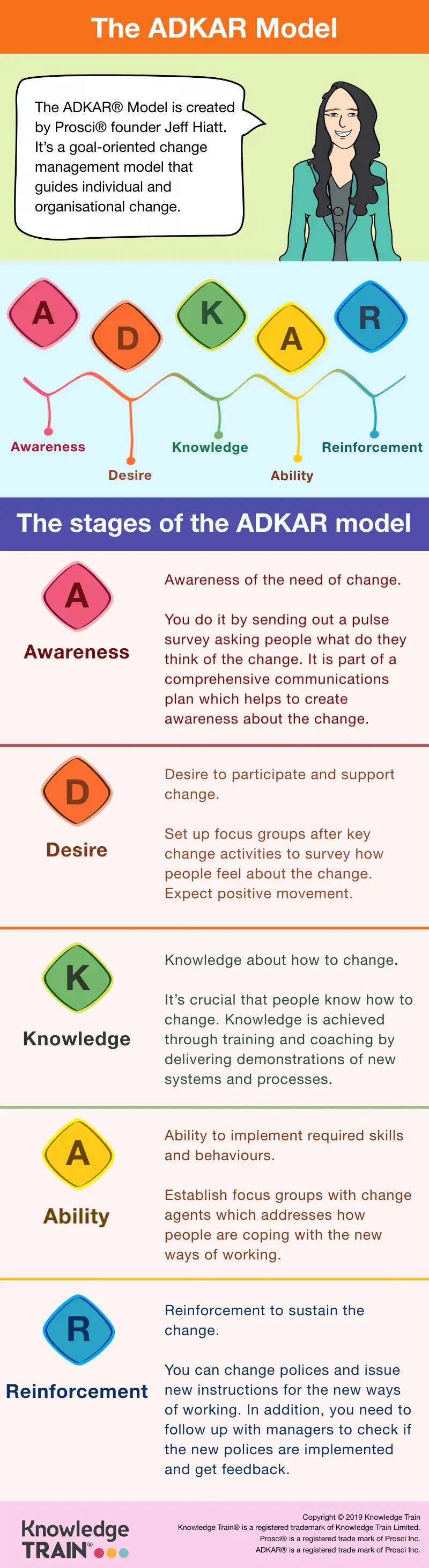
Infographic
The ADKAR change management model is summarised in this colourful infographic.