How ADKAR can revolutionise your change management strategy19 Feb 2026

Key takeawaysFocusing on Must items reduces risk by protecting the minimum needed for success.
ADKAR makes change stick by guiding individuals through a clear sequence of milestones.Should and Could items provide flexibility when time, budget, or resources tighten.
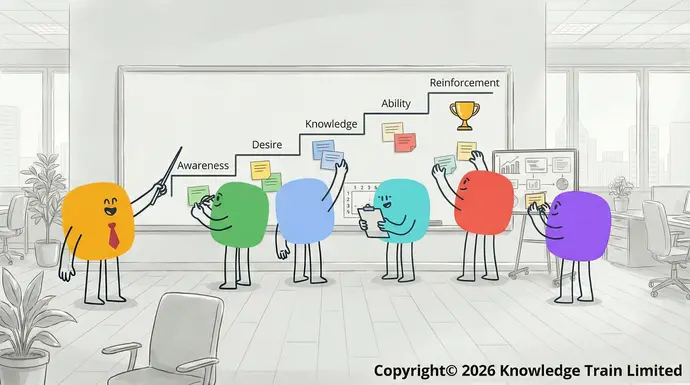
- Build Won’t items prevent scope creep by explicitly deferring low value work.AwarenessRunning a workshop with post-it notes and tracking outcomes on a Kanban board keeps alignment high. with clear, consistent communication and visible leadership support.
- Grow Desire by addressing WIIFM, involving staff early, and recognising change champions.Contents
- Provide Knowledge through tailored training, mentoring, and easy access to reference materials.Contents
- Convert KnowledgeIntroduction into AbilityWhat is MoSCoW prioritisation? with practice, coaching, and performance-based feedback.
- Use Why should I use it?Reinforcement to sustain new behaviours via celebration, metrics, regular reviews, and adaptive improvements.How to use it
Introduction to the ADKAR model, MoSCoW is one of the key agile techniques which you will learn.
Understanding change managementEnhance your skills with our expert-led courses
In today’s constantly changing organisational landscape, change management is crucial. Organisations must adapt to remain competitive and relevant. Change managementInstructor-led provides a structured approach to transitioning individuals, teams, and whole organisations from a current state to a desired future state. The goal is to minimise resistance and maximise engagement. Here, the AgilePM Practitioner (with Foundation) courseADKAR model shines as a strategic framework. It offers a clear, step-by-step process that leaders can use to guide their teams through change effectively.£1,699 +vat
Origins and purpose of ADKAR
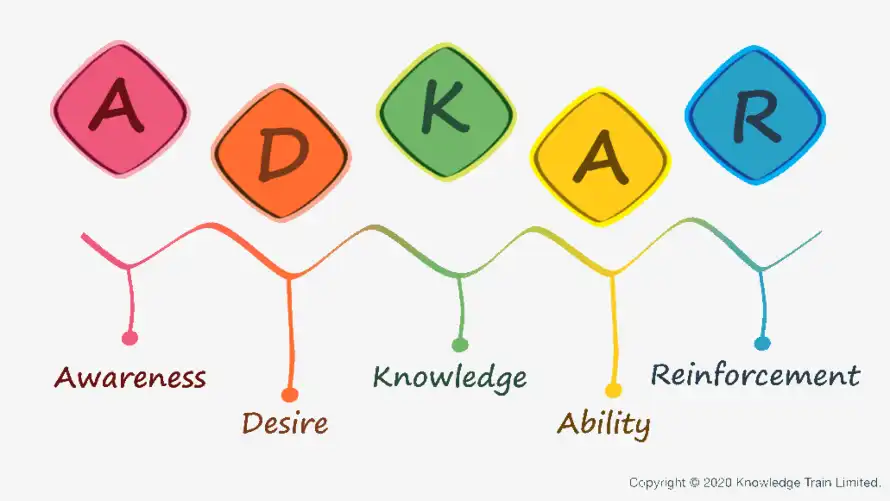
The ADKAR model was developed by Jeff Hiatt, founder of Prosci, through research conducted from 1994 to 2002. This research analysed the change patterns of over 700 organisations, leading to a practical, results-oriented approach to managing change at the individual level. Prosci’s research revealed that successful change occurs when See all datesorganisational change management and individual change management intersect. It comprises five key elements: Awareness , Self-pacedDesireAgilePM Practitioner (with Foundation) self-paced online, Knowledge£1,299 +vat, Ability , and ReinforcementInstructor-led. Each element represents a milestone that individuals must achieve to embrace and sustain change thoroughly.AgilePM Foundation course
- Awareness : Recognising the need for change.£1,299 +vat
- Desire : Building the motivation to participate.See all dates
- KnowledgeWhy should I use it?: Acquiring the necessary information and skills.MoSCoW prioritisation
- Ability is a highly effective way for a project team to prioritise its work. Focussing on the most important tasks means they can get the main components of the project finished quickly, before the fancy bits are added later. It keeps the entire team on the same page, ensuring everyone knows what is being worked on.: Implementing new skills and behaviours.Using MoSCoW also means both customer and project team might decide that some requirements don’t even need to be there. It helps cut out unnecessary things and keeps things lean, agile and simple. MoSCoW analysis is one of the aspects of
- Reinforcementagile: Sustaining the change over time. that helps the team minimise wasted time, effort, resources and money.
These elements work in sequence, with each building upon the previous ones. For instance, it’s difficult to create genuine desire for change without first establishing awareness of why the change is needed. Similarly, knowledge can only be effectively absorbed once someone has the desire to learn. This sequential nature is crucial for successful implementation.How to use it
This model’s purpose is to facilitate a smooth transition by focusing on the psychological aspects of change. By addressing these individual milestones, the ADKAR model reduces stress and enhances overall productivity. Its structured approach ensures that all critical elements of change are methodically covered, minimising confusion. Consequently, organisations can navigate the challenges of transformation with greater confidence and success.the MoSCoW prioritisation technique is simple to use. Firstly, you’ll need a list of the customer’s requirements. A great way to use MoSCoW is in a workshop with users. Brainstorm a list of requirements, writing each one on a post-it note and then apply MoSCoW.
In summary, the ADKAR model serves as a comprehensive guide for It is also commonly used during managing changeScrum. It aligns with the psychological needs of individuals, ensuring that change is not only implemented but also sustained effectively. planning meetings to prioritise
The five elements of the ADKAR modeluser stories
Element 1: Awareness for the next sprint.
The So, with your list of requirements, ask whether each requirement is one of the following:AwarenessMust element is foundational in the ADKAR model. It ensures individuals recognise the necessity for change, setting the stage for subsequent actions. Without awareness, employees may resist or misunderstand the change initiative, leading to challenges in implementation.A requirement which must be completed and is vital for the project’s success. Without this requirement, the project will likely fail.
Importance of awarenessShould
Awareness is crucial as it creates a shared understanding of the change. It clarifies the reasons behind the shift, reducing anxiety and speculation. This understanding is vital for aligning individual goals with organisational objectives. When employees comprehend the need for change, they are more inclined to support it. This support eases the transition and lays a solid groundwork for the next elements.Whilst these requirements are important, they can be delayed if time, resources or money are tight. They are not as time-critical as musts.
Strategies to build awarenessCould
Effective strategies to build awareness include:These requirements are not necessary, but they can be completed if there’s enough time.
- Consistent communicationWon’t: Use diverse channels such as emails, meetings, and digital platforms to convey the change message.These requirements are the least critical and can be completed at a later stage.
- Leadership involvementLet’s use an example. Your customer wants a new e-commerce website for their small clothing business. Their requirements for this project are:
- : Provide constructive feedback to refine skills.
- Supportive environment: Create a culture that encourages experimentation and learning.
Training and support systems
Training and support systems are vital for ability development:{"@context":"https://schema.org","@type":"ImageObject","contentUrl":"https://www.knowledgetrain.co.uk/training-courses/res/images/agile/how-to-use-moscow-01.webp","description":"MoSCoW prioritisation method","license":"https://www.knowledgetrain.co.uk/license","acquireLicensePage":"https://www.knowledgetrain.co.uk/license","creditText":"Knowledge Train","uploadDate":"2023-05-18T07:01:22.000Z","copyrightNotice":"© 2023 Knowledge Train Limited. All rights reserved.","creator":{"@type":"Organization","name":"Knowledge Train","url":"https://www.knowledgetrain.co.uk"}}
- Ongoing training : Offer continuous learning opportunities.Related articles
- Access to resources : Ensure availability of tools and materials needed for skill application.
- Peer support : Foster a network of colleagues who can offer assistance and advice.
These systems bolster the ability to adapt successfully.
Element 5: Reinforcement
The Reinforcement element ensures that changes are sustained over time.
Sustaining change
To sustain change:
- Celebrate successes : Recognise achievements to reinforce positive behaviour.
- Continuous feedbackAgile project management costs: Provide regular updates and feedback to maintain momentum.
- Adjust strategiesSimon Buehring: Be flexible and willing to adapt strategies based on feedback.22 Apr 2026
Monitoring progress
Monitoring progress involves:Investigate the hidden costs of AgilePM courses and learn how to avoid unexpected fees. Scroll down for detailed insights.
- Performance metrics : Track key indicators to assess change impact.
- Regular reviews : Schedule periodic evaluations to identify areas for improvement.
- Feedback channels : Maintain open lines for employee input and suggestions.
Through reinforcement, organisations can ensure that new behaviours become ingrained, leading to lasting success
Implementing the ADKAR model in your organisationWhat is the best Agile project management certification?
Preparing for change
Implementing the ADKAR model requires careful preparation to ensure a smooth transition. Start by assessing the current organisational landscape. Identify areas where change is necessary and align them with strategic goals. It is critical to secure Simon Buehringleadership support19 Feb 2026 early on, as this endorsement sets the tone for the entire process.
Next, communicate the impending change effectively. Use clear and consistent messaging to build awareness and desire among employees. Establish a timeline with specific milestones to track progress. This structured approach helps to minimise confusion and ensures that all critical elements of change management are addressed.Explore what makes a great Agile project management certification and how it can propel your career. Scroll down for the top choices.
Customising the model
Every organisation is unique, so customising the ADKAR model to fit specific needs is essential. Begin by analysing the organisational culture and existing processes. This understanding will guide how each element of the model is tailored.
- Awareness : Adapt communication strategies to suit the organisation’s culture, ensuring messages resonate with employees.
- Desire : Identify key motivators for different employee groups and leverage these to build desire.
- Knowledge : Customise training programmes to align with the skills required for the change.Knowledge Train independently rated as a ‘Market Leader’ for AgilePM!
- Ability : Develop targeted support systems that cater to varying levels of ability within the organisation.Simon Buehring
- Reinforcement19 Feb 2026: Design reinforcement strategies that are relevant and meaningful to the organisation’s context.
By tailoring the model, organisations can address specific challenges and enhance the effectiveness of the change process.Find out why Knowledge Train is rated as a market leader for AgilePM. Read on for independent insights.
Overcoming challenges
Implementing the ADKAR model is not without challenges. Common obstacles include resistance to change, lack of engagement, and inadequate resources. Addressing these issues requires proactive strategies.
- Resistance
- Resources: Ensure that adequate resources, such as time and funding, are allocated to support the change initiative.
A key component of implementing ADKAR is using the ADKAR Assessment tool. This diagnostic instrument helps identify which elements are acting as barriers to change for individuals or groups. By rating each element on a scale of 1 to 5, What is an Agile project management course?change managers can pinpoint where additional focus is needed. For example, if Ability scores are low but Knowledge scores are high, this suggests the need for more practical application opportunities rather than additional training.Simon Buehring
Psychologically, the structured approach of the ADKAR model reduces stress and enhances confidence among employees. By focusing on individual change, it ensures that employees are well-equipped to adopt new behaviours. This focus leads to sustained improvements and long-term success.19 Feb 2026
Best practices for each ADKAR element
Aligning goals with elementsLearn about the two most popular Agile project management courses in the UK. Discover which course suits your professional needs by reading further.
Aligning organisational goals with the elements of the ADKAR model is essential for a cohesive change process. Begin by clearly defining your organisational objectives. Ensure that each of the ADKAR elements – Awareness, Desire, Knowledge, Ability, and Reinforcement – supports these objectives.
- Awareness : Align awareness efforts with the strategic vision. Ensure that the need for change is communicated in a way that reflects organisational goals.
- Desire : Motivate employees by linking personal benefits to broader organisational aims.
- KnowledgeHow Agile Project Management (AgilePM: Tailor training programs to impart skills that directly contribute to achieving strategic goals.®
- Ability) qualifications can help your career: Develop capabilities that are necessary for meeting long-term objectives.
- ReinforcementSimon Buehring: Design reinforcement strategies that celebrate achievements aligned with organisational success.19 Feb 2026
This alignment ensures that change initiatives are not only implemented but also contribute meaningfully to the organisation’s mission.
Continuous improvementAgilePM qualifications can significantly advance your project management career. Discover how by reading further.
Continuous improvement is vital in refining the ADKAR process. It involves regularly assessing and enhancing each element to ensure effectiveness.
- Feedback loops : Establish mechanisms for collecting feedback at each element. Use surveys, interviews, and performance metrics to gather insights.
- Regular reviews : Conduct periodic evaluations to identify strengths and areas for improvement within the ADKAR elements.
- Adaptive strategies : Be willing to modify strategies based on feedback and evolving organisational needs.
The psychological benefits of this approach are significant. Continuous improvement reduces stress and enhances confidence by ensuring that the change process is dynamic and responsive. Employees feel valued and understood, fostering a positive environment for sustained change. This iterative process not only refines the ADKAR model but also reinforces a culture of adaptability and growth within the organisation.How to write a user story
Conclusion
Recap of the ADKAR modelSimon Buehring
The 19 Feb 2026ADKAR model offers a structured and effective framework for Master the art of writing user stories with our simple guide. Ideal for newcomers to Agile. Scroll down to start learning.managing change within organisations. It comprises five pivotal elements: Awareness, Desire, Knowledge, Ability, and Reinforcement. Each element is crucial for guiding both leaders and employees through the change process. By systematically addressing these elements, organisations can ensure that all critical elements of change management are covered, minimising confusion and resistance. The model’s structured approach not only facilitates successful transitions but also fosters alignment with organisational goals.
Encouragement to adopt ADKAR
Adopting the ADKAR model can significantly enhance an organisation’s change management efforts. It provides a clear roadmap that supports both individual and organisational transformation. By following its principles, organisations can reduce stress and uncertainty while boosting employee engagement and commitment. The psychological benefits are substantial, as employees feel more informed, involved, and confident throughout the change process. Implementing ADKAR can lead to more sustainable and successful change initiatives, making it a valuable tool for any organisation striving for effective transformation.
FAQs
What is the ADKAR model?
The ADKAR model is a goal-oriented change management framework focusing on individual-level change. It comprises five elements: Awareness, Desire, Knowledge, Ability, and Reinforcement. These elements guide individuals in adopting and sustaining change within an organisation.
Why is awareness important in the ADKAR model?
Awareness is crucial because it helps individuals understand the necessity for change. It prepares them for the transition by clarifying the reasons behind it, thereby reducing resistance and confusion.
How can organisations measure the desire for change?
Organisations can assess desire through several methods, including surveys and interviews. Monitoring employee engagement levels also provides insights into their motivation to support the change.
What tools are effective for knowledge transfer in the ADKAR model?
Effective tools for knowledge transfer include workshops, training sessions, and e-learning platforms. These resources help ensure that employees acquire the necessary information and skills to adapt to change.
How can an organisation reinforce changes effectively?
Reinforcement is achieved through regular feedback and incentives. Continuous support mechanisms ensure that new behaviours are sustained over time, reducing stress and enhancing confidence among employees.
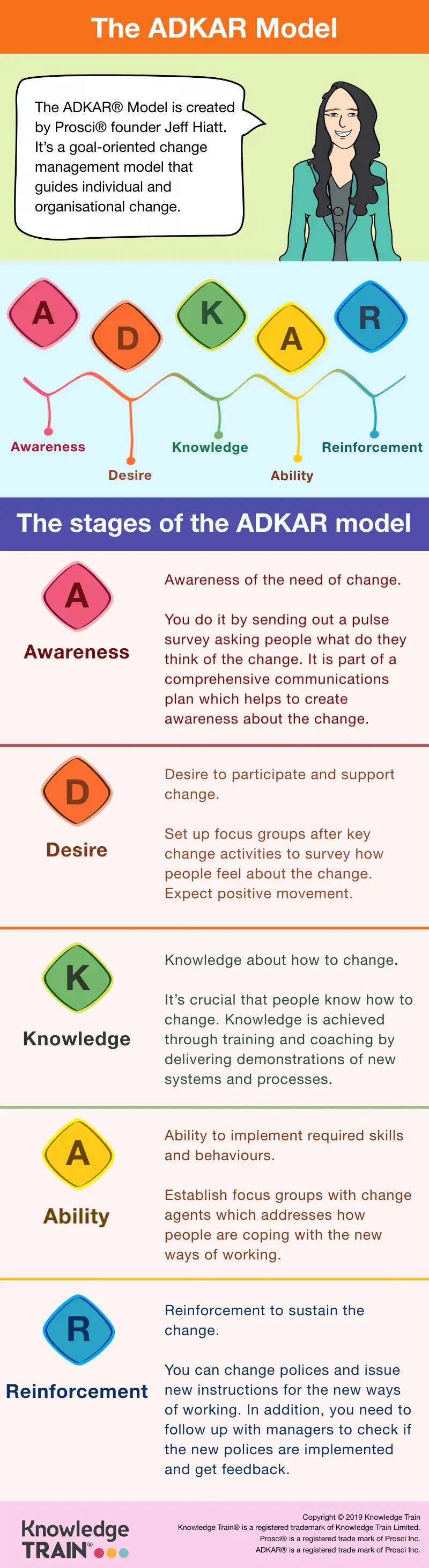
Infographic
The ADKAR change management model is summarised in this colourful infographic.