How ADKAR can revolutionise your change management strategy

Key takeaways
ADKAR makes change stick by guiding individuals through a clear sequence of milestones.
- Build Copied!AwarenessKey takeaways with clear, consistent communication and visible leadership support.Scope, time and cost move together, so every change needs a conscious trade-off.
- Grow Any shift in scope, schedule, or budget typically forces an adjustment in at least one other constraint.DesireImbalances often show up as rushed work, under-resourcing, or overambitious deliverables that reduce quality. by addressing WIIFM, involving staff early, and recognising change champions.Pick at least one flexible constraint early so you can respond to issues without losing control.
- Provide Use prioritisation and formal change control to prevent scope creep and keep decisions objective.KnowledgeMonitor risks and progress continuously, and communicate trade-offs clearly to stakeholders. through tailored training, mentoring, and easy access to reference materials.
- Convert
Introduction to the ADKAR model
Understanding change managementInfographic
In today’s constantly changing organisational landscape, Introductionchange managementThe is crucial. Organisations must adapt to remain competitive and relevant. project management triangleChange management, also known as the triple constraint model, is a concept that visualises the constraints of provides a structured approach to transitioning individuals, teams, and whole organisations from a current state to a desired future state. The goal is to minimise resistance and maximise engagement. Here, the scopeADKAR, model shines as a strategic framework. It offers a clear, step-by-step process that leaders can use to guide their teams through change effectively.time
Origins and purpose of ADKAR, and
The ADKAR model was developed by Jeff Hiatt, founder of Prosci, through research conducted from 1994 to 2002. This research analysed the change patterns of over 700 organisations, leading to a practical, results-oriented approach to managing change at the individual level. Prosci’s research revealed that successful change occurs when costorganisational change management in and individual change management intersect. It comprises five key elements: project managementAwareness. It highlights the interconnected nature of these three aspects in delivering a successful project., The triangle model is a crucial tool for project managers to understand and balance the competing demands of a Desireproject, . The scope refers to the project’s requirements, objectives, and deliverables. Time refers to the schedule and deadlines. Cost encompasses the budget and resources. The challenge is to optimise all three to meet project goals.KnowledgeEach corner of the triangle is dependent on the other two. A change in one element typically results in a change in at least one other. By understanding and managing these constraints, project teams can make informed decisions and adjustments to ensure project success., The project management triangle is a fundamental concept that helps Abilityproject managers , and visualise and optimise the key constraints of any project. By balancing scope, time, and cost, project teams can deliver successful outcomes that meet stakeholder expectations.ReinforcementUnderstanding the project management triangle. Each element represents a milestone that individuals must achieve to embrace and sustain change thoroughly.The three constraints explained
- AwarenessThe project management triangle is made up of three main constraints: : Recognising the need for change.scope
- Desire, : Building the motivation to participate.time
Implementing the ADKAR model in your organisation: Create a detailed budget for each phase of the project.
Preparing for changeForecasting
Implementing the ADKAR model requires careful preparation to ensure a smooth transition. Start by assessing the current organisational landscape. Identify areas where change is necessary and align them with strategic goals. It is critical to secure : Regularly estimate the future costs of the project based on current performance and trends.leadership supportVendor management early on, as this endorsement sets the tone for the entire process.: Negotiate favourable terms and monitor supplier costs.
Next, communicate the impending change effectively. Use clear and consistent messaging to build awareness and desire among employees. Establish a timeline with specific milestones to track progress. This structured approach helps to minimise confusion and ensures that all critical elements of change management are addressed.Quality assurance practices
Customising the modelWhen managing project quality, you can try these tips:
Every organisation is unique, so customising the ADKAR model to fit specific needs is essential. Begin by analysing the organisational culture and existing processes. This understanding will guide how each element of the model is tailored.Quality standards
- Awareness: Define specific, measurable quality criteria for the project deliverables.: Adapt communication strategies to suit the organisation’s culture, ensuring messages resonate with employees.Continuous testing
- Desire: Implement regular quality checks throughout the project lifecycle.: Identify key motivators for different employee groups and leverage these to build desire.Peer review
- Knowledge: Leverage the expertise of team members to identify and address quality issues.: Customise training programmes to align with the skills required for the change.Customer feedback
- Ability: Regularly collect and incorporate stakeholder feedback on project deliverables.: Develop targeted support systems that cater to varying levels of ability within the organisation.Through the implementation of these methods, project managers can successfully navigate and mitigate trade-offs between the competing constraints of scope, time, cost, and quality. However, it is important to note that constraint management is an iterative process that necessitates continuous monitoring and adjustment in response to changing project dynamics.
- ReinforcementTools for managing the project management triangle: Design reinforcement strategies that are relevant and meaningful to the organisation’s context.Software can help you keep track of the project management triangle and ensure your project management is top-notch. Here are some of the best project management software to consider:
By tailoring the model, organisations can address specific challenges and enhance the effectiveness of the change process.Project management software options
Overcoming challengesMonday.com
Implementing the ADKAR model is not without challenges. Common obstacles include resistance to change, lack of engagement, and inadequate resources. Addressing these issues requires proactive strategies.: A flexible platform suitable for multiple project types and management styles. With Visual boards for easy task tracking and prioritisation, it’s one of the best software for project management, and it also has customisable workflows for specific project requirements.
- ResistanceClickUp: Engage stakeholders early and involve them in decision-making processes. This involvement can reduce resistance and foster a sense of ownership.: A feature-rich tool with robust Agile project support and time tracking and resource management features. ClickUp also provides multiple view options (list, board, Gantt, calendar) to cater to different preferences and project needs.
- EngagementTeamwork: Maintain open lines of communication and provide regular updates. Transparency builds trust and keeps employees engaged.: A client-focused platform designed for team collaboration. It has a budget and expense tracking features, as well as
- Resourcesrisk management: Ensure that adequate resources, such as time and funding, are allocated to support the change initiative. and issue tracking tools for comprehensive project management.
A key component of implementing ADKAR is using the ADKAR Assessment tool. This diagnostic instrument helps identify which elements are acting as barriers to change for individuals or groups. By rating each element on a scale of 1 to 5, Key features to look for in project management toolschange managersWhen choosing a project management tool, consider these vital features and capabilities: can pinpoint where additional focus is needed. For example, if Ability scores are low but Knowledge scores are high, this suggests the need for more practical application opportunities rather than additional training.Constraint tracking
Psychologically, the structured approach of the ADKAR model reduces stress and enhances confidence among employees. By focusing on individual change, it ensures that employees are well-equipped to adopt new behaviours. This focus leads to sustained improvements and long-term success.: The ability to track and manage scope, time and cost constraints concurrently
Best practices for each ADKAR elementResource allocation
Aligning goals with elements: Features and tools to optimise team and resource utilisation
Aligning organisational goals with the elements of the Reporting and analyticsADKAR model: Real-time project status and insights through intuitive dashboards and analytics is essential for a cohesive change process. Begin by clearly defining your organisational objectives. Ensure that each of the ADKAR elements – Awareness, Desire, Knowledge, Ability, and Reinforcement – supports these objectives.Collaboration features
- Awareness: Shared workspaces, integrated communication tools and file-sharing capabilities for effective teamwork: Align awareness efforts with the strategic vision. Ensure that the need for change is communicated in a way that reflects organisational goals.Integration capabilitie
- Desires: Compatibility with other software and tools used within your organisation: Motivate employees by linking personal benefits to broader organisational aims.Customisation options
- Knowledge: Flexibility to adapt the software to your project management methodologies and processes: Tailor training programs to impart skills that directly contribute to achieving strategic goals.Mobile accessibility
- Adaptive strategiesSee all dates: Be willing to modify strategies based on feedback and evolving organisational needs.
The psychological benefits of this approach are significant. Continuous improvement reduces stress and enhances confidence by ensuring that the change process is dynamic and responsive. Employees feel valued and understood, fostering a positive environment for sustained change. This iterative process not only refines the ADKAR model but also reinforces a culture of adaptability and growth within the organisation.
Conclusion
Recap of the ADKAR modelInstructor-led
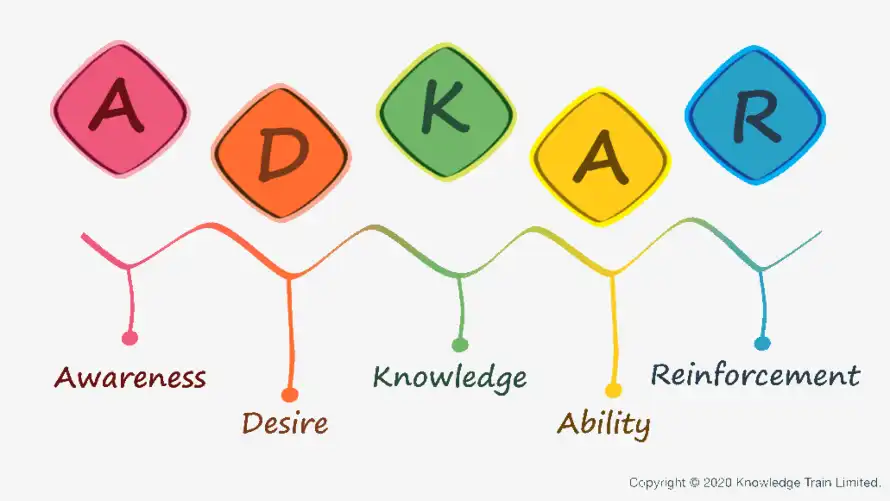
The Project Management EssentialsADKAR model offers a structured and effective framework for £999 +vatmanaging change within organisations. It comprises five pivotal elements: Awareness, Desire, Knowledge, Ability, and Reinforcement. Each element is crucial for guiding both leaders and employees through the change process. By systematically addressing these elements, organisations can ensure that all critical elements of change management are covered, minimising confusion and resistance. The model’s structured approach not only facilitates successful transitions but also fosters alignment with organisational goals.See all dates
Encouragement to adopt ADKARCommon challenges and solutions
Adopting the ADKAR model can significantly enhance an organisation’s Scope creepchange managementScope creep efforts. It provides a clear roadmap that supports both individual and organisational transformation. By following its principles, organisations can reduce stress and uncertainty while boosting employee engagement and commitment. The psychological benefits are substantial, as employees feel more informed, involved, and confident throughout the change process. Implementing ADKAR can lead to more sustainable and successful change initiatives, making it a valuable tool for any organisation striving for effective transformation. involves changes or expansion in the project’s scope after it has already started. This can lead to an increase in resources, time, and effort needed to complete the project.
FAQsSolutions
What is the ADKAR model?Establish a formal change control process to manage scope changes effectively.
The ADKAR model is a goal-oriented change management framework focusing on individual-level change. It comprises five elements: Awareness, Desire, Knowledge, Ability, and Reinforcement. These elements guide individuals in adopting and sustaining change within an organisation.Clearly define project scope and requirements during the planning phase.
Why is awareness important in the ADKAR model?Communicate regularly with stakeholders to manage expectations.
Awareness is crucial because it helps individuals understand the necessity for change. It prepares them for the transition by clarifying the reasons behind it, thereby reducing resistance and confusion.Implement a prioritisation system for new requests and changes.
How can organisations measure the desire for change?Time constraints
Organisations can assess desire through several methods, including surveys and interviews. Monitoring employee engagement levels also provides insights into their motivation to support the change.Projects often face
What tools are effective for knowledge transfer in the ADKAR model?tight deadlines
Effective tools for knowledge transfer include workshops, training sessions, and e-learning platforms. These resources help ensure that employees acquire the necessary information and skills to adapt to change., which can put pressure on the team and the quality of work.
How can an organisation reinforce changes effectively?Solutions
Reinforcement is achieved through regular feedback and incentives. Continuous support mechanisms ensure that new behaviours are sustained over time, reducing stress and enhancing confidence among employees.Use critical path analysis to identify and focus on essential tasks.
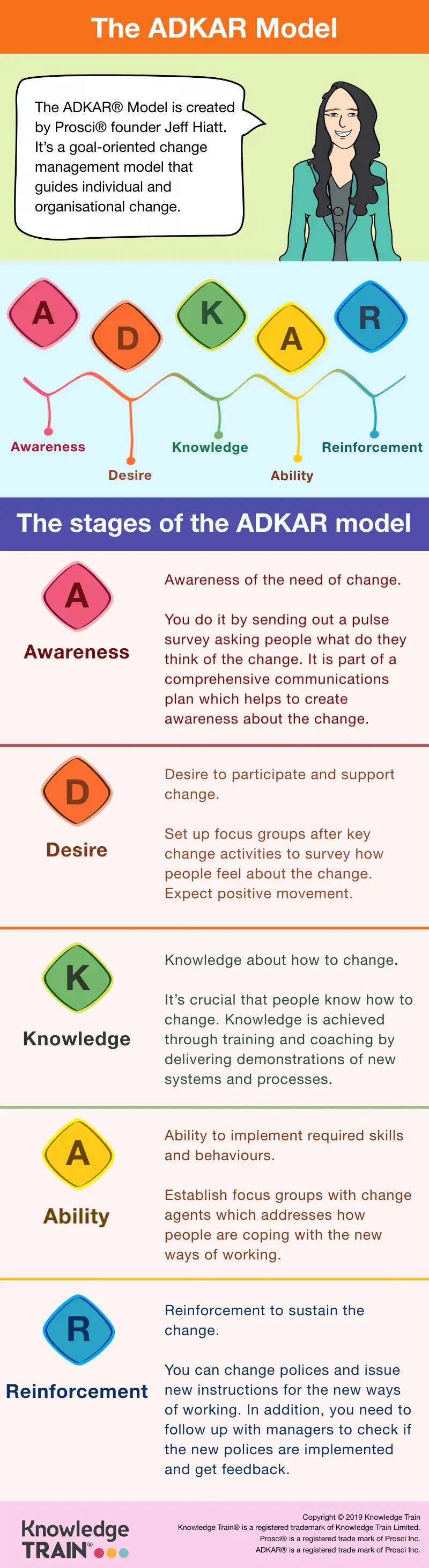
InfographicImplement time-boxing techniques to improve focus and productivity.
The ADKAR change management model is summarised in this colourful infographic.Consider parallel processing of tasks where possible.