Knowledge Train is a Lean Six Sigma Accredited Training Organization.
- BCS accredited training partner for Business Analysis. Knowledge Train is a Change Management Accredited Training Organization.
- Knowledge Train is an MSP Accredited Training Organization.
- AXELOS Peoplecert accredited training organisation for ITIL (IT Infrastructure Library). AXELOS Peoplecert accredited training organisation for ITIL (IT Infrastructure Library).
- Knowledge Train is an AIPGF Accredited Training Organization. Knowledge Train is an AIPGF Accredited Training Organization.
- BCS accredited training partner for Business Analysis. WHAT YOU WILL GET
- Give us a call
+44 (0)207 148 5985
Or chat with us using the link at the bottom of the screen.Contact us with questions about the courses on this page, or about which project management certification or training is best for you.
Finance FAQs
Contact
- CookiesPrivacy
- TermsCustomer Support
- [email protected]
Join Our Team
- [email protected] Copyright © 2005-2026 Knowledge Train Limited.
- Registered in UK: 5566983. Registered VAT: GB872413526.
- Knowledge Train®
is a registered trademark of Knowledge Train Limited.
20 Old Bailey, London, EC4M 7AN, England, United Kingdom.
Knowledge Train are experts in project management, PRINCE2, agile and change management training and certification. Choose from a full range of instructor-led and self-paced project management courses, a
PRINCE2 course
, or an
- agile project management course to boost your career.
- PRINCE2®
- , MSP®
, ITIL
®
- , P3O®
- , PRINCE2®
- Agile, RESILIA®
, and the Swirl logo are registered trademarks of the PeopleCert group. Used under licence from PeopleCert. All rights reserved. AgilePM
Work Breakdown Structure (WBS)
- The Work Breakdown Structure
- (WBS) is a project management technique that involves breaking down a project into smaller, more manageable components. It is a hierarchical decomposition of the total scope of work and provides a visual representation of all the tasks required to complete a project.The essence of a WBS is to break down the final deliverable into smaller, more manageable components called work packages. It starts with the final deliverable at the top and is subdivided in a tree structure, where each level of detail represents an increasingly granular level of the project components. These components are typically organised into phases, deliverables, and work packages. By definition, WBS becomes more detailed as you go deeper into the tree. In
- project management, WBS is used to:
Define and organise the total scope of a projectEnsure all the work required is included, and nothing outside the scope is addedCreate a foundation for estimating costs, duration, and resources
Assign responsibilities to team members
Develop a
project schedule
and budget.Developing a WBS
- typically requires input from the project team and stakeholders to ensure it is comprehensive and accurate. A WBS is usually presented as a tree diagram or outline, with each level representing an increased level of detail and each item on the same level representing a similar type of work. Note that the term ‘tree’ is used by many software systems and it is not necessarily drawn as a tree.A WBS becomes the foundation for other
- project management processes, including risk assessment, task assignments, and progress tracking. It helps the project team to provide a common structure for the whole project, and other details and activities are based on the work breakdown structure.
- Gantt chartsGantt charts
- are one of the most widely used and recognised project management techniques. They provide a visual timeline for the project and can display the relationships and dependencies between different tasks or activities. Gantt charts have a long history, with their use dating back to the early 1900s when they were popularised by Henry Gantt, a mechanical engineer and management consultant. In recent years, Gantt charts have transitioned from physical, hand-drawn charts to digital project management tools.A Gantt chart typically consists of a horizontal bar chart with the project tasks listed on the vertical axis on the left side and the time periods spread across the top. The project tasks are then represented by horizontal bars spanning the time periods in which they are scheduled to be performed. The length of the bar indicates the duration of each task. This format allows
- project managers and team members to:
Clearly visualise the project timeline and the duration of each task
Identify dependencies and relationships between tasks
Track progress against the planned schedule
Adopting the ADKAR model can significantly enhance an organisation’s Begin with a clear list of all project tasks and their dependencies.change managementThe technical storage or access that is used exclusively for anonymous statistical purposes. Without a subpoena, voluntary compliance on the part of your Internet Service Provider, or additional records from a third party, information stored or retrieved for this purpose alone cannot usually be used to identify you.Use software tools for easy creation and updating of network diagrams. efforts. It provides a clear roadmap that supports both individual and organisational transformation. By following its principles, organisations can reduce stress and uncertainty while boosting employee engagement and commitment. The psychological benefits are substantial, as employees feel more informed, involved, and confident throughout the change process. Implementing ADKAR can lead to more sustainable and successful change initiatives, making it a valuable tool for any organisation striving for effective transformation. Regularly review and update the diagram as the project progresses.
FAQs Utilise color-coding to highlight critical paths or high-risk activities.
What is the ADKAR model? Common pitfalls
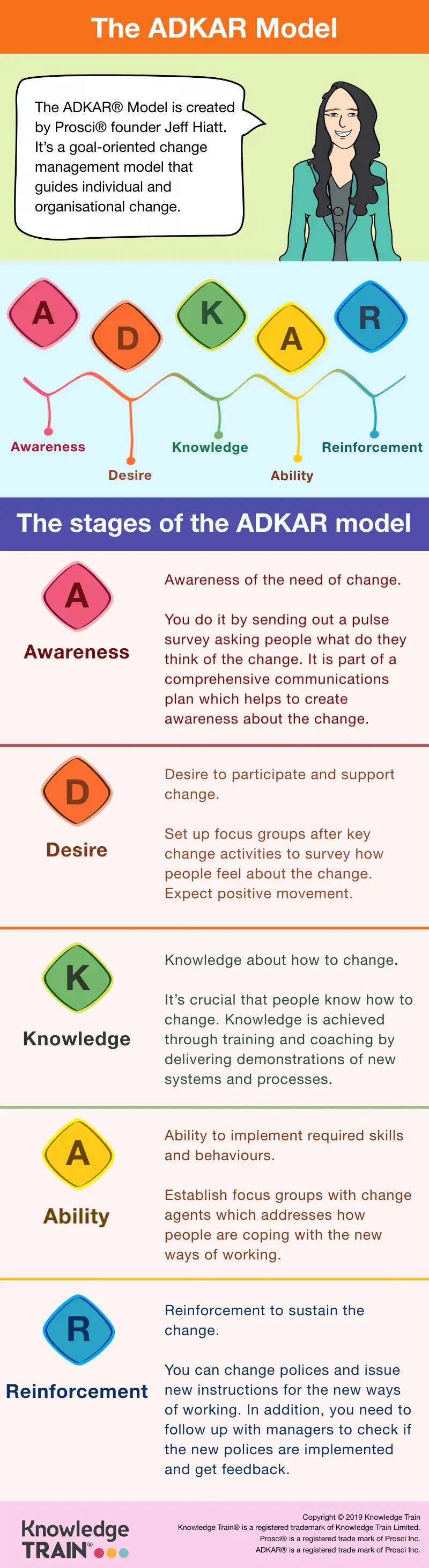
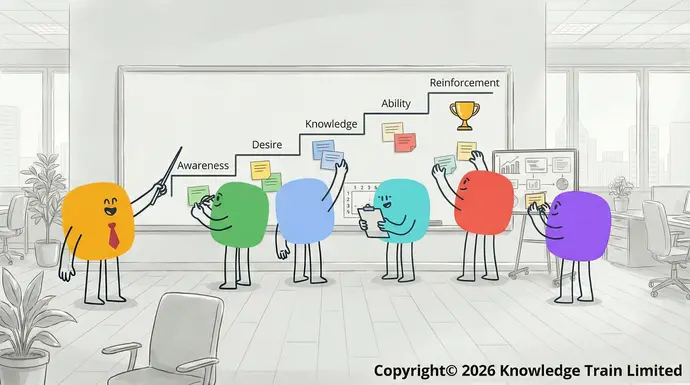
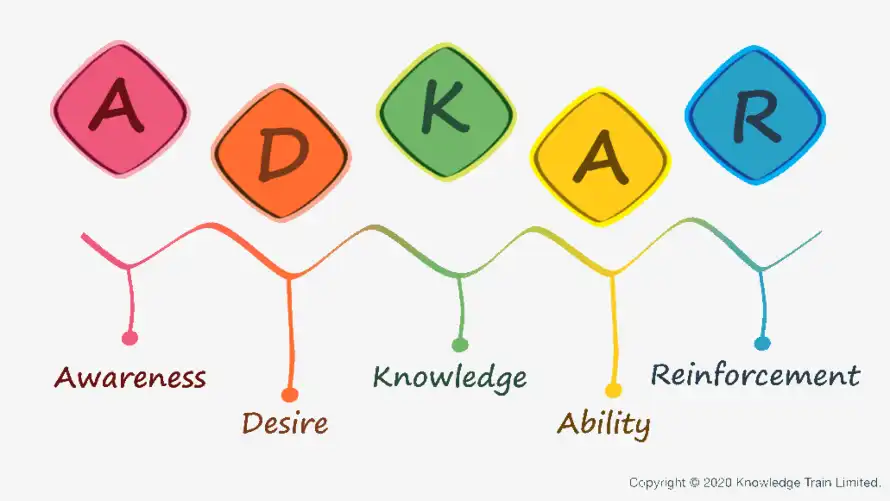
The ADKAR model is a goal-oriented change management framework focusing on individual-level change. It comprises five elements: Awareness, Desire, Knowledge, Ability, and Reinforcement. These elements guide individuals in adopting and sustaining change within an organisation. Overlooking important task dependencies.
Why is awareness important in the ADKAR model? Creating overly complex diagrams that are difficult to understand.
Awareness is crucial because it helps individuals understand the necessity for change. It prepares them for the transition by clarifying the reasons behind it, thereby reducing resistance and confusion.MarketingFailing to update the diagram as project scope or timelines change.
How can organisations measure the desire for change? Neglecting to consider resource constraints when analysing the network.
Organisations can assess desire through several methods, including surveys and interviews. Monitoring employee engagement levels also provides insights into their motivation to support the change. By learning project network diagrams, managers can enhance their ability to plan, schedule, and control complex projects effectively.
What tools are effective for knowledge transfer in the ADKAR model? Enhance your skills with our expert-led courses
Effective tools for knowledge transfer include workshops, training sessions, and e-learning platforms. These resources help ensure that employees acquire the necessary information and skills to adapt to change. Marketing
How can an organisation reinforce changes effectively?
Reinforcement is achieved through regular feedback and incentives. Continuous support mechanisms ensure that new behaviours are sustained over time, reducing stress and enhancing confidence among employees.
InfographicSelf-paced
The ADKAR change management model is summarised in this colourful infographic.APM PFQ blended online