Introduction to the ADKAR model
Understanding change management
In today’s constantly changing organisational landscape, change management is crucial. Organisations must adapt to remain competitive and relevant. Change management provides a structured approach to transitioning individuals, teams, and whole organisations from a current state to a desired future state. The goal is to minimise resistance and maximise engagement. Here, the ADKAR model shines as a strategic framework. It offers a clear, step-by-step process that leaders can use to guide their teams through change effectively.
Origins and purpose of ADKAR
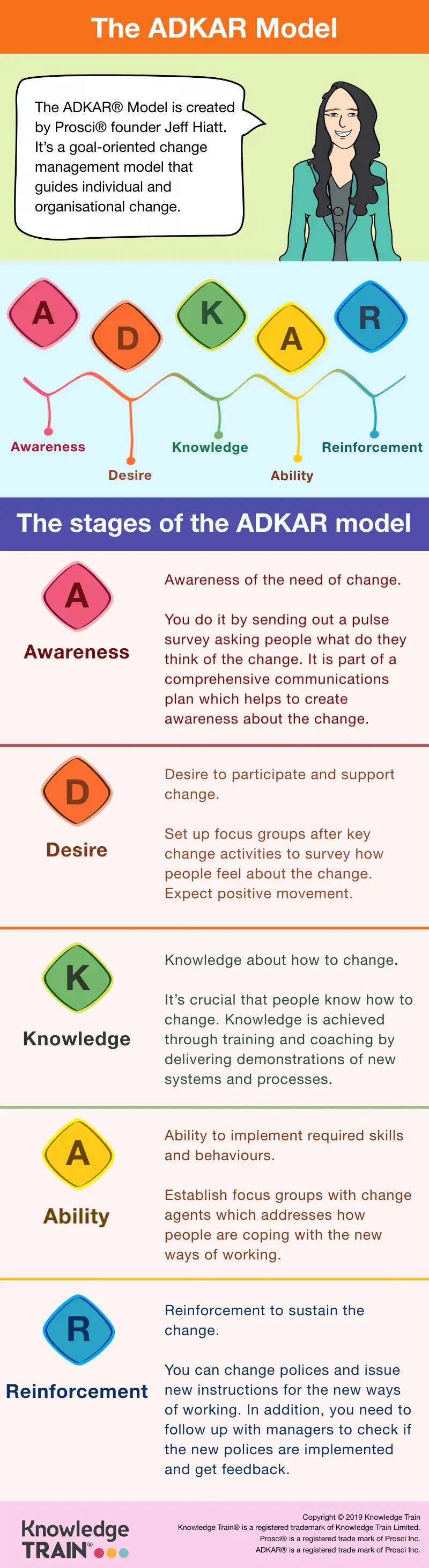
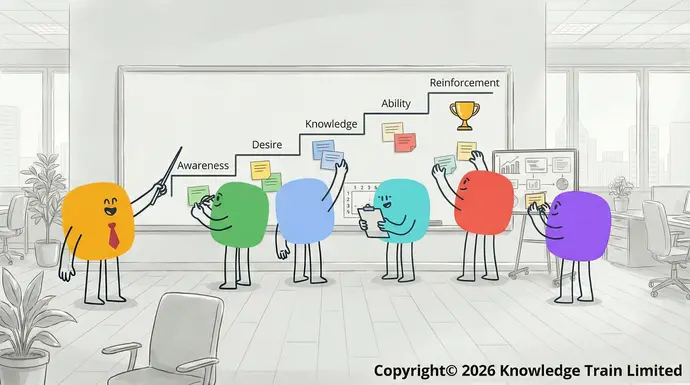
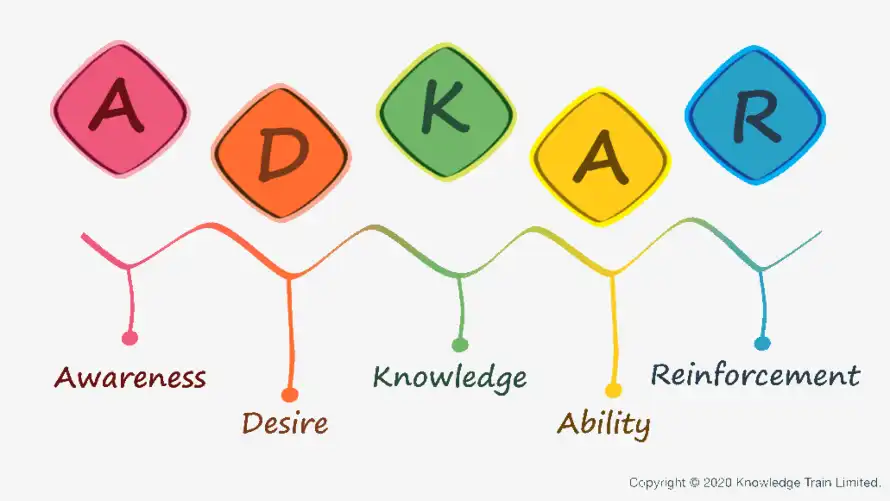
The ADKAR model was developed by Jeff Hiatt, founder of Prosci, through research conducted from 1994 to 2002. This research analysed the change patterns of over 700 organisations, leading to a practical, results-oriented approach to managing change at the individual level. Prosci’s research revealed that successful change occurs when organisational change management and individual change management intersect. It comprises five key elements: Awareness , Desire , Knowledge, Ability
- Enhance your project risk management skills.Engage employees: Involve them in planning and decision-making processes to create a sense of ownership.AgilePM
- Recognise contributions®: Acknowledge and reward early adopters and change champions to motivate others. – Agile Project Management
Measuring desire levelsFoundation
Understanding the level of desire is essential for gauging readiness. This can be achieved through:Learn the key principles of Agile Project Management.
- Surveys and feedbackPractitioner : Gather input on employee sentiments towards the change.Includes Foundation & Practitioner combined option.
- ObservationPRINCE2: Monitor engagement levels during change-related activities.®
- Interviews Agile: Conduct one-on-one discussions to explore individual concerns and motivations.Foundation
Assessing desire helps tailor support and interventions, ensuring greater engagement. It’s crucial to understand that while organisations can create an environment that fosters desire, the ultimate decision to participate in the change is a personal choice that cannot be forced. Leaders can influence desire by addressing the question ‘What’s in it for me?’ (WIIFM) but must recognize that genuine commitment cannot be mandated.Learn the fundamentals of the PRINCE2 Agile method.
Element 3: KnowledgePractitioner
The third element of ADKAR addresses the practical aspects of change implementation. The Includes Foundation & Practitioner combined option.KnowledgeAI Project Governance Framework (AIPGF) element focuses specifically on how to implement the change. This includes two critical types of knowledge: understanding how to change (the required skills, processes, and behaviours) and what to do during the transition state. This goes beyond just sharing information – it requires detailed training on new processes, systems, and roles that will be part of the change.Foundation
Knowledge acquisitionLearn the fundamentals of the governance framework.
To facilitate knowledge acquisition:Practitioner
- Structured trainingIncludes Foundation & Practitioner combined option.: Provide comprehensive training programmes tailored to different learning styles.Better Business Cases
- Mentorship™: Pair employees with mentors to offer guidance and support.Foundation
- Self-paced learningLearn the fundamentals of Better Business cases.: Use e-learning platforms for flexible, on-demand knowledge access.Practitioner
Tools for knowledge transferIncludes Foundation & Practitioner combined option.
Effective tools include:P3O
- Workshops and seminars®: Offer hands-on experience and practical insights.Foundation
- Knowledge repositoriesLearn the fundamentals of the P3O project management office.: Maintain accessible databases for quick reference.Practitioner
- Peer learningIncludes Foundation & Practitioner combined option.: Encourage knowledge sharing through peer networks.Workshops
These tools ensure that employees have the required knowledge to succeed.Introduction to Project Management
Element 4: Ability1-day workshop to learn the basics of project management.
The Project Management Essentials Ability2-day workshop to learn how to manage projects without getting certified. element represents the actual execution of the change – turning knowledge into action. Whilst Knowledge is about understanding how to change, Ability is about demonstrating performance in real-world conditions. This element often requires time for practice, coaching, and feedback as people develop proficiency in new skills or behaviours. Success in this element is measured by actual performance rather than just completing training.
Developing ability
Developing ability involves:Writing Business Cases
- Practical trainingHalf-day workshop to learn to write robust business cases.: Conduct real-world exercises to build confidence.AI in Project Management
- Feedback loopsLearn how to use AI tools in everyday project work.: Provide constructive feedback to refine skills.ARTIFICIAL INTELLIGENCE (AI)
- Supportive environmentBCS AI: Create a culture that encourages experimentation and learning.Foundation
Training and support systemsLearn the fundamentals of artificial intellegence.
- Feedback channelsSelf-paced training course to learn the essentials of Scrum.: Maintain open lines for employee input and suggestions.Scrum Master
Through reinforcement, organisations can ensure that new behaviours become ingrained, leading to lasting successChoose Scrum Alliance or Scrum.org Scrum Master training courses.
- : Align awareness efforts with the strategic vision. Ensure that the need for change is communicated in a way that reflects organisational goals.
- BUSINESS LEARNING LIBRARY (BLL)™: Tailor training programs to impart skills that directly contribute to achieving strategic goals.
- AbilityAgile Learning Library (ALL)™: Develop capabilities that are necessary for meeting long-term objectives.Business Analysis Learning Library (BALL)™
- ReinforcementCompliance Learning Library (CLL)™: Design reinforcement strategies that celebrate achievements aligned with organisational success.IT Learning Library (ITLL)™
This alignment ensures that change initiatives are not only implemented but also contribute meaningfully to the organisation’s mission.Business solutions
Continuous improvement_blank
Continuous improvement is vital in refining the ADKAR process. It involves regularly assessing and enhancing each element to ensure effectiveness.About
- Feedback loops