
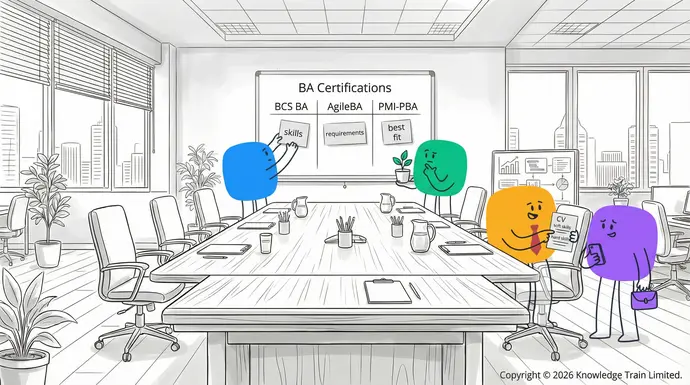
Business analysts and aspiring analysts working in agile environments, or collaborating closely with agile delivery teams.
Choose this if…
You need BA techniques that fit iterative delivery - exploring needs, shaping requirements, and supporting prioritisation as work evolves.
You’ll leave with
- An AgileBA qualification route and practical approaches for effective business analysis in agile teams.
- AgileBA courses
- Preparing for PMI-PBA?
- We also offer
- PMI Professional in Business Analysis (PMI-PBA) exam preparation
- for candidates planning to sit the PMI exam.
Business Analysis Learning Library{"@context":"http://schema.org","@type":"BreadcrumbList","itemListElement":[{"@type":"ListItem","position":1,"name":"Home","item":"https://www.knowledgetrain.co.uk/"},{"@type":"ListItem","position":2,"name":"Project management","item":"https://www.knowledgetrain.co.uk/project-management"},{"@type":"ListItem","position":3,"name":"Project management courses and online training","item":"https://www.knowledgetrain.co.uk/project-management/project-management-courses"}]}
- TM
- Want to explore business analysis before committing to a qualification? Get bite-sized learning you can start immediately and fit around work.
- Explore the Business Analysis Learning Library
Why choose Knowledge Train?Instructor-led Whether you’re starting your BA career or sharpening your skills for agile delivery, we make it easy to learn with confidence.
Project management courses
Compare project management qualifications and practical workshops. Choose the route that fits your role, experience and goals.
Creating and managing project budgets Accurate budgeting is vital for financial success. Consider these steps:
Accredited qualifications availableEstimate costs for each project element Add contingency for unexpected expenses Get stakeholder approval for the budgetPractical workshopsSet a baseline for future comparisons. Monitoring and controlling expenses Monitor expenses to stay within budget:
Expert trainersUse Earned Value Management (EVM)
Review costs regularly
- Compare options Leverage
- project management software
- Speak to our team for real-time tracking
- Act quickly on variances to avoid overruns.
Quality management Implementing quality assurance processes Ensure project deliverables meet required standards by:
Defining clear quality metrics
Performing regular quality audits Conducting peer reviews and inspections Using quality control tools (e.g., Pareto charts, control charts). Continuous improvement strategiesChoose your routePromote a culture of continuous enhancement:
Perform post-project reviews
Encourage team feedback and lessons learnedCompare qualificationsImplement process improvements based on insights
Stay informed on industry best practices. By refining these technical project management skills, professionals can enhance their capabilities and increase the likelihood of delivering successful projects
.Workshops & practical skills
Enhance your skills with our expert-led courses
- Why usInstructor-led
: Involves sharing information across different teams.Stakeholders
Customers, product owners, cross-functional teams, Scrum Masters
| : Identifying risks and developing contingency plans.Summary of the Agile Manifesto and Its values | Change managementThe | : Handling scope changes while minimising impacts.Agile Manifesto |
|---|---|---|
| Best practices for successful construction project management, published in 2001 by 17 software development experts, established the foundation for | Establish precise objectives and expectations at the very start of the project.Agile methodologies | Implement effective resource management strategies.. It promotes four core values and twelve underlying principles to guide teams toward continuous improvement and customer satisfaction. |
| Maintain regular communication with all stakeholders.Agile Manifesto: Four values | Monitor project progress continuously and adjust plans when needed.Individuals and interactions over processes and tools | Make safety and quality control your top prioriWorking software over comprehensive documentation |
| Customer collaboration over contract negotiation | Responding to change over following a plan | Agile principles |
Agile is supported by twelve guiding principles, intended to help teams create successful products in an ever-changing environment. These principles inform day-to-day Agile practices.Satisfy the customer through early and continuous delivery of valuable softwareWelcome changing requirements, even late in development
Deliver working software frequently, from a couple of weeks to a couple of monthsCollaborate daily between business people and developersBuild