
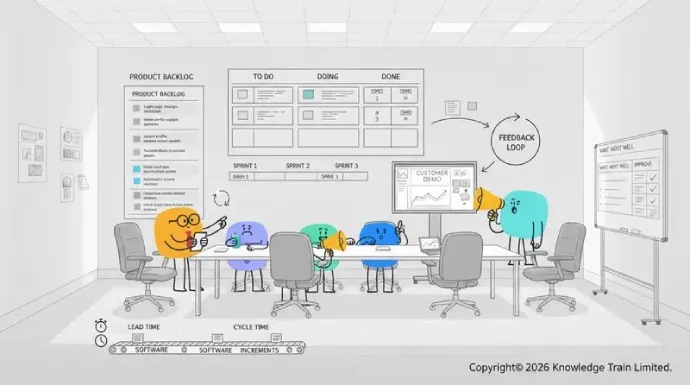
Definition of Agile
Agile refers to a set of principles and practices that guide teams in developing software products through incremental delivery, adaptive planning, and continual improvement. Agile emphasises iterative development, close team collaboration, and frequent customer feedback to deliver high-quality solutions quickly and efficiently.
Agile methodology at a glance
| Aspect | Description |
|---|---|
| Purpose | Deliver working software frequently, respond to change rapidlyPRINCE2 Agile Foundation sample exam questions |
| Key values | Individuals and interactions, working software, customer collaboration, responding to changeSimon Buehring |
| Approach19 Feb 2026 | Iterative, adaptive, and incremental |
| Popular frameworksEvaluate the quality of PRINCE2 Agile Foundation sample exam questions available online. Read this guide to find reliable practice resources. | Scrum , Kanban, Extreme Programming (XP) |
| Stakeholders | Customers, product owners, cross-functional teams, Scrum Masters |
Summary of the Agile Manifesto and Its values
The Agile Manifesto , published in 2001 by 17 software development experts, established the foundation for Fixing and flexing in PRINCE2 AgileAgile methodologies . It promotes four core values and twelve underlying principles to guide teams toward continuous improvement and customer satisfaction.Simon Buehring
Agile Manifesto: Four values19 Feb 2026
- Individuals and interactions over processes and tools
- Working software over comprehensive documentationLearn about the flexibility within the PRINCE2 framework to balance performance aspects effectively. Discover key strategies by reading further.
- Customer collaboration over contract negotiation
- Responding to change over following a plan
Agile principles
Agile is supported by twelve guiding principles, intended to help teams create successful products in an ever-changing environment. These principles inform day-to-day Agile practices.
- Satisfy the customer through early and continuous delivery of valuable software
- Welcome changing requirements, even late in development
- Deliver working software frequently, from a couple of weeks to a couple of months
- Collaborate daily between business people and developersPRINCE2 Agile cost
- Build projectsSimon Buehring around motivated individuals and provide support28 Apr 2026
- Convey information face-to-face whenever possible
- Working software is the primary measure of progressUnderstand the costs of PRINCE2 Agile courses and what to expect beyond the course fee. Read on to plan your budget effectively.
- Maintain a sustainable development pace
- Continuous attention to technical excellence and good design
- Simplicity – the art of maximising the work not done – is essential
- Self-organising teams produce the best architectures, requirements, and designs
- Regularly reflect and adapt to improve effectiveness
Historical origins and evolution of Agile
The Agile approach originated in the late 1990s as software teams sought alternatives to rigid project management models like the WaterfallPRINCE2 benefits, advantages and disadvantages model. In 2001, seventeen thought leaders signed the Agile ManifestoSimon Buehring, formalising Agile values and sparking the formation of the Agile Alliance. Since then, Agile has evolved beyond software development into 19 Feb 2026project management , product development, and operations.Evaluate the benefits and potential drawbacks of PRINCE2 to see how it fits into your career development. Scroll down for a balanced view.