
Copied!
Key takeaways
- DSDM is an agile framework that blends iterative delivery with built-in project management discipline.
- Keep decisions anchored to the business case by prioritising with MoSCoW and delivering within fixed timeboxes.
- Build one collaborative team by involving business, technical staff and stakeholders throughout via workshops and empowered roles.
- Fix quality expectations early and protect them with continuous testing and frequent reviews.
- Agree firm foundations upfront, then deliver increments that are regularly revalidated against viability and feedback.
- Maintain control through clear communication, visible plans and progress measured by outcomes delivered, not activity.
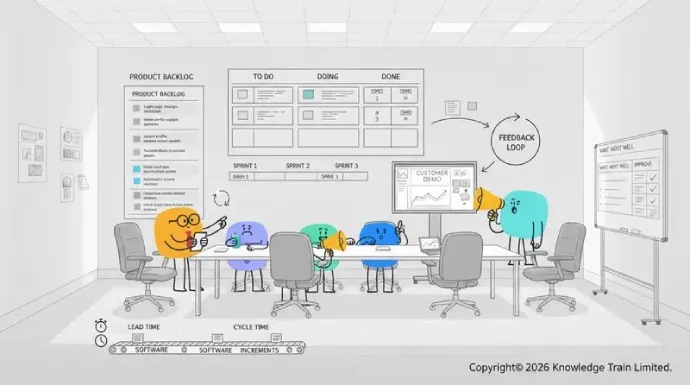
DSDM provides agile project management
.
| Enhance your skills with our expert-led courses | |
|---|---|
| Instructor-led | AgilePM Practitioner (with Foundation) course |
| Iterative, adaptive, and incremental£1,699 +vat | |
| Popular frameworks Download this ebook | ScrumSee all dates , Kanban, Extreme Programming (XP) Download |
| Stakeholders | Customers, product owners, cross-functional teams, Scrum Masters |
Summary of the Agile Manifesto and Its valuesSelf-paced
The AgilePM Practitioner (with Foundation) self-paced onlineTopics to know
Agile Manifesto: Four values working within an environment supporting
- Individuals and interactions over processes and toolsInstructor-ledPRINCE2
- Working software over comprehensive documentationAgilePM Foundation course.
- Customer collaboration over contract negotiation The exam addresses each of the following areas. The percentage of questions for each topic on an exam paper is shown.
- Responding to change over following a plan£1,299 +vatLearning outcome
Agile principles Percentage of questions
Agile is supported by twelve guiding principles, intended to help teams create successful products in an ever-changing environment. These principles inform day-to-day Agile practices.See all datesUnderstand the key concepts relating to projects and PRINCE2.
- Satisfy the customer through early and continuous delivery of valuable softwareDSDM principles – the building blocks3%
- Welcome changing requirements, even late in developmentDSDM based upon principlesUnderstand how the PRINCE2 principles underpin the PRINCE2 method.
- Deliver working software frequently, from a couple of weeks to a couple of monthsBased upon 8 principles and an underlying agile philosophy, DSDM became a popular agile approach amongst software developers seeking an alternative to rapid application development (RAD) approaches in the years after 2000. RAD approaches did not scale well for people collaborating on a team however. DSDM thus became one of the first agile approaches to be used within the software development community.8%
- Collaborate daily between business people and developersThe 8 DSDM principles underpin the whole framework. Each principle must be adhered to by the project team, as ignoring any of the principles can increase the chance of project failure.Understand the importance of people in successful projects.
- Build The graphic below was created to help you learn about DSDM. If you like it, please show your appreciation by linking back to this page.14%projectsNow, let’s find out more about the Understand the PRINCE2 practices and how they are applied throughout the project. around motivated individuals and provide support60%DSDM principles
- Convey information face-to-face whenever possibleUnderstand the PRINCE2 processes and how they are carried out throughout the project. and how teams can ensure they stick to them.
- Working software is the primary measure of progress15%The 8 DSDM principles
- Maintain a sustainable development paceIf you want a detailed understanding of the Foundation syllabus you can download a copy from AXELOS.1. Focus on the business need
- Continuous attention to technical excellence and good designExam tip DSDM has a strong business-driven approach. A
- Simplicity – the art of maximising the work not done – is essential– learn all about the PRINCE2 by reading our free PRINCE2 study guides which can be downloaded as free e-books: business case
- Self-organising teams produce the best architectures, requirements, and designsPRINCE2 principles must be established for the project and the team must understand project priorities. Every decision the team make during the project should help achieve the project goal and the team must ensure the project is delivered on time.
- Regularly reflect and adapt to improve effectiveness, MoSCoW prioritisation
Historical origins and evolution of AgilePRINCE2 practicesTo adhere to this principle, DSDM teams have several tools at their disposal. For example, the
The Agile approach originated in the late 1990s as software teams sought alternatives to rigid project management models like the , MoSCoW techniqueWaterfallPRINCE2 People helps the team prioritise which of the business requirements model. In 2001, seventeen thought leaders signed , and Mthe Agile ManifestoPRINCE2 processesust be, , formalising Agile values and sparking the formation of the Agile Alliance. Since then, Agile has evolved beyond software development into .Sproject managementPurchase your official online examshould be, , product development, and operations. C
Benefits of Agile ould be or
- Flexibility: W Respond rapidly to changing customer needs and market conditions.Examon’t be delivered. Timeboxing helps to separate work into manageable chunks of time, with each chunk having its own deliverables and deadline.
- Continuous improvement:Foundation PRINCE2 examThe Foundation phase in DSDM also helps the team build focus. During this phase, team roles are established. The team then form the overall strategy, decide how risk/quality will be assessed, how technology will be used and how the project will be managed. Regular retrospectives help teams adapt and improve their processes. 2. Deliver on time
- Customer satisfaction:£465 +vatFixed time periods Frequent delivery ensures customer requirements are met early and often. DSDM is an agile framework that works plans work in fixed time periods (timeboxes), rather like sprints in
- Transparency: Agile Scrum Iterative development and open communication foster stakeholder trust. . The aim is to deliver a useable software product at the end of each timebox (iteration). DSDM is thus an incremental approach, as well as an iterative development approach to delivering software.
- Reduced risk:ExamDSDM places a strong emphasis on prompt delivery, proposing that even projects without any need for a fixed deadline still benefit from one. This is because having deadlines is the best way to control changing requirements. To stick to this principle, DSDM teams should focus on priorities, hit deadlines and manage their time by using the Incremental delivery allows for earlier issue detection and correction.Practitioner PRINCE2 examMoSCoW
- Enhanced team collaboration: and timeboxing techniques. Cross-functional teams communicate daily to resolve challenges efficiently.£470 +vat3. Collaborate
Agile vs waterfall modelQuestion typesTeam spirit and collaboration is highly important for DSDM teams. This is based on a rejection of having multiple departments that rarely interact. Teams should instead work as one unit and collaborate to encourage understanding, higher performance and shared ownership.
| AspectThe exam is made up of 60 multiple-choice questions, which you must complete in 1 hour. All the questions are contained within a question booklet.Business and technical staff work together | AgileThe pass mark is 60% so you need to score at least 36 correct answers to pass. The exam is closed book, which means that you cannot use the DSDM teams fulfil this principle by having business and technical staff together in the team, instead of separately. The team involve stakeholders throughout the project and ensure each team member feels empowered to make decisions. The team use ‘workshops’ to meet stakeholders and involve them in the project. | WaterfallPRINCE2 manualEnsuring collaboration |
|---|---|---|
| Process or any other printed or electronic materials during the examination.The visionary, ambassador and business advisor roles also ensure collaboration. The visionary conveys the sponsor’s needs to the team and ensures the business case objectives are achieved. Ambassadors communicate user’s needs to the development team, whilst business advisors assist with areas such as law or marketing. On a non-agile project, these roles would be performed outside of the project or would not exist at all. | Iterative and incrementalThe exam contains 4 types of question style: ‘standard’, ‘list’, ‘negative’, and ‘missing word’. The questions are always in multiple-choice format, so you simply need to pick one answer out of the four options given. There are no trick questions on the exam paper and each question only has one correct answer.4. Never compromise quality | Sequential and linear‘Standard’ style questionsQuality is always fixed on DSDM projects and must be decided at the start. The final product shouldn’t be any more or any less than the quality decided upon. |
| FlexibilityThis is the style of question which you will have answered many times before. For example:Continuous testing | Adaptive to changeQ. In which of the following processes does the project board choose a suitable risk response?To adhere to this principle, DSDM teams must ensure quality doesn’t become a variable by testing continuously and reviewing constantly. This testing and reviewing occurs during the ‘exploration’ and ‘engineering’ iterative development phases. Testing should happen early in the project. Again, MoSCoW and timeboxing can be used to ensure testing is appropriate and organized. | Resistant to change after initial planningControlling a stage5. Build incrementally from firm foundations |
| Customer involvementManaging a stage boundaryDSDM differs from other | High, continuous feedbackDirecting a projectagile methods | Typically only during requirements and acceptance stagesStarting up a project as it requires the foundations of the project to be agreed early. The foundations don’t need to be in too much detail – just agree on what the problem is and how to solve it. Once foundations are established, the solution must be delivered incrementally. |
| DeliveryIf you remember that the project board only performs one of the seven processes then the answer is straightforward – it’s Just enough design up front | Frequent, partial releasesdirecting a projectTo adhere to this principle, DSDM teams must ensure they perform analysis and ‘enough design up front’ (EDUF) at the start of the project. During each increment, the team must re-assess priorities and project viability, ensuring they have taken stakeholder feedback into consideration. Both the feasibility and foundation phases allow for establishing a foundation; the exploration and engineering phases allow for incremental delivery. | Full product delivered at project end.6. Develop iteratively |
| Risk‘List’ style questionsDSDM proposes that nothing is created perfectly first time and projects operate in a constantly changing world. Incremental delivery allows for such change to be embraced and leads to higher stakeholder satisfaction. Each iteration is combined with testing, demonstrations and feedback. This ensures that each iteration improves upon the last and leads to a decent final product. | Problems discovered earlyFor example:Feedback loop | Issues often found lateQ. Which of the following tasks form part of the product-based planning method?DSDM teams can adhere to this principle by building feedback into each iteration. They must also be in the mindset that details should emerge later, not sooner, and they must embrace change. During each iteration, they should encourage creativity and experimentation, which will lead to learning and improvement. Constant review and feedback allow for change and progress to occur. |
Agile frameworks and practicesi. Writing the product descriptionsTo deliver an incremental working release of software at the end of each iteration DSDM recommends the
Scrum frameworkii. Creating a product flow diagramMoSCoW prioritisation
Scrumiii. Designing the plan technique to prioritise requirements to be worked on by the team during a timebox. Requirements are typically capture in the form of is a widely adopted Agile framework structured around short, timeboxed periods called iv. Creating the product breakdown structureuser storiessprints(i), (ii) and (iii).. Teams maintain a (ii), (iii) and (iv)7. Communicate continuously and clearlyproduct backlog(i), (ii) and (iv)Bad communication often leads to project failure and traditional non-agile approaches fail to address this. DSDM a of features and tasks, delivering increments of working software at the end of each sprint. Roles in Scrum include Product Owner, (i), (iii) and (iv)For the above question, read the statements i-iv, and then decide which three form part of the product-based planning method. I suggest that you read each of the 4 options and tick the ones you are sure form part of the technique. If there are only 2 options you are sure about, at least you have reduced your last decision to a choice between the 2 remaining options, so pick one of them and then mark your answer accordingly.‘Negative’ style questions
Kanban emphasises visualising work, limiting work in progress, and optimising flow. Teams use Kanban boards to track tasks and identify bottlenecks, often integrating continuous improvement practices.Which is DSDM teams commonly use modelling and prototyping to further improve communication. These practical methods help replace the need for heavy, useless documentation.
User stories and Product BacklogNOTModelling
Features are typically described as a role within PRINCE2?Modelling is a visual form of communication utilizing diagrams. This allows for complex systems, designs and products to be better understood.user storiesProject managerDSDM makes use of prototyping by creating prototypes of the product early in development, to allow stakeholders to ‘test-drive’ early versions of the solution. The idea is to build something fast, get feedback quickly, and to break it sooner, rather than later. The underlying DSDM philosophy is that if something isn’t going to work, it is better to find that out as soon as possible, and change course sooner, rather than later. in a product backlog. This backlog is prioritised by the Product Owner and guides the work to be pulled into each sprint or iteration.Project assurancePrototyping
Agile project managementBusiness managerPrototyping means creating prototypes of the product early in development, to allow stakeholders to ‘test-drive’ early versions of the solution.
Agile project managementSenior supplier8. Demonstrate control focuses on iterative planning, adaptive resource allocation, and continuous stakeholder engagement. Leaders support self-organising, cross-functional teams, encourage regular customer feedback, and facilitate incremental value delivery.For this type of question, it is important that you take notice of the wordIt is vital to keep control of the project. DSDM proposes that it is only possible to do this by using a plan aligned to the project aims, with both being accessible to the entire team.
Key concepts: Iterative and incremental delivery NOTEnsure progress is visible
Agile projects proceed in small iterations, each resulting in an incrementally improved product. This iterative approach enables rapid adaptation, regular feedback, and incremental value to stakeholders.. The word DSDM teams, especially the
Team collaboration and cross-functional teamsNOTproject manager
Agile emphasises collaboration between customers, stakeholders, and team members from diverse disciplines. Cross-functional teams are empowered to make decisions and deliver complete solutions within each iteration. is always bolded to bring your attention to the fact that the question is a negative one. and team leader, can fulfil this principle by ensuring plans and progress are visible to everyone. Managing must be proactive with an emphasis on reporting and tracking.
Continuous improvement practices‘Missing word’ style questionsMeasure progress by delivery
Agile teams conduct regular retrospectives to identify areas for improvement and adjust their processes. This culture of continuous improvement leads to increased quality, productivity, and team morale over time.For example:Also, progress must be measured by looking at what has been delivered, rather than activities completed. Timeboxing helps to control who is doing what and when. DSDM can also be combined with methods such as Kanban, which help teams to visualize project progress and see who is doing what, when and how long it will take them.
Further ResourcesIdentify the missing word in the following sentence.Enhance your skills with our expert-led courses
FAQsPlans
What is Agile methodology?ProgressInstructor-led
Agile methodologyRiskAgilePM Practitioner (with Foundation) course is a set of practices and values that promote adaptive planning, evolutionary development, early delivery, and continual improvement. Agile methods empower teams to respond quickly to change and collaborate closely with stakeholders.The answer is the progress theme. Even if you couldn’t remember the purpose of the progress theme, you might have been able to get the answer by a process of elimination by asking yourself what the other themes are about (controlling changes and issues, planning what is to be done, controlling uncertainty). As you can see, it really does help to be able to quickly recall your
What are the 12 principles of Agile?PRINCE2£1,699 +vat
The knowledge quickly. 12 Agile principlesExam tipSee all dates include prioritising customer satisfaction through early and continual delivery, welcoming changing requirements, delivering working software frequently, fostering daily collaboration, supporting motivated teams, preferring face-to-face communication, using working software as the main progress measure, maintaining a sustainable pace, focusing on technical excellence, maximising simplicity, enabling self-organising teams, and reflecting regularly for process improvement. – with limited time and no manual allowed, revision must be top of your exam preparation plan.
What is the difference between Agile and waterfall?Revision
Agile is iterative, adaptable, and focuses on incremental delivery with frequent stakeholder feedback. Exam practice WaterfallThe most common revision method is to practice those exam questions! As the questions are compiled from a limited question bank, the more practice questions you attempt, the more prepared you will be. The Self-paced is linear, sequential, and requires upfront planning, often only allowing changes late in the project cycle.PRINCE2 examAgilePM Practitioner (with Foundation) self-paced online
What are Scrum and Kanban frameworks? board provides 2 sample exam papers to PRINCE2 Accredited Training Organisations, so if you have studied using an accredited training course, these should be provided to you.
ScrumIn addition, £1,299 +vat is an Agile framework that organises work into fixed-length sprints and uses roles like Product Owner and Knowledge Train Scrum Master has developed a further . Kanban is a visual method for managing workflow, limiting work in progress, and focusing on incremental improvements. mock Foundation exam
How does Agile improve team collaboration?Instructor-led which you can also use to practice exam style questions.
Agile improves collaboration through daily communication, cross-functional team structures, and regular stakeholder engagement, ensuring all members align towards shared goals.AgilePM Foundation courseExam tip