
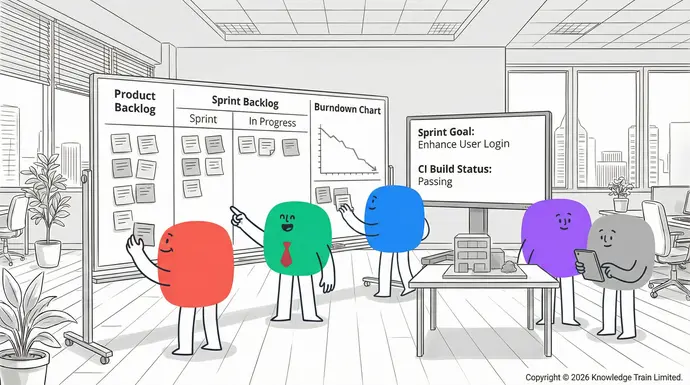
Definition of Scrum
ScrumProject management methods: a guide to modern approaches is an agile framework designed to help teams develop, deliver, and sustain complex products through collaboration, transparency, and iterative progress. Most widely used in software development, Scrum offers a structured approach to project managementKnowledge Train by defining specific roles, events, and artifacts that guide work and foster continuous improvement.23 Feb 2026
What is Scrum?
Scrum is an iterative and incremental agile framework that enables teams to manage complex projects by delivering work in short cycles called Sprints . It is characterised by roles, events, and artifacts, all of which facilitate transparency and adaptability. Scrum empowers cross-functional teams to achieve high productivity and deliver value quickly.
History of Scrum
The Scrum framework was formalised in the early 1990s by Ken Schwaber and Jeff Sutherland, who drew inspiration from iterative development concepts described in a 1986 Harvard Business Review article. Since then, Scrum has evolved and become one of the most recognised frameworks in Agile software development, with its core guidance outlined in the Scrum Guide .
Core principles of Scrum
- Empirical process control: Decisions are based on observation, experience, and experimentation.
- Transparency: Important aspects of the process must be visible to those responsible for the outcome.
- Inspection: Scrum users inspect Scrum artifacts and progress regularly to detect undesirable variances.
- Adaptation: Processes are adjusted as soon as possible if inspection reveals an aspect outside acceptable limits.
Key roles in ScrumCopied!
- Scrum MasterKey takeaways:Choose a project approach that fits the work, the team, and the organisation. Facilitates the Scrum process, removes obstacles, and supports the team in adhering to Scrum practices.Waterfall suits stable requirements and benefits from clear phases, documentation, and predictable planning.
- Product Owner:Agile methods prioritise rapid, iterative delivery, close collaboration, and frequent feedback to handle change.
- Plan and execute Sprints using Scrum events.Project management methodologies
- Review progress, adapt processes, and incrementally deliver value. may be classified into two broad categories, based on their fundamental philosophies. These are
FAQslinear
What is the main purpose of Scrum? and
Scrum’s main purpose is to help teams develop and deliver complex products by encouraging collaboration, adaptability, and incremental value delivery in short cycles called Sprints.iterative
How does Scrum differ from Agile?. It’s important to be aware of these core strategies when choosing the best approach for your project.
AgileLinear (Waterfall) approach is a set of guiding principles for software development, whereas Scrum is a specific framework within Agile that defines roles, events, and artifacts for teamwork and accountability.Description and key principles
What are the key roles in a Scrum team?The
The key Scrum roles are WaterfallScrum Master strategy is a linear approach where a project is broken down into distinct phases, and each phase is completed before progressing to the next. Core tenets of this approach include detailed upfront planning, comprehensive documentation at each phase, rigorous change control processes, and a strong emphasis on following the planned path., Product Owner, and Development Team. Each has defined responsibilities to ensure effective collaboration and delivery.Advantages and disadvantages
What are Scrum events and why are they important?Advantages:
Scrum events include Sprint, Sprint Planning, Daily Scrum, Sprint Review, and Sprint Retrospective. These events facilitate communication, inspection, and continuous improvement.Clear structure and defined milestones
How can a team start with Scrum?Well-defined deliverables
A team can start with Scrum by learning the framework, defining roles, creating a Product Backlog, planning Sprints, and using Scrum events and artifacts to guide work.Easier costs and timelines estimation.
What is a Burndown Chart in Scrum?Disadvantages:
A Burndown Chart visually tracks the amount of work remaining in a Sprint, helping teams monitor progress and forecast completion.Limited flexibility to accommodate changes