Agile project management: Frameworks, benefits and how it worksPMO

Key takeaways
Agile improves delivery by combining iterative planning, tight feedback loops and disciplined ways of working.
- Agile delivers value in short iterations, using regular reviews and retrospectives to adapt quickly to change.
- Scrum, Kanban, Lean and XP offer different structures, so choose based on workflow needs and team maturity.
- Clear roles, prioritised backlogs and well-written user stories reduce confusion and keep work aligned to outcomes.
- Metrics such as velocity, cycle time and burn-down charts improve predictability when paired with a clear definition of done.
- Lightweight governance, change management and technical debt controls help Agile scale without losing quality.Copied!
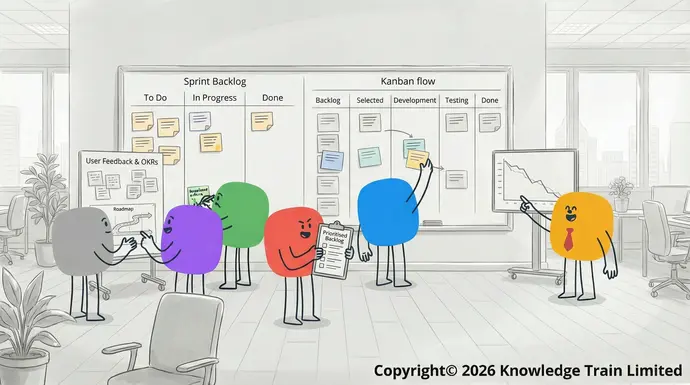
What is Agile project management?Centres of excellence
Agile project management is an iterative approach to planning, executing, and Conclusiondelivering projectsIntroduction by breaking work into small, manageable increments known as iterations or sprints. Rather than following a strict linear plan, PMOsAgile have been a common feature on focuses on adaptability, team collaboration, and continuous delivery of value to stakeholders. projectsAgile principles in larger organizations. However, in the last decade or so, the responsibilities of PMOs have evolved into a much wider brief. Nowadays, PMOs are also expected to support both emphasise close communication, incremental progress, and regular feedback cycles to enhance quality and meet customer needs.portfolios
The Agile Manifesto: Values and principles and
The programmesAgile Manifesto, in addition to their traditional project management brief. underpins Agile project management, defining four core values and twelve guiding principles. These foster a culture of collaboration, adaptability, and response to change.Agile creates change
Agile Manifesto core valuesWhen an organization tries to adapt agile practices on its projects, it is setting out on a programme of change. These changes can affect stakeholders beyond the usual realm of the project. Therefore, to support the change to agile, a PMO must also change.
- Individuals and interactions over processes and toolsValue-driven agile PMOs
- Working software (or product) over comprehensive documentationAll projects should deliver the optimum value, to the right stakeholders, at the right time. A PMO objective is to smooth the path to achieving these goals.
- Customer collaboration over contract negotiationJust as
- Responding to change over following a planagile
Twelve principles of Agile itself is a customer-focused mindset, an
- Customer satisfaction through early and continuous deliveryagile PMO
- Welcome changing requirements, even late in development must be based upon a customer-collaboration mindset.
- Deliver working products frequentlyPMOs should tailor the support they give to projects depending upon the project’s unique circumstances. In the same way, an
- Close, daily cooperation between business people and developersagile PMO
- Build should tailor its agile support to what each project needs to deliver the value the customer is expecting. Some might need specific assistance with training and coaching team members in certain agile practices. Others might need tools and templates.projectsAgility requires practitioners adapt quickly to change. Therefore, an agile PMO must have its pulse on the customer to understand what it truly needs. around motivated individualsEnhance your skills with our expert-led courses
- Face-to-face conversation as the best form of communication
- Working product as the primary measure of progress
- Sustainable development pace
- Continuous attention to technical excellence and good designInstructor-led
- Simplicity – the art of maximising the amount of work not done – is essentialP3O Practitioner (with Foundation) course
- Self-organising teams produce the best results
- Regular reflections for continuous improvement£2,099 +vat
Key Agile frameworks and methodologies
AgileSee all dates encompasses various frameworks, each with its own practices and terminology. The most widely used Agile frameworks were designed for more efficient product delivery, rather than project management . They include ScrumInstructor-led, Kanban, Lean, and Extreme Programming (XP):P3O Foundation course
Scrum
- Main focus:£1,599 +vat Team roles, time-boxed sprints, and iterative delivery
- Core roles:See all dates Product Owner, Building an agile PMOScrum MasterWhen starting out building an agile PMO, it is tempting to think of mandating a set of agile practices and templates across , Team Membersprojects
- Artefacts:. That would be a mistake. Product backlog, sprint backlogBecoming an agile organization requires the employees themselves understand why the change is taking place and having them take a role as active participants.
- Key events:Often when organizations mandate a top-down change, the initiative fails because the staff do not buy into the change. Sprint planning, daily scrum, sprint review, sprint retrospectivesTherefore, a much better approach to building an agile PMO is to let the project participants come to the agile PMO. When actively seeking the help of an agile PMO, those staff are far more likely to engage with the
- Advantages:PMO Well-defined structure, clear accountability, transparency than if it is mandated from the top down.
KanbanStarting an agile PMO
- Main focus:One key question to answer is ‘how to start building an agile PMO?’ After all, if the agile PMO is to get its first customers, there must be an initial project where its support is trialled and championed.The team should measure progress solely on its ability to deliver working products early and regularly. The team must be based around self-motivated people who collaborate with the business. To minimize waste, the team should keep things simple. The team should also have regular retrospectives to improve the agile processes being used.
- Core elements:Multi-skilled agile PMOs Kanban board, work-in-progress limits, cards/tasksSince moving an organisation from a more predictive, functional style organization to a more agile organisation required organizational change management. Therefore, the agile PMO must become conversant with
- Advantages:organisational change management Flexibility, real-time workflow visualisation, easy adoption without role changesThis therefore requires the PMO and its staff to become more than just project management experts.
LeanCentres of excellence
- Main focus:Some agile PMOs deal with the challenges of helping organizations become more agile by becoming centres of excellence which provide a range of services. The best practice PMO framework Elimination of waste, maximising value, continuous improvementP3O
- Core elements: describe the role and function of a PMO centre of excellence. This kind of Value stream mapping, optimised flow, customer focusPMO structure
- Advantages: provides some of these services: Improved efficiency, reduced delays, enhanced qualityDeveloping and implementing standards
Extreme Programming (XP)user stories
- Main focus:, test cases), and standardizing the use of agile toolsets. Technical excellence, frequent releases, customer involvementDeveloping personnel
- Core practices:Coordinating Pair programming, test-driven development, continuous integration, agile traininguser stories, coaching, and mentoring to help team members and business leaders’ transition to an agile mindset.
- Advantages:Multi-project management Rapid feedback, high product quality, adaptability to changeCoordinating projects between agile teams. Some of this can be done by sharing things such as progress, issues, risks and retrospective findings and improvements. Another way is by using appropriate portfolio and programme management frameworks to provide decision-making support for investment decisions taken at the portfolio and programme levels.
Comparison: Scrum, Kanban, Lean, XPFacilitating organisational learning
| FrameworkGathering, storing and disseminating project metrics and retrospective findings. | Main focusManaging stakeholders | Key practiceProviding support and training for business leaders, especially in the product owner role, on things such as acceptance testing, and how to evaluate and give feedback on systems. | Team structureEnhance your skills with our expert-led courses | Best use case |
|---|---|---|---|---|
| Scrum | Time-boxed iterations (Sprints) | Predefined roles and eventsInstructor-led | Cross-functionalP3O Practitioner (with Foundation) course | Complex projects needing structure |
| Kanban£2,099 +vat | Visual workflow & limits | Kanban board, WIP limitsSee all dates | Flexible roles | Ongoing support/operations |
| Lean | Eliminate wasteInstructor-led | Value stream mappingP3O Foundation course | Any | Process improvement, efficiency£1,599 +vat |
| XP | Technical best practicesSee all dates | Pair programming, TDDConclusion | Small, tech-focused teamsAs organisations grapple with the challenges of becoming more agile, there is an increasing awareness that to succeed requires understanding more than just agile practices and | Software projects needing qualityproject management |
Agile vs traditional (waterfall) project management.
The To move to greater agility requires the organisation to understand that what in fact it is undertaking, is organizational change. Therefore, the people driving these changes must understand and be able to apply some of the well-established frameworks, techniques and bodies of knowledge that form the waterfall modelchange management is a sequential, plan-driven approach where phases follow one another with minimal overlap. profession.Agile project managementRelying only on agile gurus to coach team members is only one small part of a much bigger jigsaw puzzle requiring an organisational change management approach. contrasts this with its focus on flexible planning, iterative progress, and stakeholder feedback throughout:Subscribe to our exclusive offers and promotions
Project Management Institute (PMI) provide resources, definitions, and certifications for Agile professionals.
FAQs
What is the difference between Agile and waterfall project management?
The main difference is that Agile is iterative and flexible, allowing change at any stage, while waterfallWhat is the Association for Project Management (APM)? follows a strict, linear process where each phase must be completed before the next begins. Agile encourages frequent feedback and continuous delivery of value, whereas waterfall often delivers only at the end.
What are the main stages of an Agile project?Simon Buehring
Typical stages of an Agile project include vision and roadmap creation, backlog development, sprint planning, execution (iteration), review, and retrospectives. Continuous improvement occurs at every stage.29 Apr 2026
What are the key frameworks of Agile project management?
Key Agile frameworks are The Association for Project Management (APM) is the UK’s chartered body advancing project management standards, membership and professional development.Scrum , Kanban, Lean, and Extreme Programming (XP). Each offers a unique structure for managing roles, processes, and workflow.
What are the benefits and challenges of Agile project management?
Advantages include adaptability, stakeholder engagement, and high product quality. Challenges may include initial resistance, need for team discipline, and less suitability for projects with fixed, unchanging requirements.
Where is Agile project management commonly used?
While most common in software development, Agile is used in industries such as marketing, manufacturing, construction, and education wherever flexible, iterative approaches add value.