
Key takeawaysSee all dates
Agile improves delivery by combining iterative planning, tight feedback loops and disciplined ways of working.Conclusion
- Agile delivers value in short iterations, using regular reviews and retrospectives to adapt quickly to change.The project management triangle is a simple yet powerful tool for understanding and managing project constraints such as
- Scrum, Kanban, Lean and XP offer different structures, so choose based on workflow needs and team maturity.scope
- Clear roles, prioritised backlogs and well-written user stories reduce confusion and keep work aligned to outcomes.,
- Metrics such as velocity, cycle time and burn-down charts improve predictability when paired with a clear definition of done.time
- Lightweight governance, change management and technical debt controls help Agile scale without losing quality., and
What is Agile project management?{"@context":"https://schema.org","@type":"ImageObject","contentUrl":"https://www.knowledgetrain.co.uk/training-courses/project-management-triangle-infographic-v1.0.webp ","description":"Project management triangle infographic","license":"https://www.knowledgetrain.co.uk/license","acquireLicensePage":"https://www.knowledgetrain.co.uk/license","creditText":"Knowledge Train","uploadDate":"2024-10-14T09:00:28.000Z","copyrightNotice":"© 2024 Knowledge Train Limited. All rights reserved.","creator":{"@type":"Organization","name":"Knowledge Train","url":"https://www.knowledgetrain.co.uk"}}
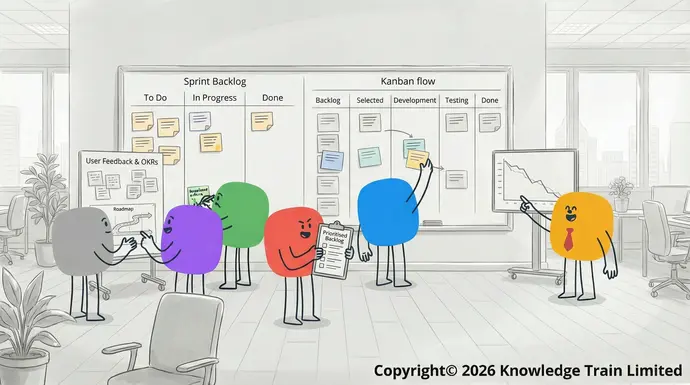
Agile project management is an iterative approach to planning, executing, and Related articlesdelivering projects by breaking work into small, manageable increments known as iterations or sprints. Rather than following a strict linear plan, Agile focuses on adaptability, team collaboration, and continuous delivery of value to stakeholders. Agile principles emphasise close communication, incremental progress, and regular feedback cycles to enhance quality and meet customer needs.
The Agile Manifesto: Values and principles
The Agile Manifesto underpins Agile project management, defining four core values and twelve guiding principles. These foster a culture of collaboration, adaptability, and response to change.
- Individuals and interactions over processes and tools
- Working software (or product) over comprehensive documentationWhat is PMP Certification? | How to Get Project Management Professional Certified
- Customer collaboration over contract negotiation
- Responding to change over following a planKnowledge Train
Twelve principles of Agile29 Apr 2026
- Customer satisfaction through early and continuous delivery
- Welcome changing requirements, even late in developmentPMP certification is a globally recognised qualification for project managers, awarded by the Project Management Institute (PMI). It demonstrates advanced knowledge and experience in project management and is highly valued across multiple industries worldwide.
- Deliver working products frequently
- Close, daily cooperation between business people and developers
- Visualisation of workflow, limiting work in progress, continuous flow
- Core elements:Sevcan Yasa Kanban board, work-in-progress limits, cards/tasks19 Feb 2026
- Advantages: Flexibility, real-time workflow visualisation, easy adoption without role changesIn this video, Elizabeth Moon describes her experience of taking a PRINCE2 Foundation and Practitioner course with Knowledge Train.
Lean
- Main focus: Elimination of waste, maximising value, continuous improvement
- Core elements: Value stream mapping, optimised flow, customer focus
- Advantages: Improved efficiency, reduced delays, enhanced quality
Extreme Programming (XP)PRINCE2 vs Agile or PRINCE2 Agile?
- Main focus: Technical excellence, frequent releases, customer involvementSimon Buehring
- Core practices:19 Feb 2026 Pair programming, test-driven development, continuous integration, user storiesConfused between PRINCE2, Agile, or PRINCE2 Agile? Discover their distinctions and how they can be effectively combined in projects by reading on.
- Advantages: Rapid feedback, high product quality, adaptability to change
Comparison: Scrum, Kanban, Lean, XP
| Framework | Main focus | Key practice | Team structure | Best use caseProject management steps |
|---|---|---|---|---|
| Scrum | Time-boxed iterations (Sprints)Knowledge Train | Predefined roles and events19 Feb 2026 | Cross-functional | Complex projects needing structureProject management is crucial for success. Discover the essential phases and elevate your skills to ensure projects from start to finish deliver exceptional outcomes. |
| Kanban | Visual workflow & limits | Kanban board, WIP limits | Flexible roles | Ongoing support/operations |
| Lean | Eliminate waste | Value stream mappingPRINCE2 cost | Any | Process improvement, efficiencySimon Buehring |
| XP28 Apr 2026 | Technical best practices | Pair programming, TDDSave on PRINCE2 certification costs with our exclusive discount codes. Read on to find out how to make your training more affordable. | Small, tech-focused teams | Software projects needing quality |
Agile vs traditional (waterfall) project management
The waterfall model is a sequential, plan-driven approach where phases follow one another with minimal overlap. Agile project management contrasts this with its focus on flexible planning, iterative progress, and stakeholder feedback throughout:PRINCE2 Foundation exam mock questions
| Aspect | AgileSimon Buehring | Waterfall19 Feb 2026 |
|---|---|---|
| Approach | Iterative and incrementalAccess a full PRINCE2 Foundation exam sample for free. Perfect for assessing your readiness for the actual exam. | Sequential and linear |
| Flexibility | Highly adaptive to change | Change-resistant |
| Customer Involvement | Continuous collaboration | Primarily at start/end |
| Risk managementPRINCE2 practices: Free ebook | Early and ongoing detection | Late-stage identificationSimon Buehring |
| Delivery19 Feb 2026 | Work delivered frequently | Single final deliveryGet a free ebook on PRINCE2 practices to prepare for your PRINCE2 Foundation exam. Discover the integrated elements of PRINCE2 by reading further. |
| Suitable for | Complex, evolving projects | Clear, fixed requirements |
Key roles and concepts in Agile projects
- Product Owner: Represents stakeholders, manages product backlog, prioritises features
- Scrum MasterPRINCE2 vs the PMBOK:® Facilitates Guide: A comparisonScrum process, removes impedimentsSimon Buehring
- User stories19 Feb 2026: Short, simple descriptions of a feature told from the perspective of the userThis article offers a detailed comparison between PRINCE2 and the PMBOK® Guide, helping you understand their unique methods and frameworks. Scroll down for insights.
- Backlog: Ordered list of project tasks and features
- Sprint/Iteration: Short, time-boxed development cycles
- Stakeholders: Individuals or groups with interests in project outcomes
- Retrospectives: Regular meetings to assess and improve processes
- Deliverables: Outputs produced at the end of each iteration
- Continuous Improvement: Commitment to reflect and implement enhanced ways of working
Benefits of Agile project management
- Accelerated delivery of value through iterative increments
- Improved team collaboration and transparency
- Quick response to customer feedback and market changes
- Reduced project risks and higher stakeholder satisfaction
- High-quality deliverables due to continuous review
Challenges and limitations
- Requires experienced, self-organising teams
- Most Agile frameworks are designed for product delivery, not project management .
- Less suitable when requirements are fixed and well-defined
- Organisational resistance to cultural change
- Potential for scope creep without disciplined backlog managementGive us a call
Real-world applications and use cases
Agile project management originated in software development but is now used in industries including marketing, education, manufacturing, and construction. Its continuous improvement+44 (0)207 148 5985 and team collaborationOr chat with us using the link at the bottom of the screen. principles enhance innovation, adaptiveness, and client-centric outcomes.Contact us with questions about the courses on this page, or about which project management certification or training is best for you.
- ITFinance FAQs/software:Contact Dynamic product requirements, regular releases, user feedbackCookies
- Marketing:Privacy Campaigns adapted based on analytics and feedbackTerms
- Construction:Customer Support Early delivery of completed sections, iterative design
Authoritative standards organisations like the [email protected]Agile Business ConsortiumJoin Our Team, Agile Alliance[email protected], Copyright © 2005-2026 Knowledge Train Limited. Scrum.org Registered in UK: 5566983. , and Registered VAT: GB872413526.Project Management Institute (PMI) Knowledge Train provide resources, definitions, and ®certifications is a registered trademark of Knowledge Train Limited. for Agile professionals. 20 Old Bailey, London, EC4M 7AN, England, United Kingdom.
FAQs, ITIL
What is the difference between Agile and waterfall project management?®
The main difference is that , P3OAgile® is iterative and flexible, allowing change at any stage, while , PRINCE2waterfall®
and AgileBAKey Agile frameworks are Scrum®, Kanban, Lean, and Extreme Programming (XP). Each offers a unique structure for managing roles, processes, and workflow.