
Key takeawaysA
Agile improves delivery by combining iterative planning, tight feedback loops and disciplined ways of working.dedicated expert trainer
- Agile delivers value in short iterations, using regular reviews and retrospectives to adapt quickly to change. available by email, responding within 1 working day
- Scrum, Kanban, Lean and XP offer different structures, so choose based on workflow needs and team maturity.Self-paced courses
- Clear roles, prioritised backlogs and well-written user stories reduce confusion and keep work aligned to outcomes. include identical sample exams and built-in revision tools to help you learn faster and retain information longer.
- Metrics such as velocity, cycle time and burn-down charts improve predictability when paired with a clear definition of done.How can I prepare for the course?
- Lightweight governance, change management and technical debt controls help Agile scale without losing quality.
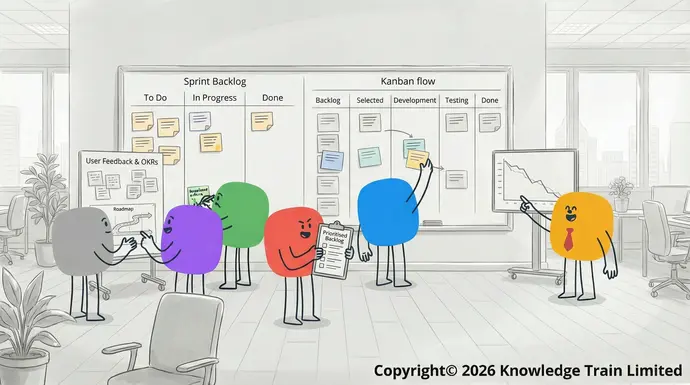
What is Agile project management? to your
Agile project managementself-paced AgilePM course is an iterative approach to planning, executing, and materials from the date of purchase.delivering projectsHow long is an Agile project management course? by breaking work into small, manageable increments known as iterations or sprints. Rather than following a strict linear plan, Agile focuses on adaptability, team collaboration, and continuous delivery of value to stakeholders. How long an Agile Project Management course takes depends on which level you choose:Agile principlesFoundation emphasise close communication, incremental progress, and regular feedback cycles to enhance quality and meet customer needs.: 3 days (classroom) or 23 hours (self-paced online).
The Agile Manifesto: Values and principlesPractitioner
The : 2 days (classroom) or 20 hours (self-paced online). Combined, the two levels take Agile Manifesto5 days (classroom) underpins Agile project management, defining four core values and twelve guiding principles. These foster a culture of collaboration, adaptability, and response to change. or
Agile Manifesto core values43 hours (e-learning)
- Individuals and interactions over processes and tools.
- Working software (or product) over comprehensive documentationFind out more about
- Customer collaboration over contract negotiationAgile Project Management courses
- Responding to change over following a plan and how Agile Project Management can help your career.
- Value stream mapping, optimised flow, customer focus
- Advantages:changing requirements Improved efficiency, reduced delays, enhanced quality.
Extreme Programming (XP)Agile welcomes change, focusing on
- Main focus:customer collaboration Technical excellence, frequent releases, customer involvement and
- Core practices:adaptability Pair programming, test-driven development, continuous integration, . The challenge lies in balancing flexibility with consistent delivery – a key skill for Agile project managers.
- Agile PM helps organisations achieve Short, simple descriptions of a feature told from the perspective of the user
- Backlog:faster results Ordered list of project tasks and features while adapting to change effectively.
- Sprint/Iteration:It bridges the gap between purely Agile approaches such as Short, time-boxed development cyclesScrum
- Stakeholders: Individuals or groups with interests in project outcomes and structured project-management frameworks like
- Retrospectives:PRINCE2 Regular meetings to assess and improve processes.
- Deliverables:When can I take my AgilePM exam? Outputs produced at the end of each iteration
- Continuous Improvement: Commitment to reflect and implement enhanced ways of workingIf you’re on an
Benefits of Agile project managementinstructor-led AgilePM course
- Accelerated delivery of value through iterative increments, your trainer may set exam time during class, though you can book it
- Improved team collaboration and transparencywhenever convenient
- Quick response to customer feedback and market changes.
- Reduced project risks and higher stakeholder satisfactionSelf-paced students
- High-quality deliverables due to continuous review can sit exams
- You can take your exams when ready, and you’ll receive email notification when your certificate is available./software:When do I receive my AgilePM handbook? Dynamic product requirements, regular releases, user feedback
- Marketing: Campaigns adapted based on analytics and feedbackInstructor-led classroom
- Construction:: AgilePM handbook provided on the Early delivery of completed sections, iterative designfirst day
Authoritative standards organisations like the .Agile Business ConsortiumVirtual classroom (UK), : printed handbook sent by Agile Alliancecourier, before your course.Scrum.orgVirtual classroom (outside UK), and : digital copy by Project Management Institute (PMI)email provide resources, definitions, and , with optional printed version for a postage fee.certificationsSelf-paced course for Agile professionals.: no physical handbook, as all key content is built into the e-learning.
FAQsaward-winning AgilePM trainers
What is the difference between Agile and waterfall project management? with years of hands-on agile project experience.
The main difference is that Our classes offer Agilehigh-quality, practical learning is iterative and flexible, allowing change at any stage, while that helps you apply agile skills immediately.waterfallTo see our approach, call follows a strict, linear process where each phase must be completed before the next begins. Agile encourages frequent feedback and continuous delivery of value, whereas waterfall often delivers only at the end.+44 (0)207 148 5985
What are the main stages of an Agile project? and request a
Typical stages of an Agile project include vision and roadmap creation, backlog development, sprint planning, execution (iteration), review, and retrospectives. Continuous improvement occurs at every stage.free observer place
What are the key frameworks of Agile project management? on the next available course.
Key Agile frameworks are Still have questions? Contact us by phone on 0207 148 5985, via live chat, email, or by completing the form below.Scrum , Kanban, Lean, and Extreme Programming (XP). Each offers a unique structure for managing roles, processes, and workflow.How to find us
What are the benefits and challenges of Agile project management?Knowledge Train
Advantages include adaptability, stakeholder engagement, and high product quality. Challenges may include initial resistance, need for team discipline, and less suitability for projects with fixed, unchanging requirements.20 Old Bailey, London, EC4M 7AN,
Where is Agile project management commonly used? England, United Kingdom.
While most common in software development, Agile is used in industries such as marketing, manufacturing, construction, and education wherever flexible, iterative approaches add value.Call