Agile project management: Frameworks, benefits and how it worksWhat is the Association for Project Management (APM)?

- Key takeawaysAgile delivers value in short iterations, using regular reviews and retrospectives to adapt quickly to change.
- Scrum, Kanban, Lean and XP offer different structures, so choose based on workflow needs and team maturity.APM is the UK chartered professional body that sets expectations for project delivery and professional development.
- Clear roles, prioritised backlogs and well-written user stories reduce confusion and keep work aligned to outcomes.APM supports better project, programme, and portfolio outcomes through standards, guidance, and a shared professional language.
- Metrics such as velocity, cycle time and burn-down charts improve predictability when paired with a clear definition of done.PFQ builds fundamentals, PMQ validates broader knowledge, and ChPP recognises assessed competence and judgement in practice.
- Lightweight governance, change management and technical debt controls help Agile scale without losing quality.The APM Body of Knowledge helps standardise terminology and strengthens governance, decision making, and capability building.
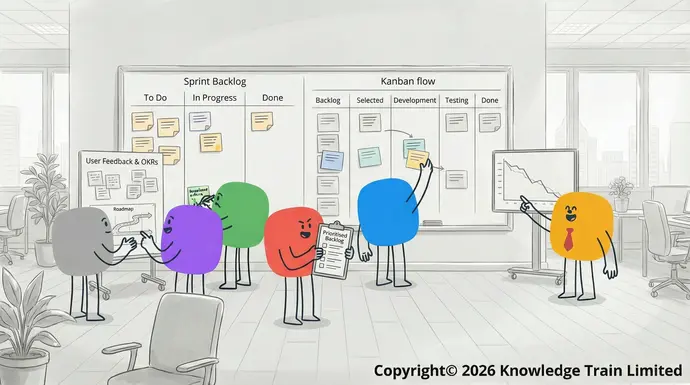
What is Agile project management?
Agile project managementFAQs is an iterative approach to planning, executing, and Key factsdelivering projectsThe Association for Project Management (APM) is a United Kingdom based professional association for project management. It supports the profession through membership, qualifications, standards, and guidance such as the APM Body of Knowledge. by breaking work into small, manageable increments known as iterations or sprints. Rather than following a strict linear plan, Not to be confused withAgile: APM can also mean Applications Performance Monitoring or other industry acronyms. This page is about the focuses on adaptability, team collaboration, and continuous delivery of value to stakeholders. Association for Project ManagementAgile principles in the UK. emphasise close communication, incremental progress, and regular feedback cycles to enhance quality and meet customer needs.Full name
The Agile Manifesto: Values and principlesAssociation for Project Management
The AcronymAgile ManifestoAPM (acronym) underpins Agile project management, defining four core values and twelve guiding principles. These foster a culture of collaboration, adaptability, and response to change.Organisation type
Agile Manifesto core valuesProfessional association (professional body for project management)
- Individuals and interactions over processes and toolsCountry
- Working software (or product) over comprehensive documentationUnited Kingdom
- Customer collaboration over contract negotiationHeadquarters
- Responding to change over following a planBuckinghamshire, England (UK)
Twelve principles of AgileMission
- Customer satisfaction through early and continuous deliveryTo advance the discipline of project management and support project professionals and organisations.
- Welcome changing requirements, even late in developmentCore services
- Deliver working products frequentlyProfessional membership, qualifications and certification, events and community, publications and guidance, Continuing Professional Development (CPD)
- Close, daily cooperation between business people and developersFlagship qualifications
- Build APM Project Fundamentals Qualification (PFQ), APM Project Management Qualification (PMQ), Chartered Project Professional (ChPP)projectsMembership types around motivated individualsStudent, Associate, Full, Fellow (grade availability and criteria vary)
- Face-to-face conversation as the best form of communicationOfficial website
- Working product as the primary measure of progresshttps://www.apm.org.uk/
- Sustainable development paceWhat APM does for project management in the UK
- Continuous attention to technical excellence and good designThe Association for Project Management (APM) is the chartered professional body for project management in the United Kingdom. In practice, it works to improve how projects, programmes, and portfolios are delivered by providing a recognised
- Simplicity – the art of maximising the amount of work not done – is essentialqualifications framework
- Self-organising teams produce the best results, professional standards, and membership pathways for a
- Regular reflections for continuous improvement
Key Agile frameworks and methodologiesproject manager
Agile and wider delivery roles. encompasses various frameworks, each with its own practices and terminology. The most widely used Agile frameworks were designed for more efficient product delivery, rather than APM’s activities commonly relate to:project managementProfessional membership. They include and recognition, including progression through membership grades.ScrumQualifications and certification, Kanban, Lean, and Extreme Programming (XP): that assess knowledge and professional competence.
ScrumCPD
- Main focus: expectations and learning resources to support ongoing capability. Team roles, time-boxed sprints, and iterative deliveryGuidance on
- Core roles:project governance Product Owner, , ethics, and good practice.Scrum MasterCommunity building through events, interest networks, and publications., Team MembersAPM qualifications and certifications
- Artefacts:APM qualifications are designed to support learning and professional development across different career stages, from introductory project management to more advanced competence assessment. The best starting point depends on your experience, the Product backlog, sprint backlog
- Key events:project management methodology Sprint planning, daily scrum, sprint review, sprint retrospectives used in your organisation (for example PRINCE2 environments), and whether you need knowledge validation or professional recognition.
- Advantages:APM Project Fundamentals Qualification (PFQ) Well-defined structure, clear accountability, transparencyPurpose
Kanban: Introductory certification covering key concepts, language, and foundational knowledge in project management.
- Main focus:Who it is for Visualisation of workflow, limiting work in progress, continuous flow: Beginners, new starters, and people who work with projects (including stakeholders) but are not yet project managers.
- Core elements:Prerequisites Kanban board, work-in-progress limits, cards/tasks: None.
- Advantages:Format Flexibility, real-time workflow visualisation, easy adoption without role changes: Typically a short course plus a multiple choice exam.
LeanOutcomes
- Main focus:: Elimination of waste, maximising value, continuous improvementAPM PFQ
- Core elements: provides a baseline understanding of planning, roles, risk, and communication, supporting progression to more advanced study. Value stream mapping, optimised flow, customer focusAPM Project Management Qualification (PMQ)
- Advantages:Purpose Improved efficiency, reduced delays, enhanced quality: Knowledge based certification aligned to the APM Body of Knowledge and common delivery practices.
Extreme Programming (XP)Who it is for
- Main focus:: Practitioners who contribute to projects, including aspiring or current project managers. Technical excellence, frequent releases, customer involvementPrerequisites
- Core practices:: No formal prerequisite, but some experience or prior study helps. Pair programming, test-driven development, continuous integration, Formatuser stories: Assessed by a written exam.
- Advantages:Outcomes Rapid feedback, high product quality, adaptability to change:
Comparison: Scrum, Kanban, Lean, XPAPM PMQ
| Framework provides a stronger grasp of planning, governance, stakeholder management, and control, supporting improved performance in project delivery roles. | Main focusChartered Project Professional (ChPP) | Key practicePurpose | Team structure: Competence based assessment recognising professional capability and judgement in project delivery. | Best use caseWho it is for |
|---|---|---|---|---|
| Scrum: Experienced professionals working in project management, | Time-boxed iterations (Sprints)programme management | Predefined roles and events, or | Cross-functionalportfolio management | Complex projects needing structure. |
| KanbanPrerequisites | Visual workflow & limits: Demonstrable experience and evidence of professional practice, typically supported by membership and CPD. | Kanban board, WIP limitsFormat | Flexible roles: Application with evidence and assessment (process can evolve over time). | Ongoing support/operationsOutcomes |
| Lean: Professional recognition that you can apply good practice, leadership, and governance in real delivery contexts. | Eliminate wasteHow APM qualifications relate to PRINCE2 and other methodologies | Value stream mappingAPM qualifications are generally methodology agnostic and focus on transferable principles and knowledge. | AnyPRINCE2 | Process improvement, efficiency is a project management methodology used widely in the UK and beyond; many organisations use PRINCE2 alongside APM aligned learning. In practice, PRINCE2 may provide a structured method for managing stages and controls, while APM learning may broaden understanding across domains such as governance, stakeholder engagement, risk, and professionalism. |
| XPAPM Body of Knowledge | Technical best practicesThe | Pair programming, TDDAPM Body of Knowledge | Small, tech-focused teams is a reference framework that describes key concepts, functions, and areas of knowledge used in project based work. It is used by learners, practitioners, trainers, and employers to build a shared language and improve capability across delivery roles. | Software projects needing qualityIt supports the profession by helping to: |
Agile vs traditional (waterfall) project managementStandardise terminology across teams and organisations.
The Inform learning pathways and a qualifications framework.waterfall modelProvide a common basis for improving governance and decision making. is a sequential, plan-driven approach where phases follow one another with minimal overlap. High level knowledge areas commonly associated with the APM Body of Knowledge include:Agile project managementGovernance and organisational context, including contrasts this with its focus on flexible planning, iterative progress, and stakeholder feedback throughout:project governance
| AspectPlanning and scheduling | AgileRisk, issues, and change control | WaterfallQuality management |
|---|---|---|
| ApproachPeople, leadership, and teamwork | Iterative and incrementalCommunication and | Sequential and linearstakeholder management |
| FlexibilityCommercial and procurement considerations | Highly adaptive to changeIntegration across | Change-resistantprogramme management |
| Customer Involvement and | Continuous collaborationportfolio management | Primarily at start/endMembership |
| Risk managementAPM membership (professional membership) provides a way to demonstrate commitment to the profession and access support for career development. Membership criteria and naming can change over time, but grades typically align to experience and contribution. | Early and ongoing detectionTypical APM membership grades | Late-stage identificationStudent |
| Delivery: For people in education who are building foundational knowledge. | Work delivered frequentlyAssociate | Single final delivery: For early career professionals and those developing competence. |
| Suitable forFull | Complex, evolving : For experienced practitioners who meet defined experience and professionalism requirements.projectsFellow | Clear, fixed requirements: Senior recognition for significant contribution and leadership in the profession. |
Key roles and concepts in Agile projectsCommon member benefits
- Product Owner:Access to learning resources that support Represents stakeholders, manages product backlog, prioritises featuresContinuing Professional Development (CPD)
- Scrum Master.:Professional recognition and use of post nominal designations where applicable. Facilitates Networking through events, branches, and special interest groups.ScrumPublications and guidance supporting better project delivery and governance. process, removes impedimentsCareer support, including frameworks and pathways for project roles.
- User storiesChartered status and what it means:APM holds Short, simple descriptions of a feature told from the perspective of the userchartered status (chartered body)
- Backlog: as the professional body for project management in the UK. In general, chartered status signals formal recognition and a public interest role in maintaining standards, professionalism, and development routes within a discipline. Ordered list of project tasks and featuresFor individuals, chartered recognition is commonly associated with assessed competence, professional behaviours, and continuing development rather than only passing a knowledge exam.
- Sprint/Iteration:APM vs PMI Short, time-boxed development cyclesSome people compare APM with the
- Stakeholders:Project Management Institute ( Individuals or groups with interests in project outcomesPMI
- Retrospectives:) Regular meetings to assess and improve processes when deciding on training, certification routes, or professional membership. Both support project management, but they have different histories, geographies, and qualification portfolios.
- Deliverables:Factor Outputs produced at the end of each iterationAPM (UK professional body)
- Continuous Improvement:PMI (global professional body) Commitment to reflect and implement enhanced ways of workingGeography focus
Benefits of Agile project managementUnited Kingdom centred, with wider international reach through members and partners
- Accelerated delivery of value through iterative incrementsInternational membership and certifications used globally
- Improved team collaboration and transparencyCommon certifications
- Quick response to customer feedback and market changesPFQ, PMQ, ChPP
- Reduced project risks and higher stakeholder satisfactionPMP (Project Management Professional) and other PMI credentials
- High-quality deliverables due to continuous reviewPrimary emphasis
Challenges and limitationsProfessional body, membership grades, standards, and UK chartered role
- Requires experienced, self-organising teamsProfessional body with a broad certification ecosystem and global communities
- Most Terminology and frameworksAgileAPM Body of Knowledge oriented language in many UK contexts frameworks are designed for product delivery, not PMI standards and terminology used widely across industriesproject managementTypical audiences.UK based project professionals, employers, and sectors using APM aligned frameworks
- Less suitable when requirements are fixed and well-definedProject professionals seeking globally recognised certification such as PMP
- Organisational resistance to cultural changeIf you work in a
- Potential for scope creep without disciplined backlog managementPRINCE2 environment
Real-world applications and use cases, you may still choose APM or PMI learning depending on organisational expectations, role scope (project, programme, portfolio), and your preferred certification path.
Agile project management originated in software development but is now used in industries including marketing, education, manufacturing, and construction. Its History and governancecontinuous improvementAPM is a long established UK organisation supporting the project profession. It operates as a membership organisation with governance arrangements typical of professional bodies, including leadership, committees, and published standards and policies. Key milestones often referenced in authoritative sources include its development into the UK’s chartered body for the profession and the establishment of structured qualification and membership pathways. and For verifiable organisational facts such as dates, governance updates, and current policies, consult APM’s official publications and register entries where applicable.team collaborationSources principles enhance innovation, adaptiveness, and client-centric outcomes.APM official website: membership, qualifications, chartered information, and publications.
- ITGeneral reference entry for Association for Project Management for high level organisational facts./software:UK professional standards and governance references where relevant to chartered bodies. Dynamic product requirements, regular releases, user feedbackFAQs
- Marketing:What does APM stand for in project management? Campaigns adapted based on analytics and feedbackIn project management, APM most commonly stands for the Association for Project Management, the United Kingdom based professional association for the project profession. Because APM is also used in other industries, it is worth confirming the context, especially in IT where APM can refer to Applications Performance Monitoring.
- Construction:What is the Association for Project Management (APM)? Early delivery of completed sections, iterative designThe Association for Project Management (APM) is the chartered professional body for project management in the United Kingdom. It supports the profession through membership (professional membership), CPD, standards and guidance such as the APM Body of Knowledge, and a qualifications framework th
Authoritative standards organisations like the Agile Business Consortium
FAQs
What is the difference between Agile and waterfall project management?
The main difference is that {"@context":"https://schema.org","@type":"WebPage","name":"Association for Project Management (APM): What It Is","url":"https://www.knowledgetrain.co.uk/project-management/association-for-project-management-apm","description":"Learn what the UK Association for Project Management (APM) is, its chartered status, memberships, Body of Knowledge, and qualifications.","significantLink":"https://www.knowledgetrain.co.uk/project-management/association-for-project-management-apm","mainEntity":{"@type":"Article","headline":"What is the Association for Project Management (APM)?","about":[{"@type":"DefinedTerm","name":"Association for Project Management","sameAs":["https://en.wikipedia.org/wiki/Association_for_Project_Management","https://www.wikidata.org/wiki/Q4804041"]},{"@type":"DefinedTerm","name":"Project management","sameAs":["https://en.wikipedia.org/wiki/Project_management","https://www.wikidata.org/wiki/Q170584"]},{"@type":"DefinedTerm","name":"Professional association","sameAs":["https://en.wikipedia.org/wiki/Professional_association","https://www.wikidata.org/wiki/Q193441"]}],"mentions":[{"@type":"DefinedTerm","name":"APM Body of Knowledge","sameAs":["https://www.apm.org.uk/book-shop/apm-body-of-knowledge-7th-edition/","https://www.wikidata.org/wiki/Q106645155"]},{"@type":"DefinedTerm","name":"United Kingdom","sameAs":["https://en.wikipedia.org/wiki/United_Kingdom","https://www.wikidata.org/wiki/Q145"]},{"@type":"DefinedTerm","name":"Project Management Institute","sameAs":["https://en.wikipedia.org/wiki/Project_Management_Institute","https://www.wikidata.org/wiki/Q724606"]},{"@type":"DefinedTerm","name":"PMP (Project Management Professional)","sameAs":["https://en.wikipedia.org/wiki/Project_Management_Professional","https://www.wikidata.org/wiki/Q1766491"]},{"@type":"DefinedTerm","name":"PRINCE2","sameAs":["https://en.wikipedia.org/wiki/PRINCE2","https://www.wikidata.org/wiki/Q1521443"]},{"@type":"DefinedTerm","name":"Continuing professional development","sameAs":["https://en.wikipedia.org/wiki/Continuing_education","https://www.wikidata.org/wiki/Q516761"]},{"@type":"DefinedTerm","name":"Project governance","sameAs":["https://en.wikipedia.org/wiki/Project_governance","https://www.wikidata.org/wiki/Q7241946"]},{"@type":"DefinedTerm","name":"Stakeholder management","sameAs":["https://en.wikipedia.org/wiki/Stakeholder_(corporate)","https://www.wikidata.org/wiki/Q852835"]},{"@type":"DefinedTerm","name":"Programme management","sameAs":["https://en.wikipedia.org/wiki/Program_management","https://www.wikidata.org/wiki/Q7243124"]},{"@type":"DefinedTerm","name":"Portfolio management","sameAs":["https://en.wikipedia.org/wiki/Project_portfolio_management","https://www.wikidata.org/wiki/Q7243134"]},{"@type":"DefinedTerm","name":"Project manager","sameAs":["https://en.wikipedia.org/wiki/Project_manager","https://www.wikidata.org/wiki/Q188860"]},{"@type":"DefinedTerm","name":"Certification","sameAs":["https://en.wikipedia.org/wiki/Professional_certification","https://www.wikidata.org/wiki/Q3146405"]}]},"hasPart":{"@type":"FAQPage","mainEntity":[{"@type":"Question","name":"What does APM stand for in project management?","acceptedAnswer":{"@type":"Answer","text":"In project management, APM most commonly stands for the Association for Project Management, the United Kingdom based professional association for the project profession. Because APM is also used in other industries, it is worth confirming the context, especially in IT where APM can refer to Applications Performance Monitoring."}},{"@type":"Question","name":"What is the Association for Project Management (APM)?","acceptedAnswer":{"@type":"Answer","text":"The Association for Project Management (APM) is the chartered professional body for project management in the United Kingdom. It supports the profession through membership, CPD, standards and guidance such as the APM Body of Knowledge, and a qualifications framework that includes certifications like PFQ, PMQ, and Chartered Project Professional."}},{"@type":"Question","name":"What does APM do?","acceptedAnswer":{"@type":"Answer","text":"APM advances project management by setting professional expectations, providing qualifications and certification, supporting CPD, and publishing guidance on topics such as project governance and stakeholder management. It also connects members through events, communities, and resources that help improve project, programme, and portfolio delivery."}},{"@type":"Question","name":"Is APM a chartered body?","acceptedAnswer":{"@type":"Answer","text":"Yes. APM holds chartered status as the professional body for project management in the UK. Chartered status indicates formal recognition of a professional body’s role in promoting standards and competence. APM also provides professional recognition routes such as Chartered Project Professional (ChPP)."}},{"@type":"Question","name":"What qualifications does APM offer?","acceptedAnswer":{"@type":"Answer","text":"APM offers qualifications and certifications including the Project Fundamentals Qualification (PFQ), the Project Management Qualification (PMQ), and Chartered Project Professional (ChPP). These support development from beginner to experienced practitioner and align with APM guidance and the APM Body of Knowledge."}},{"@type":"Question","name":"How do I join APM membership?","acceptedAnswer":{"@type":"Answer","text":"You join by selecting a membership grade such as Student, Associate, Full, or Fellow and applying via the APM website. Requirements vary by grade and may include experience evidence and commitment to CPD for higher grades. Always check the latest criteria with APM before applying."}},{"@type":"Question","name":"Is APM equivalent to PMI or PMP?","acceptedAnswer":{"@type":"Answer","text":"APM and the Project Management Institute (PMI) are different professional bodies. PMP is a PMI certification, not an APM qualification. They are not direct equivalents; suitability depends on factors such as location, employer expectations, and whether you want UK chartered body alignment or a globally used certification route."}}]}}Agile is iterative and flexible, allowing change at any stage, while Related articleswaterfall follows a strict, linear process where each phase must be completed before the next begins. Agile encourages frequent feedback and continuous delivery of value, whereas waterfall often delivers only at the end.
What are the main stages of an Agile project?
Typical stages of an Agile project include vision and roadmap creation, backlog development, sprint planning, execution (iteration), review, and retrospectives. Continuous improvement occurs at every stage.
What are the key frameworks of Agile project management?
Key Agile frameworks are Scrum , Kanban, Lean, and Extreme Programming (XP). Each offers a unique structure for managing roles, processes, and workflow.
What are the benefits and challenges of Agile project management?
Advantages include adaptability, stakeholder engagement, and high product quality. Challenges may include initial resistance, need for team discipline, and less suitability for projects with fixed, unchanging requirements.
Where is Agile project management commonly used?
While most common in software development, Agile is used in industries such as marketing, manufacturing, construction, and education wherever flexible, iterative approaches add value.